
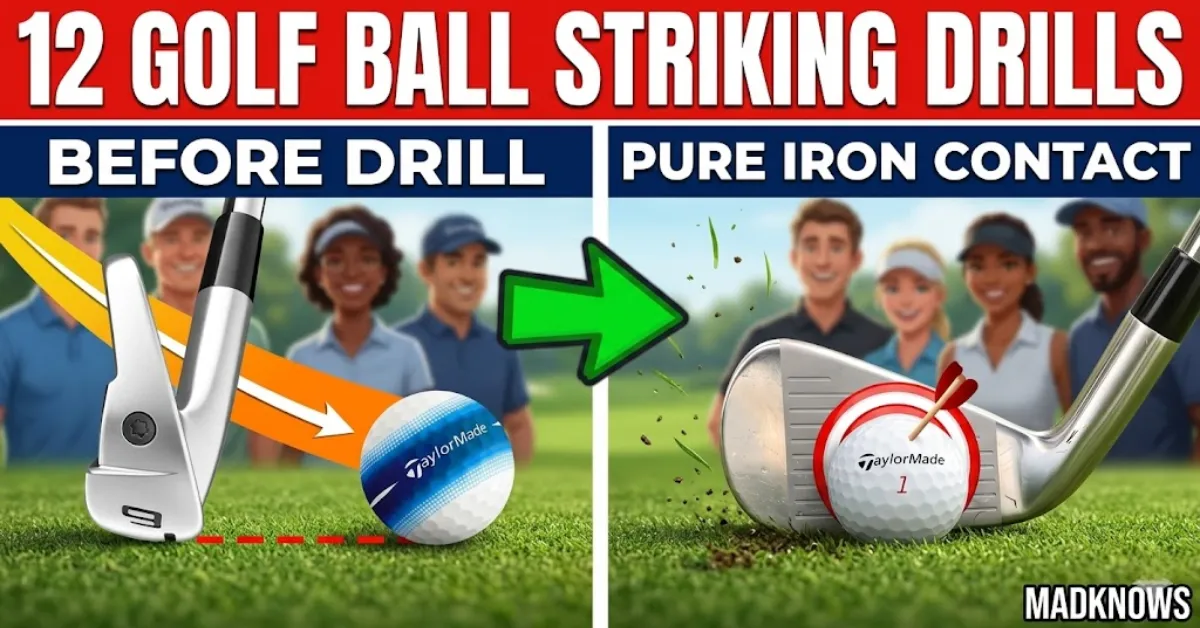
These golf ball striking drills target the real reason you’re mishitting shots — whether that’s fatting it, thinning it, or losing all your power at impact. Most golfers practice more without fixing the actual problem. This guide gives you specific drills matched to your specific miss, so every range session moves the needle.
Fat shots, thin shots, weak contact off the toe — they all have one thing in common: something breaks down before the club reaches the ball. The good news is that ball striking is a skill, not a talent. The right drills, done with purpose, fix it faster than you think.
Neglecting any one of these elements can lead to poor ball contact and loss of distance and control. By ingraining the proper motions through targeted practice, golfers can train their bodies to deliver the clubface to the ball effectively on a regular basis.
An on-plane backswing sets the stage for solid ball contact. When the club is brought back too far inside or outside the ideal path, complications arise on the downswing.
The clubface will either be too open or closed relative to the swing path, leading to off-centre hits. A short game is also reliant on sound ball striking skills around the greens.
Consistently hitting chip shots crisply improves scoring by getting the ball closer to the hole more regularly.
The top players on Tour don’t achieve their elite Golf ball strike drills and tips solely based on talent.
Their skills are honed through rigorous practice routines targeting their swing paths, impact positions, launch angles, and energy transfer to the ball. Amateurs can use the same drills and techniques to improve their own consistency.
This guide gives you specific drills for ball strike tips, swing path techniques, and impact drills.
Implementing even a few of these can lead to better ball compression, more powerful shots, and lower scores. Read on to start flushing more shots.
What’s Causing Your Inconsistent Ball Striking? Find Your Miss Below
Before you start drilling, you need to know what you’re actually fixing. Here’s a quick guide — find your typical miss and jump straight to the right drill:
Hitting the ball fat (club hits ground first) → Go to: Towel Drill / Hit Ball Then Turf Drill
Thinning or topping iron shots → Go to: Ball-Forward Drill / Impact Spray Drill
Slicing or pushing shots right → Go to: Alignment Drill / Gate Drill
Weak, high shots with no compression → Go to: Impact Bag Drill / Hit Down Drill
Losing power through impact → Go to: Downswing rotation tips + Divot Drill
Off-centre strikes (toe or heel) → Go to: Impact Spray Drill / Half-Swing Drill
Use this as your checklist. Pick the one or two drills that match your miss and focus your next three range sessions on those alone. Jumping between every drill leads to no drill sticking.
Golf ball strike drills and tips
Improving your ball striking is one of the best ways to immediately lower your scores. Making solid contact just feels so crisp and pure. But if you’re like me and most amateur golfers, you mishit plenty of shots.
Topping it, chunking it, slicing it – you name it, I’ve done it. The frustrating part is knowing your swing is decent but the results are embarrassing at times.
Lately, I’ve been working on some simple ball strike drills and swing tips that have really helped me make way more consistent contact.
Just small things like keeping my head still, not swaying off the ball, and turning through my shots have led to way more flushed irons and lasers off the tee. I can already see my scoring dropping.
So if you want to compress those golf balls and hear that sweet sound when you nut one, try implementing a few basic ball strike pointers into your range sessions.
Your buddies might finally stop asking if you’re kicking the turf before you hit your drives.
The Setup Fundamentals Every Good Ball Striker Gets Right
Your setup and stance are the foundation for an effective golf swing and solid ball strike. Keep these elements in mind:
Grip
- Use a neutral or slightly strong grip to promote a square clubface at impact. Avoid a weak grip that can lead to slices and poor contact.
- Don’t grip too tight. Maintain a light but secure grip pressure throughout the swing.
Posture and Alignment
- Stand tall with a slight bend at the hips so your arms hang comfortably. Don’t slouch or stand too upright.
- Position your body so that it’s lined up to the left of the target. Your feet, hips, and shoulders should all be aimed in the same direction.
Ball Position
- Position the ball off your left heel for most full-swing shots with irons and woods. This allows for solid impact with a slightly descending blow.
- Move the ball position forward or back to adjust the trajectory. Forward for lower shots, back for higher shots.
Balance and Weight Distribution
- Distribute weight evenly between both feet. Avoid swaying.
- Keep your head still and spine angle consistent during the swing.
Backswing Drills to Fix Your Swing Path and Stop Mishits
The golf swing path for ideal ball strike a proper takeaway and backswing set you up for a solid downswing and ball strike. Practice these drills:
Toe-Up Drill
Lift your toes at the start of the backswing to feel your weight shift to the insides of your feet. Promotes proper weight transfer.
Alignment Stick Drill
Place an alignment stick or club outside your feet and parallel to the target line. Brush the ground with the stick as you take the club back to ingrain the proper path.
Wall Drill
Take your backswing with your back facing a wall. If your arms hit the wall you are swinging too far outward. Feel your arms stay close to your chest.
Half-Swing Drill
Make smooth, controlled backswings to a 9 o’clock position with the shaft pointing down. Groove this on-plane path before making full swings.
How to Square the Clubface at Impact (Downswing Keys)
Many solid ball strike issues stem from an open or closed clubface at impact. Work on these keys for straight shots:
- Start the downswing by firing your hips and rotating your trunk forward. Avoid sliding or swaying laterally.
- As you start down, feel like your hands and arms are passive. Let them drop into the slot rather than getting too handsy.
- Rotate through impact, keeping your head still as your chest turns to face the target.
- Release the club naturally rather than flipping your wrists. A late release leads to pulls and slices.
- Extend your arms after impact and resist the urge to decelerate too quickly.
Golf Ball Striking Drills for the Driving Range
Incorporate these drills during range sessions and practice to improve your ball-striking technique:
Alignment drill: Set up two alignment sticks or clubs parallel to your target line. Place one stick on the ground to help with your feet alignment and another above your ball to ensure your clubface is also aiming correctly.
This will help improve your alignment and ensure you’re hitting the ball on the intended target line.
Impact drill: Place a towel about two inches behind the ball and aim to hit the ball without touching the towel. This drill will encourage a proper downward strike on the ball and help with solid ball-striking.
Divot drill: Place an alignment stick or club on the ground perpendicular to your target line and ahead of your ball. Aim to take divots that start after the stick and in front of the ball. This drill will promote a proper ball-turf interaction and help eliminate fat or thin shots.
Impact Bag Drill
Hit an impact bag to really feel compressing the ball at impact. Start with short 1/2 swings then build to fuller swings.
Using an impact bag is a great way to improve your golf swing and feel the proper compression of the ball at impact. Here’s how you can effectively use an impact bag:
Remember to focus on quality repetitions rather than quantity. It’s better to perform a few swings with proper form and technique than to rush through a large number of swings without paying attention to the details.
Practice regularly and be patient, as it may take time to develop the desired feel and ball compression at impact.
Hit Ball Then Turf Drill
Make a divot after the ball, not before. Helps you strike ball first then take a bit of turf.
One common mistake amateur golfers make is taking a divot before making contact with the ball. This leads to fat shots and thin shots, resulting in a lack of both distance and control. To improve ball-first contact, use the Hit Ball Then Turf drill.
Practicing the Hit Ball Then Turf Drill trains your body to properly sequence your downswing and strike the ball before digging into the ground.
This is a great exercise to incorporate regularly into range sessions to improve ball-striking consistency.
Gate Drill
Place two clubs on the ground creating a gate about 1-2 inches wider than your stance. Swing down and through the gate to control your path.
Impact Spray Drill
Apply impact spray to the clubface. It will show exactly where you are making contact on the face. Aim for consistent impact near the sweet spot.
Ball-Forward Drill
Position balls slightly forward of where you’d normally play them. Forces you to make crisp contact and compress the ball.
Hit Down Drill
Place tee pegs 1-2 inches in front of and behind the ball. Goal is to hit the back peg, not the front. Helps with hitting down through the ball.
Golf Ball Striking Drills You Can Do at Home (No Range Needed)
You don’t need a bucket of balls and a range mat to improve your ball striking. Some of the most effective drills can be done in your living room, garden, or garage in ten minutes. Here are three that actually work:
Mirror Drill (Living Room) Stand in front of a full-length mirror with a short iron. Make slow-motion swings and pause at three checkpoints: the takeaway, the top of your backswing, and impact. At impact, check that your hips are open to the target, your hands are ahead of the club head (forward shaft lean), and your lead wrist is flat — not flipped. Do 15 slow-motion reps per session. This alone fixes the most common cause of thinned shots.
Feet-Together Drill (Garden or Hallway) Hit chip shots or make practice swings with your feet touching. This forces your upper body to stay centred and stops the lateral sway that causes fat shots. You’ll topple slightly if you sway — your body self-corrects immediately. Ten swings with feet together, then ten with normal stance. You’ll notice the difference straight away.
Wall Drill (Garage or Indoor Space) Stand about two feet from a wall with your back to it. Make your backswing. If your arms hit the wall, you’re swinging too far out to the right (across the line). This drill teaches the on-plane backswing path that leads to solid, centred contact. No ball needed. Five minutes before any round is enough to groove the feeling.
These three drills combined take about 12 minutes. Do them three times a week and you’ll feel the improvement in your range sessions within two weeks.
Ball Position by Club: Where Most Golfers Get It Wrong
Consistent ball position for correct ball strike based on your club selection is a key factor for optimizing solid ball striking.
The exact placement of the ball at the address relative to your body has a significant influence on your ability to make square contact and compress each shot properly. Follow these guidelines for ideal ball position with each club type:
Driver
Use a tee and position the ball opposite your left heel. This inside placement promotes striking the ball slightly on the upswing, allowing you to maximize loft and distance.
Fairway Woods
Position the ball off your left heel or slightly forward of your heel. This ball position supports hitting down on the ball slightly while still releasing the clubface.
Long Irons
Place the ball aligned off your left heel or in the mid-stance area. The ball is played back enough for you to make solid contact with a descending blow.
Middle Irons
Move the ball up towards the center between your feet or slightly forward of center. You will hit more down as the ball moves forward in your stance.
Short Irons
Play the ball off the inside of your left foot up towards your armpit. This promotes hitting steeply down when you have less loft on the club.
Wedges
Position the ball at or just forward of your left armpit so you can strike down aggressively with these lofted clubs.
Adjust ball position based on shot shape and trajectory as well. Move back for higher shots, forward for lower trajectories.
Dialing in proper ball position for each club is important for meeting the ball before the turf and compressing your shots consistently. Take the time to practice shots from different ball locations to find what works best for your swing.
Equipment and Mental Checkpoints for Better Ball Striking
Beyond drills and setup, keep these tips in mind:
Good ball striking requires coordination between your swing mechanics and delivery. Mastering these techniques through purposeful practice is the path to pure ball striking.
Be patient, focus on one element at a time, and keep working at your game. Consistency will come with repetition.
Start Hitting It Better at Your Next Round
Ball striking improves faster than most golfers expect — when you practice the right things. The drills in this guide are not random exercises. Each one fixes a specific breakdown in your swing. Pick the one that matches your miss, take it to the range for three sessions, and then add the next one.
The golfers who go from 18 handicap to 12 don’t suddenly find a better swing. They just stop making the same contact mistake on repeat. That starts with knowing what you’re fixing and having the right drill to fix it.
Looking to take your game further? Read our full guide to golf swing fundamentals on Madknows, or explore our iron tips for mid-handicappers if you’re looking to drop shots with your irons specifically. Every shot you flush on the course starts with what you do on the range.
Frequently Asked Questions About Golf Ball Striking
The most common mistake is hitting the ground before the ball — known as a fat shot. This happens because the low point of the swing is behind the ball instead of in front of it. The towel drill and the Hit Ball Then Turf drill both fix this directly by training your body to bottom out the club after the ball, not before.
Place a folded towel about two inches behind the ball at address. Swing normally with the goal of missing the towel and striking the ball first. If you hit the towel, your low point is too far back. Repeat 20 times per session. Most golfers feel the correction within one session. Move the towel progressively closer as your contact improves.
Yes. The Mirror Drill, the Feet-Together Drill, and the Wall Drill can all be done at home with no ball required. The Mirror Drill is especially powerful for fixing impact position — the leading cause of thin shots. Fifteen slow-motion reps in front of a mirror three times per week produces real results within two weeks.
Most golfers notice cleaner contact within two to four weeks of focused, purposeful practice using targeted drills. The key word is purposeful — hitting 100 balls without a drill goal changes very little. Doing 30 deliberate reps with the right drill builds muscle memory much faster. Consistency of practice matters more than volume.
The Towel Drill is the most effective drill for irons because it directly fixes the most common iron problem — hitting behind the ball. It gives instant physical feedback, requires no special equipment, and works for golfers at every handicap level. Pair it with the Impact Spray Drill to also check where on the face you are making contact.
Significantly. Playing the ball too far back in your stance promotes steep, outside-in swings and thin contact. Too far forward promotes hitting up on the ball with irons, causing fat shots and loss of distance. Moving the ball just one inch in either direction changes your impact conditions completely. For irons, the inside of your lead heel is the starting reference point — adjust from there based on your shot shape.