
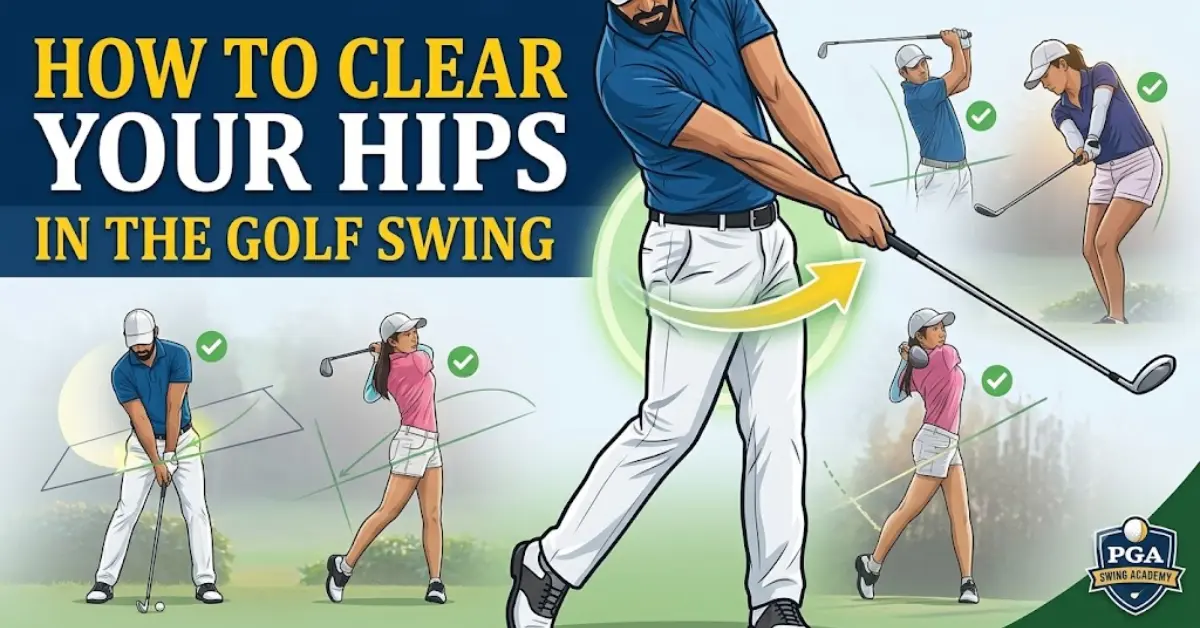
Quick Answer: Clearing the hips means rotating your lead hip open toward the target so your hips are facing roughly 40 to 45 degrees left of the ball at impact. It sounds simple. The reason it doesn’t feel simple is that most golfers try to force the rotation manually instead of letting it happen as a result of the right downswing sequence. Start with the Step-Over Drill and the feeling will click faster than any tip you’ve read.
Clearing the hips in the golf swing is something almost every golfer has heard about and almost none of them can actually feel happening. You get the tip on the range, you try to swivel your hips open on the way down, and you hit a thin pull-hook and feel nothing remotely like what the tip described. So you file it away under “things instructors say” and get on with your round.
I used to do the same thing. Playing off a 12 handicap for most of my adult life, I thought I understood hip rotation because I’d watched enough YouTube. What I actually understood was the theory. What I was missing was the timing, which is a completely different thing. Once that clicked, my irons stopped bleeding to the right and my divots started pointing at the target instead of three yards left of it. That’s what this article is actually about.
What Clearing the Hips Actually Means
Clearing the hips is a term that means opening your hips toward the target at impact with the ball. The hips initiate the downswing and, if your technique and mobility allow it, they’ll be well open to the target by the time your clubface strikes. Failing to clear the hips results in reduced power, poor ball-striking, and shots that miss to the right for most golfers.
Now, this isn’t a one-size-fits-all move. Flexibility, mobility, strength, and the individual proportions of each golfer all change how much hip clearance is possible. There is tremendous variability even on the professional circuit. Watch Dustin Johnson and you’ll see tremendous hip rotation flowing loosely through his swing, producing a fully open hip angle at impact. Jon Rahm is almost the opposite: a quick, compact backswing and a rapid downswing where his hips are half open at impact, then complete their rotation through the follow-through. Both get the ball miles down the fairway. The principle is the same even if the pictures look different.
For the average golfer, the goal is not to copy DJ or Rahm. The goal is to stop leaving the hips closed entirely, because that’s what most of us are doing.
Why It Matters More Than You Think
PGA Tour players average roughly 40 to 45 degrees of hip rotation open at impact. Most amateur golfers reach somewhere around 20 degrees. That gap is not a small styling difference. It’s the difference between generating power from your body and generating power entirely from your arms, which produces much less of it.
Ben Hogan put it plainly in Five Lessons: the hips initiate the downswing and they are the pivotal element in the chain reaction that follows. TPI, the Titleist Performance Institute, has measured this with 3D motion capture and found that tour players carry over 45 degrees of internal hip rotation range on each side. Recreational golfers, particularly those who sit at a desk most of the day, often have half that. The swing your hips can produce is limited by the range of motion they actually have, which is a physical reality no swing tip can work around.
The practical number to keep in mind is 40 degrees. That’s your target at impact. Not squared up. Not just “slightly open.” Genuinely rotated, with your belt buckle pointing left of the target line before the ball has left the clubface.
What Happens When Your Hips Don’t Clear
This is where it gets useful, because the misses you’re probably hitting already tell you whether your hips are stalling.
The most common result is a blocked shot, straight right, no draw, no compression. The clubface is open at contact because the hips never created the space for the arms to swing through. If you hit this shot regularly, hips are almost certainly part of the problem.
The second thing that happens is the chicken wing. Your lead elbow bends and lifts through impact because your arm has nowhere to go. The arms need the hips to have moved first in order to swing freely through the ball. When the hips stall, the arms improvise, and the chicken wing is that improvisation in action. It looks like an arm problem. It’s a hip problem.
The third is early extension, which is the one that gets measured most often on launch monitors at club fittings. Instead of rotating, the hips thrust forward toward the ball on the way down. The spine shallows out, the arms get pushed out and away from the body, and contact becomes inconsistent, usually thin or off the toe. TPI estimates that early extension affects over 60% of amateur golfers. The cure is always some version of learning to rotate the hips instead of thrusting them.
The Timing Nobody Talks About
Here’s the part that most articles on hip clearing skip, and it’s the reason the tip doesn’t work for most people who try it.
Your hips don’t start moving at the top of the backswing. They start moving while the club is still on its way to the top. There’s an overlap, a brief moment where the lower body is already beginning to shift toward the target while the arms are still completing the backswing. In a good golf swing, the lower body leads the upper body by roughly 0.3 seconds across the full downswing. That gap is what creates the X-factor, the separation between hips and shoulders that stores energy like a coiled spring.
Most amateur golfers initiate the downswing with their shoulders. When the shoulders go first, the hips have no time to lead, the X-factor collapses immediately, and the stored energy dissipates before it reaches the clubface. The ball goes the distance your arms generate, not the distance your whole body could generate.
The cue that works for a lot of people is to feel their left knee moving toward the target before their hands start to move at the top of the swing. Not the hips directly. The knee. That knee movement automatically starts the lower body chain without requiring you to consciously spin your pelvis, which almost always produces the wrong kind of rotation. For more on how that sequencing connects to your ball-striking overall, our breakdown of low point control and ball-striking covers the next layer.
How to Clear the Hips: 3 Drills That Will Actually Work
The easiest way to clear your hips is to stop focusing on your hips. This sounds like advice from a fortune cookie but it’s genuinely true. The hips open as a consequence of what the feet and lower body do in the downswing. Train the feet and the hips follow. Try to consciously spin the hips and you usually get sliding, spinning, or both at the wrong time.
Drill 1: The Step-Over
This one is the fastest way to feel proper hip sequencing if you’ve never felt it before.
Set up in your normal address position with a club. Take a slow backswing. At the top, lift your trail foot off the ground and step it backward, behind your body, before starting the downswing. Then, as you start the downswing, bring that trail foot back to its normal stance width and plant it before swinging through.
What happens is that the act of stepping and replanting forces your lower body to lead. Your hips open naturally because your feet have reorganized underneath you, and your arms have no choice but to follow the lower body. Do five repetitions without a ball, paying attention to what the hip opening feels like. Then hit five shots with a shortened version of the same sensation, without the full step. Within about 15 minutes, most golfers who try this can feel what a properly sequenced downswing actually produces.
Drill 2: The Foot Pressure Drill
This one teaches what your feet should be doing to drive hip rotation, which is something very few golfers have ever thought about consciously.
Place one golf ball under your trail heel and one under the ball of your trail foot. From this slightly elevated position, make your normal swing. The raised foot forces you to feel the pressure points that generate rotation. Your trail foot should feel like it’s pushing down and slightly inward as you swing through. Your lead foot should feel like it’s driving down from the ball of the foot toward the heel. Those two opposing forces, pulling in different directions, are what physically spin the hips open as a byproduct of ground reaction rather than a deliberate hip turn.
At the completion of your swing, pause and check your foot positions. Your weight should be balanced on your trail toe and your lead heel. If your weight is on the lead toe, you’ve slid rather than rotated.
Drill 3: The Wall Bump-and-Turn
This one solves the rotating versus sliding confusion directly, and you can do it at home without hitting a ball.
Stand about eight or nine inches from a wall, facing where your target line would be, with your lead hip closest to the wall. Take your backswing. Then start the downswing by gently bumping your lead glute against the wall, and immediately rotate so that glute slides along the wall rather than pushing into it. The sequence is bump, then turn. The bump is the small lateral shift. The turn is the rotation. Both have to happen. Neither works without the other.
Golfers who slide will press into the wall and stay there. Golfers who spin without shifting never make contact with the wall at all. This drill makes both mistakes immediately obvious in a way that’s hard to replicate on the range.
Clearing Your Hips With Irons vs the Driver
Hip clearing looks slightly different depending on what club you’re hitting, and this is something almost nobody explains when they talk about how to clear the hips in the golf swing with irons specifically.
With the driver, you want full hip clearance: 40 to 45 degrees open by impact. The driver is played on an upswing, and your hips need to be completely out of the way for your arms to swing through on that ascending path. Restricted hips with a driver produce a steep outside-in swing path, which is the mechanical origin of most slices.
With irons, you still need to clear, but the clearance is slightly more measured, especially with shorter irons. You’re hitting down and through the ball, and if the hips fire extremely aggressively very early, they can pull the swing path too far left and produce a pull or a thin shot. The cue with irons is to feel the bump toward the target before the rotation fires, making the lateral shift a bit more deliberate before the hips open. The Step-Over Drill works for both clubs without any modification, which is one of the reasons it’s worth learning first. For more on compressing irons consistently, our guide to hitting irons solidly covers the full setup-to-follow-through picture.
Rotating vs Sliding: The Mistake That Looks Like Clearing
A lot of golfers think they’re clearing their hips when they’re actually sliding them, and the two things feel surprisingly similar from inside the swing.
Sliding is when your hips move toward the target laterally without turning. Your belt buckle shifts left but doesn’t rotate. Your weight gets onto your front side too early, your club path gets steep, and your shots go left or come out fat. It creates the illusion of lower-body movement without the actual rotational benefit.
Sam Snead described the correct motion with a barrel analogy. Imagine you’re standing inside a barrel just wide enough to fit your hips. A correct hip turn means rotating inside the barrel without breaking it. A slide means smashing out through the side wall. One generates power. The other just moves the golfer’s center of gravity in a direction that doesn’t help.
The way to tell from inside the swing whether you’re rotating or sliding is to track your lead knee. If your lead knee races toward the target during the downswing, you’re probably sliding. If it moves slightly toward the ball, then rotates to face the target as you complete your follow-through, you’re rotating. One thought that helps: feel like your lead hip is moving back and around rather than forward and through. That back-and-around sensation is what separating the hips in the golf swing actually feels like from the inside.
Two Exercises That Make Hip Clearing Easier Off the Course
If your hips physically can’t rotate to 40 degrees, no drill in the world will get them there. Technique is always limited by mobility. The average PGA Tour player has over 45 degrees of internal hip rotation range on each side. Many recreational golfers, especially those with desk jobs or a history of lower back trouble, have significantly less. The gap is trainable, but it requires work off the course, not just on it.
The 90/90 Hip Stretch
Sit on the floor with your front leg bent to 90 degrees in front of you and your back leg bent to 90 degrees behind you, with both shins flat on the ground. Sit upright and hold the position for 90 seconds per side. Most golfers immediately notice one hip is considerably tighter than the other. TPI uses this as the first test for golfers who lack turn. Three sessions per week for four weeks will produce a noticeable improvement in your available range, which then becomes available rotation in your swing.
The Hip Bridge With Rotation
Lie on your back with your knees bent and feet flat. Push your hips up into a bridge position. At the top of the bridge, let one knee drop outward toward the floor while keeping your hips elevated. Hold two seconds per side, 12 reps per set, three sets total. This exercise builds the glute strength that controls and produces rotation while simultaneously training the range of motion you need.
Two months of these two exercises won’t rebuild your swing. They will, however, stop your body from physically preventing the move that your brain already knows how to make.
Frequently Asked Questions
What does it mean to clear your hips in a golf swing?
Clearing your hips means rotating your lead hip open toward the target through impact so your hips are facing left of the target line at contact. At the moment the clubface strikes the ball, your belt buckle should be pointing well left of the ball, not at it. The motion creates space for your arms to swing freely through the hitting zone and delivers the clubface to the ball with the power generated by the full body rather than just the arms and hands.
What happens if you don’t clear your hips in a golf swing?
When the hips stall through impact, the club gets trapped behind the body and has no space to swing through. The arms compensate by bending the lead elbow outward, which is the chicken wing. The clubface arrives open, and the shot goes right. You also lose a significant amount of power because roughly 80% of clubhead speed in a good swing comes from body rotation. Stalled hips leave that power on the table every time.
How to get your hips through a golf swing?
The most reliable way to get your hips through is to start the downswing with your lower body rather than your shoulders. At the top of the backswing, feel your left knee nudge toward the target before your hands move at all. That small knee movement triggers the chain: lower body goes first, hips open as a result, torso follows, arms drop into position, and the clubface arrives square at speed. The Step-Over Drill in the drills section above is the fastest physical way to train this sensation.
How to clear hips faster in golf swing?
Faster hip clearing comes from better ground force. The more effectively your feet push against the turf, the faster the hips rotate as a byproduct. The Foot Pressure Drill in this article trains exactly that: opposing forces between the trail foot and the lead foot spinning the hips open through physics rather than effort. Improved hip mobility through the 90/90 stretch also removes the physical restriction that slows rotation for many golfers, letting them reach the full 40 degrees at impact that the swing demands.
Before Your Next Round
Hip clearing is the thing that separates golfers who swing their arms from golfers who swing their bodies. Get the lower body moving first, bump toward the target before you rotate, and the rest of the swing organizes itself around that foundation. The divots point at the target. The face arrives square. The ball goes where you aimed.
Take one drill to the range on your next session: the Step-Over. Not all three. One. Spend your first 20 balls doing nothing except feeling your lower body plant before your arms move. You won’t need anything else to start feeling what this is supposed to be. For everything that feeds into that from setup and low-point control, our ball-striking guide is the natural companion piece.