
Quick Answer: A steep golf swing happens when the club travels into impact on an overly vertical, downward path – usually from outside the ideal swing plane. It causes pulls, pull-fades, slices, and fat shots. The most effective fix is retraining the transition: let your arms fall before your upper body rotates, so the club drops into a shallower slot behind your trail shoulder.
Ever had a playing partner say “you’re too steep” or “you’re coming over the top”? You nod, try to feel it, hit the next ball – same miss. The steep golf swing is one of the most common faults in recreational golf and one of the least clearly explained. Most instruction tells you what it is, but not exactly why it’s happening to you, or what to do about it.
This guide is for any golfer who pulls left, slices right, or can’t figure out why their divots always point at the next county. You’ll learn what causes a steep swing, what it actually does to your ball flight, when steepness can help you, and five drills that genuinely flatten that downswing. No fluff, no vague tips – just the stuff that works.
What Is a Steep Golf Swing?
A steep golf swing means the club is delivered into impact on an overly vertical downward path – the club comes from above the ideal swing plane rather than approaching from inside or along it. Think of chopping wood with an axe versus sweeping leaves with a broom. A steep swing chops. A good swing sweeps.
The technical measurement that defines “steep” is the angle of attack (AoA): the angle at which the clubhead travels through the impact zone relative to the ground. Negative numbers mean the club is moving downward through impact. Here is what the data looks like across different player types:
| Player Type | Iron Angle of Attack | Driver Angle of Attack |
|---|---|---|
| PGA Tour Average | -4.1° | +1.3° |
| Amateur Average | -5.2° | -1.3° |
| Steep (Problematic) | -7° to -10° | -3° to -6° |
| Ideal Range (Irons) | -3° to -5° | +1° to +5° |
When your irons are landing at -8 or -9 degrees, you are fighting physics every swing. The difference between -4° and -8° with a 6-iron can cost you 10-15 yards of carry – roughly one full club of distance – purely from plane angle, before spin rate or face angle even enter the picture.
The term overlaps closely with “over the top,” “outside-in,” and “coming over it.” Those phrases all describe versions of the same root problem: the club arriving at the ball from an angle that’s too steep and too far outside the ideal path.
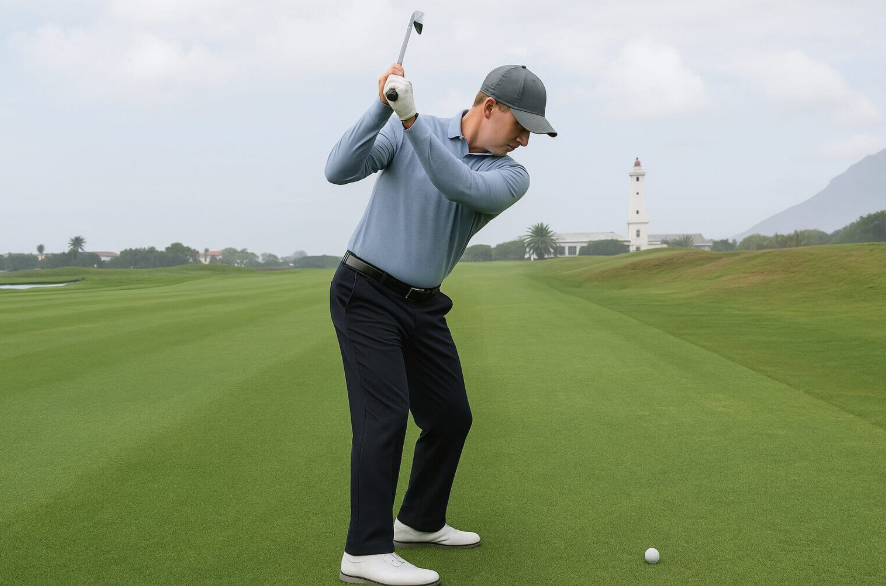
What Does a Steep Golf Swing Look Like?
Most golfers have no idea what their swing actually looks like. The feel of a steep swing and its actual appearance on video rarely match. Here’s how to read it properly.
From Down the Line (Camera Behind You)
At the top of the backswing, the club shaft typically points to the right of the target. As the downswing starts, instead of the hands falling down and in (toward the trail hip pocket), they move away from the body and the shaft crosses to point left of the target. You will also see the trail elbow flying out away from the ribs instead of tucking downward.
The shaft crosses the line at the top. A shallow swing keeps it pointing parallel to the target. A steep swing points it left, which sets up the outside-in path on the way down.
From Face On (Camera Facing Your Chest)
The lead shoulder tilts steeply toward the ground at impact rather than turning level around the spine. The hands look “cast out” toward the ball rather than dropping and coming from inside. The divot, if you take one, points noticeably left of the target line – often 10 to 20 degrees left for a severe case.
The Feel vs. Reality Problem
Here’s the frustrating part. Many steep swingers feel like they are swinging inside-out. Their brain tells them they are coming from behind the ball. But the club is going the other direction entirely. Don’t trust the feel – trust the video.
Pro Tip: Film your swing from directly down the line at waist height. Pause at the top, then again at impact. If the shaft is visibly steeper and more across the line at impact than at address, you have confirmed the steep pattern. Film from this angle every few weeks while you work on fixing it.
Steep Golf Swing vs Shallow: Key Differences
People throw around “shallow” like it’s automatically good and “steep” like it’s automatically bad. The reality is more nuanced – but for most recreational golfers, here’s what you need to know about the key differences:
| Factor | Steep Swing | Shallow Swing |
|---|---|---|
| Swing Plane | Club comes down above the ideal plane | Club comes down on or below the ideal plane |
| Club Path at Impact | Out-to-in (leftward) | In-to-out or neutral |
| Angle of Attack | -7° to -10° (irons) | -2° to -4° (irons) |
| Common Ball Flight | Pull, pull-fade, slice | Draw, straight, occasional push |
| Contact Tendency | Fat, thin, toe strikes | Center-face contact |
| Main Cause | Over-the-top transition | Arms fall before rotation in transition |
| Natural Miss | Left start, right curve (slice) | Right start, right curve (block/push) |
| Divot Direction | Points left of target | Points at or right of target |
| Great For | Short iron spin, bunker shots | Driver distance, consistent irons |
| Famous Example | Lee Trevino | Rory McIlroy, Adam Scott |
You might also hear “flat” as a third category. A flat swing travels on an extremely horizontal plane – very around-the-body, almost like a baseball swing. Steep vs flat is the full spectrum, with “on-plane” or “neutral” sitting comfortably in the middle. A flat swing brings its own problems (low hooks, blocks, difficulty with downhill lies) but it is a different problem from steep. Most recreational golfers who struggle with consistency are too steep, not too flat.
What Causes a Steep Golf Swing?
This is where most instruction falls short. It tells you that you’re steep, but not what specifically made you steep. You usually have two or three contributing causes stacked on each other. Fixing the wrong one wastes months of practice. Here are the four most common causes, in order of how frequently they appear.
Cause 1: Coming Over the Top (Early Upper Body Rotation)
This is the big one. Coming over the top means your first move from the top of the backswing is a rotation of the shoulders and chest – before your arms have had a chance to fall. The upper body fires first, drags the arms with it, and throws the club outside the plane.
It feels powerful. That’s the cruel irony. You feel like you’re ripping through the ball when in reality you’re glancing off it. The clubhead arrives at the ball from 2 o’clock instead of 4 o’clock, which is why the divot points left and the ball starts left before slicing right.
What to feel: The shoulders need to stay closed while the arms fall in transition. Think of keeping your chest facing away from the target just a moment longer than feels natural. The lower body leads, the arms fall, and then the chest opens.
Cause 2: A Steep Takeaway
Steep swings don’t always start in the downswing. Sometimes the problem starts in the very first move away from the ball. If your takeaway is too far inside – the clubhead moving low and behind your hands immediately – you create a backswing that’s too flat and behind you. The swing then over-corrects and goes steep on the way down.
This is less obvious because the takeaway and the downswing are separated by 0.8-1.0 second of full backswing time. Golfers rarely connect their takeaway to their downswing fault. But your takeaway determines your backswing plane, which strongly influences your downswing plane.
What to feel: In the first foot of the takeaway, the clubhead should stay outside your hands. When the shaft reaches parallel to the ground (P2 position), it should look parallel to your foot line when viewed from down the line. Think “club outside hands, not inside hands.”
Cause 3: Trail Arm Dominance (The Arm-Wrestling Move)
If your trail shoulder internally rotates early – like the starting movement of an arm-wrestling match – the shaft gets steep almost instantly. The trail arm essentially pushes the club away from the body and out in front of you in transition.
This pattern is common in physically strong golfers and former baseball or tennis players. The dominant hand wants to push and drive, when the correct feeling is more like the trail arm supporting from underneath rather than pushing from behind.
What to feel: Try making practice swings with your lead hand only. Notice how naturally the arm falls into a shallow slot without the trail hand pushing it off plane. That fall is what you’re after with both hands. The trail elbow should feel like it’s moving toward your trail hip pocket in transition, not flying out away from the body.
Cause 4: Steep Shoulders at the Top
If your lead shoulder tilts downward during the backswing instead of rotating across your chest, the swing plane at the top of the backswing becomes excessively steep. The downswing then simply follows the angle that was set at the top.
Watch for your head dropping during the backswing. If it drops more than half an inch, you’re tilting rather than turning. The shoulders should work like a merry-go-round – rotating around a stable center – not like a seesaw with one end going up and one going down.
What to feel: Your lead shoulder should move toward your chin on the backswing, not toward the ground. Imagine the shoulder turn happening at belt-buckle height, not knee height.
Pro Tip: A quick check for steep shoulders – stand in your setup position, cross your arms over your chest, and make a backswing. Your right shoulder (trail shoulder) should move back and up, not just forward and down. If it moves primarily downward, you have a tilt issue that’s creating steepness from the top.
What Does a Steep Golf Swing Cause?
Understanding your ball flight is your fastest diagnostic tool. A steep swing produces entirely predictable patterns. Once you know them, you stop second-guessing and start fixing.
Ball Flight Patterns from a Steep Swing
The steep golf swing creates an out-to-in club path combined with a steep angle of attack. The ball flight outcomes depend on where the face is pointing relative to that path:
- Straight pull – Face square to the path, both going left. Ball starts left and stays left. Clean contact, wrong direction. Common with more severe over-the-toppers.
- Pull-fade or slice – Face slightly open to the path. Ball starts left, then curves right. This is the classic amateur miss. 🏌️ About 70% of recreational golfers who identify as slicers are dealing with exactly this combination.
- Pull-hook – Face closed to the path. Ball starts left and hooks further left. Happens when golfers try to “cure” their slice by closing the face without fixing the path.
- Fat shots – The steep angle hits the turf before the ball. Very common on tighter lies and in cold, soft conditions.
- Thin shots – The flip correction that follows a fat shot leads to thin contact on the next swing. Golfers who alternate fat and thin almost always have a steep swing pattern.
- Toe strikes – The steep, over-the-top path rotates the face at impact, catching the toe. FYI, if you’re seeing a lot of toe-side wear on your irons, a steep path is the most likely culprit.
What It Does to Your Distance
A steep angle of attack doesn’t just hurt accuracy. It kills distance. Launch monitor data consistently shows that steeper angles of attack reduce smash factor – the efficiency of energy transfer from club to ball. A steep iron swing that’s hitting -8° often produces a higher, shorter trajectory with less carry than the same swing speed at -4°. For a 6-iron, that difference in AoA alone can cost 10 to 12 yards. That’s not a small number.
The Physical Cost
Long-term steep swinging is hard on the body. The downward, glancing blow creates stress on the wrists, lead elbow, and lower back that a shallower, more sweeping path does not. If you regularly finish a round feeling sore in your left wrist or lower back, this is a real possibility worth addressing – not just for scores, but for longevity.
Your divots will also be a giveaway. A steep swing creates divots that are:
- Deeper than 1 inch
- Point 10+ degrees left of target
- Feel “chunky” or jarring at impact
- Sometimes take turf before the ball on irons
If that describes your divots, you now know why.
Is a Steep Golf Swing Always Bad?
No. And this is where most instruction oversimplifies things badly. A steep swing is a problem when it’s exaggerated, uncontrolled, or paired with compensations that eventually break down. But a controlled, slightly steeper angle of attack has real uses in golf – even at the highest level.
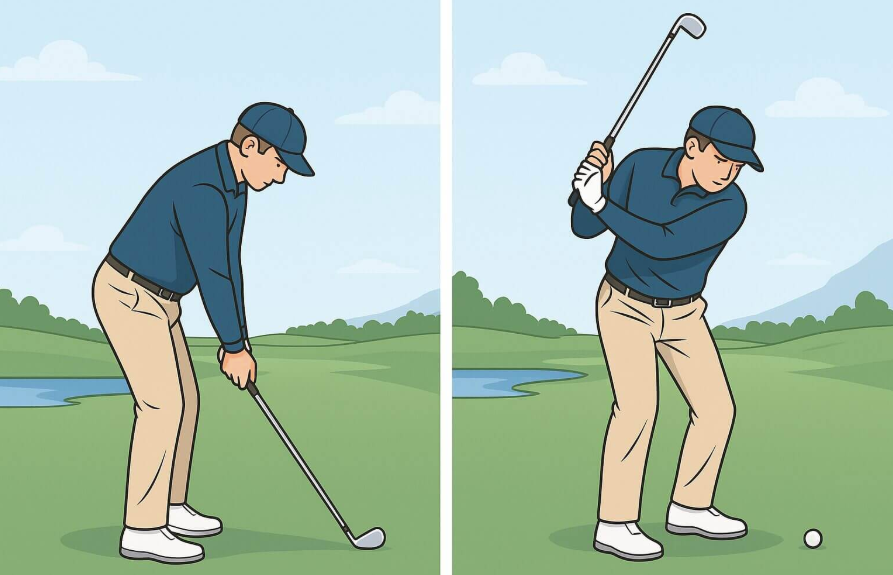
When Steepness Actually Helps You
- Greenside bunker shots: You need a sharp, descending entry to get underneath the ball and move sand together with it. Shallow bunker swings catch the ball clean and skull it across the green. A steeper path is correct here.
- Short irons and wedges: A more downward strike with a PW or 9-iron creates spin and stopping power. Trying to sweep a wedge the way you’d sweep a 3-wood costs you control around the greens.
- Tight lies: On hardpan or closely mowed fairways, a steeper descent gives you the best chance of solid ball-first contact. Too shallow and you thin it.
- Low, windy trajectories: When you want to flight a punch shot under the wind, a more downward strike delofts the club and keeps trajectory down. Deliberately steepen your swing for this shot and play the ball back in your stance.
- Very tall players: Upright posture often creates naturally steeper swings that match their body structure. Working too hard against a natural steep plane can actually make things worse for taller golfers.
Tour Pros Who Used a Steep Swing
Lee Trevino had one of the most famous steep, over-the-top swings in history. His club came dramatically from outside the plane on the downswing. He compensated by playing with an extremely open stance and keeping the face perfectly square to his outside-in path through impact. He won six major championships with this pattern. It was not conventional. It worked beautifully because he committed fully to the compensation and built his entire game around it.
Nick Price had a steep, fast swing that drew criticism from instructors who didn’t see the precision underneath it. His sequencing was so good that the steep angle of attack became a weapon rather than a fault.
What’s the lesson? A steep swing isn’t automatically a failure. Uncontrolled steepness is. The difference between Trevino’s steep swing and an amateur’s steep swing is that Trevino knew exactly what his swing produced and built a complete, consistent compensation around it. Most recreational golfers can’t maintain that level of precision under pressure. Getting into a better position is far more reliable than learning to compensate for a severe fault.
Pro Tip: IMO, if you’re going to accept some steepness in your swing rather than fully rebuilding, at minimum commit to a consistent setup: open your stance 10-15 degrees, play the ball slightly forward, and use a slightly stronger grip. Half-baked compensations make everything worse.
5 Drills to Fix a Steep Golf Swing
These are not generic tips. These are the drills that actually change the pattern – not in theory, but on the range. Do them in order because they build on each other. Start with a 7-iron and short, partial swings before moving to full swings.
Drill 1: The Slot Pump Drill
Goal: Feel the correct transition sequence – arms fall before upper body rotates.
How to do it:
- Take your normal setup with a 7-iron.
- Make a full backswing to the top.
- Pause for a full count of “one.” Do not rush through this.
- While your chest stays facing away from the target, let your arms drop straight down – hands moving toward your trail hip pocket.
- Feel the club drop behind you and underneath the shoulder plane. It will feel strange – like it’s going to hit your leg.
- Now rotate your chest through.
- Repeat 10 times before every practice session.
Why it works: The pause forces your brain to separate arm action from body action in transition. Most steep swingers have merged them together into one simultaneous movement. The exaggerated pause teaches your nervous system that arms and body can move at different times. Once the pattern is grooved, reduce the pause until it’s seamless.
What to feel: Like the club is “slotting” behind your trail shoulder, not moving out toward the ball. The shaft should feel like it’s dropping under your shoulder plane, not chopping across it.
Drill 2: The Headcover Under the Trail Arm
Goal: Keep the trail elbow from flying out in transition.
How to do it:
- Place a headcover, folded towel, or glove under your trail armpit – tucked in snugly.
- Make slow-motion half swings, keeping the object pinched under your arm.
- If the object drops at or just before transition, your trail elbow flew out – that is the exact moment your swing goes steep.
- The object should stay tucked until well into the downswing, releasing only as you extend through the ball.
Why it works: The flying trail elbow is one of the most common physical causes of an over-the-top move. When the elbow stays connected, the only place the club can go is down and into a shallower slot. It physically prevents the steep path.
Drill 3: The Alignment Stick Plane Guide
Goal: Get immediate visual feedback on your swing plane.
How to do it:
- Push an alignment stick into the ground just outside your trail shoulder at address.
- Angle it to match the slope of your shaft at setup (this sets your “ideal” plane).
- Make practice swings at half speed. The shaft should travel parallel and below the stick on the downswing.
- If your club shaft touches or cuts across the stick on the way down, you came over the top.
Why it works: Unlike most drills where you guess whether you fixed it, the alignment stick gives you instant physical and visual feedback. You either hit it or you don’t. After 20-30 practice swings with this guide in place, the correct feel starts to register.
Drill 4: Feet Together Drill
Goal: Remove reliance on brute force and train proper sequencing.
How to do it:
- Place your feet together – heels and toes touching.
- Hit 7-iron shots at 60-65% effort.
- Focus entirely on balance and the feeling of your arms falling before your chest opens.
- Hit 15-20 balls this way before returning to a normal stance.
Why it works: A narrow base removes the option to muscle the ball. Your balance is too fragile to rely on upper-body force, so you’re forced to use proper sequencing instead. Steep swingers almost always produce their best ball flight in the first few minutes of this drill – because the sequence finally takes over from the force. I’ve watched golfers who’ve battled a steep swing for years hit their best iron shots with their feet together on their first try. It’s genuinely eye-opening.
Drill 5: The Pause-at-the-Top Counting Drill
Goal: Break the rushed transition that causes steepness.
How to do it:
- Make your full backswing.
- At the top, silently count “one… two” before starting down.
- During those two counts, keep your chest facing away from the target. Feel the hands staying back and the club setting behind you.
- Then start the downswing – lower body leading, arms dropping, chest following last.
Why it works: Over-the-top moves almost always start with a rush at the top. Golfers feel like they need to immediately generate power from the top, so the upper body fires instantly. The count creates a deliberate pause that breaks that panic move. It feels awkward and slow at first. The ball will go further anyway because the sequence is finally right.
Once you’ve done this 50-60 times, reduce the pause to just a mental beat – not a full count – and you will find the new sequence sticking naturally.
Steep to Shallow: Mastering the Transition
The transition is 0.2 seconds of the swing. It’s also where steep patterns are made, and where they’re fixed. Here’s what needs to happen in the correct order:
Step 1 – Lower body initiates: The lead heel drops, hips start rotating toward the target. This happens while the backswing is still completing.
Step 2 – Arms fall: As the lower body starts, the arms begin descending. They move downward and inward – toward the body – not outward toward the ball line.
Step 3 – Chest stays behind: The lead shoulder and chest remain closed while the arms fall. This gap between lower body rotation and upper body rotation is what creates lag, power, and a shallow club path. Some coaches call it the “X-factor stretch.”
Step 4 – Club slots: As the arms fall and the chest stays closed, the club naturally moves into a shallower position. The trail elbow tucks toward the trail hip. The shaft angle becomes less steep.
Step 5 – Now rotate through: Only after the club has shallowed does the chest open and the club fire through the hitting zone.
The steep swing breaks this sequence at Step 2. The arms don’t fall – they cast outward because the chest rotates first and drags them with it. Fix the sequence and the steep path becomes a shallower one almost automatically.
The single feeling that helps most golfers: Think “trail elbow to trail hip pocket” as your first downswing move. That feeling – elbow moving toward the pocket rather than flying out – forces the arms to fall and the club to shallow. It’s not the only cue that works, but it works for most people faster than anything else.
Equipment Notes for Steep Swingers
Your equipment might be making your steep swing worse. Here are three things worth knowing:
Shaft flex: Steep swingers often create more downward force at impact than golfers with shallower swings. A shaft that’s too flexible can bow, kick unpredictably, and amplify the inconsistency already present from the steep path. If you’re steep and playing regular flex, get on a launch monitor and check your shaft loading – you may benefit from a stiffer profile.
Lie angle: A steep angle of attack tends to contact the ball with the toe slightly low through impact, which often means the lie angle is effectively too flat for your swing. Getting fitted for a slightly more upright lie angle can improve contact quality and straighten ball flight even before you’ve fully fixed the plane.
Club type: If you’re actively working on your steep swing, this is not the time to play blade irons. Game-improvement irons with wider soles and more offset forgive off-center hits and reduce the tendency to dig deep divots. Play with equipment that supports where your swing is going, not where it’s been. Once your angle of attack improves, you can reassess.
FAQs
What does a steep golf swing do?
A steep golf swing creates an out-to-in club path and a steep angle of attack at impact. This typically produces pull shots, pull-fades, and slices – the ball starts left of the target and curves further right or stays left depending on face angle. It also creates inconsistent contact (fat shots, thin shots, toe strikes) and costs distance due to less efficient energy transfer through the ball.
How to correct a steep golf swing?
The most effective correction starts in the transition. Let your arms fall before rotating your upper body on the downswing – this shallows the club into a better delivery position. Start with the Slot Pump Drill (pause at the top, drop the arms toward the trail hip pocket, then rotate). Add the Headcover Under the Arm Drill to train the trail elbow. Fix the root cause – coming over the top or a steep takeaway – rather than just masking the result.
Is it better to have a shallow or steep golf swing?
For most recreational golfers, a neutral-to-slightly-shallow swing plane produces more consistent contact, better ball flight, and more distance. That said, “better” depends on the shot. A steeper angle of attack is correct for short irons, wedges, bunker shots, and low punch shots. The best ball-strikers modulate steepness by club and situation. But if you’re choosing between defaulting to one or the other, shallow is more forgiving and far easier to manage under pressure.
Did Tiger Woods have a steep swing?
Not in the traditional sense. Tiger was known for modulating his angle of attack by club type – shallowing with his driver to optimize launch, but delivering his short irons and wedges on a notably steeper path for spin and stopping power. During his Butch Harmon years, his transition was exceptionally well-sequenced: shallow to start, loading steeply into impact only with the shorter clubs. He was never a “steep swinger” by definition – he was a master of using steepness precisely when it helped him.
Final Thoughts
The steep golf swing is the most widespread fault in recreational golf – and one of the most fixable. Once you understand what it really is (a sequencing problem, not a strength problem), the fix stops feeling mysterious. You’re not broken. Your transition is just out of order.
Start with the Slot Pump Drill and the Headcover Under the Arm Drill. Do both consistently for four to six weeks before moving to the others. Give your nervous system enough correct repetitions that the new sequence becomes automatic. When it does, your divots will straighten out, your ball flight will start right instead of left, and those 10-15 yards you’ve been losing to a steep angle of attack will show back up in your carry numbers.
Save this guide and share it with the golfer in your group who keeps asking why their shots always start left. Chances are, they’re steep – and now you know exactly what to tell them.
Related Articles on madknows.com: