
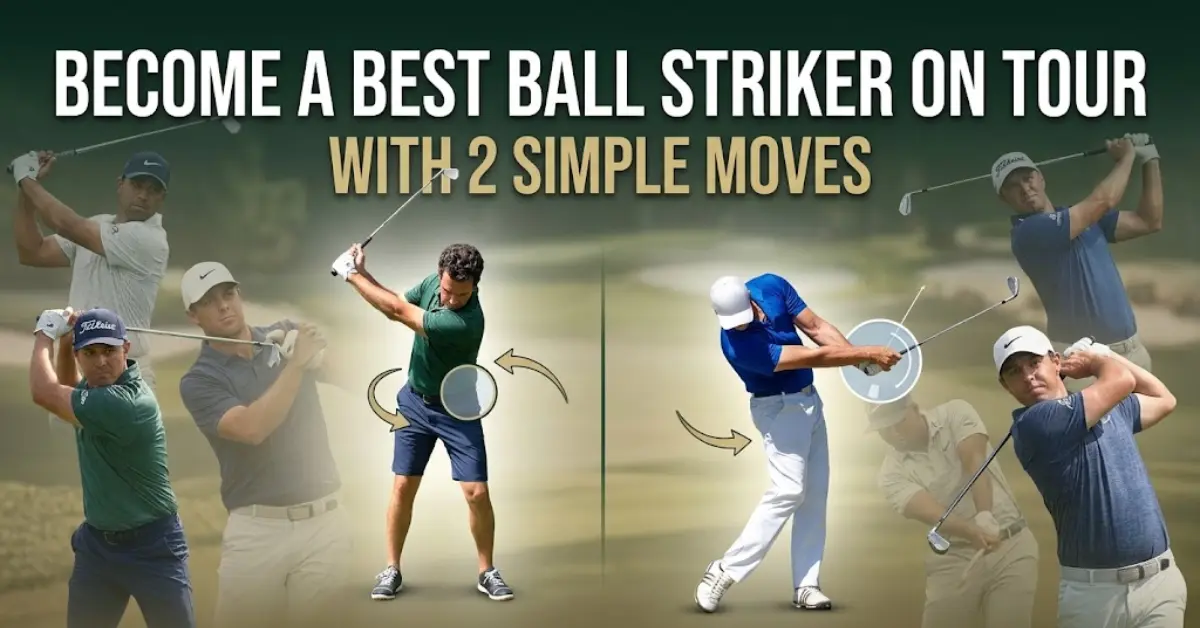
Quick Answer: Two moves make a great ball striker. First, bump your hips 1 to 2 inches toward the target at the top of your swing. Second, keep your swing radius the same all the way through the ball. Do both and the club hits the ball before the turf, every single time.
The Problem Most Golfers Never Fix
One year ago I could not hit my 7-iron clean two times in a row.
One swing went 158 yards. The next one went 130 yards. The one after that hit the turf two inches behind the ball and went almost nowhere.
I was working on my grip. And i was working on my backswing. I was watching YouTube videos every night. Nothing worked.
A scratch golfer at my club watched me hit balls for about five minutes. He told me to stop thinking about my backswing and start paying attention to where the bottom of my swing was landing.
That one conversation changed my ball striking completely.
The thing is, the best ball strikers on tour are not stronger than you. They are not more flexible than you. They are not swinging with some secret technique that only tour pros know about. And they are just moving their swing circle in the right direction at the right moment.
This article covers exactly what that means, why it works, and how you can train it in a few range sessions.
What “Best Ball Striker on Tour” Actually Means in Numbers
Most people use the phrase “best ball striker on tour” without ever explaining what it means in real numbers. So before anything else, here is the exact data.
What a tour-level ball striker produces with a 7-iron:
- Attack angle: -3 to -5 degrees (club moving downward at impact)
- Shaft lean at impact: 4 to 6 degrees forward
- Smash factor: 1.38 to 1.42 (this is ball speed divided by clubhead speed)
- Low point position: 3 to 4 inches ahead of the ball on every single swing
Every one of those numbers comes from one thing. Where the bottom of the swing arc sits at the moment the club reaches the ball.
What strokes gained: approach tells us:
Scottie Scheffler led the PGA Tour in strokes gained: approach in 2025. His number was +1.269 strokes per round. That means he gained more than one full shot on the entire field every round, just from iron play. Not from driving. Not from putting. Just from the quality of ball contact with his irons.
Collin Morikawa has finished in the top 3 in that same category every season since his first year on tour. He is not the longest hitter on tour. He averages around 275 to 285 yards off the tee. But he is one of the most consistent iron players the game has ever seen because he controls his low point better than almost anyone else.
That is the skill this article teaches.
How Different Golfers Compare at Impact
| Golfer Type | Low Point | Hip Lead? | Radius Held? | Typical 7-iron Result |
|---|---|---|---|---|
| Tour Pro (0-3 hdcp) | 3 to 4 inches ahead of ball | Yes, 1 to 2 inches lateral before turn | Yes, shaft leans forward at impact | Ball first, tight spin, consistent carry every time |
| 5 to 10 handicap | 0 to 1 inch ahead | Sometimes, but not consistent | Sometimes, occasional flip under pressure | Mostly solid but thin shots show up when it matters |
| 15 to 20 handicap | At ball or slightly behind | Rarely, upper body usually leads | Often not, early wrist extension common | Fat or thin, usually 20 to 30 yards short of target |
| 25 plus / beginner | 3 to 5 inches behind ball | No, weight stays on trail side | No, severe flip and scoop | Heavy chunk or topped ball, 50 to 80 yards total |
Why Your Ball Goes Fat or Thin (And Why It Is Not Your Backswing)
Most golfers spend years working on the wrong thing.
They work on the takeaway. They work on keeping the left arm straight. And they work on staying connected. And none of it fixes the real problem because the real problem happens somewhere else entirely.
Here is the simple explanation:
Think of your swing as a circle tilted at an angle through your body. The very bottom of that circle is called the low point. That is the spot where the club gets closest to the ground during the swing.
At address, the low point of your circle sits roughly under the ball. If the low point stays there, you either hit the ball and the turf at the same time, which gives you a weak shot with no compression, or you hit the turf first, which gives you a fat shot, or you catch the ball on the way up slightly, which gives you a thin.
Move that low point 3 to 4 inches forward toward the target and everything changes. The club hits the ball while it is still moving downward. The turf comes after the ball. The ball gets compressed against the face. That is what that crisp, clicking sound is. That is what tour pros feel on every iron shot.
The worst instruction cue in golf:
“Hit down on the ball.”
I know instructors mean well when they say it. But for most amateur golfers, trying to hit down on the ball makes things worse. It causes the upper body to lunge forward and the swing arc to get steep. That pushes the low point further behind the ball, not further ahead of it.
The right way to think about it is this: move the bottom of the arc forward. When you do that, the downward hit happens automatically. You do not have to force it.
The Turf Line Test (Do This Before Anything Else)
Before you try any drill in this article, do this test. It takes 30 seconds and it will show you exactly what your swing is doing.
Steps:
- Find a patch of turf on the range or in your yard
- Draw a line in the turf that goes across your stance, perpendicular to the target line, right where the ball would sit
- Take your 7-iron and make a full swing with no ball
- Look at where the club first touches the turf
What the results mean:
- Club touches behind the line: your low point is too far back. This is the most common result for golfers who hit fat and thin shots
- Club touches right on the line: your low point is at the ball. You will catch some clean but it is not consistent
- Club touches ahead of the line: your low point is in the right place. You are already doing something right
Do this test 10 times and note where most of your marks land. That tells you how much work you need to do with the two moves below.
Move 1: The Lateral Hip Bump
What It Is and Why It Works
This is the move that shifts the arc forward.
Every great ball striker makes this move. Ben Hogan wrote about it in Five Lessons. Tiger Woods was famous for driving into his lead side at transition. Scottie Scheffler does it so aggressively in slow motion that it almost looks like a different sport.
Here is what the move is:
At the very top of the backswing, before your arms start to come down, your hips slide 1 to 2 inches toward the target.
That is it.
Not a full weight shift. Not a lateral lunge. And not a big movement that looks different on video. Just a controlled 1 to 2 inch slide of the hips toward the target before the arms start moving.
Why 1 to 2 inches makes such a big difference:
Your swing arc moves with your body. When your hips shift 1 to 2 inches toward the target, the bottom of your swing arc shifts 2 to 3 inches toward the target at the same time.
That is enough to move your low point from behind the ball to in front of it.
That is the entire difference between a tour ball striker and a 15-handicap on iron shots.
What happens if you do not bump:
When the hips do not lead the downswing, the upper body takes over. The club comes over the top. The swing path goes from outside to inside. You pull the ball left or hit a glancing blow that goes weak to the right. Neither is what you want.
The Difference Between a Bump and a Slide
This is where most golfers get confused when they first hear about the hip bump. They worry they will slide instead of bump.
Here is the difference:
A bump:
- Hips move 1 to 2 inches toward the target at the start of the downswing
- Hips stop moving sideways and immediately start rotating toward the target
- Weight transfers naturally onto the lead foot as part of the rotation
- Result: square or slightly closed path, good compression, ball-first contact
A slide:
- Hips keep moving laterally past the ball all the way through impact
- Hips never fully rotate, they just keep going sideways
- Hands flip to try to square the face because the body is stuck out in front
- Result: weak push shots, blocks, or flips
The bump is a trigger. It starts the downswing and then immediately hands off to rotation. The slide never makes that handoff.
Drill: The Alignment Stick Hip Bump Drill
This is the single best drill for training the hip bump. It gives you instant feedback on every swing and most golfers start seeing divots move forward within 20 to 25 balls.
What you need:
- One alignment stick
- Your 7-iron or 8-iron
Setup:
- Push the alignment stick into the ground vertically
- Place it just outside your lead thigh, about one hand-width from your leg
- At address, you should barely feel the stick against your lead thigh
- The stick should be close enough that a 1 to 2 inch hip move will graze it
How to do the drill:
- Take your normal address position
- Make your backswing as normal
- At the very top of the backswing, before your arms come down, bump your lead hip into the stick
- Let the rotation follow naturally after the bump
- Swing through to a full finish
What your feedback tells you:
- You never touch the stick: you are not shifting far enough, the arc stays back, you will see fat divots
- You touch the stick at impact or after: you are bumping too late, more like a slide
- You touch the stick at the start of the downswing and then rotate through: this is correct
Recommended practice:
Check your divots after every 5 balls. You will see them move forward as the session goes on.
What Golfers Usually Feel vs What Is Actually Happening
Almost every golfer who tries the hip bump for the first time feels like they are falling over sideways.
On video, they moved about one inch.
The feeling is completely different from reality and this is normal. Most golfers have been turning the upper body too early for years. Any lower body lateral movement feels huge and wrong by comparison. The internal sense of what is “normal” has been calibrated to the wrong movement.
What to do about it:
Trust the divots, not the feeling. If your divots are moving to the target side of the ball, the move is working. It does not matter if it feels strange. Strange is different. Different is good. That is the whole point.
Scheffler’s transition as a visual reference:
Watch Scheffler’s downswing in slow motion. His lower body is already moving toward the target while his hands are still going back. The hip bump and the backswing overlap. They are not sequential.
Most amateur golfers wait until the backswing is completely finished before they start shifting. By the time that happens, the window for a good bump has already closed.
Move 2: Keeping the Swing Radius (Drops the Arc Underground)
What It Is and Why It Works
Move 1 shifts the arc forward toward the target. Move 2 pushes it downward through the turf.
Together these two moves explain why tour players take divots and most amateur golfers do not.
The divot is not a technique. It is an outcome.
When the arc’s lowest point is physically below the surface of the turf, the club naturally passes through the ground. You do not have to force the club down. You do not have to dig. The geometry of the arc puts the club underground at the right moment.
What the swing radius is:
Picture a string running from your lead shoulder all the way down to the clubhead. The length of that string is your swing radius.
When that length stays the same from the top of the backswing all the way through the ball, the arc drops below the turf surface at the right point. The club passes through the turf naturally and you get a divot.
When that length gets shorter too early, because the lead wrist flips, because the right elbow pushes away from the body, because the spine rises up, the club head rises up too. The arc bottoms out above the turf. The club catches the ball on the way up or at the very bottom and you hit a thin.
Why most amateur golfers lose their radius:
The most common cause is the wrist flip. The trail hand pushes the club through impact from underneath instead of staying behind it. This is called casting and it is the most common flaw in amateur ball striking. The club loses its angle too early, the radius shortens, the arc rises up, and the ball is hit thin.
My Personal Experience With Radius Maintenance
I spent three full weeks doing nothing but the lead forearm drill at the start of every range session.
Ten minutes every session before I picked up a ball. Just controlled small swings with attention to keeping the grip in contact with my forearm.
Here is what happened to my 7-iron carry:
The top number actually went down a little. I was no longer getting those lucky flush shots that flew further than expected. But the bottom number went way up. The 130-yard chunks almost completely stopped.
That tighter window is what ball striking actually is. It is not about the best shot. It is about raising the floor.
Drill 1: The Punch Shot Shaft Lean Drill
Collin Morikawa uses a version of this drill in practice. It is one of the most effective ways to feel shaft lean and radius maintenance without the pressure of a full swing.
What you need:
- 7-iron
Setup:
- Normal stance and ball position
- Take a three-quarter backswing, hands to about hip height
- This is not a full power swing
How to do the drill:
- Set up with your hands slightly ahead of the ball at address, shaft leaning slightly toward the target
- Make your three-quarter backswing
- Swing through at about 70 percent effort
- Focus on returning your hands to that same forward position at impact
- The shaft should lean toward the target at impact, not away from it
- Do not flip the wrists through the ball. Let the hands lead.
What the ball flight should look like:
Signs the drill is working:
Recommended practice:
Run 15 to 20 of these punch shots before you move to full swings in any range session. The feel from the punch shot carries directly into the full swing.
Drill 2: The Lead Forearm Grip Drill
This drill makes radius maintenance physically impossible to mess up. It removes the wrist flip mechanically, not through thought.
What you need:
Setup:
How to do the drill:
- Make shoulder-to-shoulder swings, slow and controlled
- Keep the grip touching your lead forearm all the way through the impact zone
- If the grip separates from your forearm before impact, you have flipped. Stop and start again.
- The goal is to feel the grip maintaining contact through the hitting area.
Why this works:
When the butt of the grip is touching your forearm, the wrist cannot flip early. The radius stays consistent whether you think about it or not. The drill teaches the right feeling without requiring you to think about wrist angles or elbow positions or shaft lean measurements.
The most common mistake:
Swinging too hard. This drill is entirely about feeling, not about distance. Slow, deliberate swings where you can pay attention to whether the grip stays on the forearm. Speed comes later.
How to move from the drill to a full swing:
Once the feeling of grip-to-forearm contact is clear and consistent in the drill, take a full grip. Make a full swing. Try to hold onto the same feeling of the hands staying ahead through the impact zone even without the physical contact to guide you.
How to Combine Both Moves
Why Neither Move Works Alone
This is the part most golf instruction articles miss.
Bump without radius:
- The arc moves forward toward the target from the hip bump
- But the radius shortens too early and the arc rises back up above the turf
- Result: thin shot with no compression, the ball flies low and weak
Radius without bump:
- The arc drops underground correctly from the maintained radius
- But it drops underground in the wrong spot because the hips never shifted forward
- Result: fat shot, club hits the turf 2 to 3 inches behind the ball
Both together:
- The arc moves forward from the bump
- The arc drops underground from the maintained radius
- Low point ends up 3 to 4 inches ahead of the ball
- Club hits ball first, then turf, every time
The Correct Sequence Step by Step
- Backswing reaches the top
- Before the arms start down, hips bump 1 to 2 inches toward the target
- Hips stop moving sideways and begin rotating toward the target
- Trail shoulder drops as the hips rotate
- Radius holds, grip stays ahead of the clubhead
- Club arrives at the ball while still moving downward
- Ball first, turf second, divot appears forward of ball position
At tour speed, steps 2 through 7 take less than 0.3 seconds. You cannot think through each step in real time during a full swing. You have to train each move separately until both feel natural, and then trust the body to sequence them automatically.
How to Practice the Combination
Step 1: Train the bump alone
Do the alignment stick drill for a full range session. Keep going until 15 out of 20 divots land on the target side of the line. Do not move on until this is consistent.
Step 2: Train the radius alone
Do the forearm grip drill and the punch shot drill for a full range session. Keep going until the compressed punch shot sound is consistent on most balls. Do not move on until this is consistent.
Step 3: Combine with a single swing thought
Only after both feel natural do you make full swings combining them. Use one swing thought only: bump, hold.
Bump means the hip move at transition. Hold means keep the radius through the ball. Two words. One swing.
Drill Reference Table
| Drill | What It Trains | Equipment Needed | How You Know It Is Working |
|---|---|---|---|
| Alignment Stick Bump | Move 1, hip shift forward | One alignment stick | Lead hip grazes stick at transition, divots move to target side of line |
| Punch Shot | Move 2, shaft lean at impact | 7-iron | Sharper impact sound, divot starts just forward of where ball was |
| Lead Forearm Grip | Move 2, anti-flip radius | 7-iron choked down | Grip stays against lead forearm all the way through the impact zone |
| Turf Line Test | Both moves, diagnostic check | Iron and turf | Divot or brush mark starts consistently on the target side of the line |
When These 2 Moves Will Not Help
These moves are not for everyone. Here is an honest look at who will benefit and who will not.
If you are a 4 handicap or lower:
Your arc control is probably already solid. The thing holding you back is more likely swing speed, better lag retention, or shot shape control. Changing your low point when it is already working well will make your ball striking worse before it gets better, sometimes for several months. This is not where you should spend your time.
If you have hip or lower back pain:
The bump is a small movement, 1 to 2 inches at most. But the lead hip has to accept load during the backswing and that can create discomfort if there is an underlying mobility problem. If the bump causes pain, do not push through it. Work with a golf fitness professional on hip mobility first. Revisit the bump once you have the physical range of motion to do it without compensation.
If you are a true beginner (playing less than one year):
Learn the fundamentals first. Get a neutral grip. Learn to aim correctly. Build a swing that repeats in a basic way. These two moves are adjustments to a swing that already exists. Trying to add them to a swing that is still being built from scratch will create more confusion, not more progress.
Frequently Asked Questions
What makes someone the best ball striker on tour?
Consistent low point control. Divots that start 3 to 4 inches ahead of the ball on almost every iron swing, combined with a high smash factor. The statistical measure is strokes gained: approach. Scheffler led the PGA Tour at +1.269 in 2025, which means he gained more than one full stroke per round over the entire field through iron play alone. The two physical moves that create that number are exactly what this article covers: a forward arc position from the hip bump and maintained radius through impact.
What is the most important thing in ball striking?
Low point control. Not grip, not swing plane, not alignment. All of those things matter, but they all serve one purpose: putting the low point in the right place. Every other measurable impact factor, attack angle, shaft lean, face angle, either depends on or flows directly from where the swing arc bottoms out. A golfer who controls the low point within a 2-inch window consistently will strike the ball more solid than someone with a textbook-looking swing and a low point that moves around from shot to shot.
How do I get more distance with my irons by improving ball striking?
Better arc control adds distance in two separate ways:
A 15-handicap who fixes the low point and starts hitting ball-first consistently will typically pick up 10 to 20 yards of carry without changing anything else about the swing.
Can seniors become better ball strikers with this approach?
Yes. In some ways these two moves suit older golfers better than speed-based training methods. The lateral bump and radius maintenance are about geometry and sequencing, not physical strength or extreme flexibility. A 65-year-old with limited rotation who learns the 1 to 2 inch bump will compress the ball better than a 30-year-old who swings hard but keeps the weight on the trail side.
The forearm drill in particular requires almost no flexibility. It is just small, controlled swings with attention to feel. A 71-year-old at my club went from catching thin shots about 70 percent of the time to solid ball-first contact about 80 percent of the time in four weeks of consistent drill practice.
What is the difference between a ball striker and a good putter?
In professional golf, these two skills are statistically independent from each other. About half of the top 20 ball strikers in any given season rank in the bottom half of the tour in putting. Both skills matter for scoring, but they draw on completely different abilities.
Ball striking is about body sequencing, arc geometry, and contact consistency. Putting is about green reading, speed control, and staying calm under pressure.
For most amateur golfers, ball striking improvement gives more scoring benefit because poor approach shots create a chain reaction: longer putts, harder chip situations, and more penalty strokes. One bad iron shot can cost you two or three strokes through that chain alone.
Does watching tour pros on video help me improve my ball striking?
Yes, but only if you watch the right thing.
Watch Scheffler’s transition in slow motion. His lower body starts moving toward the target before his hands have finished going back. That timing is the visual representation of the hip bump. You can see exactly when the bump starts and how quickly the rotation takes over after it.
Watch Morikawa’s impact position. The shaft leans forward. The lead wrist is flat or slightly bowed. The hands are clearly ahead of the ball at impact. That is radius maintenance made visible.
Do not try to copy the full swing of either player. The only useful information is those two positions: the bump at transition and the hands-ahead position at impact. Everything else between those two points will vary from player to player and is not useful to try to replicate.
Two Moves. One Swing. Every Time.
Golf instruction has an overcomplification problem.
Strip it back to geometry and the whole thing becomes simple. Your swing is a circle. The circle needs to move forward and downward to compress the ball. Two moves at the start of the downswing accomplish both of those things.
The short version:
How to practice it:
- Do the alignment stick drill until divots land on the target side of the line consistently
- Do the forearm grip drill until the compressed impact sound feels normal
- Use the turf line test as your ongoing diagnostic check, not carry distance
- Only combine both moves in a full swing after each one feels natural in isolation
- Use one swing thought when you do combine them: bump, hold
The goal:
Every best ball striker on tour, from Scheffler to Morikawa to the scratch player at your local club, has made these two moves automatic. They are not thinking about the bump during a round. And they are not thinking about radius maintenance on the 18th tee. They trained both until the moves stopped needing attention.
That is what you are working toward. Not a perfect-looking swing. Not a specific divot shape. Just a circle that bottoms out in the right place, reliably, every time.
The numbers take care of themselves after that.