
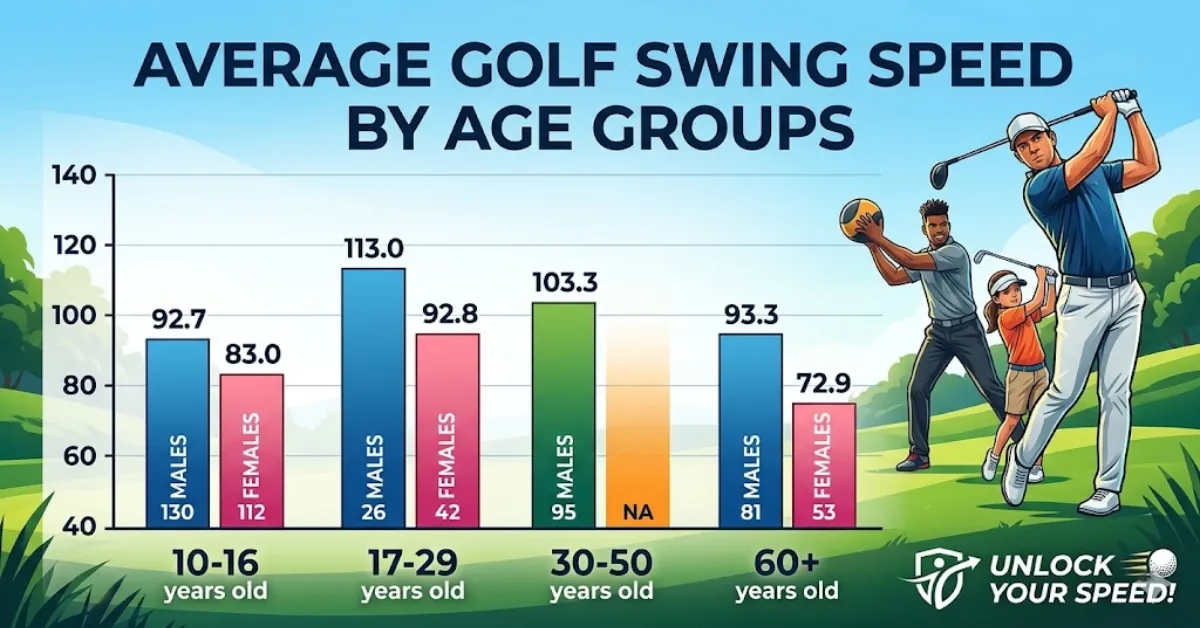
The average golf swing speed by age group varies more than most golfers expect – and knowing your number is the first step to doing something about it. For male amateurs in their 20s, the average sits around 96 mph. By the time a man reaches his 50s, that drops to around 90 mph, and into the 60s it falls closer to 85 mph. For female golfers, the averages run roughly 15–20 mph lower across every bracket. Research from TrackMan shows that each 1 mph increase in swing speed adds up to 3 yards of driving distance — so even a modest improvement makes a real difference on the course.
This guide breaks down average swing speeds by age, gender, handicap level, and club type – including a full 7-iron speed chart. You will also find out what percentile you fall into and what you can do right now to pick up speed, regardless of how old you are.
What Is Golf Swing Speed and Why Does It Matter?
Swing speed is the speed of your clubhead at the moment it makes contact with the ball, measured in miles per hour (mph). It is the single biggest factor in how far your ball travels. The faster the clubhead moves through the hitting zone, the more energy transfers to the ball – and the further it goes.
But raw speed is only part of the picture. Two golfers can swing at 90 mph and hit the ball very different distances, depending on strike location, smash factor, and launch conditions. A golfer who catches it dead center on a modern driver at 90 mph will out-drive someone who catches it off the toe at 95 mph. That said, more speed is always an advantage — because it raises your ceiling for every other variable.
Why Swing Speed Matters for Your Handicap
Speed and scoring are directly connected. According to TrackMan data, scratch golfers average around 106 mph of swing speed with the driver. A 14-handicap golfer averages roughly 93–94 mph. The extra distance from faster swing speeds means shorter irons into greens, more birdie looks, and fewer recovery shots. It is not the only path to better golf, but it is one of the most measurable ones.
Average Golf Swing Speed by Age Group — Full Chart (Male and Female)
The table below shows average driver swing speeds by age and gender for amateur golfers. These figures are compiled from TrackMan data, TPI (Titleist Performance Institute) research, and Arccos Golf tracking data from millions of rounds.
| Age Group | Male Avg. Driver Speed (mph) | Female Avg. Driver Speed (mph) |
|---|---|---|
| Under 20 | 93–98 | 70–78 |
| 20–29 | 96–100 | 76–82 |
| 30–39 | 93–97 | 74–80 |
| 40–49 | 90–94 | 71–77 |
| 50–59 | 86–92 | 66–73 |
| 60–69 | 80–87 | 60–68 |
| 70–79 | 70–78 | 53–60 |
| 80+ | 58–66 | 44–52 |
Sources: TrackMan Golf, TPI Par4Success Research, Arccos Golf (2024–2025)
How Do These Numbers Compare? Key Takeaways
Golfers in their 20s are at their peak. Most male amateurs in this bracket swing between 96 and 100 mph — and with proper speed training, some reach 105 mph or beyond. Female golfers in their 20s typically sit between 76 and 82 mph.
The 30s and 40s bring a gradual decline of around 1–2 mph per decade on average. The good news is that this decline is largely driven by reduced mobility and flexibility — not the passage of time itself. Golfers who stay active and train for rotation often maintain speed well into their 40s.
The 50s and 60s are where the gap widens. Men in their 60s average between 80 and 87 mph — still more than enough to enjoy the game and play well. Women in the same bracket typically sit around 60–68 mph.
For golfers 70 and older, the focus shifts from generating more speed to maintaining what they have for as long as possible. Equipment adjustments — lighter shafts, higher loft, senior flex — make a significant difference at this stage.
What Percentile Is Your Swing Speed for Your Age Group?
Knowing your average is useful. Knowing where you rank among golfers your age is even more useful. The percentile breakdown below is based on TPI’s Par4Success research — a dataset of over 600 tested amateur golfers across age groups.
Reading the table: If you swing at the 50th percentile, half of golfers your age swing faster and half swing slower. The 75th percentile means you are faster than 75% of golfers your age.
Male Driver Swing Speed Percentiles by Age Group (mph)
| Age Group | 10th %ile | 25th %ile | 50th %ile | 75th %ile | 90th %ile |
|---|---|---|---|---|---|
| Under 20 | 78 | 85 | 93 | 100 | 108 |
| 20–30 | 82 | 89 | 96 | 103 | 112 |
| 31–40 | 79 | 86 | 93 | 101 | 109 |
| 41–50 | 74 | 82 | 90 | 98 | 106 |
| 51–60 | 70 | 78 | 86 | 94 | 102 |
| 60+ | 62 | 71 | 80 | 89 | 97 |
Female Driver Swing Speed Percentiles by Age Group (mph)
| Age Group | 10th %ile | 25th %ile | 50th %ile | 75th %ile | 90th %ile |
|---|---|---|---|---|---|
| Under 20 | 57 | 64 | 72 | 80 | 88 |
| 20–30 | 62 | 69 | 77 | 85 | 93 |
| 31–40 | 60 | 67 | 75 | 83 | 91 |
| 41–50 | 57 | 64 | 72 | 80 | 88 |
| 51–60 | 52 | 60 | 68 | 76 | 84 |
| 60+ | 46 | 54 | 63 | 72 | 80 |
What Your Percentile Means in Practice
If you are in the bottom 25th percentile for your age, speed training should be a priority before worrying about swing technique. Speed and mobility work will move the needle faster than a mechanical overhaul.
If you are around the 50th percentile, you are a normal amateur golfer. Structured training can realistically move you up to the 75th percentile within 6–12 months.
If you are already in the 75th percentile or higher, technique and ball striking are where your next scoring gains will come from — your speed is already an asset.
Average Golf Swing Speed by Age Group and Handicap
Swing speed and handicap are strongly linked — but not because better golfers simply try harder. Lower handicap golfers have developed efficient mechanics that extract more speed from the same body. Here is what the data from TrackMan shows for male amateur golfers:
Male Driver Swing Speed by Handicap Level
| Handicap Level | Average Driver Speed (mph) | Avg. Carry Distance |
|---|---|---|
| Scratch (0) | 106 | 260–270 yards |
| 1–5 handicap | 102–106 | 245–260 yards |
| 6–10 handicap | 97–102 | 230–245 yards |
| 11–15 handicap | 93–97 | 214–230 yards |
| 16–20 handicap | 88–93 | 200–214 yards |
| 20+ handicap | 80–88 | 180–200 yards |
| PGA Tour (pro) | 115–118 | 290–310 yards |
Female Driver Swing Speed by Handicap Level
| Handicap Level | Average Driver Speed (mph) | Avg. Carry Distance |
|---|---|---|
| Scratch (0) | 90 | 215–225 yards |
| 1–10 handicap | 85–90 | 195–215 yards |
| 11–20 handicap | 79–85 | 175–195 yards |
| 20+ handicap | 68–79 | 150–175 yards |
| LPGA Tour (pro) | 93–96 | 240–260 yards |
The 2025 PGA Tour season average was 116.46 mph — and those players average 299.9 yards per drive. Their driving efficiency (yards per mph) is 2.61, compared to 2.29 for the average 14-handicap amateur. The gap is not just speed — it is also where they hit the face. Tour players strike it near the sweet spot almost every time. Amateurs rarely do.
Golf Swing Speed by Age Group for Seniors (60s, 70s and 80+)
Senior golfers deserve their own section — not because the numbers are discouraging, but because the strategy changes significantly once you cross 60. The data below shows what realistic swing speeds look like across senior age groups, and what that means for your game.
Driver Swing Speed for Senior Male Golfers
Men in their 60s average between 80 and 87 mph with the driver. That still produces drives of 190–220 yards for most players, which is plenty of distance to play most courses well from the right tee. Men in their 70s typically swing between 70 and 78 mph, with drives ranging from 165 to 195 yards. Men over 80 average around 58–66 mph — producing drives of 140 to 165 yards on average.
Driver Swing Speed for Senior Female Golfers
Women in their 60s average around 60–68 mph with the driver, translating to carry distances of 130 to 155 yards. Women in their 70s typically sit between 53 and 60 mph. At 80 and above, female senior golfers average between 44 and 52 mph.
Senior Golf Driver Swing Speed and Estimated Distance
| Age Group | Male Avg. Speed (mph) | Est. Male Drive (yards) | Female Avg. Speed (mph) | Est. Female Drive (yards) |
|---|---|---|---|---|
| 60–64 | 83–87 | 205–220 | 64–68 | 145–158 |
| 65–69 | 80–84 | 194–210 | 60–65 | 135–148 |
| 70–74 | 74–79 | 180–198 | 55–61 | 125–140 |
| 75–79 | 70–75 | 168–185 | 50–56 | 115–130 |
| 80+ | 58–66 | 140–165 | 44–52 | 100–118 |
Equipment Advice for Senior Golfers by Swing Speed
Below 80 mph (driver): Switch to a senior flex shaft (A-flex). Use a driver with 12–14 degrees of loft to get the ball airborne more easily. Replace your 3, 4, and 5 irons with hybrids or a 7-wood — these are far easier to hit at slower swing speeds and will actually produce more distance.
Between 80 and 90 mph (driver): A regular flex shaft is the right call for most golfers in this bracket. Aim for 10.5–12 degrees of driver loft. You can keep a 5-iron in the bag if you strike it well, but a hybrid is a safer bet.
Above 90 mph (senior): You still have plenty of speed. A regular or even stiff shaft may suit you depending on your tempo. Focus on getting properly fitted rather than assuming you need “senior” equipment just because of your age.
Average 7 Iron Swing Speed by Age Group
The 7-iron is one of the most important clubs in any bag — it sits in the middle of your set and the distances you hit it shape every course management decision you make. Most golfers swing a 7-iron roughly 15–20 mph slower than their driver speed.
Here is the data, broken down by age and gender:
Average 7 Iron Swing Speed by Age Group
| Age Group | Male 7-Iron Speed (mph) | Est. Male Carry (yards) | Female 7-Iron Speed (mph) | Est. Female Carry (yards) |
|---|---|---|---|---|
| 20–29 | 80–86 | 160–175 | 62–68 | 115–130 |
| 30–39 | 78–84 | 155–170 | 60–66 | 110–125 |
| 40–49 | 75–81 | 148–162 | 57–63 | 105–118 |
| 50–59 | 71–77 | 138–154 | 53–59 | 97–112 |
| 60–69 | 66–73 | 126–142 | 48–55 | 88–102 |
| 70+ | 58–66 | 110–126 | 42–50 | 76–92 |
Based on TrackMan club data. A 76 mph 7-iron swing with a good strike produces approximately 150 yards of carry for most golfers.
What Swing Speed Do You Need to Hit a 7 Iron 150 Yards?
A 7-iron swing speed of around 75–78 mph will carry the ball roughly 145–155 yards for most amateur golfers — assuming a solid strike near the middle of the face. The exact distance also depends on your launch angle, ball compression, and how fresh your grooves are.
If you are consistently coming up short of 150 yards with your 7-iron, there are two places to look: speed and strike. A golfer hitting it out of the heel at 80 mph will often carry it no further than one hitting it from the center at 72 mph.
Average Golf Ball Speed by Age and Gender
Ball speed is what actually determines how far your shot travels — not swing speed. Swing speed creates ball speed, but the efficiency of that conversion depends on your smash factor (how cleanly you strike the face). The ideal smash factor for a driver is 1.50. For a 7-iron, it is around 1.33.
Here is what average ball speeds look like by age group:
Average Golf Ball Speed by Age and Gender (Driver)
| Age Group | Male Avg. Ball Speed (mph) | Female Avg. Ball Speed (mph) |
|---|---|---|
| 20–29 | 141–150 | 110–122 |
| 30–39 | 138–146 | 107–119 |
| 40–49 | 132–141 | 103–115 |
| 50–59 | 127–135 | 97–110 |
| 60–69 | 118–128 | 89–101 |
| 70+ | 103–115 | 78–90 |
| PGA Tour | 171–177 | — |
| LPGA Tour | — | 136–144 |
Ball speed = swing speed × smash factor. Average amateur smash factor is approximately 1.46–1.48 for driver.
Smash Factor Explained Simply
Smash factor is just the ratio of ball speed to swing speed. If you swing at 90 mph and your ball leaves the face at 132 mph, your smash factor is 1.47 — solid for an amateur. PGA Tour players average around 1.49–1.50. Getting closer to 1.50 without swinging faster is essentially free distance — and it comes from better strike quality, not more effort.
3 Things Most Golfers Get Wrong About Swing Speed
Before we dive into actionable tips, let’s address some common misconceptions about swing speed that may be holding you back.
Myth #1: Only Young Golfers Can Gain Speed
While younger players tend to have higher swing speeds due to natural athleticism, older players can still achieve impressive results with proper training. Many senior golfers have maintained or even increased their swing speeds through strength conditioning and flexibility exercises.
Studies of golfers in their 50s and 60s who followed structured overspeed training programs — such as SuperSpeed Golf – have recorded average increases of 5–8 mph over 6 to 8 weeks of training.
Myth #2: You Need Expensive Equipment to Swing Faster
While lighter clubs and advanced shaft materials can enhance performance, they’re not essential. Focus on improving your technique and physical fitness first—these changes will yield the most significant results.
Myth #3: Swing Speed Is All About Strength
Strength plays a role, but flexibility, balance, and timing are equally important. Research published in the Journal of Sports Science confirms that jump power and explosive upper body strength correlate more strongly with clubhead speed than raw gym strength alone — meaning how fast you can move matters more than how much you can lift.
How to Increase Your Golf Swing Speed at Any Age
Ready to take your swing speed to the next level? Here are some proven strategies to help you achieve faster, more powerful swings.
1. Train Your Core and Lower Body for Rotational Power
Your core muscles (abs, obliques, lower back) and legs are the foundation of a powerful swing. Incorporate these exercises into your routine:
- Medicine Ball Throws: Develop explosive rotational power.
- Deadlifts: Build lower body strength and stability.
- Planks and Russian Twists: Enhance core endurance and control.
One of the most effective drills is the medicine ball rotational throw against a wall. Stand side-on to the wall from about 3 feet, and throw the ball into the wall using your hips first, then your core, then your arms — in that sequence. Do 3 sets of 8 repetitions, twice per week. Within 4–6 weeks, most golfers feel a noticeable difference in their ability to rotate through the ball.
2. Improve Hip Mobility — This Is the Fastest Win for Most Golfers
A flexible body allows for a fuller range of motion, which translates to greater swing speed. Try these stretches:
- Hip Rotations: Loosen tight hips for better rotation.
- Thoracic Spine Stretch: Increase upper back mobility.
- Dynamic Warm-Ups: Use arm circles and torso twists before hitting the range.
Tight hips are the number one cause of swing speed loss in golfers over 40. A simple test: can you rotate your trail hip behind you fully at the top of your backswing without your heel lifting? If not, hip mobility work will directly add mph. Spend 10 minutes before every range session doing hip 90/90 stretches and kneeling hip flexor stretches. This is not glamorous, but it works.
3. Fix Your Swing Sequence Before Buying New Equipment
Efficient mechanics are crucial for maximizing swing speed. Work with a coach to refine your swing path, tempo, and sequencing. Key areas to focus on include:
- Lag Creation: Maintain wrist hinge during the downswing to store energy.
- Weight Transfer: Shift your weight smoothly from back foot to front foot.
- Follow-Through: Finish with a balanced, extended position.
The most common speed leak in amateur golfers is starting the downswing with the arms and shoulders before the hips have cleared. This creates an early release of the wrist hinge and loses all stored energy before impact. Work with a coach or use video analysis to check your downswing sequence. If your hips are not moving toward the target before your arms start down, you are leaving distance on the table.
4. Get a Club Fitting Matched to Your Swing Speed
While equipment isn’t the primary factor, switching to lighter clubs or graphite shafts can make a difference if your current gear feels cumbersome. Consult a professional fitter to find the right setup for your swing.
As a general rule: if your driver swing speed is below 85 mph, you should be using a regular or senior flex shaft. Between 85 and 95 mph, regular to stiff. Above 95 mph, stiff or extra stiff. Playing with a shaft that is too stiff for your swing speed creates a lower ball flight, reduced distance, and loss of feel — all of which hurt your game without your even knowing it.
5. Use a Launch Monitor — Even Just Occasionally
Modern tools like launch monitors and swing analyzers can provide real-time feedback on your swing speed and other metrics. Use this data to identify areas for improvement and track your progress over time.
You do not need to own a launch monitor. Most modern driving ranges have them built in, and many golf shops offer free sessions on TrackMan or Flightscope when you are considering a purchase. Even one session per year gives you a baseline to work from. The key number to track is ball speed, not just swing speed — because ball speed accounts for your strike quality as well.
Average Golf Swing Speed by Age Group — Frequently Asked Questions
Male golfers in their early 60s average around 83–87 mph with the driver. By the mid-to-late 60s, this typically drops to 80–84 mph. These speeds produce drives of roughly 190–215 yards for most golfers. It is worth noting that within any age group, there is significant variation — a 65-year-old who has maintained their flexibility and trains regularly can still swing 95 mph or more.
For female amateurs, anything above 75 mph with the driver is a solid number. LPGA Tour professionals average between 93 and 96 mph. Female amateurs in their 20s typically swing between 76 and 82 mph. By their 50s, the average falls to around 66–73 mph. The most important thing is not the number itself but whether your equipment and technique are matched to your speed.
You need a driver swing speed of approximately 98–102 mph to carry the ball 250 yards, assuming a solid strike and reasonable launch conditions. At 90 mph, most golfers carry between 210 and 225 yards. And at 95 mph, expect 225–240 yards. At 100 mph, you are in the 240–255 yard range. Every 1 mph of extra swing speed adds approximately 3 yards of carry (TrackMan data).
Yes, swing speed declines with age — but the decline is slower than most golfers assume and is largely driven by reduced hip mobility and flexibility rather than age alone. Research shows that structured overspeed training programs can produce measurable gains even for golfers in their 60s and 70s. Golfers who maintain lower body flexibility and rotational strength consistently hold onto speed longer than those who do not train at all.
The average male amateur golfer swings the driver at approximately 93–94 mph, based on TrackMan data from golfers at the 14–15 handicap level. The average female amateur swings at around 76–78 mph. If you are at or above these numbers for your gender, you are at or above average. If you are below, the tips in this guide — particularly hip mobility and sequencing work — are the fastest paths to closing the gap.
Now You Know Your Number — Here Is What to Do Next
Knowing your average golf swing speed by age group puts you ahead of most golfers on the course, who have no idea what they actually swing. Use the tables in this article to find your number, check your percentile, and identify whether it is speed or technique that needs the most attention right now.
If you are below the 50th percentile for your age group, start with hip mobility and rotational training — these are the fastest, lowest-cost ways to add mph. If you are already above average, the bigger opportunity is probably in your technique and ball striking rather than raw speed.
One last number to remember: 1 mph of extra swing speed = 3 yards of extra distance. Over a full round, that compounds quickly.
Want to know exactly how far you should hit every club in your bag? Read our full golf club distance guide for your swing speed on Madknows.
If you are working on adding speed through better mechanics, our guide to fixing your downswing sequence covers the most common speed leaks we see in amateur golfers.
Looking for a driver that matches your swing speed? Check out the Madknows driver buying guide, with recommendations split by swing speed bracket.