
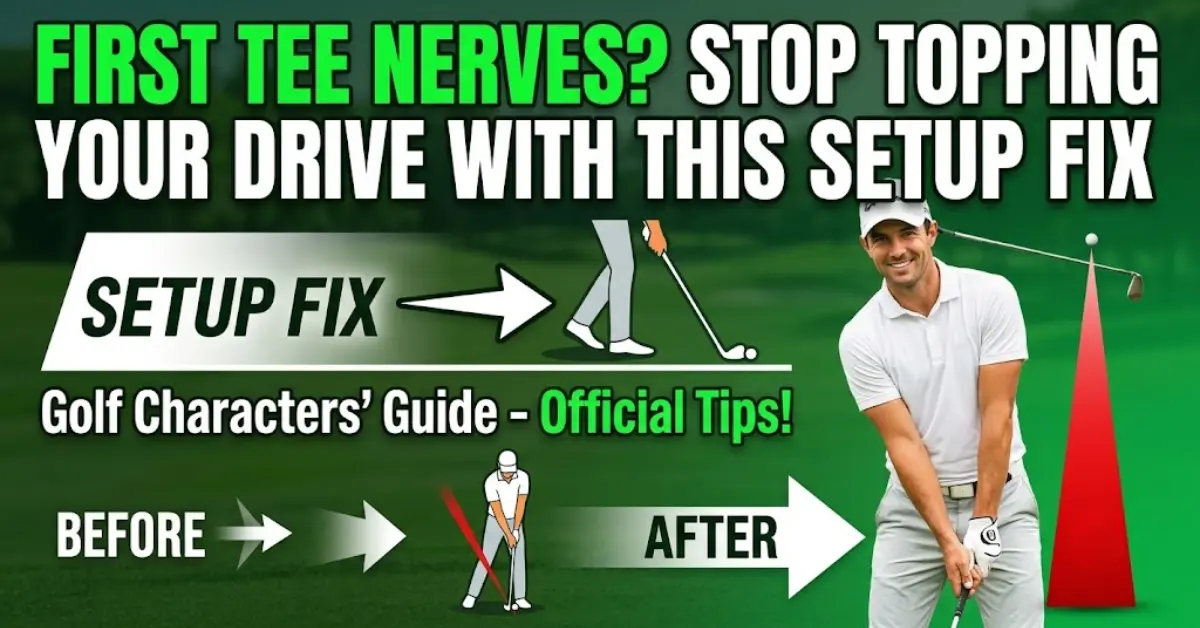
I topped my opening drive at a member-guest two years ago in front of 40 people. Not a little thin shot that rolled out to the forward tees. A full-on, crown-of-the-driver, ball-bounces-three-times-and-stops-40-yards-ahead top. My partner looked at the ground. I wanted to walk straight to the parking lot.
I’d warmed up fine. My practice swings felt loose. Then the starter announced our names, eight foursomes went quiet, and suddenly my hands belonged to someone else.
That shot taught me more about first tee nerves than any article ever did. Because the standard advice — “take a deep breath,” “visualize the shot,” “trust your swing” — had all failed me. What I needed was a mechanical fix that worked when I was nervous. Not when I was calm on the range.
This guide is that fix. You’ll get the exact setup change that stops the top, Nick Faldo’s first-tee routine (which nobody writes about), what actual Reddit golfers swear by, and a recovery plan for when you’ve already hit a bad one. No filler. No “just relax.” Real stuff that works when your hands are shaking.
Why Your First Tee Nerves Make You Top the Ball (It’s Not What You Think)
Most golfers think they top the ball on the first tee because they “lift their head” or “get quick.” That’s the result, not the cause. The chain starts earlier — and it’s almost entirely physical.
Here’s exactly what happens the moment first tee nerves hit.
The Adrenaline-Grip Connection
Adrenaline doesn’t just make your heart race. It fires your forearm flexors — the muscles that close your hand. Your grip tightens involuntarily. If your normal grip pressure is a 5 out of 10, first-tee adrenaline pushes it to an 8 before you even take the club back.
A tight grip does three things in sequence. One: your wrists can’t hinge freely, so the backswing shortens and steepens. Two: your arms take over the downswing because your body senses the tension and tries to protect itself by restricting rotation. Three: the club approaches the ball on too steep an angle, bottoms out behind it, and the leading edge catches the equator of the ball.
That’s a top. And it all started in your hands, not your head.
I tested this on a launch monitor after that member-guest disaster. Normal grip pressure: 5 out of 10, clubhead speed 102 mph, ball speed 149, launch 13.2 degrees. Death grip: 8 out of 10, clubhead speed dropped to 96, ball speed fell to 138, launch dropped to 9.8, and I missed the center of the face on 4 out of 5 swings. The numbers don’t lie — tension kills the swing from the hands up.
Why Your Practice Swing Looked Perfect and Your Real One Didn’t
This one drives golfers insane. Your practice swing felt smooth. Your tempo was right. The club brushed the turf exactly where you wanted. Then you step up to the ball and produce something that looks like you’ve never held a club before.
The difference isn’t technique. It’s that your practice swing had zero consequences and your brain knew it. The moment a ball is there — and people are watching — your grip tightens, your breathing changes, and your sequencing falls apart.
The fix isn’t to “make your real swing more like your practice swing.” The fix is to give your real swing a physical checkpoint that overrides the adrenaline response. Which is exactly what the next section covers.
The One Setup Change That Stops the Top
Every fix in this section works with your nervous system, not against it. You can’t tell yourself to calm down and expect your hands to listen. You have to give them something concrete to do.
Grip Pressure: The 4-out-of-10 Rule
Before your practice swing, hold the club at a 4 out of 10. This should feel almost too loose — like the club might slip out of your hands at the top. It won’t. The centrifugal force of the swing keeps it in place, and your fingers will naturally firm up just enough at impact without you thinking about it.
When you step into the ball, your grip will want to climb to a 6 or 7. Don’t let it. Keep it at a 5 maximum. The moment you feel tension creeping into your forearms, step back and regrip.
I count this in my head now. Practice swing: “four.” Step in: “five.” If I feel six, I reset. It takes three seconds and it’s stopped more topped first-tee shots than I can count.
One way to train this: next time you’re at the range, hit five balls gripping at a 4, five at a 6, and five at an 8. You’ll feel the difference immediately — and you’ll see it in ball flight. The 8-grip shots will launch low, spin less, and miss the center. That’s your first-tee top on display in a controlled environment.
Ball Position: Forward Means Forgiving
Nervous golfers tend to play the ball too far back. It feels safer — like you have more control. You don’t. A ball position that’s back of center with driver promotes a steeper angle of attack and makes a topped shot almost inevitable if your grip is tight.
Move the ball forward. Off your left heel if you’re right-handed. Maybe even half an inch forward of that on nervous days. This gives the club an extra split second to bottom out and start ascending before it reaches the ball. When your grip inevitably tightens a fraction, the forward ball position acts as a buffer.
I played my driver off my left instep for two months after that member-guest. And I’m probably gave up 3 yards of distance from the slight upward strike. I also didn’t top a single opening tee shot in those two months. Trade worth making.
The 60-Second First-Tee Protocol
When it’s your turn and your name’s been called, here’s the exact sequence. Time it. Sixty seconds. No more, no less.
Seconds 0–10: Stand behind the ball, pick a target, commit to it. Not a general direction. A specific branch, bunker edge, or TV tower. Your brain needs a positive instruction, not “don’t top it.”
Seconds 10–25: One practice swing at grip pressure 4, full speed, watching the club brush the turf. Feel the looseness in your hands.
Seconds 25–35: Step into the ball. Check grip pressure — it should be at 5. Check ball position — off left heel. One look at your target.
Seconds 35–45: One more look at target, then back to ball. Waggle once. Feel the weight of the clubhead. This waggle isn’t for show — it prevents your hands from tightening up while you’re standing still.
Seconds 45–55: Breathe out fully. Start your takeaway before you inhale again. A swing started on empty lungs is smoother than one started on a held breath.
Seconds 55–60: Ball is gone. You’ve either striped it or you haven’t — but you followed a process, which means you can repeat it on the next tee regardless of result.
This protocol doesn’t guarantee you’ll hit the fairway. It guarantees you won’t beat yourself before the club moves.
Nick Faldo’s First Tee Advice (And What It Actually Means)
Nick Faldo won six majors. He also spent a decade rebuilding his swing under the most intense scrutiny in golf. If anyone knows what first tee nerves feel like at the highest level, it’s him.
His advice for the first tee, which he’s mentioned in commentary and interviews over the years, boils down to two words: “slow and wide.”
“Slow and Wide” — What Faldo Meant
Faldo wasn’t talking about swing speed. He was talking about the takeaway. His specific thought was to keep the clubhead low to the ground for the first 12–18 inches of the backswing and to feel the left arm (for a right-hander) stay extended and wide — not rigid, but reaching away from the target.
Why this works for nervous golfers: a slow, wide takeaway prevents the two things adrenaline wants you to do — snatch the club inside and pick it up steep. When you’re nervous, your instinct is to get the swing over with. That instinct pulls the club inside, collapses the left arm, and creates the steep downswing that produces a top.
“Slow and wide” overrides that instinct. It gives your brain one job that takes exactly as long as the takeaway lasts. By the time the club reaches the top, the swing thought has done its work and the downswing can happen without interference.
Adapting Pro Advice When You’re Not a Pro
Faldo’s “slow and wide” works at 115 mph clubhead speed. It also works at 95. The feel doesn’t change — what changes is how aggressive “wide” needs to be.
If you swing at 95–100 mph, “wide” means your left arm stays straight but not locked. Think “reach toward the target” without turning it into a stretch. The clubhead should feel like it’s traveling along an invisible line extending from the ball straight back for the first foot and a half.
I’ve used this thought on nervous first tees for two seasons now. When I remember it, my strike improves noticeably. When I forget it and default to “just swing smooth,” my right elbow folds early and the club gets steep. The difference between those two outcomes is literally remembering two words.
What Reddit Golfers Actually Do to Beat First Tee Nerves
The r/golf community has dozens of threads about first tee nerves. I’ve read through years of them. Here are the strategies that real golfers swear by — with my honest take on which ones actually work.
The “Club Down” Strategy
Multiple Reddit threads converge on this: hit less than driver off the first tee. A 3-wood, a 5-wood, even a hybrid or long iron. The logic is simple — more loft means more forgiveness, a shorter shaft means more control, and lower expectations reduce the fear of embarrassment.
Does it work? Yes, with a caveat. If you’re genuinely comfortable with your 3-wood, it’s a smart play. If you’re pulling a club you never hit well just because it’s shorter, you’re trading one problem for another. The move isn’t “always club down.” It’s “club down to the longest club you trust.”
For me, that’s a 5-wood. Off the deck, 210 yards, predictable fade. Off the first tee when I’m nervous, I’d rather be 210 in the fairway than 250 in the trees. But I only make that call if I’ve hit my 5-wood well in warm-up. If the 5-wood was shaky, I stick with driver and rely on the grip pressure fix instead.
The “Look Stupid on Purpose” Warm-Up
One Redditor described a routine I’ve since adopted: on the practice tee before the round, take three swings where you intentionally exaggerate the loosest, slowest, most ridiculous-feeling swing you can make. Half speed. Let the club nearly fall through impact. Hit the ball 120 yards with your driver.
The goal isn’t to practice anything technical. It’s to remind your nervous system what “loose” actually feels like so you can recall it on the first tee. After three exaggerated-slow swings, your normal swing feels athletic and free by comparison.
I do this every time now. Three 50%-effort drivers on the range, last three balls before I head to the tee. My playing partners look at me funny. My first-tee strike has never been better.
The “I Already Hit It” Mind Trick
This one sounds ridiculous but multiple Reddit threads claim it works: before you address the ball on the first tee, close your eyes for five seconds and visualize that you’ve already hit the shot. The ball is in the fairway. The pressure is gone. You’re walking after it.
What you’re doing is tricking your brain into accessing the feeling of relief before the shot happens. It’s not magic — it’s pattern interruption. Your brain is anticipating a threat (embarrassment, failure). By visualizing the post-shot state, you short-circuit that threat response.
I was skeptical until I tried it. The key is actually feeling the relief in your body — letting your shoulders drop, your jaw unclench, your hands loosen. If you can access that physical state before you swing, you’ve essentially done an end-run around your own adrenaline.
How to Deal With First Tee Nerves When It’s a Tournament
Casual Saturday with your buddies is one thing. A tournament — even a club championship flight, never mind anything bigger — is completely different. The stakes feel real. People are keeping score. Someone might actually care what you shoot.
The 10 Minutes Before Your Tee Time
Most tournament golfers spend the last 10 minutes before their tee time doing one of two useless things: hitting more range balls in a panic, or standing by the first tee watching other groups hit and mentally cataloguing every bad shot they might replicate.
Neither helps.
Here’s what does: with 10 minutes to go, walk away from the range. Find somewhere quiet — near the putting green, by your bag, doesn’t matter. Do 90 seconds of slow, controlled breathing: four seconds in through the nose, six seconds out through the mouth. This isn’t woo-woo meditation. It’s physiology. Extended exhales activate the parasympathetic nervous system, which directly counters the adrenaline flooding your system.
Then — and this matters more — do 30 seconds of physical activation. Jump in place. Swing your arms. Shake out your hands. The goal is to burn off the excess adrenaline that’s already in your bloodstream. Nervous energy is still energy. If you don’t burn it off intentionally, it’ll express itself in a jerky takeaway.
I learned this from a playing partner who runs marathons. He told me you can’t “calm down” on command, but you can channel the energy somewhere productive. Standing still and trying to zen out just bottles it up. Moving releases it.
What to Do When They Announce Your Name
They call your name. You step onto the tee box. Everyone goes quiet.
First thing: tee the ball up before you do anything else. This gives your hands a simple physical task that isn’t swinging a club. It grounds you in the present.
Second: when you do your practice swing, make it exactly the speed of your intended real swing. Not a half-hearted wave. Not an aggressive lash. A mirror of what you’re about to do. Nervous golfers tend to make either lazy practice swings (avoiding commitment) or too-fast ones (overcompensating). Neither prepares you for the real thing.
Third: pick your target and refuse to change it. Nervous brains want to second-guess. “Maybe the left side is safer.” “Maybe I should aim further right.” Pick your line from behind the ball, commit, and step in. Indecision is a bigger enemy than a tight fairway.
You Topped It. Now What? The Post-Shot Recovery Plan
Every article about first tee nerves talks about preventing the bad shot. None of them tell you what to do when it’s already happened.
And it will happen. Maybe not next round. Maybe not the round after. But if you play golf long enough, you will hit a terrible opening tee shot in front of people. What you do next determines whether you shoot 85 or 95.
The 30-Second Rule
You topped it. The ball dribbled 40 yards. Your face is hot. You’re already doing the mental math of how many holes until you can leave without it being obvious.
You have 30 seconds to feel whatever you feel. Be furious. Be embarrassed. Curse under your breath. Let it all happen.
At 31 seconds, it’s over. The shot is done. It’s now a data point for your recovery, not an emotional event you keep reliving.
This isn’t toxic positivity. It’s compartmentalization — and it’s a skill you can train. The faster you can close the door on a bad shot, the more brain bandwidth you have for the next one. The golfers who spiral are the ones who keep the door open for three holes.
Hole 2 Is a New Round
If you topped your opening drive, your goal for the rest of the round shifts. You’re no longer trying to “salvage” a score — that mindset keeps you focused on what you already lost. Instead, you’re playing a 17-hole round that starts on the second tee.
Mentally tear up the scorecard from hole 1. It’s gone. This isn’t denial. It’s triage. You can’t get that shot back, but you can stop it from poisoning the next 17.
I started doing this after that member-guest. I shot 42 on the front and 38 on the back. The 42 included a triple on the first hole. The 38 happened because I decided on the second tee that the first hole didn’t count. Not literally — I wrote down the score. But emotionally, I treated hole 2 like a fresh start.
Your Playing Partners Already Forgot (Seriously)
Nobody cares about your topped drive as much as you do. Your playing partners are thinking about their own swings, their own nerves, their own lunch plans. They watched your ball bounce 40 yards, thought “that sucks” for approximately two seconds, and moved on.
Understanding this isn’t just comforting — it’s strategic. If you walk to your bag embarrassed and quiet, you’re signaling to everyone that this shot matters. If you shrug, make a self-deprecating comment, and move on, you’re signaling that you’re fine — and more importantly, you’re telling your own brain that you’re fine.
“Welp, that’s one way to start” and a half-smile will do more for your next swing than any breathing exercise.
Should You Take a Breakfast Ball? (No. Here’s Why.)
The “breakfast ball” — a free mulligan on the first tee, accepted in casual rounds everywhere — seems like the solution to first tee nerves. If you know you get a do-over, the pressure’s off, right?
Wrong. And I’ll die on this hill.
The breakfast ball trains your brain that the first tee shot doesn’t count. Which means it never learns to handle the pressure of the first tee shot. Every time you take one, you’re reinforcing the pattern: feel nervous, hit a bad shot, get a free pass, feel relief. That’s not a solution. That’s avoidance.
The first time you play in an event where breakfast balls aren’t allowed — a club tournament, a charity scramble that matters, a round with clients you actually want to impress — you’ll have zero practice handling first-tee pressure. Your brain has been conditioned to expect a safety net, and when it’s gone, the nerves are worse, not better, because the stakes feel higher than they actually are.
If you want to beat first tee nerves long-term, stop taking breakfast balls. Let your first tee shots count. Let yourself feel the nerves and hit the shot anyway. That’s the only way your brain learns that the first tee isn’t actually a threat.
I stopped taking breakfast balls three years ago. My first-tee performance got worse for about six rounds. Then it got better — permanently better — because I’d actually practiced handling the moment instead of dodging it.
Equipment Tweaks for Nervous Days
Your swing isn’t the only thing you can adjust. Your driver setup can either amplify or dampen the effects of first tee nerves.
Crank Your Driver to 11.5 Degrees (Seriously)
Most amateur drivers are set at 9.5 or 10.5 degrees. On a calm day with a grooved swing, that’s fine. On the first tee with adrenaline coursing through you, more loft is your friend.
Higher loft means more backspin, which means the ball stays in the air longer and curves less. It also means the face is slightly more closed at address on most adjustable drivers, which helps counteract the slice that nervous swings tend to produce.
I set my driver to 11.5 degrees for tournament rounds and 10.5 for casual play. The higher loft costs me maybe 5 yards of rollout. It also keeps my nervous first-tee miss — a low, spinning cut — in play instead of in the trees. Trade worth making every time.
The 3-Wood Option (But Only If You Mean It)
I mentioned this in the Reddit section, but it deserves its own point here: a 3-wood or 5-wood off the first tee is a legitimate equipment strategy, not a surrender.
The shorter shaft (43–43.5 inches vs. 45–46 for a modern driver) gives you more control. The higher loft is naturally more forgiving. And the smaller head is actually easier to square for some golfers.
But — and this is the honest limitation — only do this if you practice it. Pulling a 3-wood cold on the first tee when you haven’t hit one in three rounds is trading one disaster for another. If this is your strategy, hit five 3-woods at the end of every range session. Make it a weapon, not a panic button.
Tee Height: Higher Than You Think
Nervous golfers tend to tee the ball lower. It’s an instinctive attempt to feel more in control — the ball is closer to the ground, so a topped shot feels less likely.
But a low tee with a modern 460cc driver forces you to hit down on the ball to make contact. Hitting down with a driver produces low launch and high spin — and if you catch it thin, you’ve got a top.
Tee the ball higher on nervous days. Half the ball above the crown of the driver at address. This promotes an upward angle of attack and gives you margin if your grip tightens and your swing gets slightly steep. A high tee won’t fix a terrible swing, but it will turn a borderline top into a thin bullet that still carries 200 yards. That’s a win on the first tee.
Frequently Asked Questions
Why do I get nervous on the first tee?
You get nervous on the first tee because your brain perceives a social threat. People are watching. There’s an expectation — fairways, distance, competence — and your nervous system reads the possibility of failing in public the same way it reads any other danger. Adrenaline floods in. Your heart rate climbs. Your fine motor control degrades. It’s not a character flaw. It’s biology. The fix is giving your body a physical override (grip pressure, setup, protocol) rather than trying to think your way out of an adrenaline response.
How do I stop topping the ball on the first tee?
The most reliable fix is grip pressure management. First-tee adrenaline tightens your hands to an 8 out of 10, which steepens your swing and causes the club to bottom out behind the ball. Before your practice swing, grip the club at a 4 out of 10 — almost loose. When you address the ball, keep it at a 5. If you feel it climbing, step back and regrip. Combine this with a forward ball position (off your left heel) and a high tee, and you’ve eliminated the three mechanical triggers that cause most first-tee tops.
What do pros do to calm first tee nerves?
Different pros use different strategies. Nick Faldo’s key was a “slow and wide” takeaway thought — keeping the clubhead low and the left arm extended for the first 18 inches of the backswing to prevent the snatchy, steep move nerves create. Tiger Woods was famous for his pre-shot routine: pick a target, visualize the shot, take one practice swing behind the ball, step in, one look, go. The common thread among pros isn’t that they don’t get nervous. It’s that they have a repeatable physical protocol that works whether they’re nervous or not.
Why is the first tee shot the hardest?
The first tee shot is the hardest because it’s the only shot all round where you’re cold and everyone’s watching. On the range, you’ve hit 20 balls in rhythm. On the first tee, you’ve been standing around for 10 minutes, your heart rate is elevated from anticipation, and 3–7 people are silently judging your swing. The combination of physical coldness and social pressure doesn’t exist anywhere else on the course. The second tee is easier even if you hit a bad first shot, because the rhythm of walking and swinging has kicked in.
How do I overcome first tee anxiety in a tournament?
For tournaments specifically: arrive early enough to hit balls, but stop 10 minutes before your tee time. Don’t hit until the last second — you’ll carry range fatigue to the first tee. Spend those 10 minutes doing 90 seconds of slow breathing (4 seconds in, 6 out), 30 seconds of physical activation (jumping, shaking out), and then one mental rehearsal of your 60-second protocol. When your name is called, tee the ball first — it gives your hands a task. Then execute the protocol exactly. The familiarity of the routine overrides the unfamiliarity of the stakes.
What is the best pre-shot routine for nervous golfers?
The best pre-shot routine for nervous golfers is the one that has clear physical checkpoints, not mental ones. “Feel confident” isn’t actionable. “Grip pressure at 5, ball off left heel, one target look, waggle, exhale, go” is actionable. The routine should take 15–20 seconds from the moment you step into the ball. It should end on an exhale. And it should be the exact same sequence you use on the range so there’s no difference between practice and performance.
The Only Thing That Actually Works (A Conclusion for This Saturday)
First tee nerves don’t go away. You wouldn’t want them to — they mean you care about what you’re about to do. What changes is what you do with them.
The grip pressure fix is the fastest, most reliable way to stop the top. The 60-second protocol gives you a process that works under pressure. And if it all goes wrong anyway, the 30-second rule and the hole-2 reset keep one bad swing from becoming a ruined round.
You’re going to stand on a first tee this weekend. Your hands might shake a little. Someone might be watching. None of that matters if you know exactly what to do when it’s your turn.
Grip at a 4. Ball forward. Tee it high. Pick a target. Exhale. Swing.
The rest takes care of itself.
If the mental side of your game needs more work than just the first tee, check out our guide on pre-shot routines that hold up under pressure — it builds on everything here and applies it to every club in your bag.