
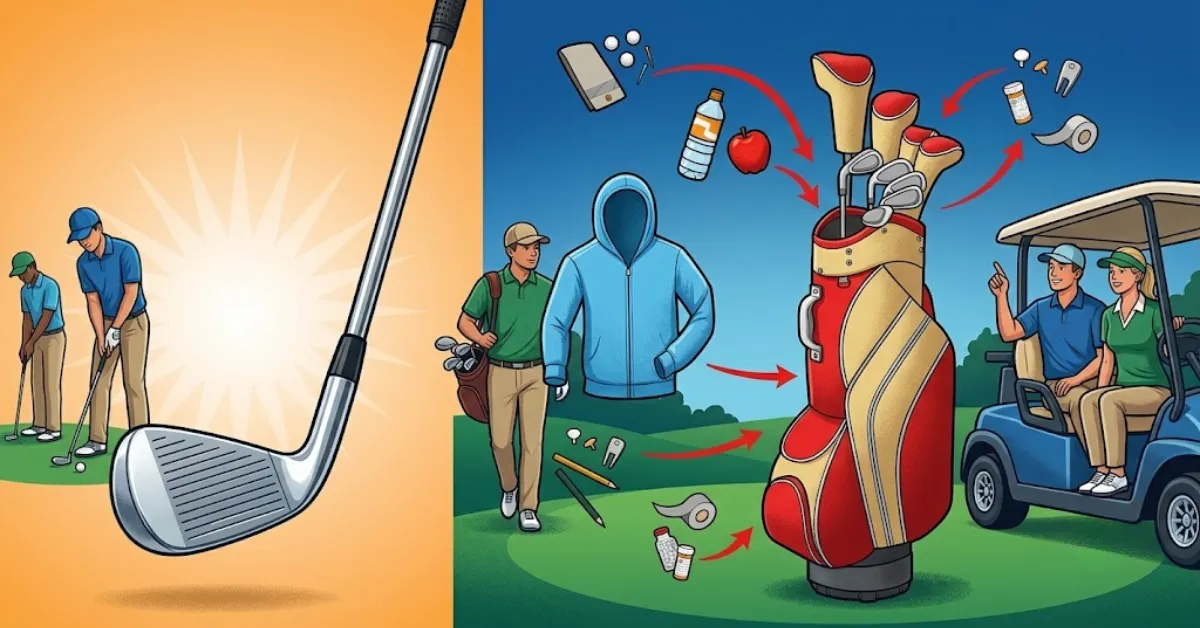
Here is what nobody tells you when you are standing in a golf store for the first time: the sheer number of options is a marketing problem, not an equipment problem. I have played to a 14 handicap for years and watched a dozen friends buy clubs they will never use because they walked into a shop without a plan. The driver that launched 280 yards at the demo day. The iron set that looked good on Instagram. The putter that felt great for five minutes in the carpet display.
This guide exists to give you that plan. Whether you are buying your first set, buying for someone else, or trying to figure out if it’s finally time to upgrade, here is exactly how to do it.
Quick Answer: Beginners should start with a complete 9–11 club set including a driver, fairway wood or hybrid, 6-through-9 irons, a pitching wedge, and a putter. Budget $200–$400 to try the game or $400–$800 for a set worth keeping for 2–3 seasons. Skip a fitting for your first purchase – it adds cost before you know your swing.
Start Here – What Most Beginners Get Wrong
Most beginners spend too much, too soon, on the wrong things.
A driver is not the first problem to solve. Neither is finding the “perfect” iron set. The first problem is getting a collection of clubs that are forgiving enough to learn on, matched to your height and swing speed, and priced at a level that doesn’t sting if you decide golf isn’t your game six months from now.
Here’s the honest truth: if you’ve never played before, you don’t need 14 clubs. You don’t need to get fitted. You don’t need to spend $800. And you need 9–11 forgiving clubs, properly sized for your body, bought for a price that reflects your actual commitment level – not the commitment level you hope to have.
That’s what this guide is built around.
How Many Golf Clubs Do You Actually Need as a Beginner?
The USGA allows 14 clubs in your bag for any official round of golf. Most tour players carry exactly 14. Most beginners should carry about 9.
That’s not a shortcut – it’s the smarter approach. Fewer clubs means fewer wrong decisions mid-round. A beginner carrying a full set will regularly pull out the wrong club for the situation, not because they lack skill, but because they haven’t logged enough rounds to know what their 4-iron even does.
A solid 9-club starter bag looks like this:
- Driver – your tee shot on par-4s and par-5s
- 5-wood or hybrid – off the fairway when you need distance
- 6-iron – the bridge between your long clubs and your scoring clubs
- 7-iron
- 8-iron
- 9-iron
- Pitching wedge – approaches inside 120 yards
- Sand wedge – bunkers and tight short-game shots
- Putter
What you’re leaving out: 3-iron, 4-iron, 5-iron, and a 3-wood off the deck. Beginners almost never generate the swing speed needed to hit low-number irons consistently. A 3-iron requires a swing speed over 90 mph just to get the ball airborne reliably. Most new players swing between 65 and 80 mph with their irons. Skip them. You won’t miss them until you don’t need them.
Many complete beginner sets – what retailers call “half sets” or “starter sets” – come configured exactly this way. That’s not a limitation. It’s the right starting point.
The 5 Types of Golf Clubs – What Each One Does
You don’t need a PhD in golf equipment to buy clubs. You need to know what five categories of club exist and which situations each covers.
Drivers do one job: launch the ball as far as possible off the tee. Every driver legally sold has a maximum head size of 460cc. Bigger heads forgive mishits better. If you’re a beginner buying a driver, the number on the loft (10.5° is the most common for beginners) matters more than the brand.
Fairway woods are the clubs you use when you need serious distance but you’re not on a tee. A 3-wood has around 15° of loft and goes almost as far as a driver. A 5-wood (18–19°) is easier to hit and goes a bit shorter. Beginners often struggle with the 3-wood because it requires a nearly flat angle of attack – most beginners are better off with a 5-wood or a hybrid instead.
Hybrids are the best thing to happen to beginner golf in 30 years. They combine the distance of a fairway wood with the shape and swing-feel of an iron. A 4-hybrid or 5-hybrid replaces the 4-iron and 5-iron, which are the hardest clubs in the bag to hit consistently. Any complete beginner set worth its price includes at least one hybrid. These also make excellent candidates if you’re looking at higher-lofted fairway woods for the gap between your 5-wood and long irons.
Irons run from 1 to 9, plus wedges. Beginners should start at the 6-iron and work downward as they improve. Cavity-back irons – the ones with a scooped-out back – distribute weight around the perimeter of the club face, which massively increases forgiveness on off-center hits. Avoid blade irons until you can break 85 consistently.
Wedges are short-game specialists. Your pitching wedge (PW, ~46°) handles approach shots from 80–125 yards. Your sand wedge (SW, ~54–56°) gets you out of bunkers and handles tight chipping situations around the green. Many beginners later add a gap wedge (GW, ~50–52°) once they notice a big yardage hole between their PW and SW.
Putters are used on the green to roll the ball into the hole. The style – blade vs. mallet – matters less for beginners than most people think. Pick one that aims straight when you look down at it.
How to Choose the Right Size Golf Clubs for Your Height
This is the most consistently skipped advice in beginner golf, and it’s one of the most important decisions you’ll make. Clubs that are too long cause you to stand too upright and hit the ball off the toe. Clubs that are too short force you to hunch over and produce fat shots. Either way, you’re developing bad habits from day one.
Most standard club sets are built for someone between 5’7″ and 6’0″. If you fall outside that range, you need to actively seek the right length.
Here are the general guidelines:
| Your Height | Club Length Adjustment |
|---|---|
| Under 5’0″ | Minus 2 inches |
| 5’0″–5’3″ | Minus 1.5 inches |
| 5’3″–5’6″ | Minus 1 inch |
| 5’6″–5’9″ | Minus 0.5 inches |
| 5’9″–6’0″ | Standard length |
| 6’0″–6’3″ | Plus 0.5 inches |
| 6’3″–6’6″ | Plus 1 inch |
| Over 6’6″ | Plus 1.5 inches |
Women’s clubs are traditionally built 1 inch shorter than men’s clubs. If a sizing chart suggests a man needs standard length, a woman at that same height would also use standard women’s length – which is already 1 inch shorter.
Many complete beginner sets now offer size variants: short, standard, and tall. Wilson’s Profile SGI – one of the strongest entry-level sets of 2026 – offers four specific sizes based on height, which is rare at any price point. If you’re on the edge of a size, go with the shorter option. Longer clubs are harder to control, and control is what beginners actually need.
Shaft flex matters too. Shaft flex refers to how much the shaft bends during your swing. For beginners, “Regular” flex works for most men with an average swing speed. “Ladies” or “Light” (Senior) flex suits slower swing speeds – typically women and older players. “Stiff” flex is for faster swingers (over 90 mph with the driver) and almost no beginner should start there.
New vs. Used Golf Clubs – What 2026 Prices Actually Look Like
The second-hand market is the worst-kept secret in golf. You don’t need to spend $800 on a brand-new complete set to get quality clubs. A used set from two or three generations ago plays nearly identically to today’s equivalent — because club technology has plateaued at the top end, and beginner-level technology hasn’t meaningfully changed in a decade.
Here’s what 2026 actually looks like across three budget tiers:
| Budget Tier | Price Range | What You Get | Best For |
|---|---|---|---|
| Entry level | $200–$400 | 9–12 club complete set, graphite shafts, stand bag included. Sets like Callaway Strata (~$250–$300) or Aspire XD1 (~$269) | Trying the game, occasional play |
| Mid-range | $400–$800 | 10–14 clubs, better shaft quality, size-fitting options. Cobra Fly XL (~$400–$500), Wilson Profile SGI (~$400–$450), TaylorMade RBZ SpeedLite (~$500–$600) | Regular players who want to improve |
| Premium | $800–$1,400 | Full 13–14 club sets from top brands with premium forgiveness tech. Callaway XR 13-piece (~$900), STIX custom sets (~$900–$1,100) | Committed golfers who know they’ll stick with it |
For the used market, GlobalGolf, Callaway Pre-Owned, and eBay all have legitimate graded used clubs. A 2-year-old set in “Good” condition typically sells for 40–60% of original retail. A Cobra Fly XL that retailed at $450 new costs roughly $200–$250 used in solid condition. That’s the same forgiving technology for half the price.
One important rule for buying used: check the grooves on the wedges. Run your finger along them – they should feel sharp and defined. Worn-down grooves produce inconsistent spin and are the single biggest reason to buy a wedge new even when buying everything else used.
Should a Beginner Get a Club Fitting?
Every article in this space says: yes, always get fitted.
The reality is more honest than that.
Get a fitting if: you’re spending over $500 on clubs, you’ve played at least one full season and have consistent swing tendencies, or you’re an unusually tall or short person where off-the-rack specs are clearly wrong for you.
Skip the fitting if: you’ve never played before and you’re buying a complete set under $400. A fitting costs $0–$150 for a basic session at a Golf Galaxy, PGA Superstore, or local course pro shop. When you don’t yet have a repeatable swing, the data from a launch monitor session has real limitations – your swing will change dramatically in the first 20 rounds, so any specifications derived from today’s swing may not hold six months from now.
GolfWRX’s advice to get fitted before spending anything is excellent for experienced golfers upgrading their bag. For a true beginner? Buy a forgiving complete set at the right length for your height, play 10–15 rounds, and then get fitted. By that point, you’ll have consistent miss patterns, a fitter will have real data to work with, and any money you spend on the fitting will actually produce meaningful results.
The one exception: grip size. Ask any pro shop to check your grip size when you buy. An incorrectly sized grip produces a closed or open face at impact. It takes about two minutes to check and costs nothing if you’re buying clubs at the same shop.
How to Buy Golf Clubs Online Without Getting Burned
Buying clubs online saves money – but only if you know the five things to check before clicking buy.
1. Confirm handedness. Right-handed and left-handed clubs are not interchangeable. The photos on listing pages often show the same club from the same angle regardless of handedness. Read the title carefully.
2. Check shaft flex. “Stiff” shafts in a beginner set are almost always wrong for a beginner. Search the product specifications for “flex” and verify it matches your swing speed. Regular and Ladies/Senior flex work for most beginners.
3. Read the return policy before you buy. Most reputable online retailers – Golf Galaxy, Global Golf, Rock Bottom Golf -offer returns within 30–45 days. Marketplaces like eBay and Facebook Marketplace are all-sales-final. Know which world you’re entering.
4. For used clubs, understand the condition grading system. Most sites use: Like New / Excellent / Good / Fair / Poor. “Good” is fine for irons but avoid “Fair” or lower for drivers (face cracks are common and invisible in photos). Buy used irons and woods from “Excellent” or better condition when possible.
5. Check loft gapping if you’re building piece by piece. If you’re buying clubs individually – say, a driver from one listing and an iron set from another – make sure the lofts create even distance gaps. A 5-wood at 18° and a 5-hybrid at 27° gives you a usable 9° gap. A 5-wood at 18° and a 4-iron at 24° gives you a 6° gap with a club most beginners can’t hit — that’s a bag setup that hurts you.
How to Buy Golf Clubs as a Gift
This is the most overlooked scenario in every buying guide, and it’s genuinely one of the hardest purchases to get right.
The problem: clubs require handedness, height, gender, and approximate swing speed information to buy correctly. Get any one of those wrong and you’ve bought a gift that collects dust.
The honest recommendation: buy a gift card to a golf retailer, not a specific club. A $300 gift card to Golf Galaxy, PGA Superstore, or Global Golf lets the recipient get fitted on the spot, choose the right hand orientation, and pick up a set with someone helping them in real time. That experience is genuinely better than any club you’d pick off a list.
If you’re set on buying actual clubs: ask about their dominant hand (right or left), confirm whether they want men’s, women’s, or junior clubs, and find out their height. With those three pieces of information, you can safely pick a beginner complete set. The Callaway Strata 12-piece is consistently the safest all-around gift at ~$250 – it’s widely stocked, easy to return, includes a bag, and covers all the basics for someone just starting out.
Never buy individual clubs as a gift unless the recipient has specifically asked for that exact club with that exact shaft spec. The variables are too significant to guess right.
How to Know When It’s Time to Upgrade Your Golf Clubs
Your first set won’t be your last. That’s fine – it’s how the game works. But knowing when to upgrade is just as important as knowing when to wait.
Upgrade signal #1: You’re breaking 90 consistently. Once you’re shooting in the mid-to-high 80s on a regular basis, you’ve likely hit the ceiling of what a beginner set’s forgiveness can mask. At that handicap level, you’ll start to notice that the extra distance and shot-shaping capability of a game-improvement iron set is actually usable — your strike consistency is good enough to benefit from it.
Upgrade signal #2: Your wedge grooves are worn. Wedge grooves wear out faster than any other club in the bag — typically after 60–100 rounds of regular use. Grip the shaft, look at the face of your pitching wedge and sand wedge, and run your fingertip across the grooves. Smooth grooves mean less spin. Less spin means chips that release past the hole and bunker shots that don’t stop. If your grooves feel dull, replace your wedges first before buying anything else.
Upgrade signal #3: You’ve got a specific, recurring miss you’ve identified. If you slice every driver despite instruction, a fitting can help — you may need a draw-biased head or a more flexible shaft. If your irons consistently go right, your lie angles may be off. These are cases where a fitting session fixes a real, identified problem. That’s when the $75–$150 fitting investment pays for itself immediately.
You don’t need new clubs every season. Drivers have a useful life of 5–7 years for recreational players. Irons last 10+ years if you’re not grinding on them daily. Wedges are the exception – replace those when the grooves go. Everything else upgrades when the game outgrows the equipment.
Frequently Asked Questions
Beginners should buy a complete 9–11 club set that includes a driver, a fairway wood or hybrid, irons (6 through 9), a pitching wedge, a sand wedge, and a putter. Look for cavity-back irons with a 460cc driver and at least one hybrid. A complete package set with a stand bag costs $200–$800 in 2026 and covers every shot you’ll face on the course.
Spend $200–$400 if you’re testing golf and aren’t sure you’ll continue. Spend $400–$800 if you plan to play regularly and want clubs worth keeping for 2–3 years. Avoid spending over $800 as a beginner – you won’t convert the extra technology into lower scores until your swing is consistent. The $500–$600 sweet spot delivers real forgiveness and real durability without punishing you if your habits change.
For beginners, a complete set is the right call. Individual clubs cost $100–$300 each, so building a 10-club bag individually can exceed $1,000 before you add a bag. Complete sets are loft-gapped correctly from the factory, include a bag, and reduce the risk of buying the wrong combinations. Start with a complete set, then upgrade individual clubs – the driver first, then wedges – as your game develops.
If you’ve never played before, skip the full fitting for your first set. A beginner’s swing changes dramatically over the first season, and any specifications derived today may not hold six months from now. Instead, buy a complete set at the correct length for your height (see the chart above), play 10–15 rounds, and then get fitted once your swing has settled. The one exception: grip size – any pro shop will check that for free.
Golf club size is primarily determined by your height. Golfers between 5’9″ and 6’0″ use standard-length clubs. Shorter golfers need clubs shortened by 0.5 to 2 inches; taller golfers need clubs extended by 0.5 to 1.5 inches. Women’s clubs are built 1 inch shorter than men’s as standard. Many beginner complete sets now offer specific size variants – look for brands like Wilson (Profile SGI) that explicitly offer short, standard, and tall configurations.
Nine to eleven clubs is the right range for a beginner. The USGA maximum is 14, but carrying a full bag before you know your own swing creates decisions you’re not equipped to make yet. A 9-club starter setup – driver, 5-wood or hybrid, 6-through-9 irons, pitching wedge, sand wedge, putter – covers every situation on the golf course without the confusion of choosing between eight iron options on every shot.
The Bottom Line
The best golf clubs you can buy as a beginner are the ones that match your height, fit your budget, and are forgiving enough to keep you motivated through the learning curve. That points to a complete set in the $300–$600 range, bought at the correct length for your height, with a hybrid replacing your long irons and a cavity-back iron set replacing any temptation toward blades.
Don’t overthink the brand. Callaway, Cobra, Wilson, and TaylorMade all make solid beginner complete sets — the forgiveness technology in this category is genuinely similar across the major brands at the same price point.
Start simple. Play regularly. And when you’re consistently getting the ball to the green in regulation, that’s when you’ll know both your game and your equipment, and understanding how to reach the green consistently becomes the next challenge worth chasing.