
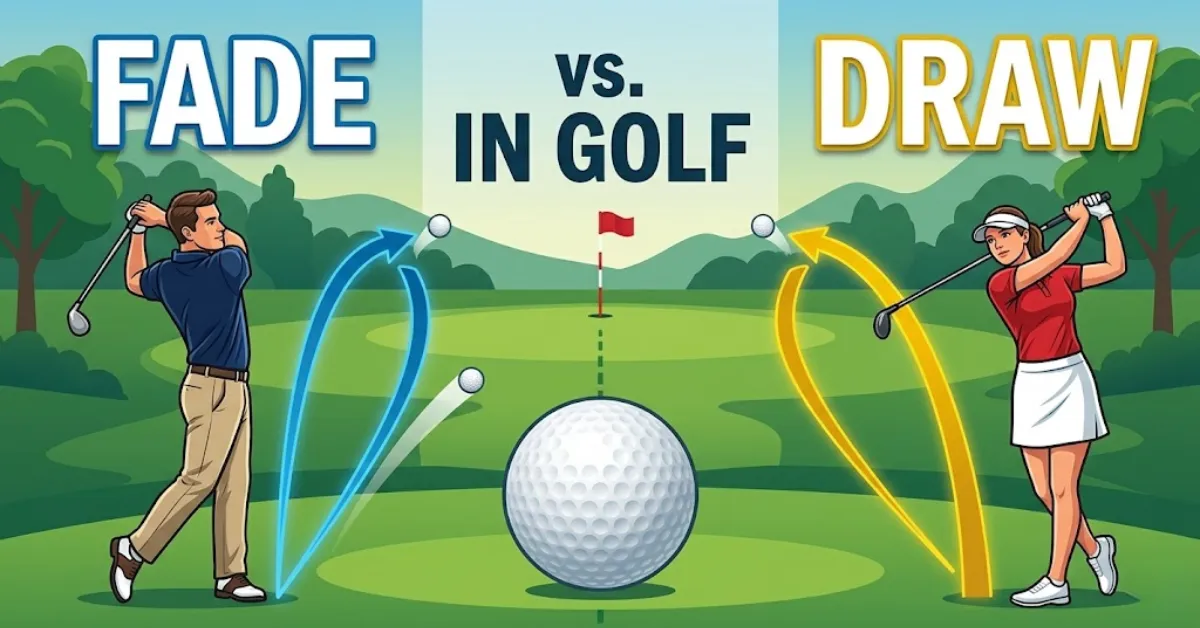
Understanding the fade vs draw in golf is one of the most important things you can learn once you can reliably hit the fairway. These two shot shapes affect your distance, direction, and how you manage a golf course — and every golfer eventually needs to choose one as their go-to flight. In this guide, you’ll learn exactly what each shot does, how to hit both, and which one actually suits your game.
What’s the Difference Between a Fade and a Draw?
When you play golf, both “draw” and “fade” shots put a little side spin on the ball. This makes the ball curve slightly to the left or right instead of going straight.
Usually, if the ball gets too much side spin, it’s a bad thing. But a little bit of curve in draw and fade shots is actually really good—sometimes even better than a straight shot!
A lot of golfers figure out from their “natural” swing if they look after to hit a draw or a fade. But some professional players are really good at shaping these shots exactly how they want them.
Now, you might be wondering: what’s the difference between a draw and a fade? It’s simple—it’s just about which way the ball curves. If you’re right-handed, a draw shot goes a little from right to left, while a fade goes from left to right. This way, you can control the shot depending on what you need.
Does that make sense? Easy to get, right? 😊
Why Shape Your Shots? Benefits of Fade and Draw
Shaping your golf shot in different ways—whether it’s from the tee box or when you’re hitting toward the green—can really help you out. Let’s explain in simple terms.
First, let’s talk about shaping a tee shot and why it’s useful.
Imagine the fairway bends to the right (in golf, they call this a “dogleg left”). In that case, a shot called a “draw” works best. With a draw, the ball curves from right to left and lands closer to the pin.
If you can’t pull off a draw and just hit it straight, that’s okay—your ball will still stay on the fairway, just a bit farther from the hole.
But if you try a “fade” here (a shot that curves left to right), your ball might curve too much and end up in trouble, like the rough or a hazard. That’s why picking the right shot shape matters a lot.
Both the draw and fade can also help you avoid things like ditches or other obstacles.
Now, let’s look at shaping a shot to reach the green.
Say the pin is on the right side of the green, a bit shallow, and there’s a big bunker in front of it.
If you hit a straight shot, you’d need to aim more toward the middle of the green to play it safe—otherwise, you might land in the bunker or overshoot the green. But if you use a fade to curve the ball toward the right, you can get closer to the pin while staying away from the danger.
Pretty smart, right?
Plus, shots like a draw or fade add more spin to the ball. That means when it lands on the green, it won’t roll too far or bounce off. This makes your shot stronger and more reliable.
So, keeping all this in mind and shaping your shots can lead to better results on the course. It’s all about picking the right move for the moment!
Fade vs Draw in Golf: Pros and Cons of Each Shot
Fade — Pros and Cons
Pros:
Cons:
Draw — Pros and Cons
Pros:
Cons:
Playing to Your Shot Shape
Hey there! So, when you’re out playing golf, you might notice that sometimes, without even trying, your ball curves a little to the left (a draw) or fades to the right (a fade) on some shots. Don’t worry—no golfer hits every shot perfectly straight. It’s just not a thing!
Between drawing and fading, most golfers tend to naturally fade the ball a bit more often. That’s pretty normal.
If your shots either go straight or curve a little one way—like a fade or draw—that’s totally fine. It can even be a good thing! You can play around your misses, whether they go a bit right or left.
For example, if you sometimes fade the ball, aim your shots so that either a straight hit or a fade sets you up for an easy next shot.
Imagine aiming for the middle of the green: if you hit it straight, you’re safely in the center. If it fades, it might even end up closer to the hole. Nice, right?
Now, if your ball keeps curving way off to the right (a slice), you might want to aim more to the left to balance it out. Same idea applies if it hooks hard to the left—aim right a bit.
Having a natural draw or fade is cool, but what you don’t want is to randomly do both. If your ball’s flying left one minute and right the next, it’s tough to pick a safe target. That’s when things get tricky.
And if you’re missing shots all over the place—slicing, hooking, or just pushing and pulling the ball all the time—don’t worry about mastering a draw or fade yet.
Work on getting more consistent first. Once you’ve got that down, you can tweak your shots however you like. Sounds good?
Let’s keep it simple and fun out there!
💡 Not yet consistent? Master a straight shot first — shot shaping only works if your fundamentals are solid.
What is a Fade in Golf?
Hey, let’s talk about a “fade” in golf—it’s a shot that curves a little from left to right in the air. This happens because of the spin you put on the ball with the club face, which is slightly open compared to the path of your swing. Pretty cool, right?
Now, here’s a key thing: even though the club face is open to the swing path, it’s not necessarily open to the target line (it might even be a tiny bit closed). If the clubface is open to the target line when you hit the ball, you’ll probably slice it instead, and that’s a whole different mess!
Does all this sound like confusing golf gibberish? No worries—I’ll break it down super simple in a sec!
Fade vs Slice — What’s the Difference?
This is the most common question beginners have, and it matters. A fade and a slice both curve left-to-right for a right-handed golfer — but the similarity ends there.
A fade is controlled and intentional. The ball curves 5–15 yards from left to right, lands predictably, and stays in play. It is caused by a slightly open clubface at impact and a swing path that moves slightly across the ball. Tour professionals hit deliberate fades all the time.
A slice is uncontrolled and unintentional. The ball curves 20–50 yards left-to-right (sometimes more), usually ending up in trouble. It is caused by a wide-open clubface combined with a steep over-the-top swing path that puts extreme sidespin on the ball. A slice is not a big fade — it is a different problem entirely.
The same distinction applies to the draw and the hook. A draw curves 5–15 yards right-to-left and is intentional. A hook curves sharply and is a miss. If you are trying to hit a draw and getting hooks, your clubface is too closed at impact.
Remember: A fade is a tool. A slice is a problem. Don’t confuse fixing your slice with learning to fade — they require different adjustments.
What Actually Makes the Ball Curve?
The old teaching said “your swing path determines which way the ball curves.” That was wrong — and modern launch monitors proved it.
Here is how ball flight actually works (called the D-Plane):
So to hit a fade: your face points slightly left of your target, and your swing path goes further left than the face. The ball starts left, then curves back right.
To hit a draw: your face points slightly right of your target, and your swing path goes further right than the face. The ball starts right, then curves back left.
This is why you can aim left, swing left, and still hit a draw if your face is more closed than your path — a confusing result that makes no sense under the old “swing path = curve” myth.
Practical takeaway: The clubface controls roughly 75–80% of the starting direction. If you want to shape shots reliably, learn to control where your face is pointing at impact — path adjustments are secondary.
How to Hit a Fade in Golf | Step-by-Step Tips for Control
Ready to try it? You don’t need a pro swing to hit a fade—just a few tweaks. Here’s the easy way:
- Aim Left: Point your feet, hips, and shoulders slightly left of your target. This sets up an “open” stance.
- Grip It Normal: No need to overthink your grip—keep it standard.
- Swing Along Your Body: Follow your stance line (left of the target) with your swing. The clubface should stay slightly open to your swing path—don’t square it up too much.
- Finish Strong: Swing through like you mean it. A weak swing kills the fade.
The ball will start left and curve right. Practice this at the range with a mid-iron (like a 7-iron) before taking it to the course. Start small—aim for a 5-10 yard fade—and build from there.
What is a Draw in Golf?
In golf, a “draw” shot happens when the ball moves a little from right to left. This happens because the clubface puts a special kind of spin on the ball.
Basically, when you hit the ball with the club slightly closed, it curves from right to left. On the other hand, a “fade” shot is the exact opposite—where the ball goes from left to right.
To keep it short:
- If you want the ball to curve right to left, go for a draw.
- If you want it to go left to right, try a fade.
Using both shots the right way can really improve your game. So, friends, which shot do you like more?
Fade vs Draw for Left-Handed Golfers
For left-handed golfers, the directions are simply reversed. What a right-hander calls a fade — a left-to-right curve — is what a left-hander calls a draw, because their swing mirrors the opposite direction. If you’re a lefty, swap all the direction references in this guide and the same principles apply.
How to Hit a Draw in Golf | Unlock Distance and Precision
The easy way to hit a draw in golf…,
First, point the face of your club toward your target (or keep it slightly open).
Next, adjust your body so it’s a little closed compared to the target—basically, your body should be aimed slightly to the right of it.
If you imagine drawing a line from your back foot to your front foot, that line would go to the left of your target.
Swing along the path of your body, but make sure the clubface is still aimed at the target when it hits the ball.
It might help if you position the ball a bit farther back between your stance—this can make things easier.
Also, when you swing, keep in mind that your body and hands should move together, almost like they’re connected. This helps the ball go in the right direction.
Take it easy, don’t stress too much, and practice a lot. The secret to getting good at golf—or anything, really—is just doing it over and over again!
Fade vs Draw in Golf: 4 Range Drills to Practice Both Shots
You do not need a lesson to start shaping shots. These four drills isolate the key variables — clubface angle and swing path — and give you immediate feedback on the range.
Drill 1 — The Alignment Stick Fade Drill
Place an alignment stick on the ground pointing 10–15 yards left of your target. Set your feet and hips along the stick, but aim your clubface at the actual target. Now make your normal swing along your body line. The outside-in path combined with the open face (relative to path) will produce a controlled fade. Start with a 7-iron and work up to your driver once the shape is consistent.
Drill 2 — The Strong Grip Draw Drill
Strengthen your grip by rotating both hands slightly clockwise on the handle (for right-handers) until you can see three knuckles on your left hand. Aim the clubface at your target and swing normally. The stronger grip makes it easier for the face to close through impact, encouraging a right-to-left draw. Use a 6 or 7-iron first. Once you’re hitting draws consistently, gradually return to a neutral grip and learn to produce the same shape through path rather than grip change.
Drill 3 — The Gate Drill for Straight Face Control
Place two tees in the ground just wider than your clubhead — one outside the ball, one inside. Practice swinging through the gate without hitting the tees. This trains you to control your swing path and prevents the extreme over-the-top move that causes slices. Once you can swing through the gate cleanly, introduce a face adjustment: open slightly for a fade, square or slightly closed for a draw.
Drill 4 — The Towel Drill for Draw Path
Place a rolled-up towel or headcover about 4 inches outside the ball and slightly behind it (in the backswing line). Your challenge is to swing without hitting the towel. To avoid it, you must approach the ball from the inside — the path that produces a draw. This drill fixes over-the-top swing paths faster than almost any other feel-based exercise. Hit 20 balls per session with this drill and check your ball flight: if you are consistently starting the ball right of target, your inside-out path is working.
Common Mistakes to Avoid When Shaping Shots
Shaping shots is fun, but it’s easy to mess up if you’re not careful. Here are the big common mistakes:
- Overdoing It: A monster curve isn’t the goal. Aim for a gentle 5-15 yard bend—anything more is tough to control.
- Bad Setup: If your stance and clubface don’t match, you’ll hit a straight shot (or worse, a slice/hook). Double-check your alignment.
- Weak Follow-Through: Stopping your swing early kills the shape. Let it rip!
- Ignoring Wind: A fade into a left-to-right breeze can turn into a ballooning slice. Adjust for conditions.
Take it slow. Hit a few buckets at the range to iron out these kinks before you bet your buddy a soda on the course.
Pro Secrets: When to Use a Fade or Draw on the Course
Wondering when to pull out these shots? Pros don’t just shape shots randomly—they pick based on the hole and situation. Here’s their playbook:
- Use a Fade When:
- The pin is on the right side of the green, and you need the ball to stop fast.
- You’re fighting a left-to-right wind (it’ll hold the line better).
- Trouble (water, bunkers) is on the left, and you want to play safe.
- Use a Draw When:
- The hole doglegs left, and you want to cut the corner.
- You need max distance off the tee (draws roll more).
- Wind’s blowing right-to-left—it’ll ride the breeze for extra carry.
Next time you’re on the course, scan the hole. Is there a hazard to avoid? A green to attack?
Scottie Scheffler — the world’s #1 ranked golfer since 2022 — plays a natural draw flight with his irons, driven by his aggressive inside-out swing path. Rory McIlroy famously rebuilt his game in 2021 and switched from a draw to a controlled fade off the tee, crediting the change with giving him more consistent driving accuracy and fewer wild misses. The takeaway: even the best players in the world commit to one primary shape and trust it under pressure. Pick yours and own it.
Fade vs Draw with Your Driver vs. Irons — Does It Matter?
With your driver, most tour players prefer a fade because it lands softer, stops faster, and is harder to turn into a snap-hook that finds the trees. The trade-off is distance — a draw typically goes 5–15 yards further off the tee.
With your irons, the gap narrows. A draw still produces slightly more distance, but a fade gives you more spin and a higher stopping point on the green — which is why pro players reaching for a back pin often shape a fade into the flag. For most amateur golfers, play the shot shape that comes most naturally to you with each club and don’t force the other one.
Fade vs Draw: Which Is Better for Most Golfers?
The honest answer is: neither is objectively better — but for most amateur golfers, a fade is the smarter starting point, and here’s why.
A fade is produced by an open clubface at impact relative to the swing path. That same open face creates more backspin, which means the ball flies higher, lands softer, and stops quicker. For golfers who already struggle with a slice, learning to control that left-to-right flight as a fade rather than a panic reaction is a game-changer. You’re not fighting your swing — you’re shaping it.
A draw, on the other hand, is produced by a closed face relative to the swing path. It flies lower, has less spin, and rolls further after landing — which is why it picks up 5–15 extra yards over a fade with the same club. The problem for higher handicappers is that a draw requires precise timing of the clubface. Get it slightly wrong and a draw becomes a hook, which is often worse than a slice.
The simple rule:
- Choose a fade if you want consistency, control off the tee, and a reliable stock shot that stops on greens.
- Choose a draw if you’re willing to practice timing, want more distance, or your course has a lot of doglegs that bend right-to-left (for right-handers).
Most tour professionals with driver in hand play a fade. Most professionals with irons in hand can hit both on demand. For amateurs, pick the shape that repeats — not the one that sounds cooler.
Fade vs Draw in Golf: Frequently Asked Questions
Neither is objectively better — it depends entirely on your natural swing and the shot in front of you. That said, most tour professionals choose a fade with their driver because it offers more control, lands softer, and produces a more manageable miss. A fade that goes a little extra left-to-right usually stays on the course. A draw that goes a little extra right-to-left becomes a hook in the rough.
If you are chasing extra distance or your course has multiple right-to-left doglegs, a draw gives you the advantage — it typically travels 5–15 yards further due to lower spin and more roll after landing. For most amateur golfers, start by mastering whichever shot comes naturally, then learn the other one once your baseline is consistent.
Scottie Scheffler, ranked world #1 since 2022, plays a natural draw with his irons. His aggressive inside-out swing path naturally promotes right-to-left ball flight, and he has built his iron game around that shape. Off the tee, Scheffler can work the ball both ways depending on the hole, but his default flight trends toward a draw. His consistent ball-striking with a draw flight is a large reason he leads the PGA Tour in Strokes Gained: Approach year after year.
Both curve left-to-right for a right-handed golfer, but the comparison ends there. A fade is controlled and intentional — it curves 5–15 yards and lands predictably in your target zone. A slice is uncontrolled and usually the result of an extreme over-the-top swing combined with a wide-open clubface at impact. The ball can curve 30–50 yards off-line and is almost always a penalty or a punch-out situation. A fade is a shot-shaping tool. A slice is a swing problem that needs fixing, not a fade you hit too hard.
With the driver, more PGA Tour professionals play a fade — it offers better driving accuracy and a softer landing on narrow fairways even at the cost of a few yards. Studies of PGA Tour TrackMan data show the average tour fade is about 2–3 yards shorter off the tee than the average draw, but misses a significantly smaller area of the fairway.
With irons, most tour professionals can hit both shapes on demand and select the shape based on pin position and green shape. Right-side pins often call for a fade; left-side pins often call for a draw. The ability to shape shots both ways on command is what separates tour professionals from amateur golfers — and it starts with mastering one shape first.
On average, a draw travels 5–15 yards further than a fade with the same club at the same swing speed. The distance gap comes from two factors: a draw has a lower spin rate (less drag, more run after landing) and a slightly flatter launch angle that keeps the ball in the air longer on a more efficient trajectory. The gap is biggest with the driver and long irons — and nearly disappears with short irons and wedges where both shots land softly anyway. If you are choosing between shot shapes purely for distance, the draw wins. If you are choosing for control, stopping power, and reliability of miss — the fade wins most debates.
Ready to Shape Shots and Lower Your Score?
The fade and the draw are not opposites — they are options. A controlled fade gives you accuracy, a soft landing, and a reliable miss. A draw gives you distance, a penetrating flight, and an advantage on right-to-left holes. Neither is always correct. Both are always useful.
Here is the simplest advice in this entire guide: pick one shape, practice it until it repeats, then add the other one. Every tour professional has a go-to flight they trust under pressure. Build yours first.
Once you have your shot shape dialed in, the next step is putting it to work on the course. Read our guide on golf course management tips to learn how to use your fade or draw strategically on every hole — not just the par 5s. And if a slice is still creeping into your game when the pressure is on, our how to stop slicing the golf ball guide walks you through the fix step by step.
What’s your natural shot shape — fade, draw, or still working it out? Drop it in the comments below.