
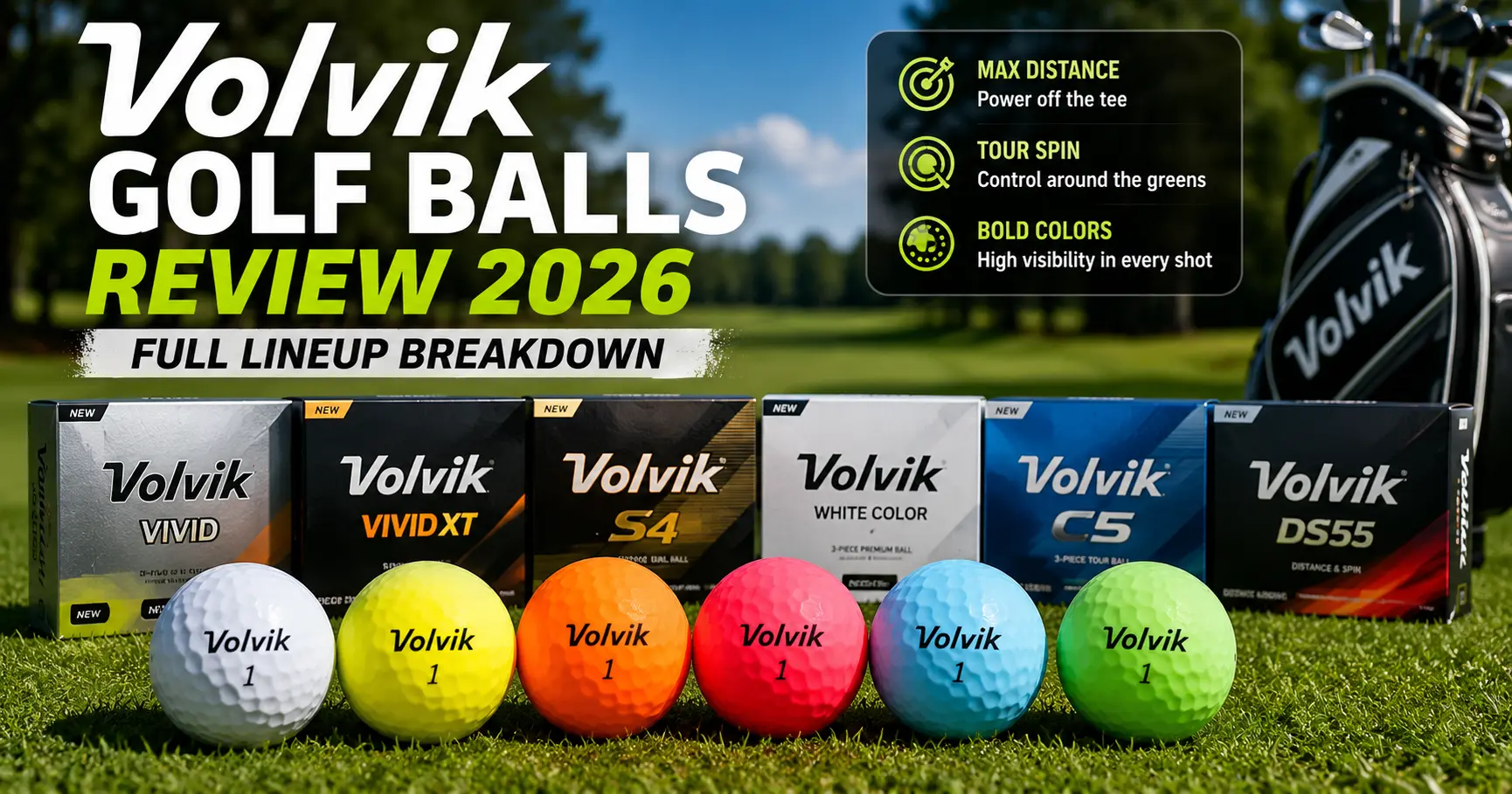
Volvik built its reputation on color, not performance. That reputation is a little out of date now.
We pulled the compression rating, cover material, and price for every ball currently listed on Volvik’s own site, then checked those numbers against the reviews still ranking for “Volvik golf balls review” today. Several don’t match anymore. The Vivid you’ll read about in an older review isn’t quite the Vivid Volvik sells in 2026, and two of the balls those older reviews treat as Volvik’s flagship tour ball, the S3 and S4, aren’t even on the current site.
This guide covers all 12 models Volvik actually sells right now, what changed, and which one fits your swing speed. No filler, no padding, just the numbers and who each ball is actually for.
Volvik Golf Balls Compared: Every Current Model, Compression, and Price
Compression tells you how firm a ball is. Lower numbers describe a ball that compresses, or squishes, more easily, which suits slower swings. Higher numbers need more clubhead speed to compress fully, and that’s where a faster swinger gets the ball’s spin and distance benefits.
Here’s the full current lineup, verified directly against Volvik’s own spec sheets in August 2026 rather than recycled from an older Volvik golf balls review.
| Model | Construction | Cover | Compression | Price/Dozen | Best For | Matches Older Reviews? |
|---|---|---|---|---|---|---|
| Condor X | 4-piece urethane | Cast urethane | 95 | $42.99 | 100+ mph swings | New model, older reviews don’t cover it |
| Condor | 3-piece urethane | Cast urethane | 85 | $42.99 | 90-105 mph, tour feel on a budget | New model, older reviews don’t cover it |
| VTU4 | 4-piece urethane | Urethane | 90 | $39.99 | Balanced “one ball” gamers | New model, older reviews don’t cover it |
| VTU3 | 3-piece urethane | Urethane | 80 | $39.99 | Slower swings who still want spin | New model, older reviews don’t cover it |
| Vimat | 3-piece ionomer | Surlyn, matte | 85 | $22.99-$29.99 | Firmer color ball, more control | No, most reviews list 70-77 |
| Vivid | 3-piece ionomer | Surlyn, matte | 85 | $29.99 | Visibility plus distance | No, most reviews list 80 |
| Vivid Soft | 3-piece ionomer | Surlyn, matte | 70 | $29.99-$34.99 | Slower swings, more feel | Different model than plain Vivid |
| Crystal Soft | 3-piece ionomer | Translucent Surlyn | 70 | $34.99 | Soft feel with visibility | Different model than original Crystal |
| Crystal | 2-piece ionomer | Translucent | 85 | $19.99-$29.99 | Maximum distance, straight flight | Roughly matches |
| Power Soft | 2-piece ionomer | Glossy Surlyn | 75 | $19.99-$22.99 | Budget-focused distance | Roughly matches |
| Axia Hologram | 3-piece ionomer | Hologram alignment band | Firm | $32.99-$34.99 | Alignment-focused putters | New model |
| Magma | 2-piece ionomer | Ionomer | High | $34.99 | Casual, non-tournament rounds only | Non-conforming, exceeds USGA distance limit |
A few things jump out once you put the whole line side by side instead of reading about it across six scattered posts. Volvik’s tour-level urethane balls, Condor, Condor X, VTU3, and VTU4, didn’t exist when most Volvik reviews still ranking today were written, so an article that never mentions them is reviewing half a product line. The plain Vivid and the current Vimat both carried lower compression numbers a couple of years ago. Volvik’s own 2026 spec sheet now lists both at 85, not the 70-80 range you’ll see quoted almost everywhere else online.
And Magma isn’t a novelty joke ball, but buying one to play your normal round is still a bad idea. Volvik itself files it under “Non-Conforming” on its own site because it exceeds USGA distance limits. Save it for a casual scramble with friends who don’t care about the rules, not anything that touches your handicap.
For the exact regulation dimensions every one of these balls has to meet, see our golf ball size guide.
Who Makes Volvik Golf Balls?
Volvik is a South Korean company, founded in 1980 and headquartered in Seoul, that has manufactured golf balls since 1989. CEO Moon Kyung-ahn took over in 2009 and pushed the company toward premium colored balls, launching Volvik USA in 2012 to handle North American distribution. Volvik produces its balls at the company’s own manufacturing facility in Busan, South Korea.
That 1989 date matters more than it looks. Volvik spent almost 20 years as a regional Korean manufacturer before it became known internationally for color. By the time Se-Ri Pak’s LPGA breakthrough sparked a wave of South Korean interest in women’s golf, Volvik already had the manufacturing base in place to capitalize on it, recruiting South Korean LPGA winners and building a colored-ball identity around them.
The company holds dozens of patents tied to ball construction and dimple design, and it still markets itself as Korea’s leading golf equipment brand. For anyone searching whether Volvik golf balls are made in Korea, the answer is yes, specifically at that Busan facility, not a licensed factory somewhere else. Volvik isn’t a no-name dropshipped brand. It’s a 45-year-old manufacturer that bet its identity on color instead of a plain white cover.
Volvik launched its American distribution arm, Volvik USA, in 2012. It’s now headquartered in Cypress, California.
The Tour-Level Volvik Balls: Condor, Condor X, VTU3, and VTU4
This is the part of Volvik’s lineup that changes the “just a novelty brand” conversation, and it’s also the part most existing reviews skip entirely because it launched after they were written.
Condor and Condor X
Condor is a 3-piece, cast-urethane ball at 85 compression, built to compete with tour balls without the tour price. At $42.99 a dozen, it undercuts the Titleist Pro V1 by roughly $15. Independent testers who’ve put it on a launch monitor describe a soft putter feel and short-game spin that holds up against balls costing significantly more, with one honest caveat: faster swingers above 95 mph sometimes see a small yardage give-up compared to a true premium ball.
Condor X is the firmer sibling, a 4-piece build at 95 compression aimed at 100 mph-plus swing speeds. It trades a little of the Condor’s soft feel for more ball speed and a flatter, more penetrating flight. If your driver swing sits comfortably above 100 mph, try Condor X first. Below that, the standard Condor is the easier ball to compress properly.
A quick Volvik Condor vs VTU3 comparison comes down to $3 and 5 compression points, not enough to lose sleep over, but worth knowing before you buy blind.
VTU3 and VTU4
VTU3 and VTU4 sit below Condor on price, at $39.99 a dozen, and on compression, at 80 and 90. The VTU3 in particular has drawn praise as a surprisingly soft, controllable ball inside 120 yards for a mid-30s price point after discount codes, the kind of short-game feel you’d expect to pay Condor money for. VTU4 flies a hair higher and gives up a little bite compared to Condor, which makes it a reasonable “one ball to cover everything” option if you don’t want to overthink which Volvik to buy.
None of Volvik’s tour-level balls beat a Pro V1 outright on tour-level short-game spin. Nobody serious claims that, including the testers who genuinely like these balls. What they offer is a real urethane-cover, tour-construction ball for $13 to $18 less per dozen than the market leader, and that’s a legitimate value case, not a marketing one.
Volvik Vivid Golf Balls Review: The Original Matte Ball
Vivid is the ball that made Volvik’s reputation. It was the first matte-finish colored golf ball on the market, and it’s still Volvik’s best-selling model.
Current spec, straight from Volvik’s own product page: 3-piece construction, Surlyn ionomer cover, 322 dimples, 85 compression, $29.99 a dozen. That compression number is the detail worth flagging. If a Volvik golf balls review 2022 told you the Vivid compresses at 80, Volvik’s current spec sheet says 85.
What hasn’t changed is the visibility case for playing one. Reviewers consistently describe the bright matte colors, especially green, as some of the easiest to track in flight and spot in the rough. That’s a real, measurable advantage if you lose balls often. It comes with a genuine tradeoff, too: matte covers pick up dirt and grass stains faster than a glossy cover, so plan on wiping it down more than you would a white Pro V1.
Vivid targets players in the low-to-moderate swing speed range who want distance and a ball they’ll never lose sight of. It’s not built to deliver tour-level check on approach shots, and Volvik doesn’t market it that way.
Volvik Crystal Golf Balls Review: The Translucent Distance Ball
Volvik sells two balls under the Crystal name, and mixing them up is the single most common mistake in older reviews.
The original Crystal is a 2-piece, translucent-cover distance ball. It’s firm, it flies straight, and it’s built for slower swingers who want maximum roll-out. It’s the ball golfers describe finding in the rough and mistaking for hard candy the first time they see it.
Crystal Soft is a different, newer 3-piece ball with a dual-core construction, a much lower 70 compression, a glossy translucent cover, and a $34.99 price tag. It’s softer off the face and built for players who want the Crystal look with more give at impact.
If a review only mentions “Crystal” without specifying which one, treat the compression and construction details with suspicion. These aren’t the same golf ball, and a slower swinger who buys the original Crystal expecting Crystal Soft’s give won’t enjoy how hard it feels off a wedge.
Volvik Power Soft Golf Balls Review: The Budget Pick
If you want the cheapest Volvik golf ball on the market, Power Soft is it, full stop, at $19.99 to $22.99 a dozen depending on the retailer.
It’s a 2-piece, ionomer-cover ball at 75 compression, glossy finish, aimed at the 70-90 mph swing speed range. The pitch is straightforward: an oversized core adds ball speed, low driver spin keeps tee shots straighter, and the ionomer cover is soft enough that greenside spin isn’t a total washout even though it isn’t urethane. That’s the honest ceiling for a two-piece ball at this price. Expect nowhere near Condor-level check on wedge shots.
Where Power Soft earns its spot is simple math. At roughly half the price of Volvik’s own Condor, and less than half of a Titleist Pro V1, it’s a legitimate everyday-play ball for golfers who lose a few a round and don’t want that to sting.
Volvik Vimat Golf Balls Review: A Ball That Quietly Got Firmer
Vimat is the model where the gap between older reviews and Volvik’s current spec sheet is largest, and it’s worth explaining why.
Golf Monthly’s hands-on test of the Vimat Soft, one of the few independently tested reviews of this model, found a ball built for the 70-90 mph swing speed range with a notably soft feel and low compression, and rated it well specifically on that softness. Other retailer listings for the earlier Vimat and Vimax Soft models put compression in the 70-77 range.
Volvik’s current 2026 product page for the Vimat lists 85 compression and pitches it toward players who want a firmer feel with added control and power. That’s a meaningfully different golf ball than the one Golf Monthly tested. The matte finish, the 322-dimple pattern, and the color range carried over. Its core did not.
If you’ve played an older Vimat and remember it as one of the softer balls in Volvik’s range, don’t assume a fresh dozen off the shelf today will feel the same way. Check the compression number printed on the box before you place a bulk order based on a memory that might be two product cycles out of date.
Volvik Golf Balls Compression Explained
Compression describes how much a golf ball deforms at the moment of impact. Manufacturers report it as a number, generally somewhere between 30 and 100-plus. Lower numbers describe a softer ball that a slower swing can compress fully. Higher numbers describe a firmer ball built for faster swing speeds, where more clubhead speed is available to do the compressing.
Volvik golf balls compression numbers only mean something once you match them to your own swing speed. Here’s how the current lineup breaks down.
Volvik golf balls compression chart, by swing speed:
| Your Driver Swing Speed | Volvik Models to Try | Compression |
|---|---|---|
| Under 80 mph | Vivid Soft, Crystal Soft, VTU3 | 70-80 |
| 80-95 mph | Vivid, Power Soft, Vimat, Condor | 75-85 |
| 95-105 mph | Condor, VTU4 | 85-90 |
| 105 mph and up | Condor X | 95 |
Playing a ball that’s too firm for your swing speed won’t ruin your round, but it will cost you distance and feel, because you’re not generating enough clubhead speed to fully compress the core. If you genuinely don’t know your swing speed, most golf retailers and club fitters can measure it on a launch monitor in under a minute, and it’s worth doing before you buy three dozen of anything.
Volvik on Tour: Sponsorships, Prize Money, and Which Pros Play It
Volvik has real tour history, though the brand’s tour presence has always leaned more toward sponsorship and marketing than a deep roster of world-ranked players gaming the ball full time.
The company signed two-time Masters champion Bubba Watson to play a pink S4 ball in 2017. That deal lasted one season and wasn’t renewed. Champions Tour veteran Craig Stadler has played Volvik colored balls for years, though he plays a limited competitive schedule these days. Volvik has had more traction on the LPGA side, sponsoring the LPGA Volvik Championship and, in 2021, the LPGA Drive On Championship, and signing multiple LPGA and developmental-tour players over the years.
The often-repeated figure of $9 million in tour prize money traces back to a 2018-era company statement covering Volvik-ball earnings across the PGA Tour, LPGA Tour, Champions Tour, and developmental tours since 2012. It’s a real number, but it’s close to a decade old at this point, and we couldn’t find a more current published figure anywhere. That gap is worth knowing if you’re deciding how much weight to put on “tour-proven” marketing language.
Here’s the honest limitation: no top-15 world-ranked PGA Tour player currently games a Volvik ball as primary equipment. If tour validation from the world’s best men’s players is the deciding factor for you, Volvik isn’t currently making that case. Where it does have a legitimate, ongoing presence is LPGA sponsorship and long-drive competition, where Volvik has served as the official ball for the World Long Drive Championship in past seasons.
Volvik vs. Titleist Pro V1: Is the Price Gap Worth It?
The comparison every Volvik shopper is actually making, whether they say so or not, is against the Pro V1.
| Fact | Volvik Condor | Titleist Pro V1 |
|---|---|---|
| Construction | 3-piece urethane | 3-piece urethane |
| Compression | 85 | Approximately 87-92.5 |
| Price/Dozen | $42.99 | $55-$57.99 |
| Independent lab testing | Not yet independently lab-tested at scale | MyGolfSpy Ball Lab: 93.0 quality score, top-10-of-106 compression consistency |
| Price difference | Baseline | $12-$15 more per dozen |
On paper, the Condor closes most of the construction gap with the Pro V1 for meaningfully less money. Both are 3-piece urethane balls in a similar compression range. What the lower price doesn’t buy you is Titleist’s manufacturing consistency data or decades of tour-validated short-game spin performance. MyGolfSpy’s independent lab testing has repeatedly found the Pro V1 among the most manufacturing-consistent balls in its entire database, a level of third-party verification Volvik’s newer tour balls haven’t accumulated yet, mostly because they haven’t been on the market long enough to get tested at that scale.
If you’re a low-single-digit handicap who needs every bit of greenside spin available, that gap is worth paying for. If you’re a mid-to-high handicapper who loses several balls a round and wants tour-style construction without a tour-style bill, the Condor is a genuinely defensible choice, not just a cheaper knockoff.
Frequently Asked Questions
Are Volvik golf balls good quality?
Yes, with a caveat. Volvik is a legitimate manufacturer with 45 years of production history and dozens of patents, and its current tour-level Condor and VTU balls use real urethane construction comparable to premium brands. Its color-performance balls, Vivid, Crystal, and Power Soft, are solid, budget-appropriate ionomer balls, not tour-quality, and Volvik never designed them to be.
Do any pros use Volvik balls?
Some do, mostly on the LPGA and Champions Tour side rather than among top-ranked PGA Tour players. Volvik has sponsored LPGA events including the LPGA Volvik Championship and signed multiple LPGA and developmental-tour players over the years. Two-time Masters champion Bubba Watson played a Volvik ball for one season in 2017, and Champions Tour player Craig Stadler has played Volvik colored balls for years.
Who makes the Volvik golf ball?
Volvik is a South Korean company founded in 1980 that has manufactured golf balls since 1989, with production based at its facility in Busan, South Korea. Volvik launched Volvik USA, the company’s American distribution arm, in 2012, and it’s now headquartered in Cypress, California.
What are the top 5 best golf balls?
That depends entirely on your swing speed, budget, and whether you value tour-level spin over distance and durability more than any single brand name. For a broader comparison across every major manufacturer rather than just Volvik, our best golf balls for low handicappers guide breaks down that wider field in detail.
Which Volvik Ball Should You Actually Buy
If you want the closest thing Volvik makes to a real tour ball without paying tour money, buy the Condor. If price matters more than spin, Power Soft at under $23 a dozen is the easy call. Everything else in the lineup, Vivid, Crystal, Vimat, solves a visibility problem more than a performance one, and that’s a legitimate reason to buy a golf ball, just not the same reason you’d buy a Pro V1.
That’s the entire point of this Volvik golf balls review: match the number to your swing, not the marketing. Check the compression printed on whatever Volvik you’re about to order. It’s changed more often than the marketing copy has. For help translating any of these dimple and compression figures into a full buying decision, our golf ball weight and rules guide covers the other USGA specs every ball on this list has to meet.