
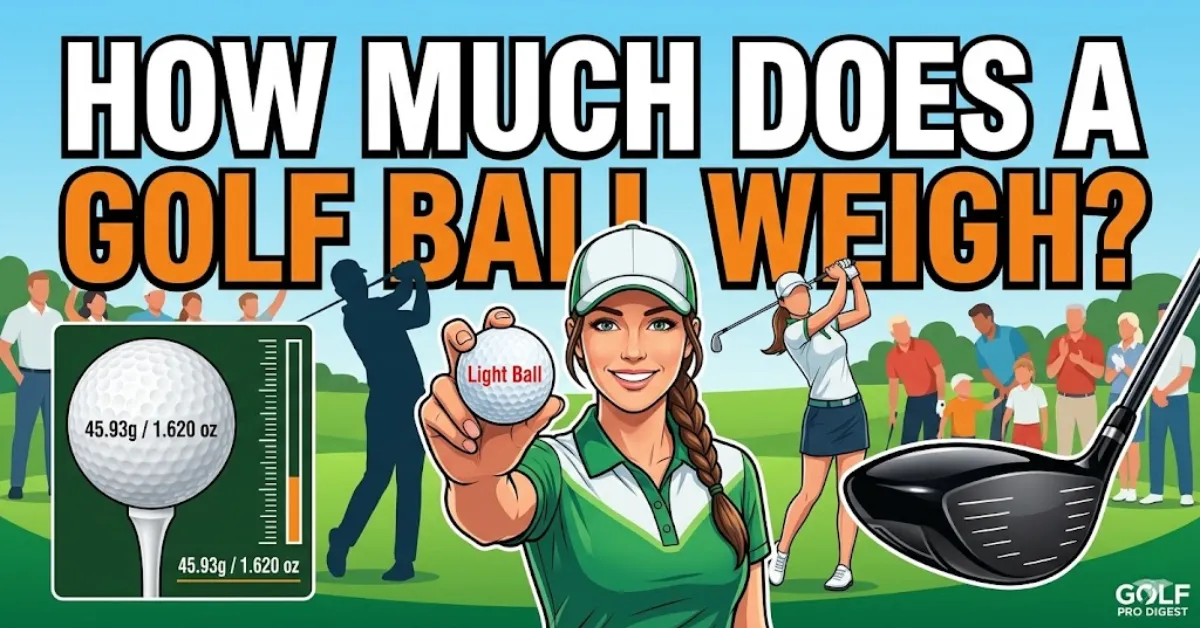
A regulation golf ball weighs a maximum of 1.620 ounces (45.93 grams). That is the official limit set by the USGA and R&A, and it has not changed since 1932. There is no minimum weight — a golf ball can legally weigh less, and some do. Most premium balls manufactured today come in between 1.614 and 1.620 ounces, as close to the maximum as possible, because extra mass helps the ball cut through wind and hold its line. Understanding golf ball weight tells you why your Pro V1 flies differently to a distance ball — and how to pick the right one for your swing.
Golf Ball Weight Rules in 2026: What the USGA and R&A Require
The United States Golf Association (USGA) and The Royal and Ancient Golf Club of St Andrews (R&A) are the two bodies that govern golf equipment worldwide. Between them, they set the rules every ball on every course in every country must follow.
For weight, the rule is simple: no golf ball may exceed 1.620 ounces (45.93 grams). There is no minimum weight. A ball can legally weigh 1.50 ounces if a manufacturer chooses to make it that way — and some lightweight balls aimed at seniors and slower-swing-speed players do weigh noticeably less than tour balls.
These rules apply to everyone — whether you play at your local municipal track on a Sunday morning or tee it up in a professional event. The same weight ceiling applies.
A note for 2026: The USGA and R&A have introduced a Model Local Rule allowing elite competitions to require a reduced-distance ball. This does not affect recreational golfers and does not change the 1.620-ounce weight limit. The weight rule remains unchanged.
Golf Ball Weight by Brand: Titleist, TaylorMade, Callaway, Srixon and More
Every major golf ball brand engineers their balls to land as close to the 1.620-ounce (45.93g) maximum as possible. Here is how the most popular models stack up.
| Golf Ball | Weight (grams) | Weight (ounces) | Construction |
|---|---|---|---|
| Titleist Pro V1 | 45.90g | 1.619 oz | 3-piece urethane |
| Titleist Pro V1x | 45.90g | 1.619 oz | 4-piece urethane |
| TaylorMade TP5 | 45.87g | 1.618 oz | 5-piece urethane |
| TaylorMade TP5x | 45.87g | 1.618 oz | 5-piece urethane |
| Callaway Chrome Soft | 45.70g | 1.612 oz | 4-piece urethane |
| Callaway Chrome Tour | 45.80g | 1.615 oz | 4-piece urethane |
| Srixon Z-Star | 45.85g | 1.617 oz | 3-piece urethane |
| Titleist AVX | 45.88g | 1.618 oz | 3-piece urethane |
| Bridgestone Tour B RX | 45.80g | 1.615 oz | 3-piece urethane |
| Wilson Staff Model | 45.90g | 1.619 oz | 4-piece urethane |
What you will notice: Every premium tour ball clusters between 45.70g and 45.90g — all within 0.23 grams of the legal maximum. Manufacturers push as close to the ceiling as their quality control allows because the additional mass helps the ball maintain speed and resist wind. The small differences you see in this table will not be noticeable on the course. What matters far more is construction, compression, and cover material — all of which affect how the ball feels and spins for your specific swing speed.
Does a Heavier Golf Ball Go Farther? What the Numbers Actually Show
Within the legal range, yes — a heavier ball generally travels farther for golfers with higher swing speeds. Here is why.
When a ball is struck, it has to push through air resistance the entire way to its landing point. A heavier ball carries more momentum for its size, which means it loses less speed during flight. This is the same reason a heavy rock rolls farther than a tennis ball thrown at the same speed.
However, this relationship reverses for slower swing speeds. Golfers who swing below 85 mph often generate better distance with a slightly lighter ball — around 44.5g to 45.0g — because they cannot compress a max-weight tour ball efficiently. The lighter ball launches easier and travels farther for them, even if tour players would lose distance with the same ball.
The practical takeaway:
Golf Ball Weight by Type: Tour, Distance and Practice Balls Compared
Not all golf balls are created equal, even though they must all meet the same weight requirements. Different construction methods and materials can affect how weight is distributed throughout the ball, which in turn affects performance.
Tour-level balls, like the Pro V1, typically weigh very close to the maximum allowed weight of 1.620 ounces. These balls are designed for maximum performance and control, with multiple layers that distribute weight precisely for optimal flight characteristics.
Distance balls, often favored by recreational players, usually weigh slightly less than tour balls but still fall within the legal range. The slight reduction in weight, combined with their construction, helps generate more distance for players with slower swing speeds.
Practice balls come in various weights, though those intended for serious practice still adhere to regulation standards. Range balls, while designed to meet general weight requirements, may vary slightly due to their intended use and the wear they endure.
How Golf Ball Weight Affects Your Distance, Spin and Shot Shape
Golf ball weight is not just a number for regulators to worry about — it directly shapes what happens from the moment your club strikes the ball to when it stops rolling on the green.
Distance off the tee: A ball at maximum weight (1.620 oz) carries more momentum through the air. For golfers with swing speeds above 90 mph, this means better penetration into wind and a longer carry. Drop below the maximum and you may notice slightly shorter distances in crosswind conditions specifically.
Spin rates: Weight affects how the ball compresses against your club face. Heavier balls — all else being equal — tend to generate more consistent spin on approach shots because they interact predictably with grooves. This is why tour players obsess over ball consistency between sleeves.
Feel around the greens: On chips, pitches and short putts, weight contributes to feel. Most golfers describe max-weight tour balls as having a more solid, connected sensation at impact. Lighter practice-grade balls often feel hollow or “clicky” by comparison — and that feedback difference is real.
In the wind: This is where weight shows its biggest effect for recreational golfers. On a breezy day, a ball closer to the 45.93g maximum will hold its line noticeably better than a range ball or cheap distance ball weighing 44.5g. If you play in coastal or exposed conditions regularly, ball weight is worth paying attention to when you choose your model.
How to Check Your Golf Ball Weight at Home
Checking your golf ball’s weight doesn’t require specialized equipment, though professional testing facilities use precise scales. For casual play, you can use a basic digital scale that measures in both ounces and grams.
To test your golf balls at home:
- Start with a clean, dry golf ball
- Use a digital scale that can measure to at least two decimal places
- Convert between units if necessary (1 ounce = 28.35 grams)
Remember that temperature can slightly affect ball weight, so it’s best to test balls at room temperature. Also, ensure your scale is properly calibrated for accurate measurements.
The History of Golf Ball Weight: From Featheries to the 1932 Rule
The history of golf ball weight regulations is as fascinating as the game itself. In the early days of golf, balls were made from wood and had no standardized weight. The introduction of the featherie ball in the 17th century marked the first attempt at consistency in golf ball manufacturing.
The gutta-percha ball, introduced in the 1840s, brought more uniformity to golf ball weight and performance. However, it wasn’t until the early 20th century that formal weight regulations were established. The current weight limit of 1.620 ounces was set in 1932 and has remained unchanged since then.
This stability in regulations has allowed manufacturers to focus on improving other aspects of ball performance while maintaining consistent weight standards. Modern materials and manufacturing techniques have made it possible to produce balls that consistently meet these weight requirements while offering various performance characteristics.
Today’s golf balls represent the perfect balance between tradition and technology. While maintaining the same weight standards that have existed for nearly a century, modern golf balls incorporate advanced materials and designs that would have been unimaginable to the game’s early players.
The consistency in weight regulations has been crucial for the game’s development, allowing players to focus on skill development rather than equipment variations. As we look to the future, it’s likely that these fundamental weight requirements will remain unchanged, even as ball technology continues to evolve in other ways.
Understanding how much a golf ball weighs might seem like a small detail in the grand scheme of golf, but it’s these precise standards that help maintain the integrity and fairness of the game. Whether you’re a casual player or a serious competitor, knowing these specifications can help you make more informed choices about your equipment and improve your understanding of the game’s fundamentals.
Golf Ball Weight – Frequently Asked Questions
A regulation golf ball weighs a maximum of 45.93 grams. Most premium tour balls are manufactured between 45.70 and 45.90 grams. There is no minimum weight requirement under USGA or R&A rules.
A golf ball must not exceed 1.620 ounces. The majority of tour-level balls weigh between 1.612 and 1.619 ounces. Budget distance balls sometimes come in slightly lighter, around 1.570 to 1.600 ounces.
The Titleist Pro V1 weighs approximately 45.90 grams (1.619 ounces) — just under the legal maximum of 45.93 grams. Titleist engineers their balls to this tight tolerance across every sleeve to ensure consistency from round to round.
No. The USGA and R&A only set a maximum weight of 1.620 ounces (45.93 grams). There is no minimum. Some lightweight balls designed for seniors and slower swing speed players weigh as little as 44.5 grams and are perfectly legal to use.
One pound equals 16 ounces. Since a golf ball weighs approximately 1.620 ounces, you need roughly 9.9 golf balls to equal one pound. In practical terms, a sleeve of three balls weighs around 4.9 ounces.
No. Any ball exceeding 1.620 ounces (45.93 grams) is classified as non-conforming under USGA and R&A rules and cannot be used in any official competition. Using a non-conforming ball in stroke play results in disqualification. In casual rounds there is no penalty, but no legal manufacturer produces balls above this weight intentionally.
Picking the Right Golf Ball Starts With Understanding What Is Inside It
Now you know exactly how much a golf ball weighs, why the 1.620-ounce ceiling exists, and how the top brands compare against each other within that limit. The weight of your ball is locked in a narrow range by design — but within that range, construction, compression, cover material, and dimple pattern create huge differences in how a ball actually performs for your game.
The next step is matching the right ball to your swing speed and playing style. At Madknows, we cover every ball category – from the best tour balls for scratch players to the top picks for seniors and high-handicappers who want more distance without sacrificing feel.
👉 Read next on Madknows: How to Grip a Golf Club: The Right Way to Hold It for a Consistent Swing
Already know your ball? Make sure you are getting the most out of it. Learn how to Clean Your Golf Ball Properly and whether Golf Swing Speed is the real distance factor you should be focusing on.