
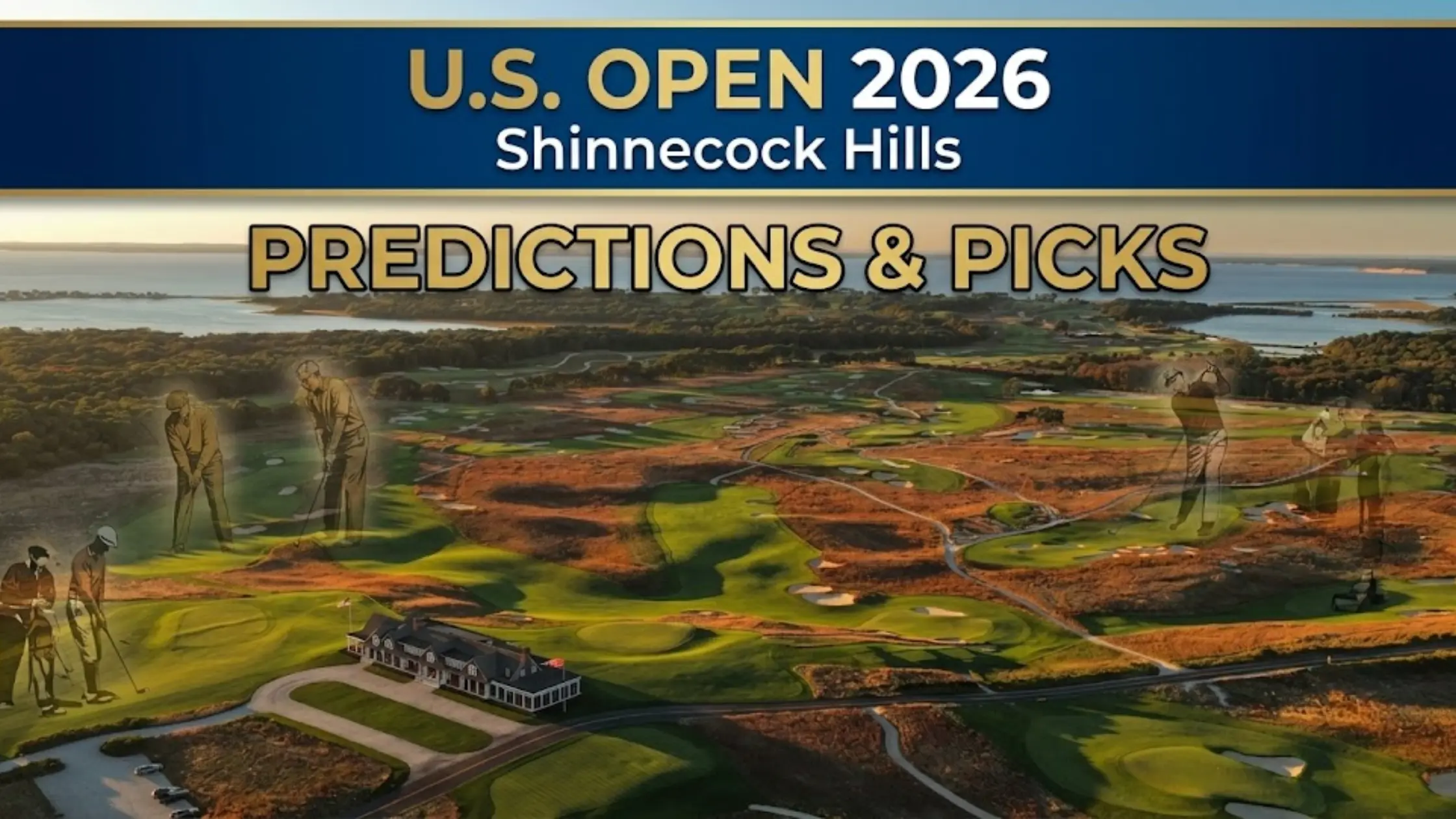
I’m a 9-handicap, and a few years back I played a wind-exposed course on the Long Island shore the week after a tournament crew had been through to firm up the greens. I three-putted from inside 15 feet on four different holes that day. Nothing was wrong with my speed control on a normal Tuesday — the greens themselves had changed. That’s the closest most of us will ever get to feeling what Shinnecock Hills does to a scorecard, and it’s a big part of why I think this U.S. Open plays differently than the last few majors.
The 126th U.S. Open tees off Thursday, June 18, at Shinnecock Hills Golf Club in Southampton, New York — the course’s sixth time hosting, and its first since Brooks Koepka’s back-to-back win in 2018. Here’s who I like, why Shinnecock’s history points to a low-scoring ceiling, and where the real value sits beyond the obvious favorites.
Quick Answer: Scottie Scheffler is the favorite (around +550) to win the 2026 U.S. Open at Shinnecock Hills, chasing the career Grand Slam. But this course has only let two champions ever finish under par. Expect a winning score between even par and 3-under, with Tommy Fleetwood and Cameron Young as the sharpest plays behind Scheffler.
My Pick to Win: Scottie Scheffler, But Here’s the Catch
Scheffler enters as the betting favorite at roughly +550, and the storyline writes itself. He’s already won the Masters twice (2022 and 2024), the PGA Championship in 2025, and last year’s Open Championship. A U.S. Open title makes him the seventh player in history to complete the career Grand Slam. Sunday’s final round even falls on his 30th birthday — you couldn’t script it better.
Here’s the part most preview pieces skip: Scheffler’s actual U.S. Open record is good, not great, and that distinction matters. He finished runner-up to Matt Fitzpatrick in 2022, third at -7 in 2023, then dropped to T41 in 2024 before climbing back to T7 last year at Oakmont. Eight appearances, zero wins. He’s been the best player in the world for most of that stretch and still hasn’t closed this specific tournament.
He’s also never played a competitive round at Shinnecock. That’s not nothing. The last time he teed it up at a major for the first time on an unfamiliar course — this year’s PGA — he finished T14, solid but not the dominant week his ranking suggests he’s capable of.
None of that makes him a bad pick. Scheffler’s iron play is precise enough to handle Shinnecock’s small, tilted greens, and a player who’s been top-3 in half his starts this year doesn’t need a hot streak to contend. I just wouldn’t call this a lock, and anyone telling you it is hasn’t looked closely at how many times the best player alive has been good-not-great at this exact major.
The Smarter Bet: Fleetwood’s Course Record and Cameron Young’s Putter
If I’m spreading bets beyond the favorite, two names jump out — and not for the reasons you’d expect from a typical “value picks” list.
Tommy Fleetwood holds the Sunday scoring record at Shinnecock Hills. In the final round of the 2018 U.S. Open — the same week Koepka was grinding out a 1-over win — Fleetwood shot 63. He’s the only player to ever shoot 63 in a U.S. Open final round twice, doing it again at Los Angeles Country Club in 2023. He’s also in good current form, with top-5 finishes in two of his last three signature-event starts. A player with major-specific course history at this exact venue, who’s trending the right direction, is the kind of detail that gets buried under bigger names.
Cameron Young is the other name. He’s currently ranked No. 3 in the world off the back of a breakout year — a win at The Players Championship, a tie for third at the Masters — and his best-ever U.S. Open finish, a tie for fourth at Oakmont last year, came with the putter finally cooperating. I had Fleetwood for a top-10 finish at a major two years ago on a hunch about his iron play in crosswind conditions, and it cashed. This year, the Fleetwood-and-Young combination is exactly the profile I’m chasing again: proven ball-strikers whose short-game and putting numbers have caught up to their tee-to-green games.
Neither is a “win” play at the size of Scheffler’s market. Both are live for top-10s, and at Shinnecock — where the cut line and the leaderboard tend to compress into a tight bunch around par — that’s where the value lives.
How Shinnecock Hills Will Actually Play: The 4 Holes That Decide It
Shinnecock measures 7,440 yards at a par of 70, but the yardage tells you almost nothing about why it’s hard. The difficulty comes from four holes in particular — the ones that have decided every U.S. Open this course has hosted since William Flynn finished his redesign in 1931.
No. 7 — The Redan That Eats Birdies
A 185-yard par 3 built on the bones of Macdonald and Raynor’s original Redan template, the 7th tilts front-to-back with a fatal bunker short and right. Unlike a traditional Redan, you can’t run the ball onto this green — the tee shot has to fly all the way to the front edge. In the final round of the 2004 U.S. Open, this hole averaged 3.65 strokes against a par of 3. That’s not a birdie hole. That’s a hole players are simply trying to survive.
No. 9 — The Blind Monster Off the Clubhouse Porch
At 481 yards, the 9th plays into a blind, heaving fairway where only the longest hitters can find the rare flat ground. Miss left or short and you’re looking at a blind approach to a green that sits 25 feet above the fairway, tilted hard enough that being above the hole is nearly as dangerous as coming up short. This is the hole where bombers either gain a full shot on the field or lose two.
No. 11 — Koepka’s Bogey That Won a Major
Lee Trevino once called this 155-yard par 3 “the shortest par 5 in golf,” and in 2018 it nearly proved him right for Brooks Koepka. Leading on Sunday, Koepka found the rough nearly 30 yards behind this green, pitched into a front bunker, splashed out, and sank a 13-footer for bogey — one of the great saves in U.S. Open history. I’ve faced almost that exact shot, a long bunker recovery to a green with nothing behind it, at my home course’s hardest par 3. The only sane play is the one Koepka made: get it on the green, take your two putts, and walk to the next tee. I made double there for two years before that lesson stuck.
No. 18 — Pavin’s 4-Wood and the Closing Test
The 490-yard closing hole demands a drive that either challenges a left-side bunker or risks bouncing into rough on the low side, into a green tucked into a bowl with a vicious back-to-front slope. Corey Pavin made it look easy in 1995, hitting a 229-yard 4-wood to five feet to seal his title. Nobody since has made it look that easy again.
What Score Wins It? Shinnecock’s Brutal History
Here’s the number that should anchor every prediction for this week: in four U.S. Opens at Shinnecock since the modern stroke-play era began, only two champions have finished under par.
| Year | Champion | Winning Score |
|---|---|---|
| 1986 | Raymond Floyd | -1 |
| 1995 | Corey Pavin | Even |
| 2004 | Retief Goosen | -4 |
| 2018 | Brooks Koepka | +1 |
Longtime Golf Channel commentator Rich Lerner addressed this directly on a media call on June 10, saying that if the wind blows and the turf plays firm — which it almost always does here — he expects a winning score around even par, maybe 1-under or 2-under. The USGA’s stated approach, in Lerner’s words, is to “let Shinnecock be Shinnecock.” Translation: don’t expect a generous setup.
My read: anything from +1 to -3 should win this thing. A number like -8 or -10 would mean either the wind never showed up all week or the USGA softened the course in a way it almost never has here.
The Setup Story Nobody’s Telling: Why 2026 Could Play Differently Than 2018
Here’s the angle that’s been hiding in plain sight. Jim Furyk, the 2003 U.S. Open champion, broke down on that same June 10 media call exactly how Shinnecock’s identity has shifted between its last two Opens — and almost nobody has connected it to who’s actually built to win in 2026.
In 2004, when Retief Goosen won at -4, the greens were surrounded by thick rough. Misses near the green meant a recovery shot from longer grass, often from fairly close range — a more traditional “escape from the rough” test.
The 2018 renovation enlarged the greens, but a lot of that extra space became closely-mown runoff areas that push the ball away from the hole rather than gathering it. Furyk’s exact point: that shift rewards players with serious touch — guys who can skip a ball off a tight runoff with the right spin, or pitch uphill from a bare lie to an elevated green, rather than just muscling a wedge out of long grass.
If that setup philosophy holds for 2026, it quietly favors the all-around short-game players over the pure bombers. That’s a meaningful tilt toward someone like Xander Schauffele — who has never finished worse than a tie for 14th in nine U.S. Open starts — or a veteran grinder like Justin Rose, and a meaningful question mark against anyone whose game leans on overpowering a course rather than manufacturing shots around it.
Sleepers, Fades and Smart Bets Beyond the Win Market
Not every useful pick this week is a “to win” bet. Here’s where I’d look at longer odds and prop markets.
| Player | Approx. Odds | The Angle |
|---|---|---|
| Justin Rose | Outright long shot | At 45, just won at Torrey Pines and tied 10th at the PGA. Twenty U.S. Open starts and a major win at Merion in 2013 — experience at exactly this kind of grinding setup is real |
| Cameron Young | ~+2000–2200 | Covered above — World No. 3, best U.S. Open finish came last year, putting finally trending up |
| Adam Scott | ~+9000 | Playing his 100th consecutive major championship, tying Jack Nicklaus’s record. This is a storyline bet, not a serious win play — be honest with yourself about that before you put money on it |
| Brooks Koepka | ~+2500–4500 | Returns to the scene of his 2018 win, but he’s fallen to 109th in the world. Course history matters here, current form says otherwise |
| Bryson DeChambeau | ~+2000–2200 | Two-time U.S. Open champion, but multiple analysts flagged “poor course fit” and poor recent form heading into this week, with speculation he may be reconsidering his LIV commitment. I wouldn’t touch DeChambeau to win this week, and it’s not close |
| Jordan Spieth | Outright long shot | 2015 champion, qualified through the top-60 world ranking. A sentimental pick more than a sharp one, but live for a top-20 if the putter shows up |
Weather Watch: What This Week’s Forecast Means for Scoring
As of this week, the early-tournament forecast for Southampton is mild — mid-70s°F, partly cloudy, with rain chances sitting in the 10-25% range through Thursday’s opening round. No major storm system is showing up yet.
Here’s my honest caveat: five-day coastal forecasts for Long Island in June are closer to educated guesses than data, and the back half of the tournament (Saturday-Sunday) is still outside any forecast window that means much right now. What actually matters is wind, not temperature — Shinnecock sits exposed to gusts off Peconic Bay and the Atlantic, and the course plays a full club or two harder the moment that wind picks up. If Thursday and Friday stay calm and Saturday brings wind, watch for the exact “Saturday carnage” storyline that’s defined past Shinnecock Opens. If it stays mild all week, Lerner’s even-par prediction could end up on the generous side.
Frequently Asked Questions
The 2026 U.S. Open runs Thursday, June 18 through Sunday, June 21, at Shinnecock Hills Golf Club in Southampton, New York. It’s the course’s sixth time hosting, following 1896, 1986, 1995, 2004, and 2018.
Scottie Scheffler opened as the betting favorite at roughly +550, with Rory McIlroy second (+825 to +1200 depending on the book) and Jon Rahm third (around +1300-1400). A cluster of players including Xander Schauffele, Cameron Young, Tommy Fleetwood, Bryson DeChambeau and Ludvig Åberg sit around +2000-2200.
Shinnecock Hills plays to a par of 70 for the U.S. Open, at a championship yardage of 7,440 yards.
Brooks Koepka won in 2018 with a score of 1-over par, becoming the first back-to-back U.S. Open champion in 29 years. He edged Tommy Fleetwood, who shot a final-round 63 — still the course’s Sunday scoring record.
Only two of the four modern U.S. Open champions at Shinnecock have finished under par: Raymond Floyd at -1 in 1986 and Retief Goosen at -4 in 2004. Corey Pavin won at even par in 1995, and Brooks Koepka won at +1 in 2018. Anything between +1 and -3 would be in line with the course’s history.
The 2026 U.S. Open airs on NBC, with streaming coverage available on Peacock.
The USGA hasn’t released the 2026 purse yet — it’s typically announced during tournament week. For reference, the 2025 U.S. Open purse was $21.5 million, with champion J.J. Spaun earning $4.3 million.
Final Word
Scheffler’s the right favorite, but his U.S. Open record says this isn’t a formality — and a course that’s only let two champions break par in the modern era isn’t going to make it one. If I’m building a ticket, it’s Scheffler at the top, Fleetwood and Cameron Young for top-10 value, and even par to -3 for the winning number. Before you finalize your own picks, it’s worth understanding exactly how Shinnecock’s firm, sloped greens punish a poorly-struck approach — our guide to hitting pin-high approach shots breaks down why “close” isn’t always “good” on a green like these.