
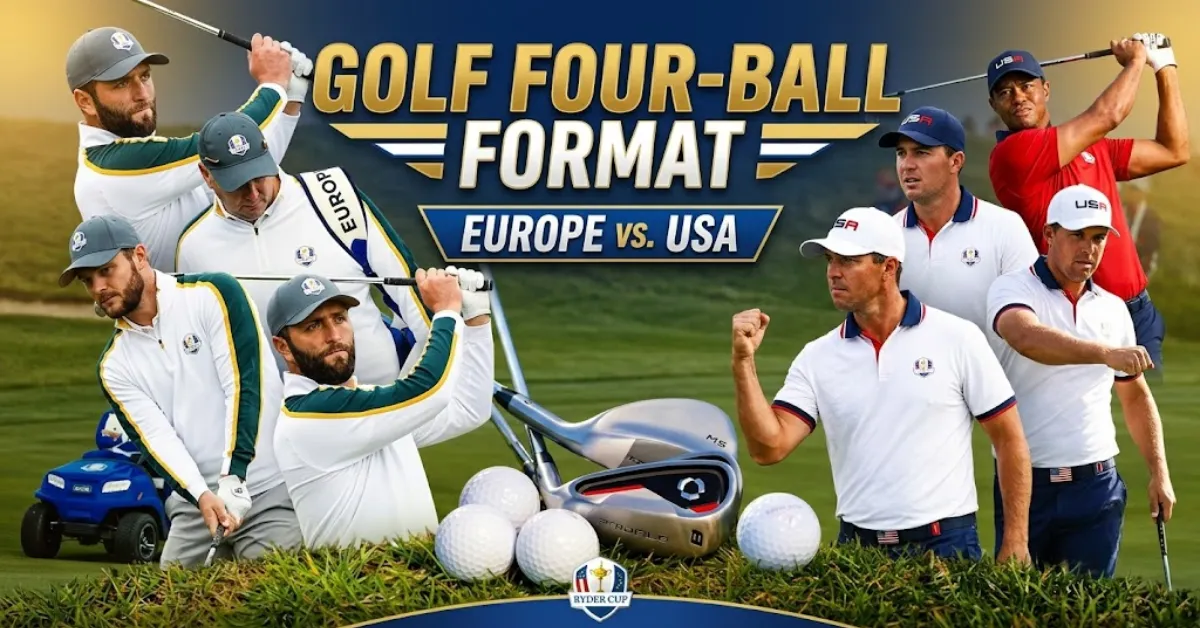
Four-ball is the format that makes Saturday mornings at golf clubs around the world worth waking up for. It’s competitive enough to matter, but forgiving enough that one bad hole doesn’t end your round – and that combination keeps golfers coming back to it every week. I’ve played more four-balls than I can count, and I still find the format rewards a type of thinking that pure stroke play never demands. You’re not managing your own game. You’re managing two games at once – yours and your partner’s – and the partnerships that figure that out fastest tend to win.
Here’s everything you need to know about how four-ball works, how handicaps are calculated, and what makes it the format of choice at the Ryder Cup.
Quick Answer: Four-ball (also called “better ball” or 4BBB) is a pairs format where two players each hit their own ball on every hole. The lower of the two partners’ scores counts as the team score for that hole. It’s played as match play or stroke play and features heavily in the Ryder Cup.
What Is the Four-Ball Golf Format?
Four-ball is a team format where two players compete as a pair, each playing their own ball throughout every hole. The team’s score on each hole is the lower of the two partners’ scores. One player can pick up if they can’t beat their partner’s score — the team keeps moving, and pace of play stays reasonable.
The name makes literal sense: in a standard four-ball match (two teams of two), all four players hit their own ball, so four balls are in play on every hole simultaneously. That’s the key distinction from foursomes, where partners share one ball and alternate shots.
Several names refer to the same thing. “Better ball,” “best ball,” and “4BBB” all describe the four-ball format. The R&A first included the name in their Rule Book in 1908, and four-ball stroke play didn’t appear in the official Rules until 1952. Knowing these terms matters because local club competitions and app-based scorecards use them interchangeably, and you don’t want to show up expecting one format and find another.
How Four-Ball Scoring Works – Match Play vs. Stroke Play
Both versions use the same core rule: the lower of two partners’ scores wins the hole (or counts for the team). The scoring system around that core is where match play and stroke play differ completely.
Four-Ball Match Play (4 Ball Better Ball Matchplay)
In match play four-ball, two teams of two compete directly against each other. On each hole, each team uses their best score. The team with the lower best score wins the hole. Ties are “halved” — both teams split the point.
Worked example:
Match play scoring uses terminology like “2 up,” “all square,” and “3 & 1.” A “3 & 1” win means the winning team is three holes ahead with only one hole remaining — the match ends there, not on the 18th. The match ends the moment one team is ahead by more holes than remain to be played.
Partners can choose their own order of play — you don’t have to play in the traditional “furthest from the hole plays first” sequence. If your partner already has a solid 5 on the green and you’re 30 feet away in two shots, you can go first, make your eagle attempt, and your partner picks up their ball if they can’t improve on your score.
Four-Ball Stroke Play (Four Ball Stroke Play Rules)
Stroke play four-ball aggregates the best score from each hole over 18 holes. Every hole must produce at least one score — if both partners pick up or are disqualified for a hole, the team gets no score and is disqualified from the competition.
Worked example, 18-hole four-ball stroke play:
The team’s 18-hole total is the sum of all 18 hole-winning scores. On the scorecard, at least one partner’s score must be recorded on each hole. Critically — the scorecard must clearly identify which partner made which score. A missing identification is grounds for disqualification, not just a warning. Record both scores, mark the counting one, and have one partner sign. That’s the routine.
Four-Ball vs. Foursomes vs. Scramble: What’s Actually Different
This is the question most golfers can’t answer confidently. Here’s the format comparison no other article gives you as a table:
| Format | Balls in Play | Who Hits Each Shot | Score Counts | Mindset Required |
|---|---|---|---|---|
| Four-Ball | 4 (1 per player) | Each player plays their own ball | Lower of partners’ scores per hole | Aggressive — your partner is your safety net |
| Foursomes (Alternate Shot) | 2 (1 per team) | Partners alternate every shot | One shared score per hole | Conservative — every shot is 50% of your partnership |
| Scramble | 4 (1 per player) | Everyone hits, team picks best, all play from there | One score from the best starting point | Very aggressive — 4 chances at every shot |
| Best Ball (3 or 4-player) | 3 or 4 | Each player plays their own ball | Lowest score of all players per hole | Similar to four-ball, more safety net |
The practical difference between four-ball and foursomes (alternate shot) is immense. Foursomes punishes weak partnerships – if your partner drives into a hazard on the 1st, you’re playing the second shot from the drop zone, and that alternating sequence follows you for 17 more holes. Four-ball removes that pressure completely. A bad tee shot from Player A on hole 1 is irrelevant if Player B hits a fairway.
Four-ball vs. best ball is mostly a terminology question. When people say “best ball,” they almost always mean four-ball better ball. The USGA’s official Rules recognize “Best-Ball” as a specific variant where one individual competes against a side of two or three partners – but in everyday club golf, “best ball” and “four-ball” mean the same thing.
How Handicaps Work in Four-Ball (With Full Worked Examples)
The four ball better ball handicap system exists to create equity between players of different skill levels. The percentage applied depends on whether you’re playing match play or stroke play.
Stroke Play — 85% of Course Handicap
Each player calculates their course handicap for the tees being played, then applies 85%.
Example — four-ball stroke play group:
Each player’s handicap strokes reduce their score on designated holes (determined by the stroke index on the scorecard). The team then compares net scores hole by hole.
Match Play — 90% of the Difference from the Lowest Handicapper
In match play, the lowest-handicap player in the group plays at scratch (zero strokes) and becomes the baseline.
Example — same four players, match play:
These strokes apply on the holes designated by the stroke index. Player D picking up a stroke on the 1st hole (stroke index 1) means if they make a 5 and their net score is 4, that’s what their team uses — and if that beats their opponents’ best score, they win the hole.
The official USGA handicap allowances are set out in Appendix C of the Rules of Handicapping. There is no additional reduction even if partners have a large difference in handicaps — the Committee could impose a limit, but the official recommendation doesn’t require one. Source: USGA Rules of Handicapping, Appendix C.
The “Free Hit” Psychology: Why Four-Ball Changes Everything
No other format does to your decision-making what four-ball does. It introduces a concept I think of as the “free hit” — a tee shot or approach you can hit at full commitment because your partner already has a safe ball in play.
Here’s a specific situation that comes up in every four-ball round. Your team reaches a par-5 in two: your partner is lying 2, 15 feet from the pin, looking at a comfortable birdie. You’re sitting 80 yards out with a sand wedge in your hands. Your team almost certainly has a 4 at worst. So you aim at the flag and go after the eagle — not because it’s the percentage play, but because you have nothing to lose. In stroke play, you’d be calculating risk. In four-ball, you’re free.
That freedom is why four-ball produces more eagles and birdies per round than stroke play. It’s also why scratch golfers can genuinely carry a 24-handicapper in this format without either player feeling cheated. The bad shots get absorbed. The great shots count for double.
Four-Ball Strategy: How to Win, Hole by Hole
Most golfers play four-ball the same way they play individual stroke play, just with a partner walking alongside them. That’s wrong. The format rewards specific strategic decisions that never come up in individual golf.
1. The stronger player goes first when you need a par If your partner is in trouble off the tee and you’re on the fairway, play your approach first. Lock in a par. Now your partner can gamble on their pitch — the safe score already exists.
2. The more aggressive player goes second when the hole is locked Your partner made a birdie putt from 12 feet. You’re 8 feet away. The team has a 3 locked in for a par-4. Approach your putt for eagle, not bogey avoidance. The pressure is off.
3. Pick up immediately — and mean it Nothing slows a four-ball round more than players grinding out 7s when their partner is on for 4. Pick up the moment you can’t improve your partner’s score. Not after one more putt — immediately. Your partner’s round, and the group behind you, both benefit.
4. Complement risk profiles across the round In an 18-hole match, think about which partner takes the aggressive line on tight driving holes and which player plays the percentage. Low-handicappers who normally attack every tee shot can play for the fairway on a tight hole, knowing their partner will attempt the driver.
5. Communicate on conceded putts (match play) In match play, once a putt is conceded (“that’s good”), it cannot be withdrawn. Before conceding anything, consider whether your partner needs the exact score on that hole. A 3-footer conceded when your team is already winning the hole with a 4 is different from the same concession when your team needs the par.
Four-Ball at the Ryder Cup: How It Works and Why It Matters
Four-ball has been part of the Ryder Cup since 1963, when it debuted at East Lake Golf Club in Atlanta. Before that, the Ryder Cup used only foursomes and singles. The addition of four-ball transformed the event — it made pairings matter more, gave captains more tactical decisions, and gave the crowd four individual performances to follow simultaneously rather than two.
At the current Ryder Cup format, 8 of the 28 total matches are four-ball games. Over the first two days, each day features two sessions: typically foursomes in the morning and four-ball in the afternoon (or vice versa, as host nations now set the order). Each session contains four matches, meaning four points available per session. All 28 points — foursomes, four-ball, and Sunday singles — are worth one point each. A team needs 14.5 to win.
At the 2025 Ryder Cup at Bethpage Black, US captain Keegan Bradley chose to open both Day 1 and Day 2 with foursomes, moving four-ball to the afternoon sessions. That’s been the US preference in recent editions — and it reflects a genuine tactical belief. Four-ball in the afternoon, after players have settled into the competitive adrenaline of a first-session foursomes match, tends to produce more aggressive play. The birdie-fest qualities of four-ball make for better TV, and the captains know it.
Ryder Cup four-ball pairings are genuinely different from foursomes pairings. In foursomes, you need two players who can adapt to each other’s ball-striking — the tee-to-green game blends. In four-ball, you want contrast: one player who attacks, one who grinds. The 2018 Ryder Cup pairing of Tommy Fleetwood and Francesco Molinari went 4-0 in their combined sessions, and their four-ball results specifically illustrated how a flamboyant birdie machine (Molinari’s incredible form that week) and a consistent ball-striker (Fleetwood) becomes nearly unbeatable.
Frequently Asked Questions
Four-ball is a team format where two players each play their own ball on every hole. The lower of the two partners’ scores counts as the team score for that hole. It’s played as match play (comparing hole scores directly against another pair) or stroke play (adding up the team’s best score on every hole). Also known as “better ball” or 4BBB.
The Ryder Cup uses four-ball as match play. Two pairs of players compete against each other, all four hitting their own balls throughout the hole. Whichever team has the lower best score wins the hole. A match ends when one team is ahead by more holes than remain to be played. There are 8 four-ball matches across the first two days of the Ryder Cup, with four per day across two sessions, each match worth one point toward the team total of 28.
The 70/30 rule is a course management principle, not an official rule. It states that 70% of your shots should prioritize control and consistency — conservative club selection, targeting the center of greens, playing to your reliable distances — while 30% should go after maximum distance or risk-reward opportunities. Four-ball is the ideal format to apply this because the “30% aggressive” shots carry no team consequences when your partner already has a safe score. On a hole where your partner is on in two, you represent the 30%.
An ostrich is an informal term for scoring 5-under par on a single hole — theoretically a hole-in-one on a par-6, or two strokes on a par-7. It has never been achieved in recorded competitive golf, as par-6 and par-7 holes are extraordinarily rare at the professional level. The term exists on the same scale as eagle, albatross, and condor — with an ostrich requiring conditions that essentially don’t exist. Worth knowing for pub quiz purposes.
In everyday use, yes. “Best ball” and “four-ball better ball” describe the same format: partners each play their own ball, the lowest score counts per hole. The USGA does define “Best-Ball” as a slightly different variant in the official Rules (one individual versus a side of two or three partners), but outside formal competition, they’re interchangeable terms. If someone asks you to play “best ball” Saturday morning, bring your A-game — they mean four-ball.
Yes. Under Rule 23.4 of the Rules of Golf, a side can be represented by one partner during all or part of a round. If your partner can’t make the tee time, you can start and play alone. If they arrive between holes, they can join at the start of the next hole — but not mid-hole. This applies in both match play and stroke play.
The Bottom Line
Four-ball’s genius is the way it rewards both individual skill and team awareness simultaneously. Play your ball, but always with one eye on your partner’s lie. It’s a format that teaches you to think two steps ahead — and once you understand that dynamic, you’ll find it hard to enjoy stroke play alone in quite the same way.