
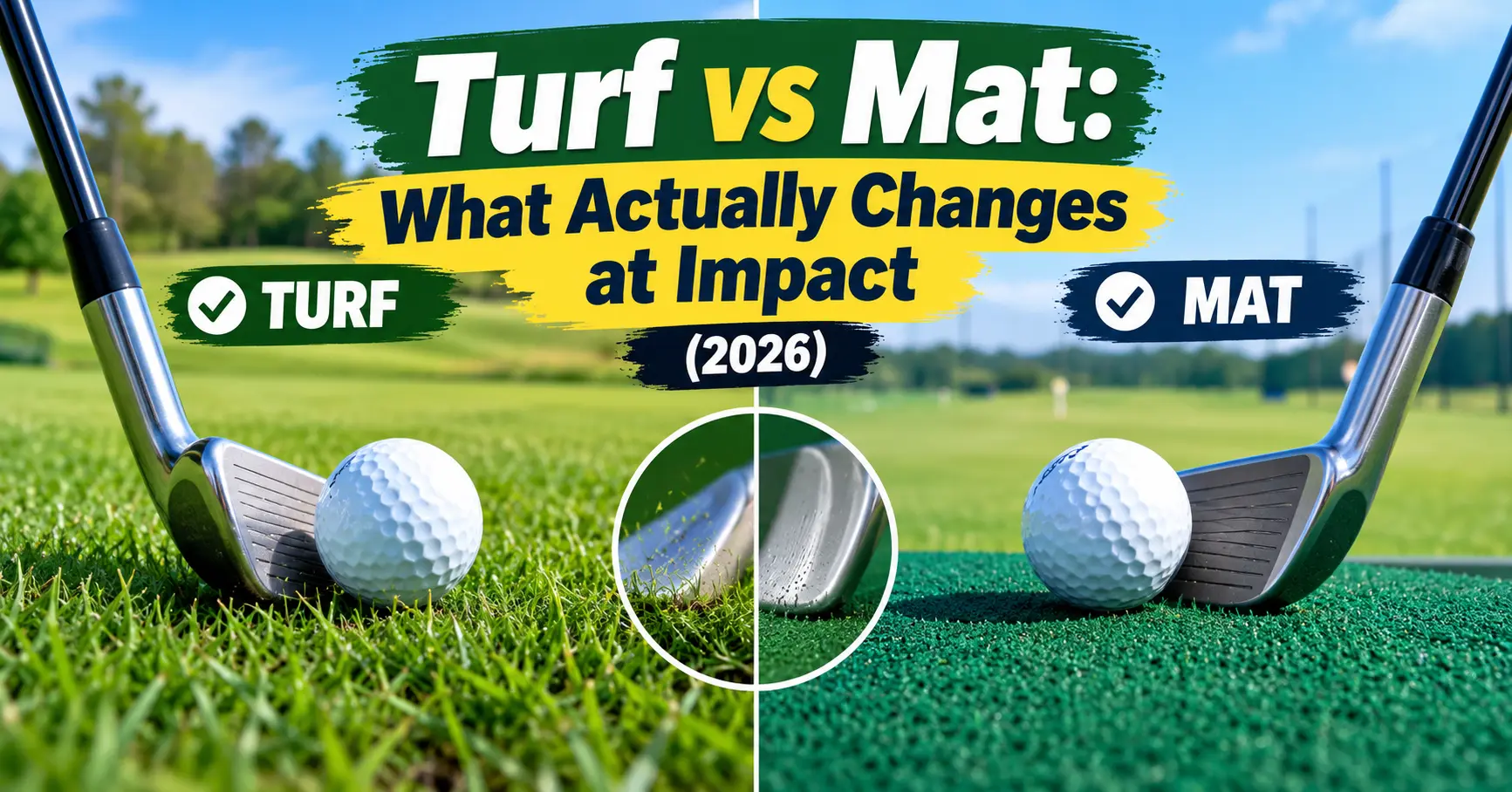
Quick Answer: Grass lets your club dig into the ground and show you a divot. A mat doesn’t, so it skids through heavy contact instead of punishing it, inflating iron carry by roughly 7 to 10 yards on off-center strikes. Practice volume on mats, verify real yardages on grass.
Grab a bucket at most ranges in 2026 and you’re standing on carpet, not grass. Rain lines, winter bays, budget municipal courses keeping costs down, indoor simulators: the mat is where the majority of practice swings happen now. Then you step onto a real fairway, the strike feels wrong, and the yardage you trusted for months doesn’t show up.
Most of the golf driving range mats vs grass debate boils down to one physical fact, and it gets missed constantly. A mat doesn’t build a bad move into your swing on its own. It hides the one you already have, and it quietly changes the number written on every club in your bag.
What Actually Happens Under Your Feet
Grass gives. That’s the entire difference in one sentence.
A fairway or tee box sits on soil, and soil compresses. Your club’s sole enters the ground on a normal swing, rides through a thin layer of turf, and exits on the far side of the ball. That’s a divot, and it’s the cheapest, most honest feedback in golf.
An artificial turf golf mat doesn’t offer that. Underneath the fake grass is usually rubber, dense foam, or straight concrete, and none of it lets the sole go anywhere. Catch the ball two inches heavy on grass and the club digs, decelerates, and the shot dies short. On a mat, that same two-inch-heavy strike skids across the hard base into the back of the ball instead, and the shot still climbs into the air.
Golf teachers split swings into two rough types. Pickers sweep the ball with a shallow low point, while diggers take a real divot on every full shot. Diggers lose the most information on a mat. The bounce absorbs the exact fault grass would punish, a low point set too far behind the ball, instead of showing it to you. Pickers barely notice the surface change, since their swing was never asking much of the ground in the first place.
That’s the real story behind turf vs mat. One surface tells you the truth about contact. The other tells you a flattering version of it.
| Factor | Real Grass/Turf | Standard Range Mat |
|---|---|---|
| Feedback on heavy contact | Instant, via a divot | Delayed or hidden, via a skid |
| Forgiveness on mishits | Low, punishes fat strikes | High, absorbs fat strikes |
| Carry on off-center iron shots | True to your actual strike | Often 7 to 10 yards long |
| Wrist and elbow load | Absorbed by soil | Transmitted from a hard base |
| Club wear over time | Minimal on healthy turf | Faster loft and lie drift, especially on forged irons |
| Cost and upkeep for a course | High, needs reseeding and daily divot repair | Low, swap worn strips every few years |
| Where you’ll find it most | Warm-climate private and daily-fee clubs | Winter bays, indoor simulators, budget public courses |
Does Hitting Off a Mat Really Add Distance?
Yes, on the shots that matter for your yardage chart. Not on the ones that don’t.
A flushed iron looks nearly identical off both surfaces, because clean, ball-first contact never asks the turf for forgiveness in the first place. The gap shows up on your average shot, the one that’s a half-groove heavy or slightly off-plane.
Launch monitor comparisons commonly show a 7-iron gaining 3 to 5 degrees of launch and roughly 2,000 additional rpm of spin off a mat compared with the same swing on grass, and that combination adds up to 7 to 10 extra yards of carry. This is the core of the mat vs grass carry distance question. Good contact barely notices the surface, but bad contact throws a party on the mat and a funeral on the grass.
Here’s the part that costs golfers strokes without them noticing. If every iron in the bag reads long by five to eight yards on a mat, your gapping between clubs stays intact, but the whole chart shifts forward. You start clubbing down on approach shots, come up short on real grass, and blame your swing for what’s actually a number problem.
Trusting a mat-only yardage chart is one of the most common, and most avoidable, mistakes an intermediate golfer makes. Mats add distance mostly on approach-length irons, not off the tee, since a full driver swing rarely bottoms out into the turf on either surface.
The Real Injury Risk: Wrists, Elbows, and Hard Mats
Ask whether hitting off a mat is bad for your golf swing and most golfers actually mean their body, not their technique.
Golfer’s elbow has a real medical name, medial epicondylitis, and it’s inflammation where tendons attach near the inside of the elbow. Repetitive shock is exactly the kind of thing that triggers it. Grass and soil absorb a portion of the energy from a mishit before it reaches your hands, while a mat sitting on rubber or concrete doesn’t.
Hit six inches behind the ball on grass and the ground eats most of that shock. That same six-inch-heavy strike on a mat sends the shock straight up the shaft into your wrist and elbow instead. A steep attack angle amplifies all of this, since diggers with a ball-first-then-ground motion ask the most of a surface that can’t give anything back.
If your lead wrist or elbow aches after range sessions but feels fine after a normal round on grass, the surface is the more likely explanation, not your swing suddenly getting worse. Not every mat punishes you equally, either. Older mats with thin foam or a rubber-and-carpet build transmit noticeably more shock than newer designs with a thick, cushioned base, and your body will tell you the difference within a single session.
What Mats Do to Your Clubs Over Time
A well-struck iron enters the ground on every full swing. That’s not an accident of bad technique, it’s how the club is designed to work.
Forged irons use a softer carbon steel, which is exactly why better ball strikers tend to prefer the feel, and exactly why that same steel is more vulnerable to gradual loft and lie drift from thousands of hard-mat impacts. Cast irons use a harder stainless alloy, and they hold their spec longer under the same abuse.
The damage isn’t one dramatic bend. Think of it as a fraction of a degree at a time, invisible in any single mat session and only obvious a full season later when your ball flight starts drifting for no swing-related reason. Players who hit mats several times a week through a winter should book a loft and lie check at the start of the following season, especially with forged blades or players’ irons.
Cast game-improvement irons tolerate mat abuse better than forged blades do. Gaming a forged set through four winter months of mat sessions is a real cost of the surface, and getting your specs checked once spring arrives is the fix, not a reason to panic.
Turf vs Mat Around the World
This is the piece most articles on turf vs mat skip completely, and it matters if you play in more than one country.
Climate splits the picture inside the United States more than anything else. Florida, Texas, Arizona, and Southern California support grass tee lines year-round at plenty of daily-fee and private clubs, while the Northeast and Midwest lean heavily on mats and heated bays for four to five months a year. Cold-climate ranges have also pushed hard into radar-tracked simulator balls recently, which let golfers keep swinging through a real winter without losing all sense of ball flight.
The United Kingdom runs the opposite pattern from what most Americans assume. Plenty of UK clubs still rotate a grass practice tee seasonally to protect the turf, but public and budget courses have installed all-weather mat bays at a faster rate than most premium American daily-fee courses, mostly because of how much recovery time rain-soaked turf needs.
Canada’s short season pushes practice indoors for a real chunk of the year, and mats or simulator bays carry most of that swing volume from November through April across most provinces. Australia’s milder climate in its main golfing regions, particularly Queensland and much of New South Wales, keeps grass tee availability closer to the sunbelt US than to Canada or the UK.
Southeast Asia runs on a different logic entirely. Heat, monsoon rain, and land cost in cities like Singapore, Bangkok, and Kuala Lumpur have made covered mat bays and indoor simulator lounges the default way most working golfers in the region practice, not a backup option. Comparing your own setup to a friend’s on the other side of the world usually says more about climate than either of your swings.
What a Practice Surface Actually Costs
Nobody arguing about turf vs mat online usually shows you a real price, so here’s one.
A genuine simulator-grade mat isn’t cheap. The SIGPRO Turf Golf Mat, a 6-foot by 10-foot pad built for real fairway wood and driver swings, runs $599 as of this writing, down from a regular $699. PGA Tour Superstore’s Rain or Shine SwingTurf line prices similarly sized mats at $549 for a 5-foot by 5-foot pad, climbing to $849 for a 4-foot by 9-foot version built for heavier daily use.
Basic rubber-backed practice mats sit at the opposite end of the market. Compact 3-in-1 strike mats with separate fairway, rough, and tight-lie zones show up for well under $50, and simple single-surface pads run even cheaper. That price gap explains a lot about what you’ll find at any given course.
A municipal range charging $8 for a bucket off a mat that cost them a fraction of the simulator-grade price isn’t cutting corners on your game. It’s running a business on a budget, and the surface under your feet reflects that decision as much as anything about golf.
If you’re building a home setup and mostly hitting wedges and mid-irons, a mid-tier mat in the $150 to $300 range with real foam underneath will outlast a bargain pad and spare your elbows in the process.
The 5-Minute Test That Tells You Your Own Mat Bias
You don’t need a launch monitor to find your personal mat-to-grass gap. A mid-iron, five balls, and a target you already trust are all it takes.
Pick a flag or yardage marker at your range you’re confident is accurate. Hit five 7-irons at it from the mat and note where they finish relative to the flag by eye alone. Write the number down. The next time you’re on a real fairway lie during a round, or at a grass practice tee, hit the same club at a similarly distanced target and compare the pattern.
Most golfers who run this find their mat shots cluster a touch long, exactly the direction the physics predicts. That gap is personal to your swing type and your local mat, so a number from any article, including this one, is a starting point and not your actual offset.
This test only works if your range’s yardage markers are actually accurate, and plenty of them aren’t. If yours look off, laser a fixed target once with a rangefinder before you trust the comparison. Do this once a season and you’ll know something almost nobody else at your course does, the real number your favorite club carries, not the number the mat has been telling you.
How to Practice on Mats Without Fooling Yourself
Practicing on mats vs grass isn’t really a choice most golfers get to make freely, since mats are the only realistic option for months at a time. Avoiding mats entirely isn’t the goal here. Catching them in a lie is.
- Move your ball position across the mat every few swings. Hitting the same worn strip over and over grooves a low point that only works on that exact spot.
- Lay an alignment stick or a towel just behind the ball. Clip it on a heavy strike and you get the same instant feedback grass gives you for free.
- Stay target-focused, not ball-focused. Golfers who fixate on the ball tend to get steep without noticing, and a steep swing is the one mats punish least and your body punishes most.
- Pick the better mat when you have a choice. A thicker pile with real foam underneath transmits far less shock than an old rubber-and-carpet strip, and your elbows will show you the difference within ten swings.
- Book a loft and lie check once a season if mats make up most of your practice. Forged players especially should treat this like routine maintenance, not an emergency repair.
Whether beginners should practice on mats or grass matters less than just getting reps in early on. According to GOLF.com’s Play Smart column, Top 100 Teacher Jim Murphy recommends slowing down and honestly assessing each shot’s impact quality on a mat instead of trusting ball flight alone, since the surface removes the divot feedback that would normally tell you the truth. That habit is worth building into every mat session, not just the ones where something feels off.
If you only ever have access to mats and never see real grass, some of this advice won’t fully close the gap, and that’s a real limitation worth admitting instead of pretending a towel drill fixes everything.
Frequently Asked Questions
Does hitting off mats ruin your golf swing?
No. Mats don’t create swing faults on their own, but they mask the ones you already have by letting the club skid through contact that grass would punish. Months of mat-only practice can let a bad low point survive unnoticed. Mixing in grass sessions and a towel drill behind the ball keeps the feedback honest.
Do you hit the ball further off a mat than off grass?
Usually yes, mostly on iron mishits rather than pure strikes. The mat’s bounce reduces the energy lost to turf interaction, so a slightly heavy strike carries closer to your best-case number than it would on grass. A flushed shot looks nearly identical on both surfaces, which is exactly why the gap catches people off guard.
Is it better to practice on grass or on mats?
Grass is better for verifying real contact and true carry distance. Mats are better for repetition, swing changes, and keeping your practice going through bad weather. The honest answer for turf vs mat is that both belong in a practice plan, with grass used to check what the mat has been telling you.
Do golf mats affect launch monitor numbers?
Not directly. The unit reads the ball and clubhead accurately no matter what surface you’re standing on, so the numbers for that specific shot are correct. What changes is which shot you’re measuring in the first place, since a mat lets you hit one that grass never would have allowed.
Do pros hit off mats?
Yes, regularly, especially indoors and through the winter. The difference is that tour players also hit constant volume off real grass and keep measured data from both surfaces, so a mat number never becomes the only number they trust.
Do golf mats damage your irons’ loft and lie?
They accelerate normal wear rather than cause sudden damage. Forged irons are more vulnerable than cast irons to gradual loft and lie drift from repeated hard-mat impact. A once-a-season check at the start of your playing season catches it before it affects your ball flight.
Why do mats add distance to iron shots?
Because the hard base under a mat reduces the energy an off-center strike would normally lose digging into turf. A mishit that would chunk into grass instead skids cleanly through a mat, which is why the extra distance shows up almost entirely on approach-length irons rather than off the tee.
Final Take
Mats aren’t the villain in this story. Practicing on one without knowing your own offset is.
Every fact here points to the same conclusion. A mat changes your carry, your spin, and the number written on your yardage chart, and none of that shows up just by watching the ball fly. Run the 5-minute test above once, hit both surfaces when you can, and stop borrowing someone else’s average.
Do that, and the version of you that steps onto the first tee after a mat-heavy winter already has the right numbers. That’s the whole advantage, and it costs nothing but one honest practice session on building a real yardage chart on grass.