
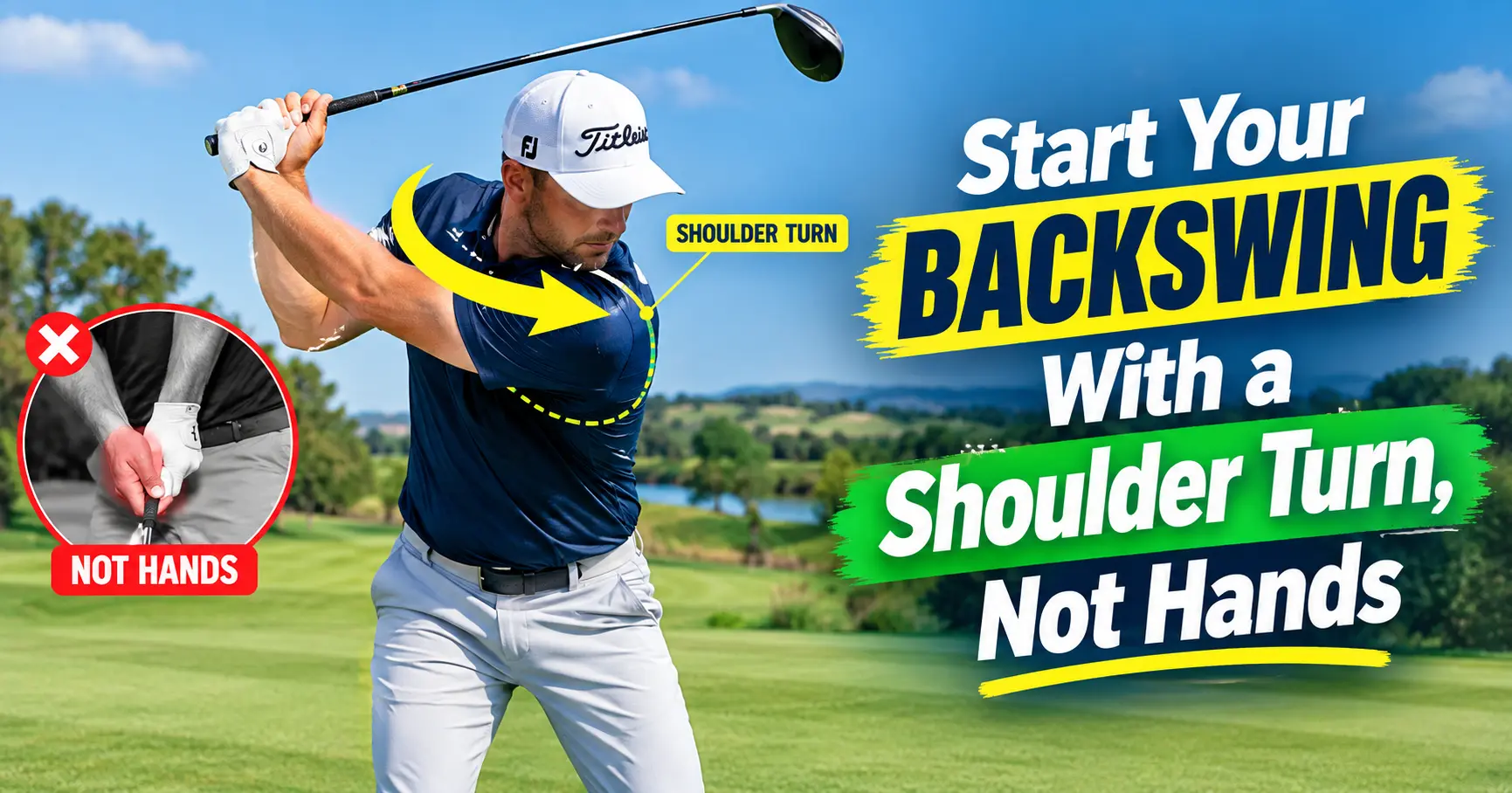
Quick Answer: Start your backswing with a shoulder turn, not your hands. Turn your right shoulder back and up while your chest rotates away from the target, roughly 90 degrees at the top. This keeps the club, arms, and torso moving together instead of your hands yanking the club inside on their own.
Watch enough range sessions and you’ll see the same first move over and over. A golfer sets up, then their hands snatch the club back before anything else moves. Wrists break early, the clubface fans open, and the rest of the swing spends itself trying to fix a mistake that happened in the first eight inches.
None of that is necessary. Turn your shoulders first and your hands become passengers instead of drivers. Get this one move right and half the swing faults you’re currently fighting disappear on their own.
Why Your Hands Shouldn’t Start the Backswing
Your hands are small, fast, and easy to move independently of everything else. That’s exactly the problem.
When the hands lead the takeaway, the club shoots to the inside, or the hands snatch it straight up, and the shoulders have to scramble to catch up later in the swing. You end up rerouting the club at the top just to get back on plane, which is where slices, pulls, and fat contact usually start.
A one-piece takeaway solves this. Your hands, arms, and shoulders move back together as a single unit for the first two or three feet, because your upper body’s turn drives them back, not any independent hand action. Nobody who plays to single digits starts their swing with a hand flick, and there’s a reason for that. The shoulders are bigger, slower, and far easier to repeat under pressure than a pair of wrists trying to time a golf swing on their own.
Learning to start your backswing with a shoulder turn instead of trusting your hands is the single biggest fix available to a mid-handicap player.
The Left Shoulder Cue vs the Right Shoulder Cue (And Why Both Are Right)
Search any golf forum and you’ll find two camps arguing past each other. One says turn your left shoulder under your chin. The other insists you should turn your right shoulder back and behind you instead.
Both camps are describing the same rotation. They’re just standing on opposite sides of it.
Turn your shoulders correctly and your left shoulder moves under your chin at the exact moment your right shoulder moves back and up behind you. You can’t do one without the other happening automatically, because they’re connected by the same turning ribcage. Mechanically, both cues are correct. The real question is which one helps a given golfer feel the move.
Here’s the practical difference. Golfers who sway, meaning their whole body slides toward the target line instead of rotating, usually respond better to the right shoulder cue. Focusing on turning the left shoulder under the chin gives a swaying golfer permission to lean and shift instead of rotate, because the chin isn’t a fixed target the way “behind you” is. Pulling the right shoulder back and up forces rotation around a stable center, and swaying gets a lot harder to do by accident.
If you’re not sure which camp you fall into, default to the right shoulder cue. It’s the safer bet for most amateurs, full stop, because swaying is the more common fault by a wide margin.
If you don’t have a sway problem and you turn cleanly already, the left shoulder cue works fine and there’s no reason to switch. Pick the one that actually fixes what’s going wrong in your swing, not the one that sounds more advanced.
Turn Your Chest, Not Just Your Shoulders
Here’s where a lot of instruction goes wrong. Telling someone to “turn the shoulders” invites them to rotate the shoulder joints on their own, disconnected from the ribcage underneath. That’s an arm swing wearing a shoulder turn’s clothing.
What you actually want is your chest, sternum and all, rotating as one piece with your shoulders riding on top of it. Picture your ribcage as a barrel turning inside your shirt. Your shoulders don’t move independently of that barrel. They move because the barrel moves.
Test this yourself. Cross your arms over your chest and turn away from an imaginary ball using only your torso. That rotation, chest and shoulders moving as one connected unit, is what a real shoulder turn feels like. Isolate the shoulder blades without involving the chest and you get a flat, disconnected turn that puts the club too far behind you at the top.
How to Start the Backswing With Your Shoulders, Step by Step
Here’s how to start your backswing with a shoulder turn, broken into checkpoints you can actually feel and verify.
- Set a neutral base. Flex your knees slightly and let your arms hang naturally from relaxed shoulders. A tense setup restricts the turn before it even starts.
- Move the triangle together. Let your hands, arms, and shoulders start back as one unit for the first foot of the swing. Nothing about the wrists should hinge yet.
- Turn your chest away from the target. Feel your sternum rotating, not just your arms swinging. Your right shoulder moves back and slightly up as your chest turns.
- Check your hip turn. Your hips should turn roughly half as much as your shoulders, somewhere around 40 to 45 degrees, while your shoulders approach 90 degrees at the top. That gap between hip turn and shoulder turn is where you store your power.
- Stop when your left shoulder reaches your chin. For most golfers with average flexibility, that’s the natural end of a full turn. Forcing it further just adds sway or arm lift, not extra distance.
Get through those five checkpoints and you’ve built a repeatable takeaway that doesn’t depend on timing your hands correctly under pressure.
A Simple Drill to Feel Your Right Shoulder Turn
Most shoulder turn drills focus on the hips or the arms. This one isolates the right shoulder directly, which is the piece most golfers never actually feel.
- Stand in your normal address posture without a club.
- Place your left hand flat against your right shoulder blade.
- Turn away from the target and feel your right shoulder blade pull back and up against your hand. Don’t let your hips slide sideways while you do this. The turn should feel like rotation around your spine, not a shift toward the trail foot.
- Hold that position for two seconds, then return to address and repeat it ten times.
- Once the feeling is familiar, grab a club and make slow, three-quarter backswings, checking that your right shoulder blade moves the same way it did without the club.
Do this drill for five minutes before you hit balls and you’ll notice the difference on real shots almost immediately. Golfers who’ve spent years starting the backswing with their hands often need a week or two of daily reps before the new move feels automatic, so don’t expect it to click on the first bucket.
What Your Right Shoulder Should Do in the Downswing
This is the part almost nobody explains, and it’s exactly where forum debates about the right shoulder tend to go sideways. Going back and coming down ask your right shoulder to do two completely different jobs.
Going back, your right shoulder turns up and behind you. Coming down, it needs to do the opposite: stay down and rotate under, not lunge toward the ball. Golfers who hear “hit the ball with your right shoulder” and take it literally often throw the shoulder out and over the top, steepening the swing and producing exactly the pull or slice they were trying to fix.
Keep your right shoulder down and let it rotate around your spine on the way through, following your hips rather than leading with the upper body. Your right shoulder should feel like it’s dropping into the space your left shoulder just vacated, working down and around your spine angle instead of firing out toward the ball. Get that sequencing backward, starting the downswing with the right shoulder throwing over the top, and no amount of backswing technique will save the shot.
Common Mistakes When Starting the Backswing With Your Shoulders
Once you commit to starting your backswing with a shoulder turn, three faults show up more than any others.
Swaying instead of turning. Your head and hips slide toward the trail foot rather than rotating around a fixed spine. Fix it by keeping your right knee flexed and stable throughout the takeaway, so there’s nothing for your hips to slide against.
Lifting the arms independently. The shoulders stall out early and the arms keep going up on their own, disconnecting the swing. If your lead arm crosses above your right shoulder before your chest finishes turning, that’s the tell.
Turning flat instead of on an angle. The shoulders rotate level to the ground rather than tilting with your spine angle. That flat plane usually produces a shot that starts well right of target with little curve, because the club approaches from too far inside.
None of these are complicated to diagnose. All three show up clearly on video from face-on, so if you have a phone and a tripod, film five swings and you’ll spot which one you’re doing within a minute.
Frequently Asked Questions
Should you start the backswing with your wrist, arm, or shoulders?
Start with your shoulders, not your wrist or arm. Your wrists and arms should stay quiet for the first foot or two of the takeaway, moving only because your shoulder turn is carrying them back. Independent wrist or arm movement at the start is what causes an inconsistent clubface and an inside-out or outside-in path later in the swing.
Should I turn my hips or shoulders first in the backswing?
Your shoulders and hips turn together, not one after the other, but your shoulders should turn roughly twice as far. Most instructors teach a 90-degree shoulder turn against a 40- to 45-degree hip turn as the standard ratio, and that separation between the two is what stores power for the downswing.
What should my right shoulder do in the golf swing?
In the backswing, your right shoulder turns back and slightly up. Coming down, it reverses that job completely, staying down and rotating under your chin rather than lunging at the ball. Confusing the two roles is the single most common mistake golfers make when they try to “use” the right shoulder.
Why do I sway instead of turn in my backswing?
Swaying usually happens when your trail knee straightens or your weight shifts sideways instead of rotating around a fixed point. Keep your right knee flexed through the takeaway and focus on turning your chest around your spine rather than shifting your hips toward the trail foot.
The Bottom Line
Starting your backswing with a shoulder turn instead of your hands fixes more swing faults than almost any other single change you can make. Turn your chest as one connected piece, let your right shoulder do its job on the way back and a different job on the way down, and stop worrying about which forum’s cue sounds smarter.
The technique matters more than the label you put on it. If your current move still opens the clubface on the way back, our guide to fixing an open clubface walks through the checkpoints that catch it before impact does.