
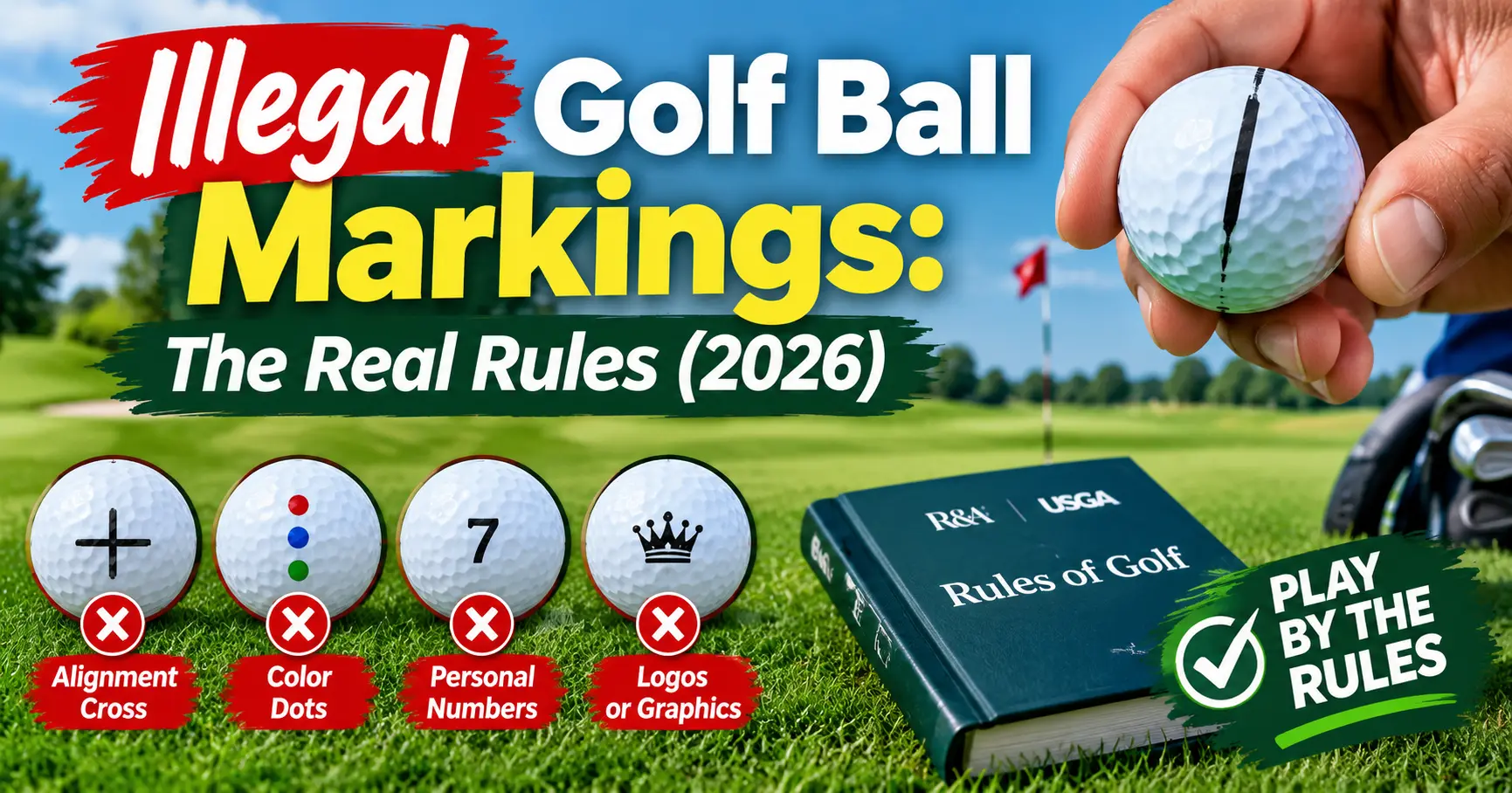
Quick Answer: Illegal golf ball markings usually mean the marker, not the ball. A line or initials drawn on your ball is legal under Rule 6.3a. A ball marker with an alignment line over 2 inches or a height over 1 inch is an illegal alignment device under Rule 4.3a, worth two strokes.
Somebody in your group draws a thick red line around their ball every single round. Another guy uses a coin with a laser-etched arrow to line up every putt. One of them is fine. The other one can cost two strokes, and most golfers have no idea which is which.
Here’s what separates the three rules people lump together under illegal golf ball markings: what you can draw on the ball itself, what turns a ball marker into a banned alignment device, and why illegal golf balls means something else entirely. You’ll walk away knowing exactly where the line sits, literally and legally.
The Three Things People Actually Mean by “Illegal Golf Ball Markings”
Search “illegal golf ball markings” and you’ll get three different rules smashed into one search result. That’s the actual problem, not the rules themselves.
First, there’s the mark you put on your ball with a Sharpie: a line, a dot, your initials. Second, there’s the object you use to mark your ball’s spot on the green, like a coin or a tee, which becomes a problem only when a manufacturer builds it past certain alignment-aid dimensions. Third, there’s the golf ball itself failing USGA testing for distance or spin, which has nothing to do with drawings or markers at all.
Conflating these three costs golfers real strokes. A guy who reads that “ball markings can be illegal” might panic about his Sharpie line while ignoring the actual $13 coin in his pocket that’s built to violate Rule 4.3a. Nobody explains the split. Illegal golf ball markings explained simply: three separate rules, three separate objects, and only one of them involves a pen.
Is It Illegal to Draw a Line on Your Golf Ball? What Rule 6.3a Really Says
No, it’s not illegal to draw a line on your golf ball. Rule 6.3a puts no limit on markings you add for identification, as long as the original manufacturer markings stay visible. Golfers have used lines, dots, arrows, and full logos for decades without a single rules official stepping in.
The Rules of Golf actually push you toward marking your ball, not away from it. Rule 6.3 makes you responsible for playing your own ball, and a stroke at the wrong one costs two shots in stroke play or the hole in match play. That gap between formats catches more golfers off guard than any marking rule does. A distinct mark is the cheapest insurance in golf.
You’ll see old articles claim this is “unsettled” under Rule 10-2b. It isn’t, and hasn’t been for years. Rule 10.2b(3) restricts objects you set down on the ground to help your stance or aim, things like alignment rods, clubs laid on the turf, or a rake positioned behind the ball. A mark on the ball you’re about to strike is a completely different object governed by a completely different rule. The governing bodies settled this distinction years before the current rule book, and every “debate is far from settled” article you find is quoting language that’s long retired.
Here’s the part almost nobody mentions: you’re allowed to rotate your ball when you replace it on the green, as long as its height off the ground doesn’t change. Line up your Sharpie mark at the hole all you want. Interpretation 14.2c/1 covers exactly this, and it’s the reason tour players can point their line at the target every single time without a ruling.
Viktor Hovland does it. So does half the field on any given Thursday. Nobody’s called a penalty for it, because there isn’t one to call.
How to Mark a Golf Ball With a Sharpie (Without Breaking Any Rule)
Marking a ball with a Sharpie takes about ten seconds once you know the trick. Here’s the version that actually produces a straight line instead of a wobbly mess.
- Find the ball’s equator. Most golf balls have a seam or a printed line where the two dimple hemispheres meet. Use it as your guide.
- Rest the ball on a flat surface, like a tabletop or the heel of your putter, so it doesn’t roll while you draw.
- Hold the marker steady against the ball and rotate the ball with your other hand instead of moving the pen. Your hand shakes less when it’s doing one job.
- Go over the line twice for a bolder mark that survives a full round of handling.
- Let the ink dry for 30 seconds before it touches your glove or your bag.
A fine-point permanent marker works better than a broad-tip one. The thinner line gives you a sharper reference point, and it bleeds less onto the dimples around it.
How to Draw a Straight Line on a Golf Ball Without a Tool
You don’t need a $10 stencil to draw a line on a golf ball without a tool. An empty toilet paper tube does the exact same job for free.
Cut the cardboard tube down to about an inch and a half. Push the ball into one end until it sits snug, with your reference point lined up right at the tube’s edge. Run your marker around the rim of the tube while it rests against the ball, using the cardboard edge as your ruler. The line comes out straighter than most people manage freehand, and the whole setup costs nothing.
A rubber band works too, if you’re in a pinch. Wrap it around the ball at the point you want your line, use it as a guide for the pen, then peel it off. It’s not as clean as the tube trick, but it beats eyeballing it from across the room.
Golf Ball Alignment Tools and Line Stencils: What They Cost and Whether You Need One
Stencils and alignment tools run cheap. A golf ball line stencil is nothing more than a plastic guide that keeps your Sharpie moving in a straight path, and you’ll pay somewhere between $7 and $20 for a basic clip-style version.
| Tool | Typical Price | What It Does | Legal for Tournament Play? |
|---|---|---|---|
| Basic plastic stencil clip | $7–$20 | Snaps around the ball, guides a marker along a fixed line | Yes, marks on the ball have no restriction |
| Multi-line stencil kit | $13–$20 | Prints several line options in one tool | Yes, same as above |
| Pen-and-clip combo tool | $8–$13 | Bundles a fine-tip marker with a plastic guide | Yes, same as above |
| Manufactured ball marker with a printed alignment line | $10–$30 | Coin-style marker for lining up the ball on the green | Only if the line stays under 2 inches and the marker stays under 1 inch tall |
A golf ball alignment tool won’t fix a bad putting stroke, but it will get your line straight in under a minute.
Here’s the part that trips people up: the stencil that draws the line on your ball is never the problem. The line itself carries no size limit under Rule 6.3a. The marker you set down on the green to hold your ball’s spot is a separate object, and a completely different rule covers it. That’s where the real restrictions live.
I’ll say it plainly: most of these $8 alignment tools are a solution to a problem that doesn’t exist. A steady hand and a cardboard tube get you the same result for free. Buy one if you like the ritual of it, not because the rules require it. If three-putts are your actual problem, fixing your distance control saves more strokes than any alignment trick ever will.
Illegal Ball Markers: The 1-Inch, 2-Inch Rule Nobody Mentions
An illegal ball marker in golf is an object built to mark your ball’s position that also crosses specific size and feature limits the Equipment Rules spell out. This is the piece almost every article on this topic skips entirely.
Since January 2020, the USGA and R&A have defined exactly when a manufactured ball marker becomes an “alignment device” under Rule 4.3a. Three things trigger it.
A marker taller than 1 inch in any position counts. A marker with a horizontal dimension over 2 inches that also carries a painted or etched line of 2 inches or longer counts too. So does any marker built with a slope-reading level, a compass, or an electronic component.
Break it down to the plain version: a normal flat coin with a thin line is fine, no matter how you use it. A thick disc with a 3-inch arrow etched across it, marketed as a putting aid, isn’t. The size of the line matters more than the fact that a line exists at all.
The penalty structure is brutal by golf standards. Use a marker that qualifies as an alignment device once, and you take the General Penalty, two strokes in stroke play or loss of the hole in match play. Do it a second time in the same round, and the penalty jumps to disqualification.
Most golfers assume a warning comes first.
It doesn’t.
Are There Illegal Golf Balls? (Yes, But This Has Nothing to Do With Markings)
Yes, illegal golf balls exist, and the reason has nothing to do with anything drawn or stamped on them. A golf ball becomes nonconforming when it fails USGA and R&A testing for distance, initial velocity, or symmetry, which is a manufacturing issue, not a markings issue.
The clearest historical example is the self-correcting ball. Polara built a dimple pattern designed to reduce sidespin and pull hooks and slices back toward the target, and it never made the Conforming Golf Ball List because self-correction violates the symmetry standard outright. Extra-distance balls follow a similar path. Larger cores and oversized dimple patterns can push initial velocity past the USGA limit, which knocks the ball off the list just as fast.
There’s no single downloadable list of illegal golf balls that stays current, because manufacturers submit new models constantly and there’s no static nonconforming golf ball list you can bookmark forever. What you can check is whether your specific model appears on the current Conforming Golf Ball List before you play a competition or post a score for handicap purposes. If it’s not there, it’s not legal for that round, regardless of what’s drawn on it.
Recreational rounds with your buddies don’t care about any of this. Tournament golf and handicap-posting rounds absolutely do.
Marking Your Ball on the Green: Placement, Etiquette, and Penalties Nobody Warns You About
Marking your ball on the green follows a simple sequence, but small mistakes here cost real strokes every season.
Place your marker directly behind the ball, or to the side if your line to the hole runs through where a coin would normally sit. Lift the ball by hand, never with a club. When you’re ready to putt, set the ball back down by hand too, directly in front of the marker, and pick the marker up afterward.
A few specific penalties catch people off guard. Putt with the marker still sitting on the green and you take a one-stroke penalty, even if the marker doesn’t touch the ball. Use a natural object like a leaf, a twig, or a divot of grass as your marker instead of something artificial, and that’s a one-stroke penalty too. A tee, a coin, a poker chip, a ball cap clip, even the tab off a soda can all qualify as legal markers because they’re artificial objects, regardless of how casual they look.
Honestly, half the etiquette advice out there overcomplicates this. Nobody’s going to call a rules official because you marked your ball with a tee at your Saturday game. Save the precision for competition rounds and handicap-qualifying rounds, where somebody’s actually watching.
Frequently Asked Questions
Is it illegal to draw a line on a golf ball?
No, it’s not illegal. Rule 6.3a puts no limit on markings you add to your ball for identification, including lines, dots, or logos, as long as the ball’s original markings stay visible.
Can you use a Sharpie to mark your golf ball?
Yes, a permanent marker is the most common tool golfers use for this. Fine-point markers give a cleaner line than broad-tip ones, and neither breaks any rule.
What is the penalty for an illegal ball marker?
The first time you use a marker that qualifies as an alignment device, you take the General Penalty, two strokes in stroke play or loss of the hole in match play. A second use in the same round means disqualification.
Are there illegal golf balls?
Yes, but the reason is manufacturing, not markings. A ball becomes nonconforming when it fails USGA testing for distance, velocity, or symmetry, and it won’t appear on the Conforming Golf Ball List.
What is the best way to mark a golf ball for alignment?
A fine-tip permanent marker and a steady hand beat most $10 stencils. Rest the ball on a flat surface, rotate it against a stationary pen, and go over the line twice for a mark that survives the round.
Can you use a tee to mark your ball on the green?
Yes. The Rules of Golf specifically define a tee as an acceptable ball marker, along with coins and other small artificial objects.
Bottom Line
Draw whatever you want on your golf ball. That part of “illegal golf ball markings” was never actually restricted. Save your attention for the marker in your pocket instead, since that’s the object with a real 1-inch, 2-inch rule attached to it, and it’s the one nobody checks before a competition round. If you’re still fighting the yips on top of all this, a legal alignment line paired with the right putter does more for your confidence than any rules debate ever will.