
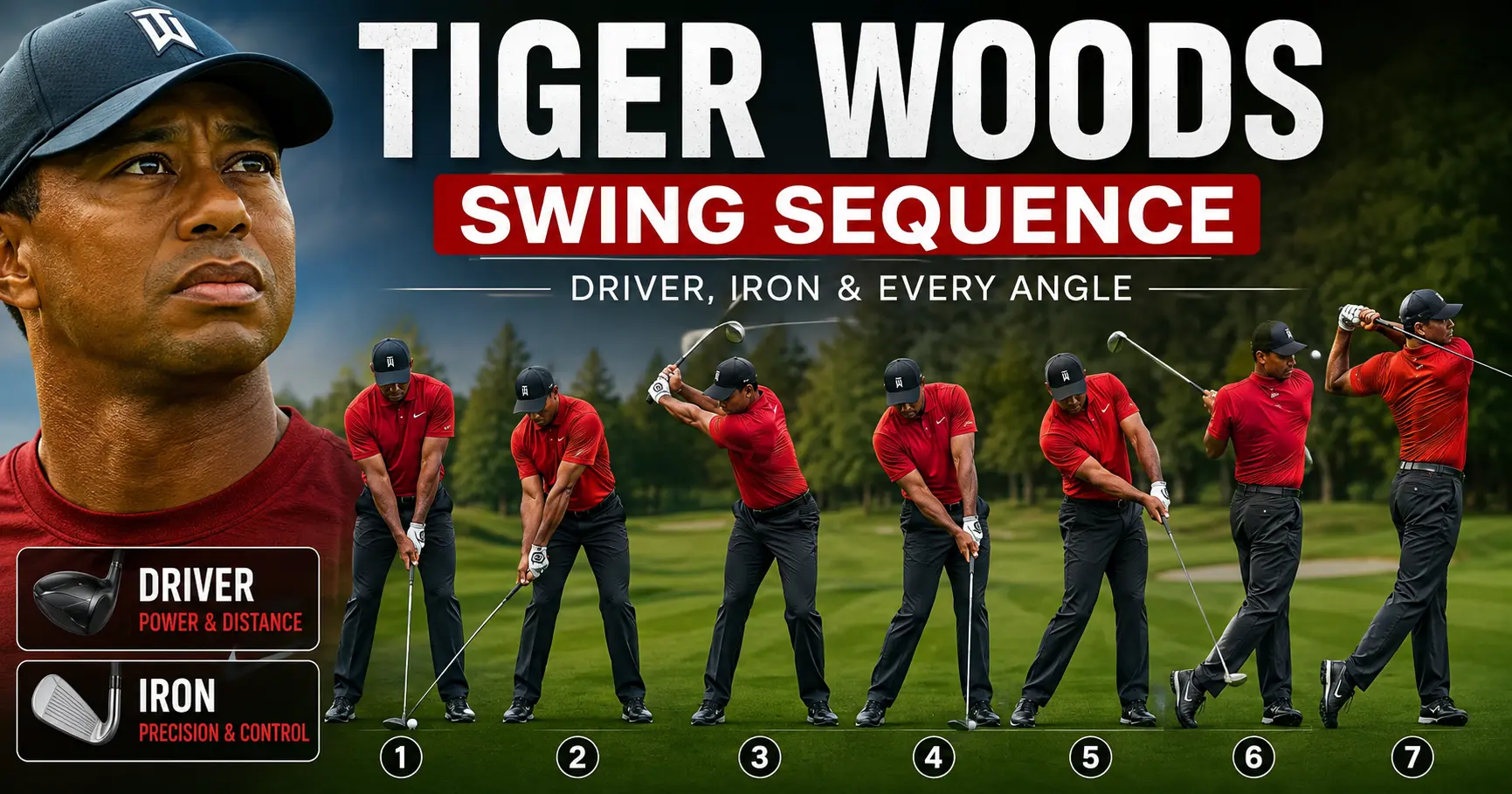
Quick Answer: Tiger Woods’ swing sequence is a frame-by-frame photo series capturing his full swing from setup to finish, usually shot face-on or down-the-line. During his 2023 comeback stretch, Golf Digest clocked his driver swing at 121 mph, eight mph above the PGA Tour average. The one move worth copying is his calmer, later transition from backswing to downswing.
Photographers have shot Tiger Woods more than almost any athlete alive, and instructors study his swing sequence more than any other image in golf. Type “tiger woods swing sequence” into Google and you get a wall of thumbnails: driver, iron, 1997, 2000, face-on, down-the-line, even poster prints for a home office wall. Most of that Tiger Woods swing analysis shows you frames without explaining what you’re actually looking at. This piece breaks his swing down by club, by camera angle, and by era, so you know exactly what to look for the next time you study one.
How to Read a Swing Sequence Photo (Before You Study Tiger’s)
A swing sequence isn’t one photo. It’s a burst of individual frames stitched into a single image, usually shot at 10 to 20 frames per second by a photographer holding down the shutter through the entire motion. That’s why you’ll see a photo credit note like “frame 3 of sequence” buried in the caption on wire-service shots of Woods.
Photographers don’t plan these shots around round numbers of frames. They just hold the button down and pick the cleanest set afterward.
Two things determine whether a sequence is actually useful to you. First, the camera angle. Second, the club.
Swap either one and the same swing can look completely different, which is exactly why “his 2000 swing” and “his driver swing” get discussed as if they’re separate topics. They kind of are. We’ll walk through both.
One honest note before you dive in: comparing your swing directly against Tiger’s positions rarely helps a mid or high handicapper. His flexibility, hip speed, and decades of repetition let him get into positions your body may not be built for yet. Study the sequence for concepts, not exact angles to copy.
Tiger Woods Driver Swing Sequence, Position by Position
The driver swing is the version most golfers picture when they hear “tiger woods swing sequence,” and it’s also the one Golf Digest documented most recently with real numbers attached. Here’s what each position in the sequence is doing and why it matters.
- Address. Woods sets up with a strong lead-hand grip, hands slightly ahead of the ball, and a wide stance built for stability rather than mobility. That grip is a big reason he could produce such an aggressive draw during his peak years. If your own grip feels weak by comparison, it’s worth checking where your hands actually sit before you touch anything else in your swing.
- Takeaway. The club, chest, and arms move back together in what instructors call a one-piece motion. Nothing gets handsy this early. The clubhead stays just outside his hands and close to the target line instead of getting yanked inside.
- Top of the backswing. This is where his sequence has changed the most across eras, which we’ll get into below. In his post-fusion swing, Golf Digest’s David Leadbetter noted that Woods doesn’t need a long, loose backswing to generate speed. His shaft doesn’t even reach parallel at the top anymore, and he’s still swinging past 120 mph.
- Transition. This is the move Leadbetter singled out as the biggest change in Woods’ more recent swings: a quieter shift into the lead side with none of the aggressive knee-sink-and-stand-up move that used to show up in his 1990s and 2000s swings.
- Downswing. The arms drop rather than get yanked, which gives him room to accelerate through the ball without feeling “stuck,” a word Woods himself used for years to describe getting his arms trapped behind his body.
- Impact and release. His trail arm crosses over the lead arm through the hitting area, and the finish looks relaxed rather than manufactured. That release is what separates a swing that just looks fast from one that’s actually efficient.
How Fast this Sequence
The numbers back up how fast this sequence really moves. During his 2023 comeback stretch, Golf Digest tracked Woods’ driver clubhead speed at 121 mph against a PGA Tour average of 113 mph. More recent tracking from swing analysts in late 2025 put his launch angle around 8 degrees with roughly 3,100 rpm of spin, a combination that costs him some of the distance his raw speed should produce.
Speed alone was never the full story with his driver. The loft and spin numbers around it always mattered just as much, which is worth remembering if you’re comparing your own driver loft against his.
Tiger Woods Iron Swing Sequence, Position by Position
Search “tiger woods iron swing face on slow motion” and you’ll find plenty of clips, but almost nothing explaining how the iron sequence actually differs from the driver sequence. It’s not a small difference.
With an iron, Woods plays the ball noticeably further back in his stance than with the driver, and his hands sit more forward at address. That forward shaft lean is deliberate. It’s what lets him hit down and through the ball rather than sweeping it, taking a shallow divot after impact instead of before it. Compare a face-on iron frame to a face-on driver frame from the same swing and you’ll notice his spine tilts less away from the target with the iron in hand, because he’s not trying to launch the ball as high off the turf.
His stinger, that low, piercing 2-iron shot, is the most famous product of this iron sequence. It comes from an abbreviated backswing, a slightly more upright plane, and a conscious effort to keep his hands ahead of the clubhead well past impact. Woods has talked openly about how he actually grew up as a natural sweeper of the ball and had to train himself over years to hit down on iron shots consistently, working through ball position, shaft lean, and wrist angle changes with multiple coaches to get there.
If your own iron contact feels inconsistent, the fix usually isn’t copying Tiger’s exact positions. It’s understanding that ball-first contact requires a forward-leaning shaft and a descending strike, two things a lot of amateur swings never actually produce. That’s covered in more detail in our guide to hitting your irons more consistently.
Face-On vs. Down-the-Line vs. From-Behind: What Each Angle Actually Shows You
Every competing article shows you these camera angles. None of them tells you what to actually look for in each one, which is a shame, because the angle changes what information you can pull from a sequence.
Face-On View
This is the camera positioned directly in front of the golfer, facing the chest. It’s the best angle for judging spine tilt, weight shift between the trail and lead side, and head movement through the swing. It’s a poor angle for judging swing plane, because a camera facing you can’t show depth accurately. If you’ve ever seen a “tiger woods iron swing front view” clip and wondered why it doesn’t look like his driver plane, the front view was never designed to show plane in the first place.
Down-the-Line (DTL) View
This is the camera set up on an extension of the target line, usually a few feet behind the ball and at hip height. It’s the single best angle for judging swing plane, path, and clubface position at the top, which is why serious instructors film DTL first. When people search “tiger woods swing sequence dtl,” this is almost always the angle they actually want, because it’s the one that shows whether a swing is on-plane, too steep, or too flat.
From-Behind View
This gets confused with down-the-line constantly, and the two aren’t identical. A true down-the-line camera sits low and directly on the target line. A from-behind camera is often set up a bit higher and further back, giving a fuller view of the whole arc, including the release and follow-through, at the cost of some plane-reading precision.
If you’re filming your own swing and only have one angle to pick, down-the-line beats from-behind for diagnosing swing faults. From-behind wins if you just want to see the full shape of the motion.
Tiger’s Swing Then vs. Now: 1997, 2000, and Today
Woods has rebuilt his swing more times than any dominant athlete in golf history, and the “tiger woods swing sequence 2000” searches exist because most instructors consider 2000 his peak. Here’s the actual arc.
Woods won the 1997 Masters by 12 shots at age 21 with a swing that had a notably shut clubface at the top, sitting somewhere around 25 to 30 degrees closed relative to square. Instead of building on that win, he told Butch Harmon he wanted a total rebuild, not incremental tweaks. The two spent nearly two years reworking his takeaway, backswing width, and left-arm plane, and Woods actually won just once in 1998 while the changes settled in.
The payoff arrived in 2000. He won the U.S. Open at Pebble Beach by 15 shots and the Open Championship at St Andrews by 8 shots in the same summer, hitting over 71 percent of fairways that season.
Frame-by-frame swing analysts have tracked his clubface angle at the top during this stretch at roughly 35 to 45 degrees open, a much more square, synchronized position than his 1997 swing produced. This is the version most golf instructors point to when they say “study the 2000 swing.”
Tracks How that Clubface Position Moved
The table below tracks how that clubface position moved across each coaching era, based on frame-by-frame analysis rather than a single photo.
| Era | Coach | Approx. Face Angle at Top | What Actually Changed |
|---|---|---|---|
| 1996-1997 | Butch Harmon | ~25-30° (shut) | Strong grip, powerful but hard to repeat |
| 1997-2003 | Butch Harmon (rebuilt) | ~35-45° | Wider takeaway, synced arms and body |
| 2004-2010 | Hank Haney | Similar range | Focus on health and long-term consistency |
| 2010-2014 | Sean Foley | ~26-33° (flatter) | More stack-and-tilt influence, steeper plane |
| 2014-2018 | Chris Como | ~33-40° | Drifted back toward the 2000-era look |
| 2023-present | Self-directed | Not tracked at this precision | Quieter lower body after spinal fusion |
Face angle at top is degrees open or closed relative to the target line, as tracked by frame-by-frame swing analysis. Camera angle, club selection, and shot type all shift the exact reading, so treat these as directional, not laboratory-precise.
As for right now: Woods has played a limited 2025-26 schedule while recovering from a lumbar disc procedure, his seventh back surgery since 2014, and he made his only real competitive swings of the 2026 season in March at the TGL Finals. If you’re searching for his current tournament swing sequence, you’re mostly out of luck this year. The most instructive sequences to study are still the 2000 peak, the 2006 Haney-era swing, and the 2018-2023 post-fusion swing Golf Digest documented, since each represents a genuinely different, complete version of his technique rather than a snapshot mid-change.
The One Move Amateurs Should Actually Copy
Most of Tiger’s swing isn’t copyable by an average golfer. His hip speed, shoulder turn, and hand strength come from decades of repetition most of us will never put in. But one piece of his sequence transfers to almost any swing speed: the quiet, unhurried transition from backswing to downswing.
Golfers at every level tend to rush this move, yanking the club down with the shoulders or arms before the lower body has finished its job. Woods’ more recent sequences show the opposite. The lower body settles into the lead side first, calmly, while the arms and club are still finishing the backswing, and only then does everything fire together into impact. That sequencing, not the raw speed, is what actually produces a whipping release through the ball.
Here’s the part most instruction content won’t say out loud: this move is genuinely harder for a golfer with limited hip mobility or a weak core, and forcing a slower transition without the rotational strength to back it up can just as easily produce a weak, disconnected swing. If your hips can’t rotate freely, work on mobility before you try to slow down your transition. A strong grip helps the rest of this sequence hold together, but it won’t fix a rushed transition on its own.
How to Build Your Own Swing Sequence to Compare Against His
You don’t need a photographer with a motor-drive camera to build a usable sequence anymore. Most modern phones shoot slow motion at 120 or 240 frames per second, which is more than enough to break your own swing into the same positions covered above.
- Set your phone to its highest slow-motion frame rate. 240fps gives you smoother, more analyzable frames than the standard 30fps video most people default to.
- Use a tripod or prop the phone against something solid. Handheld footage introduces shake that makes swing-plane comparisons useless.
- Film down-the-line first. Set the camera on your target line, a few feet behind the ball, at roughly hip height, since this angle gives you the most diagnostic information per the section above.
- Film a second face-on angle if you can. This adds the weight-shift and spine-tilt information the down-the-line angle can’t show you.
- Pull individual frames at address, top of backswing, impact, and finish. Most phone editing apps let you step through slow-motion footage frame by frame without extra software.
- Compare positions, not the whole motion at once. Look at one checkpoint against a reference photo, note the difference, then move to the next checkpoint instead of trying to fix everything simultaneously.
Where to Find Official Swing Sequence Posters and Photos
A fair number of the “tiger woods swing sequence picture” and “tiger woods swing sequence poster” searches are people who just want something to frame, not something to study. If that’s you, a couple of things are worth knowing before you buy or download anything.
Licensed sports photography retailers sell official swing sequence collages, including well-known composites shot during his 2000 peak, as framed prints through legitimate photo licensing sites. Wire services like Getty Images also license individual frames from tournament photographers, which is where most editorial swing sequence photos originate in the first place. Avoid downloading random sequence images from blogs or forums to print yourself. Almost none of those carry reproduction rights, even when the hosting site itself does.
Frequently Asked Questions
What is Tiger Woods’ swing sequence?
It’s a series of frame-by-frame photos capturing his full golf swing from address through finish, most commonly shot from a face-on or down-the-line camera angle during tournament play or dedicated instructional photo shoots.
Why does Tiger Woods’ swing look different in every photo you find?
Because it genuinely has changed multiple times. He rebuilt his swing with Butch Harmon after the 1997 Masters, then again with Hank Haney, Sean Foley, and Chris Como, and his post-fusion swing since 2023 looks different again from all of those. The camera angle and club also change how the same swing appears.
What swing plane does Tiger Woods use?
His plane has shifted by era, from a shut clubface around 25 to 30 degrees in 1997 to a more square 35 to 45 degrees during his 2000 peak, then flatter again under Sean Foley in the early 2010s. There’s no single “Tiger Woods swing plane.” There are several, depending on which year you’re studying.
Is Tiger Woods’ iron swing different from his driver swing?
Yes. His ball position sits further back, his hands lean more forward at address, and his angle of attack is steeper with irons, producing the descending strike and shallow divot that made his ball-striking so consistent.
Where can I get a Tiger Woods swing sequence poster?
Licensed sports photo retailers and wire-service licensing sites sell official framed sequence prints, most commonly from his 2000 season. Downloading and printing images from unlicensed blogs or forums generally isn’t a legal way to get one.
What’s the best angle to film your own golf swing sequence?
Down-the-line, set on your target line at hip height, gives you the most useful information about swing plane and path. Add a face-on angle if you want weight shift and spine tilt data too.
The Bottom Line
Tiger Woods’ swing sequence isn’t one thing. It’s at least five different swings across three decades, shot from angles that each reveal different flaws and strengths, applied to two clubs that ask his body to do genuinely different jobs. The 2000 sequence remains the technical peak most instructors point to, but the post-fusion version Golf Digest documented shows you something arguably more useful for an amateur: how to generate real speed with less physical strain.
Study the transition move first. Everything else in his sequence is downstream of that one piece of timing, and it’s the part of his driver setup most amateurs can actually take to the range.