
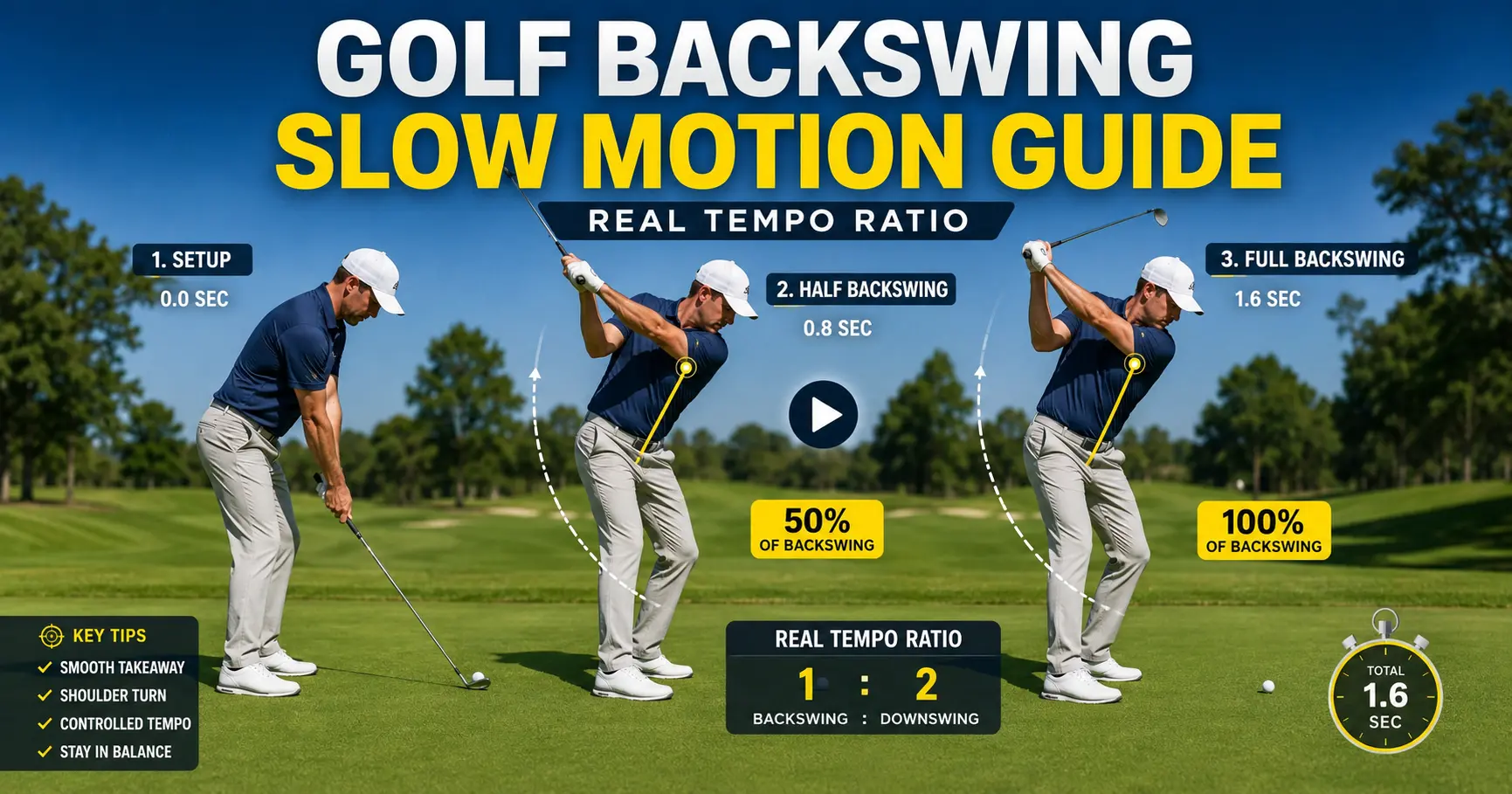
Quick Answer: Golf backswing slow motion analysis breaks your takeaway, halfway-back, and top-of-swing positions into checkpoints you can compare against tour pros. Tour players keep a 3:1 backswing-to-downswing tempo ratio, not a fast backswing. Film yourself at 240fps down the line to spot the leaks.
Here, you get both, plus the number that matters more than how slow or fast your backswing looks on video: your tempo ratio. Grab your phone, because by the end of this you’ll know exactly how to film, measure, and fix your own checkpoints.
What “Slow Motion” Actually Means for Your Backswing
Three different searches hide inside this one keyword, and they need different answers. First, some golfers want to watch a pro’s backswing slowed down to study positions, the way you’d rewind a Ben Hogan clip frame by frame. Second, some want to physically practice their own backswing in slow motion as a rehearsal move, no ball involved. Third, and this is the one nobody talks about, some golfers want to film their own swing on a phone and play it back in slow motion to diagnose faults.
Treat all three as one topic here, because they work together. You watch pro positions to know the target. Film your own swing to see the actual gap. That’s the real work behind golf backswing slow motion practice: watch, film, then fix.
Plenty of golfers still start by watching the best golf backswing slow motion clips of tour pros they can find, and that’s a fine first step. It only becomes useful once you know which three checkpoints to actually look for, which is exactly what the next section breaks down.
The Real Reason Slow Motion Practice Works: Tempo Ratio, Not Speed
Chasing a slower backswing for its own sake wastes range time. An effortless golf swing slow motion breakdown never comes from backswing speed at all, no matter how many pros you’ve watched swing at half speed on video. A specific ratio between backswing time and downswing time does the separating instead.
Yale researcher Robert Grober studied the swings of touring professionals and found something remarkably consistent. Nearly every elite player swings at a 3:1 ratio, three units of time on the backswing for every one unit on the downswing. Golf instructor John Novosel documented the same pattern years earlier in his book Tour Tempo, and built training tones around ratios like 21:7, 24:8, and 27:9, all of which reduce to that same 3:1 relationship. Amateurs, by contrast, often swing closer to 4:1 or 5:1, dragging the backswing out and rushing the transition.
Here’s what those ratios look like once you count actual video frames at 30 frames per second, the standard playback speed most swing apps default to:
| Tempo Level | Backswing (frames) | Downswing (frames) | Ratio |
|---|---|---|---|
| Slow, deliberate | 27 | 9 | 3:1 |
| Standard tour pace | 24 | 8 | 3:1 |
| Fast, explosive | 21 | 7 | 3:1 |
| Fastest recorded on tour | 18 | 6 | 3:1 |
None of these levels are inherently better for distance. What matters is that your own ratio stays close to 3:1, whichever speed you naturally fall into. A slow, deliberate 27:9 tempo and an explosive 18:6 tempo describe the same relationship, just at different absolute speeds.
Backswing Checkpoints to Watch For, Frame by Frame
A golf backswing sequence slow motion breakdown really just means slicing one continuous motion into three freeze-frames. Slow the video down and those three positions tell you almost everything about your backswing. Miss one of these and the rest of the swing has to compensate for it. There’s no single perfect golf backswing slow motion template that fits every body type, but these checkpoints hold up across almost all of them.
The Takeaway (First 18 Inches)
A golf backswing takeaway slow motion review starts here, before anything else in the swing. Your clubhead, hands, and shoulders should move away from the ball together, in one piece, for the first foot and a half. At this point in the video, the clubface should still look square to your spine angle, not rolled open or shut. Amateurs snatch the club inside with their hands here, which opens the face early and forces a steep, over-the-top move later in the swing.
Halfway Back (Club Shaft Parallel to the Ground)
By the time the shaft reaches parallel with the ground, your lead wrist should be flat, not cupped, and the toe of the club should point roughly straight up. Your shoulders have turned somewhere around 45 degrees at this checkpoint, with your hips trailing behind at roughly half that. A slow motion replay at this exact frame is where most swing flaws first become visible, well before the top of the backswing.
Top of the Backswing
Your lead arm should be reasonably straight, your wrists fully hinged, and your shoulder turn somewhere around 90 degrees relative to your hips. The clubshaft, viewed down the line, points roughly parallel to your target line rather than crossing over it. Golfers with limited shoulder mobility will never hit that 90 degree number, and that’s fine. A shorter turn with a clean 3:1 tempo beats a full turn with a rushed, disconnected one every time.
How to Film Your Own Backswing in Slow Motion
Real slow motion golf swing analysis starts with the camera, not the swing. Checkpoint analysis is useless without decent footage, so get the filming right first. Set your phone’s camera to its highest slow motion frame rate, 240 frames per second on most current iPhones and many Android flagships, at 1080p resolution. Lower frame rates like 120fps still work fine, but 240fps gives you roughly four times the individual frames to freeze and compare against the checkpoints above.
Four things matter more than the phone itself:
- Shoot down the line, not face on. Down the line is the only angle worth filming for checkpoint work, full stop. Face-on looks good on social media and tells you almost nothing about your swing plane or clubface angle. Position the camera a few feet behind the ball, roughly on your target line, low to the ground.
- Use a tripod or phone stand, not a friend holding it. Handheld footage shakes exactly when you need a still frame the most, right at the top of the backswing.
- Film in daylight or bright indoor light. Slow motion footage drops resolution and adds grain in low light, which makes wrist and clubface angles hard to read.
- Play it back frame by frame, not just in slow motion. Most phone photo apps let you scrub frame by frame once you tap into the video. Counting actual frames from takeaway to the top, then top to impact, is how you calculate your own tempo ratio from the table above.
Golf Backswing Slow Motion Drills That Fix Real Faults
Match the fault you see in your own slow motion footage to one of these five drills. Each one isolates a single position instead of asking you to fix your whole swing at once. A slow motion golf swing for beginners plan should honestly start here, without a ball, before adding one back in.
| Fault You See in Slow Motion | Drill | Why It Works |
|---|---|---|
| Hands snatch the club inside on the takeaway | One-piece takeaway drill: hold a headcover or glove under your lead armpit and make slow backswings without dropping it | Forces hands, arms, and shoulders to move together instead of the hands taking over early |
| Hip slide instead of a turn | Split-stance drill: pull your lead foot back into a narrow, staggered stance and make slow backswings | The stance physically blocks a lateral slide, forcing rotation into the trail hip instead |
| Cupped lead wrist at the top | Wall drill: stand with your back to a wall, grip a club, and make slow backswings keeping the clubhead a few inches off the wall | Gives immediate feedback if your swing plane runs too steep or too flat, which usually causes the cupping |
| Backswing and downswing at nearly the same speed | Count drill: say “one-two-three” to the top of your swing and “one” through impact, slow motion first, then at half speed | Trains the 3:1 ratio directly instead of leaving tempo to feel |
| Overswinging past parallel at the top | Pause drill: swing to the top in slow motion, stop, and hold the position for two full seconds before starting down | Removes momentum, so only the turn your body can control under its own strength shows up |
Work one drill at a time for at least two weeks before adding another. Layering three fixes into the same range session is how amateurs end up with a swing that looks like a committee built it.
Iron vs Driver: Does Your Slow Motion Backswing Change?
A golf iron backswing slow motion review and a golf driver backswing slow motion review should look almost identical at the three checkpoints above. The overall shape of a good backswing doesn’t change much between clubs, but two things genuinely do shift, and both show up clearly on slow motion video.
Ball position moves forward in your stance for the driver, off the lead heel instead of centered, which naturally shallows your swing plane on the way back. Swing length also tends to run a touch longer with a driver, since a lighter, longer shaft encourages a bigger shoulder turn than a shorter iron shaft asks for. That shallower plane and longer shaft length is part of why driver loft behaves so differently from iron loft at impact, something our golf club lofts guide covers in more depth.
A 7 iron is genuinely the easiest club to build these checkpoints with in the first place. Shorter shaft, more forgiving plane, less room for the swing to go badly wrong at speed. If you only run one slow motion golf swing 7 iron session this week, spend it on the three checkpoints above before moving to the driver. Once your checkpoints hold up on camera, our iron contact tips can help translate that into cleaner strikes at full speed.
Slow Motion Backswing Practice for Senior Golfers
Golf backswing slow motion for seniors doesn’t need a different method, just a different target number, and pretending otherwise wastes practice time. Shoulder and hip rotation both decline naturally over the decades, so a 90 degree shoulder turn that felt normal at 40 stops being realistic for plenty of players by 70. That’s not a flaw to fix. The target itself is different.
A three-quarter backswing, stopping the club a bit short of parallel at the top, keeps the same 3:1 tempo ratio while working within a smaller, more sustainable range of motion. Filming this in slow motion matters even more for senior golfers, because a shortened backswing can quietly turn into a rushed, all-arms swing if the tempo ratio slips without anyone noticing. Widen your stance slightly for stability, and don’t chase the shoulder turn numbers a 25 year old tour player posts.
None of this replaces an actual mobility assessment from a certified instructor or physical therapist if shoulder or hip rotation feels genuinely restricted, not just different than it used to be.
Common Backswing Faults a Slow Motion Video Reveals
These four faults account for most of what shows up when amateurs finally film their own backswing.
| Fault | What You See in Slow Motion | Likely Cause |
|---|---|---|
| Reverse pivot | Chest tilts toward the target during the backswing instead of away from it | Weight staying on the lead foot instead of loading into the trail hip |
| Flying elbow | Trail elbow points away from the body at the top instead of down toward the hip | Overactive arms taking over from a passive shoulder turn |
| Over-the-top transition | Club moves outside the original backswing plane at the start of the downswing | A backswing tempo running too close to 1:1 instead of 3:1 |
| Cupped lead wrist | Back of the lead hand bows away from the forearm at the top | Grip that’s too weak, or an overly steep takeaway |
Frequently Asked Questions
Is it okay to have a slow backswing in golf?
Yes. A slow backswing is fine as long as your downswing takes roughly a third of that time, the 3:1 ratio covered above, not a ratio closer to 1:1 where both halves move at nearly the same pace. Sungjae Im has one of the slowest, most deliberate backswings on the PGA Tour by reputation, and it hasn’t stopped him from becoming a PGA Tour Rookie of the Year and tournament winner. Raw speed was never the variable that mattered.
Should the backswing in golf be slow or fast?
Neither one, by itself, tells the whole story. Absolute backswing speed matters far less than its relationship to the downswing. Yale researcher Robert Grober and Tour Tempo author John Novosel independently landed on the same number studying elite players: a 3:1 backswing-to-downswing ratio, regardless of whether that player’s overall swing looked fast or slow. Chase the ratio instead of a label.
How do you slow your backswing in golf?
Don’t force it by tensing your arms. That just creates a jerky, disconnected transition. Widen your takeaway instead, pushing the clubhead low and away from the ball for the first 12 to 18 inches. Count “one-two-three” to the top and “one” through impact, in slow motion first, then closer to full speed.
How do you perform a slow takeaway in a golf swing?
Move the clubhead, hands, and shoulders away from the ball together, as one piece, for the first foot or so. Keep the clubface matched to your spine angle here, not rolled open or closed. Most amateurs snatch the club inside with their hands in this exact window, opening the face early and setting up a steep move later in the swing. Slow that first 18 inches down on purpose, even if the rest of your swing stays at normal speed.
Where to Start This Week
None of this requires new equipment or a lesson package to start. Grab your phone, set it to its highest slow motion frame rate, and film ten backswings with an iron before you touch a driver. Compare what you see against the checkpoints above, run the ratio math from the frame table, and pick one drill instead of three. If your driver checkpoints still look sloppy once your irons clean up, our driver drill guide picks up exactly where this one leaves off.