
If you want to know how to grip a golf club correctly, you are already ahead of most golfers who never think about it. A bad grip is the hidden cause of slices, hooks, weak contact, and lost distance — and it takes less than five minutes to fix.
In this guide you will learn exactly how to grip a golf club step by step, which grip type suits your game, how tight to hold the club, and the most common grip mistakes that cost golfers shots every single round.
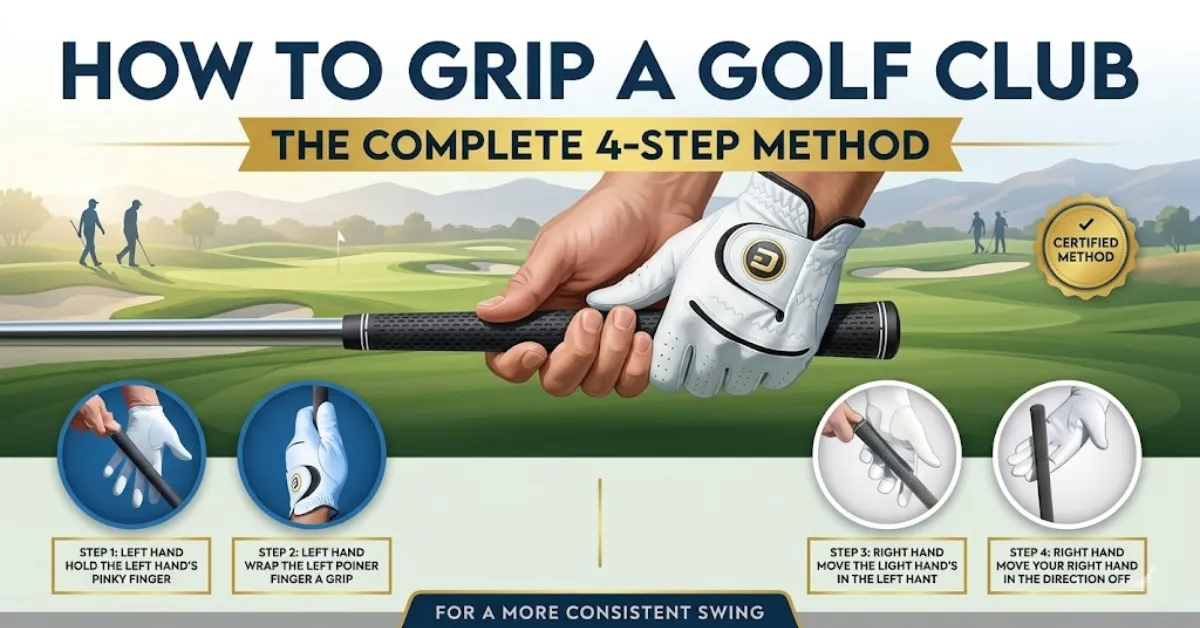
- Start by holding the club in your left hand (for right-handed players) with your palm facing up.
- Place the club diagonally across your fingers to rest across the base and the top joint of your index finger.
- Wrap your fingers around the grip, ensuring not to grip it too tightly. Your thumb should be on the grip, pointing toward the club head.
Place your right hand on the club with your palm facing up to complete the grip. Your right thumb should rest beside your left thumb, creating a V-shape. This grip promotes a more controlled and consistent golf swing.
Always hold the golf club with a light but firm grip, allowing for flexibility and a smoother swing. Practicing and perfecting your golf grip is essential in improving your game and achieving better results on the golf course.
How to Test If Your Golf Grip Is Consistent
Take your grip, then let the club hang vertically. Open your top three fingers on your left hand. If the club stays in place, held by your little finger and ring finger, your grip is in the fingers correctly. If it drops, you are palming it.
Take five practice swings without a ball and check your grip position at the top of the backswing. The club should feel secure without squeezing harder. If it slips or shifts, your starting pressure is too light.
Use a mirror or your phone camera to check the V positions after taking your grip. Photograph your grip once you find the right position and use it as a reference before rounds.
Why Your Golf Grip Matters More Than Your Swing
Most golfers blame their swing when shots go wrong. The real problem is often the grip. Your hands are the only part of your body that touches the club. Everything — clubface angle, swing path, ball flight — starts from how you hold it.
A correct grip gives you control over the clubface at impact. An incorrect grip forces your body to compensate mid-swing, which is why the same bad shot keeps happening even after lessons.
The good news: fixing your grip takes minutes. The results show up the same round.
How to Grip a Golf Club: Step-by-Step for Beginners
These instructions are written for right-handed golfers. If you are left-handed, simply reverse all left and right references.
Step 1 — Position your lead hand (left hand)
Let your left arm hang naturally at your side. Grip the club in that relaxed position — do not rotate your hand to grip it, let it fall where it naturally sits. The handle should run diagonally across your fingers from the base of your little finger to just below the middle joint of your index finger. You should see 2 to 2.5 knuckles on your left hand when you look down.
Step 2 — Place your left thumb
Your left thumb should sit slightly to the right of centre on the top of the grip — not straight down the middle. The V shape formed between your thumb and index finger should point toward your right shoulder.
Step 3 — Add your trail hand (right hand)
Place your right hand below your left so the lifeline of your right palm covers your left thumb completely. The right hand should feel like it is cradling the left. The V formed by your right thumb and index finger should also point toward your right shoulder — both Vs pointing the same direction is the key checkpoint.
Step 4 — Connect the two hands
Choose one of the three grip styles below (overlapping, interlocking, or baseball) to connect your hands. The connection is what makes your two hands work as one unit through the swing.
Step 5 — Check your grip pressure
On a scale of 1 to 10 — 10 being as tight as you can — aim for a 4 or 5. The club should feel secure but your forearms should have no tension. See the full grip pressure section below.
Long Left Thumb vs Short Left Thumb
When holding a golf club, the length of your left thumb can significantly affect your golf swing.
The golf grip is crucial as it determines how well the club is controlled throughout the swing. For individuals with a long left thumb, it can be advantageous in achieving a proper golf grip.
A longer thumb allows for a better connection between the hands and the club, creating stability and control. It enables the golfer to maintain a firm hold on the club throughout the swing, improving accuracy and distance.
Individuals with a short left thumb may face challenges in gripping the golf club correctly. The shorter thumb may result in a weaker grip, making it more difficult to control the club during the swing. This can lead to inconsistent shots and less power.
However, it’s important to note that there is no one-size-fits-all answer when it comes to thumbs.
Each golfer’s anatomy is unique, and what may work for one person may not work for another. Therefore, it’s essential to experiment and find the most comfortable and effective grip for your left thumb length.
How to Grip a Golf Club for Chipping and Pitching
For most full shots — driver, irons, fairway woods — keep the same grip you practised above. Consistency matters more than changing for each club.
Chipping: Move your hands 1–2 inches down the grip (choke down). Use a slightly firmer pressure to reduce wrist action and keep the strike clean. Keep the same grip style — do not change your overlap or interlock.
Pitching: A touch lighter grip pressure than full shots. This allows better wrist hinge on the backswing, which is what generates loft and soft landing. Do not re-grip — just ease the pressure slightly.
Putting: Your putting grip can and should be different. The most common putting grips are the reverse overlap and the claw grip. See our full guide to putting grip on Madknows.
The 3 Types of Golf Grip: Which One Is Right for You?
1. The overlapping grip (Vardon grip)
The little finger of your right hand rests on top of the groove between the index and middle fingers of your left hand. This is the most common grip on the professional tours. Best for: golfers with average to large hands, anyone wanting maximum wrist freedom.
2. The interlocking grip
The little finger of your right hand locks between the index and middle fingers of your left hand. This creates a very secure connection. Best for: golfers with smaller hands or shorter fingers. Used by Tiger Woods and Jack Nicklaus.
3. The baseball grip (ten-finger grip)
All ten fingers sit on the grip with no overlap or interlock. The most natural feel, similar to holding a baseball bat. Best for: beginners, juniors, seniors, or anyone with joint pain or arthritis in their hands.
Strong vs Weak vs Neutral Golf Grip: What the Difference Means
Grip strength in golf has nothing to do with how tightly you hold the club. It refers to how your hands are rotated on the grip.
Neutral grip: Both Vs point toward your right shoulder. The clubface returns to square at impact. Best starting point for all golfers.
Strong grip: Both hands rotated clockwise (more knuckles visible on left hand). The clubface tends to close at impact, which promotes a draw. Can cause hooks if overdone. Used by many tour players including Dustin Johnson.
Weak grip: Both hands rotated counterclockwise. The clubface tends to stay open, promoting a fade. Can cause slices if overdone.
Start with a neutral grip. Only experiment with strong or weak once you understand your natural ball flight.
Golf Grip Pressure: How Tight Should You Hold the Club?
Grip pressure is one of the biggest differences between amateur and professional golfers. Most beginners grip the club far too tightly. Tension in your hands travels up through your forearms and shoulders, restricting your swing and killing clubhead speed.
The classic feel test: imagine holding a tube of toothpaste without the cap on. Grip tightly enough that the toothpaste does not fall out — but not so tight that you squeeze any out. That is roughly the right pressure.
On a 1–10 scale, aim for 4–5 throughout your swing. Your grip can firm up slightly at impact naturally — you do not need to consciously squeeze harder.
Check for tension before every shot. If your knuckles are white, you are holding too tightly.
Common Golf Grip Mistakes (And How to Fix Each One)
Mistake 1 — Gripping in the palm, not the fingers
Fix: The handle must sit diagonally across your fingers. Palming the grip kills wrist hinge and loses distance. Check by lifting the club with just your fingers — if it feels loose, it is in your palm.
Mistake 2 — Holding too tightly
Fix: See the grip pressure section above. Consciously relax your forearms before each shot.
Mistake 3 — Thumbs pointing straight down the grip
Fix: Both thumbs should be slightly offset to the right of centre — not dead straight. Straight thumbs lead to a weak grip and an open clubface.
Mistake 4 — Hands working against each other
Fix: Make sure both Vs point in the same direction — toward your right shoulder. If they point different ways, your hands will fight each other through the swing.
Mistake 5 — Re-gripping mid-swing
Fix: If you find yourself adjusting your grip during the swing, your grip pressure is too loose at address. Start firmer so the club does not move.
In order: interlocking grip, overlapping grip, and baseball grip
As for the actual grip, there are three common techniques: interlocking grip, overlapping grip, and baseball grip.
The interlocking grip is a technique where you intertwine the little finger of your down hand with the index finger of your top hand.
This grip is often preferred by players with smaller hands or those who want a stronger connection between their hands during the game.
The overlapping grip, also known as the Vardon grip, involves resting the pinky finger of your bottom hand on top of the index finger of your top hand. Professional golfers widely use this grip as it provides a secure and consistent grip.
The baseball grip is when you place both hands side by side on the club without interlocking or overlapping. This grip is typically used by beginners or individuals with larger hands.
Strong and weak grip
It’s important to determine the strength of your grip for the different grips. This refers to positioning your hands about the clubface and can be categorized as strong, weak, or neutral.
A strong grip means that both hands are rotated clockwise on the grip, causing the clubface to close slightly. This grip can help promote a draw shot but can lead to hooks if improperly controlled.
A weak grip involves rotating both hands counterclockwise, resulting in an open clubface. This grip can lead to a fade or slice. Lastly, a neutral grip means that your hands are positioned so that the V formed between your thumb and index finger point towards the centre of your body. This grip provides a balanced and versatile setup.
Properly learning to hold a golf club is essential for improving your game. You can enhance your accuracy and distance when swinging the golf club by ensuring your hands are in the correct order, using your fingers to grip the club, and choosing the right grip and strength.
Practice and experimentation with different grips and strengths will help you find the most comfortable and effective hold for your golf game.
FAQs
How tight should you grip a golf club?
Aim for a grip pressure of around 4–5 on a scale of 1 to 10. Your hands should feel secure but your forearms should be free of tension. Gripping too tightly restricts your swing speed and leads to pulled or pushed shots.
What is the best grip for beginner golfers?
The overlapping (Vardon) grip is the most widely taught and recommended for beginners. If you have smaller hands or find the overlap uncomfortable, the interlocking grip is a solid alternative. The baseball grip works well for juniors, seniors, or anyone with hand or joint issues.
Does your golf grip affect distance?
Yes, directly. A grip that is too tight reduces wrist hinge and slows down your clubhead speed, both of which cost you distance. Gripping in your palms rather than your fingers has the same effect. A relaxed, finger-based grip lets you swing faster and hit the ball further.
Should I wear a golf glove when gripping the club?
Most golfers wear a glove on their lead hand (left hand for right-handers) to improve grip and prevent the club from slipping, especially in warm or wet conditions. It is not mandatory, but it does help maintain consistent grip pressure throughout the round.
How often should I regrip my golf clubs?
A general rule is to regrip once a year if you play regularly, or every 40 rounds. Worn grips become hard and slick, which causes you to grip tighter to compensate — leading to tension and inconsistent shots. Check your grips by running your thumb across the surface: if it feels smooth rather than textured, it is time to regrip.
For Us
Your grip is the one thing you can fix today that will show up in your very next round. Get the position right, keep the pressure light, and pick the grip style that feels natural for your hands.
Start with the step-by-step section above, check your Vs in a mirror, and take ten practice swings before your next round. Most golfers are shocked by how quickly the right grip changes their ball flight.
Ready to take it further? Head to our golf tips section on Madknows for guides on the golf swing, short game, and course management — everything you need to play better starting this weekend.