
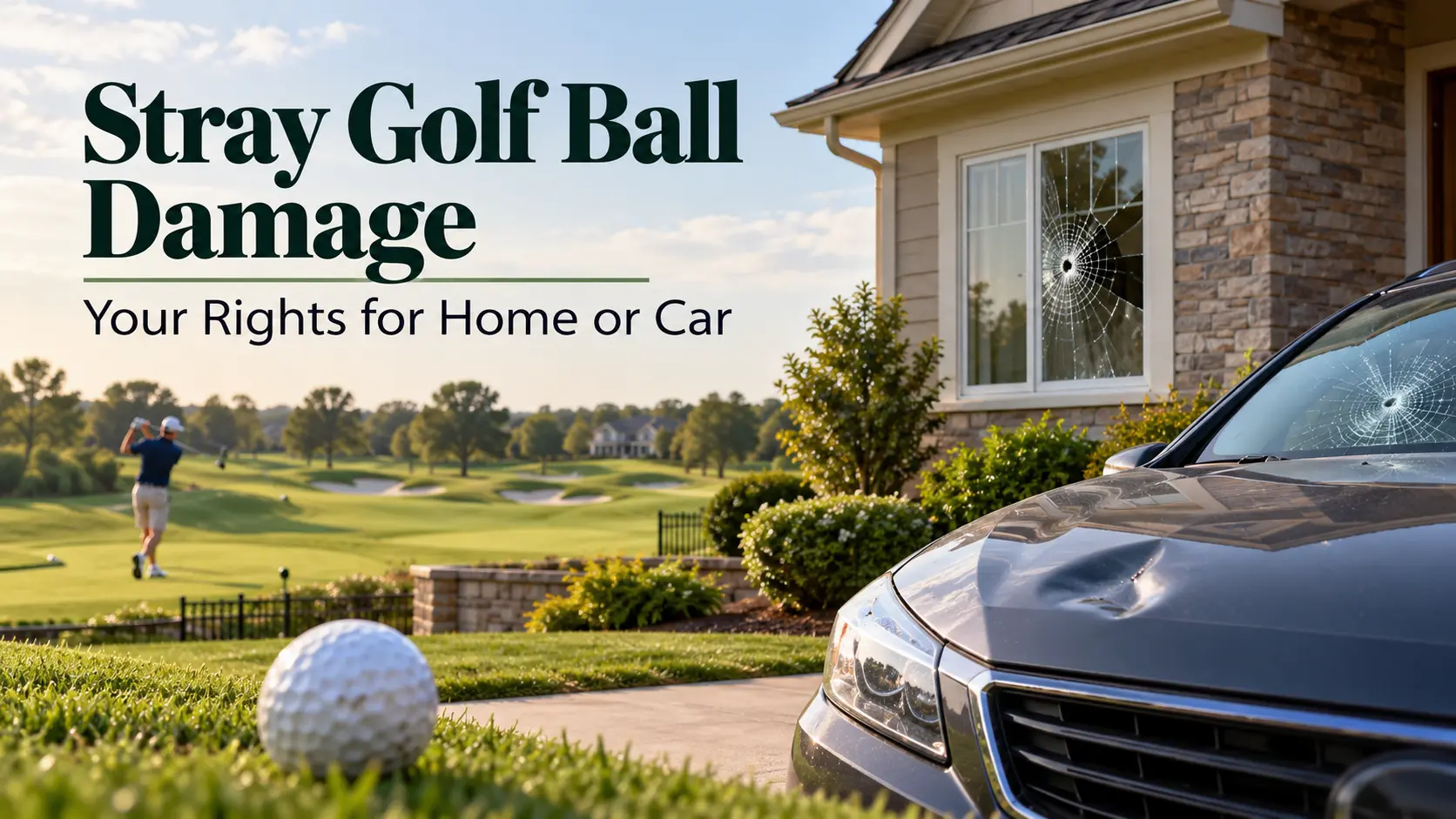
A golf ball through a kitchen window feels simple. Someone hit the ball, something broke, and somebody should pay.
The legal side rarely works that neatly.
Golf includes bad shots. A player can make a normal swing and send a ball 40 yards off line. That fact matters because property damage alone doesn’t necessarily prove that the golfer acted carelessly.
The situation changes when someone hits toward an obviously dangerous area, when a golf course has received repeated complaints about balls entering the same property, or when your deed contains language about living beside a golf course.
If you’re staring at broken glass or a golf-ball-sized dent in your hood, don’t start by arguing over liability. Start by preserving what happened.
Quick Answer: A golfer, golf course, property owner, or insurance company can end up involved after a stray golf ball damages a home or car. There is no single rule that automatically makes one party pay. The circumstances of the shot, evidence of negligence, course conditions, property agreements, and your insurance coverage all matter.
Who is responsible when a golf ball damages property?
There are usually three places to look: the golfer who hit the shot, the golf course, and insurance.
Which one matters most depends on what actually happened.
A golfer who makes an ordinary swing and unexpectedly slices the ball presents one situation. A player who intentionally cuts a corner over several homes presents another. A golf course that has received years of complaints about balls flying into the same backyard creates another set of questions.
U.S. negligence law generally looks at whether someone owed a duty of reasonable care, failed to meet that duty, caused the damage, and created an actual loss.
That means “the ball came from the golf course” isn’t enough to settle the question.
My strong view is that homeowners waste time when they begin with “Who has to pay me?” before they establish the facts. Build the evidence first. Responsibility becomes much easier to discuss once you know where the ball came from, what happened before the shot, and whether similar incidents have happened before.
Is the golfer responsible for hitting your house?
Sometimes.
An ugly slice doesn’t automatically make a golfer negligent. Bad shots happen to skilled players as well as beginners.
The more useful question is whether the golfer acted reasonably under the circumstances.
Consider a player standing on a tee where houses sit well left of the hole. The golfer aims down the fairway, makes a normal swing, and unexpectedly snap-hooks the ball through a window. That looks different from a golfer deliberately aiming over houses because the shortcut can knock 40 yards off the hole.
Danger matters too.
A golfer who sees people standing in a foreseeable landing area and hits anyway creates a different problem from a player whose ball takes an unexpected flight toward an empty property.
Rhode Island’s Supreme Court addressed golfer responsibility in Hennessey v. Pyne. The court recognized that a golfer can owe a duty to someone living immediately beside a golf course and allowed the negligence issue in that case to continue rather than treating golf as a blanket exemption from responsibility.
The practical point is simple. Don’t assume that every golfer must pay, and don’t assume golfers can never face liability.
The details of the shot matter.
Can the golf course be responsible?
A golf course doesn’t become responsible for every ball that crosses its boundary.
Courses also can’t ignore a predictable property-damage problem forever and assume that “golf balls go offline” answers every complaint.
Frequency changes the conversation.
One ball entering a yard during an entire season looks like an isolated miss. Golf balls hitting the same house several times each week raise questions about the hole layout, tee direction, landing area, trees, barriers, netting, warning systems, and the course’s knowledge of earlier incidents.
A Massachusetts case involving Indian Pond Country Club shows why homeowners should document recurring problems carefully.
The homeowners in Tenczar v. Indian Pond Country Club reported hundreds of golf balls entering their property. The Massachusetts Supreme Judicial Court examined documents governing the golf-course community and found that an easement allowed intrusions associated with reasonable operation of the course. The court still declined to decide that the course’s operation was reasonable as a matter of law.
That distinction matters.
Some errant golf balls are a normal consequence of operating a golf course. A predictable stream of balls created by the way a hole operates raises a more serious question.
If your home gets hit repeatedly, stop treating each ball as an unrelated accident.
Create one record of the whole pattern.
Keep a golf-ball incident log if the problem repeats
A homeowner who says, “We get golf balls all the time,” gives a course very little information.
A homeowner who can show that 23 balls entered the yard during six weeks, five struck the siding, two broke windows, and most appeared between 10 a.m. and 3 p.m. gives the course something specific to investigate.
Record the date and approximate time. Photograph where each ball landed. Note any damage. Write down which hole appears to send balls toward the house. Keep copies of emails sent to the golf course.
Don’t throw away repair invoices.
You want to establish frequency, direction, damage, prior notice, and what happened after the course learned about the issue.
That record can help during discussions with course management, an insurer, an attorney, or a court.
Check your deed before assuming the golf course has to pay
This is the step many homeowners skip.
Homes built inside golf communities can come with recorded easements, covenants, HOA documents, or other restrictions connected to golf-course operation.
Read them.
Your documents can contain language covering normal golf activity, errant balls, ball retrieval, course access, fencing, landscaping, or other rights associated with the course.
The wording can matter more than what another homeowner tells you.
In Tenczar, the documents governing the subdivision played a central role because they created an easement connected to reasonable golf-course operation.
A different property can have completely different language.
Buying beside a golf course also doesn’t create one nationwide rule that says you accepted every possible golf-ball intrusion forever. State law and the exact documents matter.
If the damage happens repeatedly, pull your deed and HOA paperwork before spending weeks arguing with the course.
What should you do immediately after a golf ball hits your house?
Don’t rush outside looking for someone to blame.
Spend the first few minutes creating a clean record of the incident.
- Make the area safe. Keep children and pets away from broken glass or damaged materials.
- Take close photos. Photograph the impact point, broken glass, dent, cracked tile, siding damage, or other visible loss before cleaning anything.
- Take wider photos. Show where the damaged area sits in relation to the golf course.
- Keep the golf ball. Don’t clean, mark, or alter it. A ball alone won’t normally identify a golfer, but keeping it preserves evidence.
- Write down the time. If you didn’t witness the strike, record the narrowest time window you can establish.
- Identify the likely hole. Note the tee, fairway, green, driving range, or practice area that aligns with your property.
- Find witnesses. A neighbor, family member, security camera, or golfer can provide information that photographs don’t capture.
- Contact the course. Ask the pro shop or manager whether they can identify the group playing the relevant hole and whether they create incident reports.
- Get a repair estimate. You need a real number before deciding whether an insurance claim makes financial sense.
- Save every record. Keep photos, emails, estimates, receipts, incident reports, and earlier complaints together.
Avoid trespassing onto the course to chase a group.
You need information, not an argument beside a tee box.
Will homeowners insurance cover golf ball damage?
Possibly, but the answer depends on your policy.
Homeowners insurance comes in different forms, and exclusions, deductibles, coverage limits, and definitions matter.
Some common homeowners forms cover damage from falling objects. Other policies use broader approaches to dwelling coverage, subject to stated exclusions.
That doesn’t mean every insurer automatically classifies every golf-ball loss the same way.
Call your carrier or agent and describe exactly what happened.
For a $350 window repair and a $1,000 deductible, filing a claim might offer little financial value. A ball that damages expensive custom glass, roofing, siding, solar panels, or several parts of the structure creates a different calculation.
Get the repair estimate and check the deductible before making a decision.
Don’t repair serious damage before asking the insurer what documentation it wants unless you need temporary work to keep the property safe or prevent further loss.
What if a stray golf ball damages your car?
The insurance path usually starts with comprehensive auto coverage rather than collision coverage.
Comprehensive coverage commonly handles non-collision losses such as glass damage and objects striking a vehicle. Your deductible and exact policy terms still control what the insurer pays.
If you don’t carry comprehensive coverage, you can’t assume your own auto policy will pay for the damage.
First, photograph the vehicle where it was when the ball hit it.
That location matters.
A car parked beside the fairway in a designated course parking lot gives you one set of facts. A vehicle traveling along a public road outside the golf property gives you another.
Photograph warning signs too. If the parking lot has netting, fencing, barriers, or signs about golf balls, include them in the scene photos.
Then photograph the damage from several angles.
A shallow hood dent can look minor in one picture and obvious when light reflects across the panel. Windshield damage needs attention quickly because a small chip can spread.
If you know which golfer hit the ball, collect contact information without turning the parking lot into a courtroom.
Let the facts and insurance process do the heavy lifting.
Does comprehensive car insurance cover a golf ball?
Comprehensive coverage is usually the part of an auto policy you would investigate after an object such as a golf ball strikes a parked or moving vehicle without a vehicle collision.
Insurance providers commonly describe comprehensive coverage as protection for events outside the driver’s control, including glass damage and damage caused by falling or flying objects.
Coverage isn’t automatic simply because you have car insurance.
Drivers who carry only the state-required liability coverage generally don’t have comprehensive protection for damage to their own vehicle.
Check your declarations page.
For windshield damage, ask about separate glass terms too. Some policies or state rules treat glass claims differently from body damage.
If the repair costs $450 and your comprehensive deductible is $500, filing the claim doesn’t produce the same result as a $2,500 repair with the same deductible.
Know both numbers.
What if you can’t identify the golfer?
This happens often.
You hear the impact, walk outside, and find a golf ball beside the car. By then several groups are moving around the course.
Contact the course promptly.
Give staff the time, location, ball direction, and likely hole. The course might know which group occupied that area at the time, although you shouldn’t expect the course to identify a player in every case.
Look for cameras.
A driveway camera might capture the ball, the sound of impact, or a golfer approaching afterward. A course parking lot or nearby building can also have surveillance footage.
Save video quickly because some systems overwrite old recordings automatically.
If nobody can identify the golfer, your own insurance can become much more important.
Does a “golf balls may cause damage” sign remove your rights?
Don’t treat a warning sign as a magic liability shield.
A sign can matter because it shows that a risk was disclosed. It can become part of a broader argument about what the property owner or driver knew when choosing to park, buy, or remain in that location.
It doesn’t answer every legal question by itself.
Courts examine specific facts and applicable state law. Written property agreements can also carry much more legal weight than a casual warning sign.
Photograph the sign anyway.
The exact wording, placement, visibility, and distance from the damaged property can matter later.
One broken window is different from a house hit every week
This is the most important distinction for homeowners living beside a course.
An isolated miss often centers the dispute on one golf shot.
Repeated strikes force you to look at the property and course together.
Where do golfers normally aim?
Which shot shape reaches the house?
Can average players reasonably keep the ball inside the intended landing area?
Has the course moved tees or changed the hole?
Did management receive previous complaints?
Has the course tried trees, netting, tee alignment, out-of-bounds markers, or another practical measure?
You don’t need to become a golf-course architect, but you should document enough information to show the pattern.
The Massachusetts Tenczar case involved 651 golf balls reportedly reaching the homeowners’ property after they bought the house. Eight windows broke, and balls damaged other parts of the property.
Most homeowners will never face anything remotely close to that number.
The case still teaches a useful lesson: count the incidents. “This happens constantly” has less value than a dated record.
Can you ask the golfer to pay the repair bill?
Yes.
If you know who hit the ball, you can show the golfer the damage and repair estimate and ask whether they will handle the cost or contact their insurer.
Keep that conversation calm.
Don’t tell the golfer that the law automatically makes them responsible unless a qualified local lawyer has confirmed that conclusion for your situation.
Some people will voluntarily pay a small repair bill even when legal responsibility remains uncertain.
Others will refer the matter to an insurer.
If the golfer disputes the claim, preserve your evidence rather than trying to win the argument face to face.
Can a golfer’s homeowners or renters insurance help?
Potentially.
Personal liability coverage under homeowners or renters insurance can cover certain situations where the policyholder becomes legally responsible for damaging someone else’s property.
Coverage depends on the policy and facts.
The golfer should contact their insurer rather than promising that a particular claim will qualify.
For the property owner, collecting the golfer’s contact details gives you somewhere to start if you later pursue reimbursement.
What if the golfer intentionally hit toward the house?
Intent changes the situation quickly.
A golfer trying to play the intended hole and accidentally hooking a shot creates different facts from someone deliberately firing balls at a house, car, person, or other property.
Save video and witness information if you suspect intentional conduct.
Don’t confront someone who appears angry, intoxicated, or aggressive.
Contact course management. Depending on what happened and the seriousness of the conduct, contacting local law enforcement can also make sense.
An intentional act can create legal and insurance questions that differ from an accidental golf shot.
What if the golf ball injures someone instead of damaging property?
Treat an injury more seriously than a broken window.
Get appropriate medical help first.
Document where the person was standing, where the ball came from, who witnessed the incident, which golfer or group was involved, and whether anyone shouted a warning.
Report the incident to the golf course.
Personal-injury claims introduce issues that go beyond a normal property repair, including medical costs and state-specific rules about negligence and assumption of risk.
For a significant injury, speaking with a qualified attorney in your state makes far more sense than trying to settle the legal question from general online advice.
What if you bought the house knowing it was beside a golf course?
Living beside a golf course obviously puts a property closer to golf-ball activity.
That fact matters.
It still doesn’t tell you the outcome of every dispute.
A homeowner who receives an occasional ball in an undeveloped edge of the yard presents a different situation from a family dealing with repeated impacts against windows, patios, vehicles, or areas where people regularly sit.
Your purchase documents matter too.
Read the deed, easements, HOA declaration, covenants, disclosures, and any golf-course provisions you received when buying the property.
Don’t rely on memory.
The exact wording can decide issues that a general internet article can’t.
Should the golf course install netting?
Sometimes netting makes sense. Sometimes another change works better.
Taller trees, different tee alignment, changes to landing areas, altered markers, or moving a tee can change where golfers aim and where missed shots travel.
Large protective nets also cost money, affect views, need maintenance, and don’t solve every ball-flight problem.
For that reason, “install a net” shouldn’t become the automatic answer to every complaint.
What matters is whether the course faces a meaningful, predictable problem and whether reasonable changes can reduce it.
If you’re dealing with repeat strikes, ask the course what it has investigated rather than demanding one specific engineering solution before anyone studies the pattern.
When should you contact an attorney?
You don’t need a lawyer for every golf-ball dent.
A $250 repair can cost less than an hour of legal work.
Legal advice becomes more useful when the dispute includes repeated property damage, significant repair costs, serious injury, unclear easement language, a contested boundary, persistent course-management problems, or an insurer denying a substantial claim.
A local attorney can examine something this article cannot: your state’s law and your actual documents.
Small claims court can also make sense for some property disputes, depending on the amount involved and your state’s limits.
Check your state court system for filing limits, deadlines, fees, and procedures.
If you’re the golfer who hit the house or car
Don’t disappear.
Stop and report the incident if you safely can.
Give the owner or course staff accurate contact information. Write down the hole, approximate time, club, target line, and ball flight while you still remember them.
Don’t admit to legal conclusions you don’t understand, and don’t invent a rule such as “golfers are never responsible.”
Cooperating doesn’t mean that you have already accepted legal liability.
It’s simply decent behavior after your golf shot damages somebody else’s property.
If your misses regularly start right and curve farther right, an open clubface and swing path can contribute to that ball flight. Fixing the swing belongs on the practice tee. MadKnows’ guide to the open club face golf swing explains that mechanical problem in more detail.
How to reduce future golf-ball damage around a course-side home
Repeated damage deserves a practical solution as well as an insurance conversation.
Start by identifying where the balls actually enter the property.
A homeowner can spend thousands of dollars protecting the wrong side of a yard if assumptions replace evidence.
Map the landing points for several weeks. Mark the windows, patio areas, roof sections, cars, or outdoor spaces that receive the greatest exposure.
Then speak with course management.
Course-side changes might solve the problem more effectively than altering your house. The course may also know whether another homeowner has reported the same miss pattern.
For property-side protection, ask qualified local contractors about impact-resistant glass, screening, landscaping, or barriers that comply with HOA rules and local codes.
This isn’t for everyone. A homeowner who receives one ball every three years has little reason to turn the yard into a fortress.
Match the response to the actual frequency and risk.
Frequently Asked Questions
Who pays if a golf ball breaks my window?
There isn’t one nationwide rule. A golfer can face responsibility when negligent conduct caused the damage, while a golf course can face separate questions when its design or operation creates a recurring hazard. Your homeowners insurance can also provide a claim route depending on your policy.
Is a golfer automatically responsible for property damage?
No. An errant golf shot doesn’t automatically prove negligence. Courts can examine what the golfer did, where the golfer aimed, surrounding hazards, warnings, and the circumstances that produced the damage.
Can a golf course make homeowners accept golf-ball damage?
Property agreements can grant a course certain rights or place restrictions on homes beside the course. Read your deed, easements, covenants, and HOA documents. Their effect depends on their wording and applicable state law.
Does car insurance cover a golf-ball dent?
Comprehensive auto coverage is normally the first coverage to check when an outside object damages a vehicle without a collision. Your deductible and policy terms determine whether filing a claim makes financial sense.
What should I do if a golf ball cracks my windshield?
Photograph the glass and the car’s location, record the time and likely source of the ball, contact the course if appropriate, and review your comprehensive and glass coverage. Don’t ignore a small crack because windshield damage can spread.
Can I sue the golf course if balls keep hitting my house?
Repeated strikes can raise more serious legal questions than a single errant shot. Document every incident and review your property documents. If the problem continues or the damage becomes substantial, a local attorney can assess negligence, trespass, nuisance, easement, or other claims available in your state.
What evidence should I keep?
Save scene photographs, damage photos, the golf ball if available, witness details, security footage, repair estimates, receipts, communications with the course, incident reports, and a dated record of earlier strikes.
What matters most after stray golf ball damage
Don’t let the first conversation become an argument about who is “obviously” responsible.
Photograph everything. Record where the ball came from. Get the repair estimate. Check your insurance coverage. If the damage repeats, document the pattern and read every golf-related provision attached to your property.
For a one-off accident, insurance can provide the simplest route.
For a home that keeps getting hit, the bigger question is why the same property keeps sitting in the path of missed shots and what the course, homeowner, or both can reasonably do about it.
Good evidence gives you the best chance of answering that question without guesswork.