
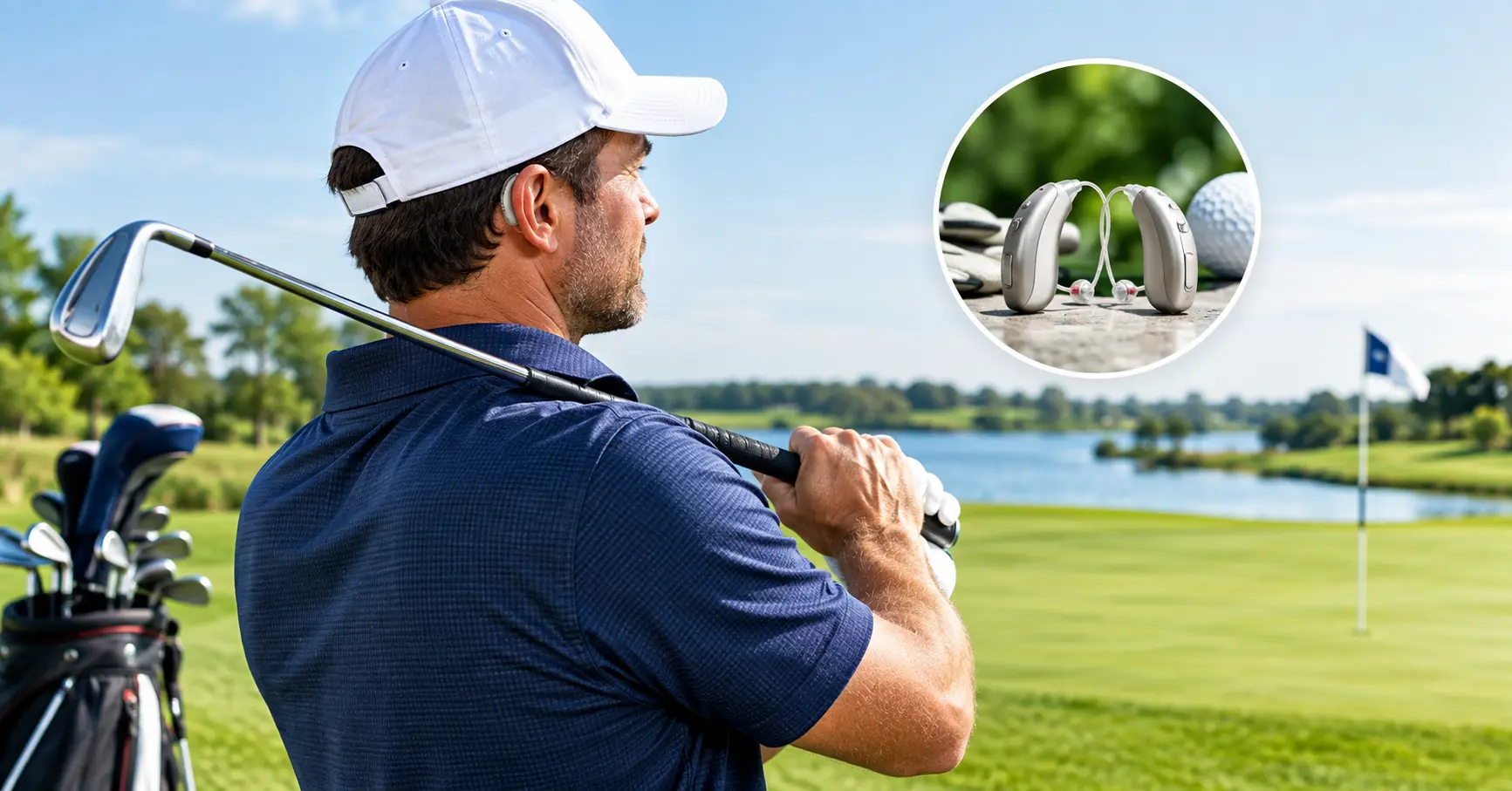
Most guides on golf and hearing loss read like hearing aid ads. Clinics write nearly all of them, and they stop at birdsong and conversation. A golfer needs more: a plan for a shout of “Fore,” a substitute for the sound of a good strike, a straight answer on the Rules, and real numbers on driver noise.
I teach golf and I’m not an audiologist. The medical claims below come from published research, and I name the source each time. Everything about the game itself comes from how golf works on the tee and in the cart.
Quick Answer: Yes. Rule 4.3b covers equipment you use for a medical condition, and hearing aids fit that description. Wear them, because you can’t dodge a ball you can’t hear called. Save a wind program with your audiologist, and keep earplugs for the range, since blocking noise during a round breaches Rule 4.3a.
Where golf and hearing loss collide during a round
Six moments in a round depend on hearing. The table sorts them by what you lose and who has to fix it, because a hearing aid setting can’t solve some of them.
| Moment | What you lose | Best fix | Who owns the fix |
|---|---|---|---|
| Ball strike | The crisp or dull sound that tells you how well you hit it | Impact tape, face spray, or a launch monitor number | You |
| A shout of “Fore” | Seconds of warning and the direction it came from | Keep your aids in, scan the neighboring holes, agree on a visual signal | You and your group |
| Talking in the cart | Speech buried under engine and wind | Stop the cart, face each other | Your group |
| Gusts on open holes | Speech drowned by wind roar in the microphones | A saved wind program | Your audiologist |
| Rain and sweat | Working aids | Check the IP rating, wear a brimmed hat, dry the aids after the round | You and your audiologist |
| Quiet stretches | A calm fairway can make tinnitus more noticeable | Ask about tinnitus support in your aids | Your audiologist |
Four of the six rows depend on you or your playing partners. Only wind and tinnitus belong entirely to your audiologist.
How much warning a shout of “Fore” really gives you
A well-struck drive stays in the air for roughly six seconds. Sound covers 200 yards in about half a second, so a warning from the tee behind you reaches your ears almost immediately. You keep most of those six seconds. What you lose is recognition: you have to hear the shout, know it means you, and work out where it came from before the ball arrives.
Vowels carry lower-frequency energy than consonants, and high-frequency hearing loss hits consonants first. A loud “Fore” is mostly vowel, so it often gets through. Wind, an idling cart, or hearing aids switched off during a gust are what stop it.
Four habits cover most of the gap.
- Keep your hearing aids in on windy holes and use a wind program instead of switching them off. A gust lasts seconds, and a ball doesn’t wait for your aids to come back on.
- Watch the fairway next to yours and the tee behind you. Scan more than your partners do.
- Ask your group to wave both arms overhead and point along the line of a ball heading toward you, on top of shouting.
- When you can’t tell where a shout came from, turn away from the tee and cover your head. Don’t look up to find the ball.
Do the Rules of Golf allow hearing aids and earplugs?
Hearing aids, yes. Rule 4.3b says a player isn’t in breach of Rule 4.3 for using equipment to help with a medical condition, as long as the player has a medical reason and the Committee decides it gives no unfair advantage. Hearing aids fit that description.
GOLF.com’s Rules Guy went a step further in a November 2022 column. He reported that the USGA and R&A had already decided a player who switches hearing aids off during a windy round doesn’t breach Rule 4.3a(4). That’s a magazine column relaying a governing-body position. It isn’t rule text, so in a competition, ask your Committee before you tee off, since Rule 4.3a tells players who are uncertain about equipment to ask for a ruling.
Earplugs work differently. A separate Rules Guy column treats them like headphones: wearing them to block noise breaches Rule 4.3a, with the general penalty for a first breach and disqualification for a second. Rule 4.3 covers equipment you use during a round, so plugs on the range break nothing. Wear them there and take them out on the first tee.
If a doctor advises plugs during play, Rule 4.3b is the route. Ask your Committee for a ruling in advance.
What to ask your audiologist before you play in wind and rain
Hearing aid microphones treat moving air as sound. On an open fairway that shows up as a roar over everything, and one poster in a HearingTracker forum thread described wind noise as the biggest problem with hearing aids and golf.
London audiologist Koorosh Nejad, writing for the clinic HearingNow, argues that completely-in-canal styles handle wind best because your outer ear shields the microphone. He says behind-the-ear and receiver-in-canal styles catch more gust, and he describes receivers with a microphone in the canal that take over when wind rises. Neither is a universal answer, so ask which option fits your loss and your ear.
Ask for three things.
- A saved wind program you can trigger from your phone. One GolfWRX poster described an app that switches to a golf preset by GPS as he pulls into the course lot.
- Real-ear measurement, the test where a probe microphone confirms what reaches your eardrum.
- A plain answer on how your aids handle sudden loud sounds like club impact.
Moisture protection comes down to two things, the rating and your habits. An IP68 rating means dust-tight and rated for continuous immersion under conditions the manufacturer sets, so check what your maker’s test covers. A brimmed hat keeps rain off your ears, as Miracle-Ear suggests, and Port Jefferson Hearing recommends storing aids in a dehumidifier after the round.
Clips or sweatbands keep an aid from dropping out mid-swing, and the apps Port Jefferson Hearing describes can locate a misplaced aid. Charge rechargeable aids fully before an 18-hole round.
I’m not naming a best hearing aid for golf. Models turn over fast. HearingNow reports that Phonak announced its EON platform on 24 August 2026, less than two years after the Infinio line launched in late 2024. A pick here would date quickly.
Do modern drivers damage your hearing?
A round of golf won’t hurt your ears. A daily basket in an enclosed range bay deserves more respect. The two studies people cite point in different directions, so here’s what each one measured.
Malcolm Buchanan’s team at Norfolk and Norwich University Hospital published the alarming version in the BMJ in December 2008. Their patient, a 55-year-old golfer, developed tinnitus and reduced hearing in his right ear after playing three times a week for 18 months with a thin-faced titanium King Cobra LD. The team then had a professional hit shots with six titanium drivers and measured the sound 1.7 meters from impact, the average distance between a golfer’s ear and the ball. All six titanium drivers beat the 110 dB impulse limit the authors used, the loudest read about 130 dB, and only two of six stainless steel drivers crossed it.
That’s one patient plus one professional’s swings. Buchanan recommended earplugs as a precaution and said readings would run higher in an enclosed range.
Fei Zhao and Barry Bardsley ran a better-designed test for BMJ Open in 2014. They placed probe microphones near the eardrums of 19 male amateurs, aged 19 to 54, at a driving range in South Wales. Each golfer hit six range balls with each of three drivers. By their estimate, a whole basket used less than 2% of a day’s allowable noise exposure, and swing speed didn’t correlate with noise.
They concluded that immediate danger to amateurs is quite unlikely, though a club above 116 dBA would carry real risk. They named their own limits, only three clubs and a small sample.
A 2018 study in Clinical and Experimental Otorhinolaryngology played a recorded titanium driver impact at 120.5 dB to mice 1,440 times over two hours and found outer hair cell loss in the repeated-impact group. No golfer takes 1,440 hits in two hours, so treat it as a lab result.
My read: if you hit indoors often, wear plugs. Buchanan flagged higher readings in enclosed ranges, and a Korean team’s earlier analysis of titanium driver impacts pointed at indoor booths as the hazard. At Zhao’s range, a full basket used under 2% of the day’s allowance, and a round has far fewer full-driver strikes than a basket.
| Option | Reduction | Price (checked September 29, 2026) | Allowed during a round? | Notes |
|---|---|---|---|---|
| Etymotic ER20XS plugs | About 20 dB, roughly even across frequencies | $24.99 standard, $29.99 universal pack on etymotic.com | No, if worn to block noise (Rule 4.3a(4)) | Low profile, fits under a hat |
| Custom-molded musician’s plugs | Depends on the filter | Varies by provider, needs an impression from an audiologist | Same rule as any plug | Ask your audiologist about golf-specific filters |
| Your hearing aids | None | Not applicable | Yes | Amplify sound and don’t protect against it |
If you wear aids, ask your audiologist what to do at the range: leave them in, take them out, or use plugs instead.
Substitutes for the sound of a good strike
Golfers get feedback three ways: feel through the hands, flight through the eyes, and impact sound through the ears. Hearing loss dulls the third. Zhao’s in-ear recordings and a Korean team’s recording of a titanium driver place the energy of impact between about 2.5 and 4.5 kHz, which is where age-related and noise-related hearing loss typically show up first.
With an iron, a thin strike rings sharp and a fat one thuds, and most golfers use that feedback without thinking about it. When it fades, replace it with something you can see or measure.
- Impact tape or face spray shows where on the face the ball met the club.
- A launch monitor’s smash factor, the ratio of ball speed to clubhead speed, gives you a number for strike quality. A well-struck driver lands around 1.45 to 1.50.
- A playing partner can watch the ball and call “flush,” “toe,” or “heel.”
- Your own test: hit ten balls with your aids in and notice whether the sound still changes with strike quality. If it doesn’t, tell your audiologist.
Do hearing aids improve your golf game?
They improve hearing. No study I found shows they lower your score.
Clinic articles say hearing aids improve balance, and the evidence is thinner than the claim. A 2023 systematic review in Folia Phoniatrica et Logopaedica, led by Limor Lavie, examined eight controlled studies of experienced older hearing aid users. Five found a significant link between aid use and balance results, the quality of the studies ran from limited to moderate, and the authors called the role of hearing aids unclear. Falls look better: an observational study in the Journal of the American Geriatrics Society by Campos and colleagues tied consistent aid use to lower fall prevalence in older adults, which shows an association without proving a cause.
Clinics also say aids free up mental energy for concentration. Researchers call that listening effort, and the idea is plausible, but I found no study that measures it on a golf course or ties it to scores.
Wear hearing aids to hear warnings and your partners. Don’t buy them to lower your handicap.
Three habits for your playing partners
Tell your group about your hearing on the first tee.
- Stop the cart before you talk. Engine noise, wind, and a turned head bury speech, and stopping costs a few seconds.
- Face you when they speak. Port Jefferson Hearing notes that directional microphones work best when they point at the speaker.
- Share yardages and pin positions at the tee, in view of you, before anyone walks to a ball. Write scores on the card in front of you instead of calling them across a green.
If you give lessons, stand where the student can see your mouth, keep cues to one short phrase, and demonstrate instead of narrating the swing from behind.
Where this advice runs out
This guide isn’t for golfers with cochlear implants or severe-to-profound loss, where your audiologist has to make the calls on wind, moisture, and equipment. It also can’t replace a hearing test. If you notice ringing, muffled speech, or constant requests for people to repeat themselves on the course, book a test before you buy anything.
FAQ
Can you wear hearing aids while playing golf?
Yes. Rule 4.3b protects equipment you use for a medical condition, and hearing aids fit that description. In a tournament, tell your Committee before the round if you want certainty.
Can golf cause hearing loss?
One case report links a thin-faced titanium driver to hearing loss and tinnitus, but the larger in-ear test of 19 amateurs found a full basket used under 2% of a day’s noise allowance. Enclosed range bays and any club above 116 dBA carry the real risk. Plugs for the range cost about $25.
Can you wear earplugs when playing golf?
On the range, yes. During a round, no when the point is blocking noise, because Rule 4.3a treats earplugs like headphones. A doctor’s recommendation turns it into a Rule 4.3b question, so ask your Committee before you play.
Do hearing aids work in wind?
They work, but wind noise is a recurring complaint in golfers’ forum threads and clinic articles. Newer aids include wind management, and some styles put the microphone deeper in the canal where your outer ear shields it. Ask your audiologist to save a wind program for the course.
Can you stream music from your hearing aids during a round?
Rule 4.3a(4) allows audio unrelated to the competition, like music or news, as long as you show consideration for others. It bans using audio to eliminate distractions or help swing tempo. A Committee can also ban personal audio devices in its competition through Model Local Rule G-8, so check the local rules sheet.
Before your next round
Golf and hearing loss mix fine once you plan for wind, warnings, and noise. Book a hearing test before you replace a driver, then ask your audiologist for a saved wind program and a real-ear measurement. Tell your group how to talk to you on the first tee, and keep earplugs for the range. If you want a number to chase in place of a sound, start with your swing speed and the carry distances on our club distance chart.