
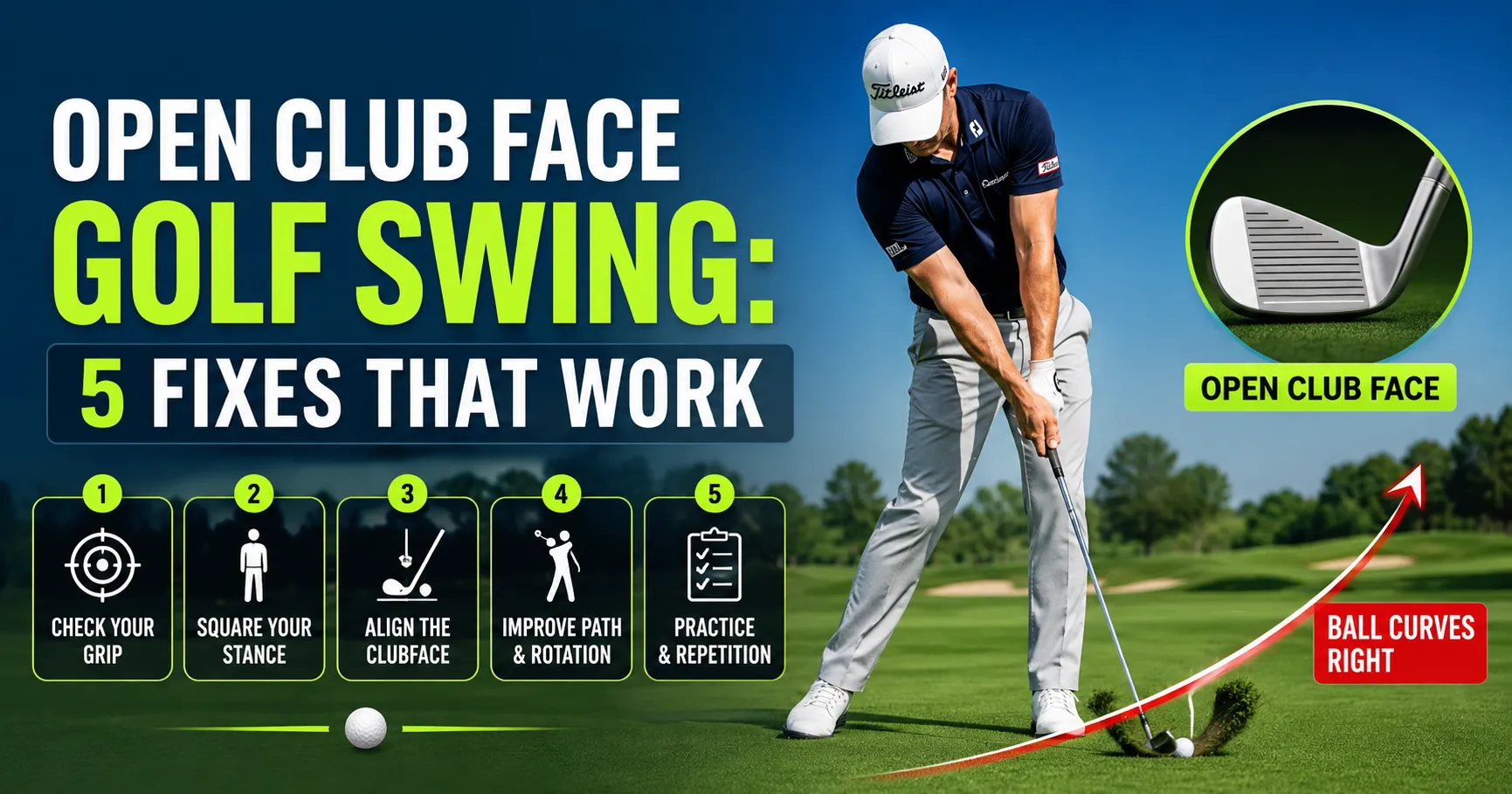
Quick Answer: An open club face points right of the target for a right-handed golfer (left for a lefty) at address or impact. TrackMan lists face angle as the main start-direction number. Square the face at setup, stop cupping the lead wrist at the top, and close the face by hip-high on the way down. Do not wait until the ball to flip it.
The miss is ugly and familiar. The ball starts right. Or it starts okay and peels into the right trees. You swear you “held on.” The next tee shot does the same thing.
That is an open club face golf swing showing up at the only moment that counts. Impact.
Most tips tell you to roll the hands harder at the ball. That is how golfers turn a slice into a thin pull, then a shank. Fix the face earlier. Then leave the last foot of the swing alone.
What an Open Club Face Means on a Real Shot
An open club face is simple. The leading edge does not point down the target line. For a right-handed player it points right of that line. For a left-handed player it points left.
You can set it open at address on purpose. You can also arrive open at impact by accident. Those are different shots with the same name.
TrackMan calls face angle the main number for starting direction. Independent launch-monitor summaries put the driver’s start line at about 85 percent face and 15 percent path. Irons sit closer to 75 percent face. The ball starts near where the face looks. Then it curves away from the path. That curve is your face to path number.
Open to the target and open to the path are not the same thing. A tour fade can start a touch left with a face that is still a degree open to an out-to-in path. A weekend slice starts right with a face that is wide open to a path already moving left. One is a shot. The other is a leak.
| Face Position | Points (right-handed) | Typical start | Typical curve if path does not match |
|---|---|---|---|
| Square | At the target | At the target | Little curve |
| Open | Right of the target | Right | Fade or slice |
| Closed | Left of the target | Left | Draw or hook |
An open face also adds effective loft. The same 7-iron launches higher and shorter when the face is laid open. That is useful from a bunker. It is death off the tee with a 9- or 10-degree driver.
Read the Ball Flight Before You Change the Swing
Do not guess. Watch the first ten yards, then the curve. That pair tells you whether you have a face problem, a path problem, or both.
| Start line | Curve | Face vs target | Face vs path | First move |
|---|---|---|---|---|
| Right, then farther right | Hard slice | Open | Open to an out-to-in path | Square the face first, then quiet the over-the-top move |
| Right, then straight | Push | Open | Roughly matching the path | Face and alignment, not a new swing thought |
| Straight, then right | Fade or slice | Near square | Open to the path | Close the face a touch relative to the path |
| Left, then right | Pull-slice | Closed to the target, open to the path | Classic over-the-top | Path and face together |
| Left, then farther left | Hook | Closed | Closed to the path | You over-fixed the open face |
A golf swing club face open at impact is the common amateur pattern. The push-slice is the giveaway. The face pointed right. The path cut left. You cannot bandage that with a stronger lunge at the ball.
Film one face-on swing and one down-the-line swing. You do not need a launch monitor to see a face that stares at the sky at the top.
Open Club Face Causes You Can Actually See
Open club face causes stack. One fault rarely travels alone.
Open club face at address
Plenty of drivers leave the factory with a face that looks a hair open when the sole sits flat. Add a weak grip and you start the hole already aimed right.
Look down at the lead hand. You want two or three knuckles. One knuckle, or none, leaves the face late. The V between thumb and forefinger on the lead hand should point near the trail shoulder, not at your chin.
Set the leading edge at a spot on the tee two inches in front of the ball and square to the target. Then take your grip. Do not grab the handle first and twist the face after. That twist disappears the second the swing starts.
The takeaway twist
The face opens when the clubhead rolls behind the hands in the first three feet. From down the line at shaft-parallel (P2), the leading edge should roughly match your spine angle. If the face looks at the sky, you already opened it.
A trail wrist that never hinges back makes this worse. The trail hand stays on top of the handle. The face fans open. You spend the rest of the swing trying to catch up.
Open club face at the top of the golf swing
A cupped lead wrist at the top is the slicer’s fingerprint. The back of the lead hand bends toward the forearm. The face points up.
A flatter lead wrist, or a slight bow, points the face more toward the ball. That position is easier to deliver. It feels shut the first week. Good. Your old “square” was open.
Club face opening on the downswing
Some players get to a decent top and then throw the trail arm at the ball. The face peels open again. Others pull the lead shoulder through impact so hard the wrists never release.
You cannot square a wide-open face in the last 18 inches if you have been open since the takeaway. The window is gone.
Five Checkpoints That Square an Open Club Face Golf Swing
Work these in order. Do not skip to impact.
- Address. Sole the club. Square the leading edge to the target. Then put the hands on. Lead hand shows two or three knuckles. Ball position with the driver sits off the lead heel, not off the toe of the front foot, which makes the face look closed when it is not.
- Shaft parallel going back. Pause. The leading edge should sit close to your spine tilt, not flat to the sky. Feel the trail wrist set back, like holding a tray.
- Top. Lead wrist flat or slightly bowed. If you see a deep cup, the face is open. Shorten the swing until that cup disappears. A three-quarter backswing that is square beats a long backswing that is open.
- Shaft parallel coming down. This is the last honest look. The face should look more “down” than it did at the top. If it opened more from the top to here, you are throwing the club from the inside with a dead trail wrist.
- Impact. Hands slightly ahead with irons. Lead wrist flat. You are covering the ball, not scooping it. The chest is turning. The lead side has braced, not slid.
How to close the club face in a golf swing is mostly those five looks. The release is a result. It is not a last-second save.
How to Fix Open Club Face Driver Problems
The driver punishes an open face more than any other club. Lower loft means less backspin to hide the sidespin. A two-degree open 9-iron still looks playable. A two-degree open driver starts right and keeps going.
Open driver club face at address is common because the head is huge and the alignment marks lie. Many golfers aim the crown logo and ignore the actual face. Pick a leaf or a tee two feet in front of the ball. Aim the face at that. Then set your feet.
An open driver face at the top of the swing is the same cupped-lead-wrist look, only louder. The long shaft exaggerates every degree. If the face is open at the top, you will either slice it or flip at it. Both cost you the center of the face.
How to fix open club face driver issues in practice:
- Tee it so half the ball sits above the crown. A low tee invites a downward hit and more left-to-right spin.
- Feel a shorter backswing. Driver does not need your longest arm swing.
- Start the face closing by left-thigh high on the way down. Waiting until the ball is how you hit that high, weak cut that never reaches the fairway bunker you were trying to carry.
- Hold the finish for two seconds. If the toe never passes the heel, you dragged the handle and left the face open.
Driver misses that start right and stay right are face. Driver misses that start left and curve right are path plus face. Fix the face first. A new path on an open face just changes which tree you hit.
Stop Opening the Club Face in the Backswing
Should you open the club face in the backswing on a full shot? No.
Opening club face in the backswing is a short-game skill. It is not a full-swing feature. A little natural rotation happens as the trail elbow folds. That is not the same as fanning the face to the sky.
To stop opening the club face in the backswing, take the club back with the logo of the grip pointing more at the ball than at the sky at waist height. Push the handle slightly in and down with the lead hand in the first two feet. The clubhead stays more in front of the hands. The face stays quieter.
The wall drill works. Stand with your backside near a fence or a range wall. Make three-quarter swings that go more up than behind you. If the clubhead crashes the wall, you whipped it inside and opened the face.
Do this with a 7-iron first. Then the driver. Full-speed driver takeaways hide the fault.
Close the Face Early. Do Not Flip It at the Ball.
Flipping is the amateur patch. You see the face open, so you throw the trail hand at the ball. One shot hooks. The next is thin. Contact lives on the bottom groove.
Close the face earlier than you think.
Motorcycle feel. From the top, imagine twisting a motorcycle throttle with the lead hand. The lead wrist moves from cup toward bow. The face shuts a few degrees before the club is hip high. It looks ugly in a mirror. It is the fastest way to feel a face that is no longer late.
Quarter-swing ladder. Hit 20 balls with a 9-iron at hip-to-hip length. Do not add length until the start line is stable. Then go to chest high. Then to a three-quarter swing. This is the drill that actually rewires the cupped-wrist habit. Full swings too soon put the old pattern back in.
Lead-side brace. As the club approaches the ball, the lead hip and lead shoulder stop racing. They stabilize. The arms can rotate against that post. If the lead side keeps spinning and pulling, the face stays open and you chicken-wing to survive.
Practice these at 70 percent. Speed before control puts the slice right back.
When You Should Open the Face on Purpose
An open clubface is the right tool around the green.
Use it in a greenside bunker so the bounce can skip through sand instead of digging. And use it on a flop when you need extra loft and a soft landing. Use a small opening to hit a controlled fade around a tree or a dogleg.
Do it in this order. Set the face open first. Toe toward one o’clock for a standard bunker shot. More than that for a high flop. Then take your normal grip on the already-open face. Then aim your feet and shoulders left of the final target. Swing along the body line.
If you grip first and then twist the hands to open the face, the hands return to their old hang at impact. The face squares up and you blade it.
Low-swing-speed players should skip the flop. Extra loft without speed is a ball that never gets to the hole.
How to Fix a Closed Club Face at Impact
This is the other ditch. You fight a slice for two seasons. Then you slam the face shut. Now the ball starts left and hooks harder left. Or you hit low pulls that never climb.
A closed face at impact usually comes from a grip that went too strong, a lead wrist that bowed too early, or a trail hand that rolls over before the body is ready.
Soften the lead hand half a knuckle toward neutral. Feel the face stay looking at the ball a split second longer through the hitting area. Swing to a finish where the belt buckle faces the target and the toe of the club points more up than over-rotated.
How to fix a closed club face at impact is not the job if you still slice two out of three drives. Square the open face first. Do not collect a hook as a souvenir.
This section is not for players who already hit a small draw they can start at the right edge of the fairway. That pattern is a stock shot. Leave it.
Frequently Asked Questions
What is an open club face in golf?
An open club face is a face that points right of the target line for a right-handed golfer, or left for a left-handed golfer, at address or at impact. The ball starts near that face angle and often curves farther right if the path is left of the face.
What does open club face mean in golf?
It means the leading edge is aimed away from the target to the player’s fade side. It adds loft and left-to-right spin for a right-hander. Intentional versions create bunker shots and fades. Accidental versions create pushes and slices.
What causes an open club face at impact?
A weak grip, a takeaway that fans the face, a cupped lead wrist at the top, and a downswing that never rotates the forearms. Waiting to flip the hands at the ball is a symptom, not a cause.
Should you open club face in backswing?
Not on a full swing. A small natural rotation is fine as the trail elbow folds. Fanning the face open on the way back is how the slice starts. Save a deliberately open face for bunkers, flops, and planned fades.
How to close club face in golf swing?
Set a stronger or neutral grip, keep the lead wrist flatter at the top, and start the face closing by the time the shaft is parallel on the way down. Build it with short swings. Do not roll the trail hand at the last second.
Does an open club face always cause a slice?
No. A face that is open to the target but closed to an in-to-out path can start right and draw. A slice needs a face that is open to the path. Path and face together decide the curve.
How to fix open club face driver?
Square the face at address before you grip. Shorten the backswing. Get the lead wrist out of a cup at the top. Start closing the face by left-thigh high. Tee the ball so half of it sits above the crown.
How to fix a closed club face at impact?
Ease a too-strong grip toward neutral and stop rolling the trail hand early. If your miss is still a slice, you do not have a closed-face problem yet.
Square the Face, Then Stop Fiddling
An open club face golf swing is not a mystery. The face points right, the ball starts right, and the curve follows the face-to-path gap. Check setup. Check the top. Close the face early with short swings.
Once the start line calms down, stop hunting new feels every Tuesday. A square-enough face that you can repeat beats a perfect face you find once a month.
If the ball still leaks right after the face looks better, the next job is path, not another grip change. Read the fade-versus-slice split on Madknows and work that next.