
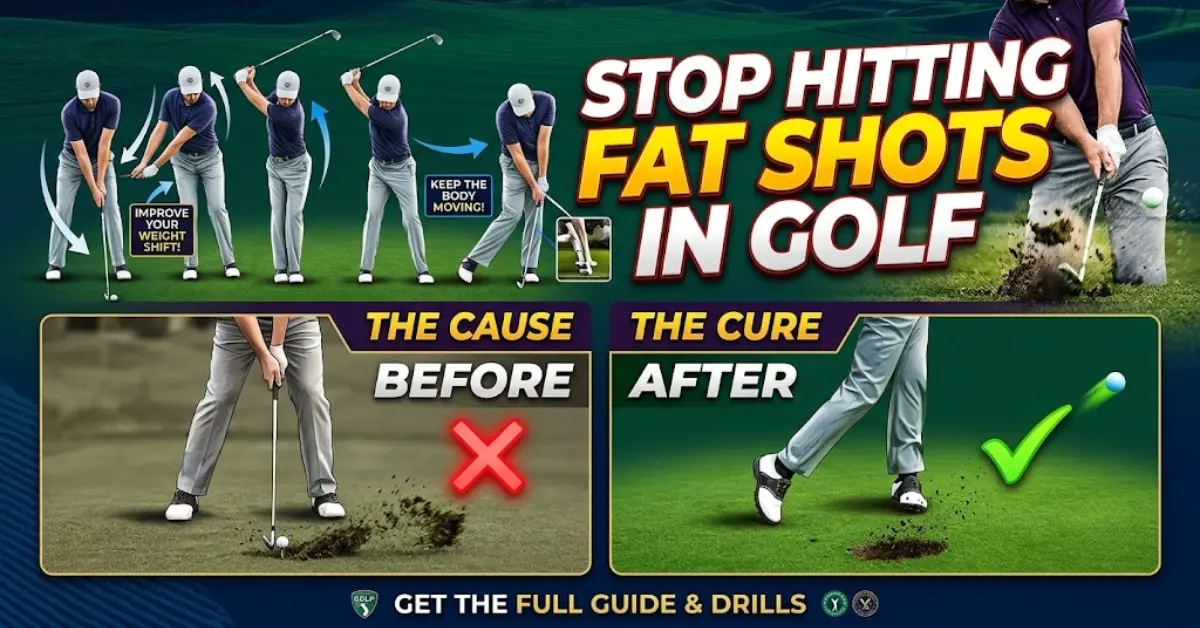
Quick Answer: A fat shot happens when your club bottoms out behind the ball. The fix depends on your specific fault: hanging back on your trail foot (shift weight forward to 70-30), flipping your wrists early (keep the lead wrist flat through impact), or swinging too steep (widen your stance and shallow your attack angle). Take a practice swing and watch where the club touches the ground—that tells you your fix.
You just flushed your tee shot. You’re 150 yards out, perfect number for your 7-iron. You take a smooth swing—and thud. The club digs in two inches behind the ball. The ball dribbles forward 20 yards. You’re staring at a bogey or worse.
Fat shots are the most costly miss in golf. Not slices—those at least travel. Not tops—those at least roll out. A fat shot goes nowhere and leaves you with a harder next shot. And the worst part? Most golfers try to fix it by doing the exact thing that makes it worse.
Here’s what’s actually happening, how to diagnose your specific problem in 10 seconds, and the drills that will fix it for good.
What Actually Causes a Fat Shot
A fat shot is simple physics: the lowest point of your swing arc happens before the ball, not after it. Your club hits the ground, then the ball. That’s it.
But why does the low point move backward? Three things, usually in combination:
1. Your weight stays on your back foot. You’re trying to “help” the ball into the air. So you hang back, scoop at it, and the club bottoms out behind the ball. The harder you try to lift it, the worse it gets.
2. You release your wrist angles too early. “Casting” or flipping throws the clubhead into the ground before it reaches the ball. The club loses its forward lean, the loft increases, and the leading edge digs.
3. You sway or dip. If your head moves away from the target or your body drops during the downswing, the low point moves with it—backward.
Here’s the counterintuitive part: to stop hitting it fat, you need to hit down on the ball more. The club has loft for a reason. Your job isn’t to lift the ball—it’s to let the club do its job.
The 10-Second Self-Diagnosis
Before you change anything, figure out what you’re doing wrong. Here’s a test that takes one practice swing:
- Step 1: Set up to a ball like you’re going to hit it.
- Step 2: Take a slow practice swing—half speed, no ball—and let the club brush the turf.
- Step 3: Look at where the club touched the ground.
The Weight-Forward Fix (For When You’re Hanging Back)
If your practice swing shows the club bottoming out behind the ball, your weight isn’t getting to your front side.
At address: Get 60 percent of your weight on your front foot. Not 50-50. Front foot.
At impact: That number needs to be 70-30 or even 80-20 on your front foot.
The feel: Imagine you’re throwing a ball underhand to a target in front of you. Your weight shifts forward naturally. That’s the move.
Drill: Step-Through Swing
- Set up normally.
- As you swing through, take a step forward with your trail foot toward the target.
- If you can’t step through without falling off balance, your weight wasn’t forward enough.
- Hit 10 balls this way. Then go back to a normal stance and keep the same feel.
The Steep Fat Shot vs. The Shallow Fat Shot
Not all fat shots are the same. Knowing which one you hit changes your fix completely.
Steep fat shot — Your club comes down too vertically. The divot is deep, sometimes a “trench.” The ball often goes left (for a right-handed golfer) because the clubface closes through the heavy turf contact.
- Fix: Widen your stance slightly. Feel like you’re swinging more “around” your body, not “up and down.” A flatter shoulder turn in the backswing will shallow your attack angle.
- Drill: Hit balls off a sidehill lie where the ball is above your feet. This forces a flatter swing. Feel that same motion on flat ground.
Shallow fat shot — Your club comes in too flat. The divot is thin, sometimes just a “scuff” or brush of the grass. The ball often goes right because the clubface stays open through the shallow strike.
- Fix: Move slightly closer to the ball. Feel like you’re swinging more “up” in the backswing—arms lift, not just turn.
- Drill: Place a headcover or towel just in front of the ball (target side). If you hit the towel, you’re too shallow and bottoming out too early. Make swings that miss the towel entirely.
Ball Position: The Simple Chart
Ball position is the easiest setup fix, and most golfers get it wrong.
Check: Take your setup. Drop a ball from your lead eye straight down. Where does it land? If it’s not in the right position for your club, move the ball. This one change fixes more fat shots than any swing thought.
Three Drills That Actually Work
Drill 1: The Towel Drill (For Weight Hang-Back)
Place a towel, headcover, or spare ball 4–6 inches behind your ball. Hit shots without touching the object behind the ball. If you hit the towel, you’re bottoming out too early. This forces your low point forward.
Progression: Start with the towel 6 inches behind. Once you can miss it consistently, move it to 4 inches. Then 2 inches. Your low point is now reliably in front of the ball.
Drill 2: The Two-Tee Drill (For Low Point Control)
Place a tee in the ground and put your ball on it. Place a second tee 1 inch in front of the ball. Make a swing that knocks down both tees — the ball tee and the front tee.
If you only knock down the ball tee, you’re bottoming out behind the ball. If you knock down both, your low point is exactly where it should be: at or just after the ball.
Progression: Start with the front tee 2 inches ahead. Move it closer as you improve. Eventually, you won’t need the tees at all.
Drill 3: Front-Foot-Only (For Weight Transfer)
Lift your trail foot completely off the ground before you start your swing. Hit balls standing on your front foot only. This forces your weight forward. You physically cannot hang back.
Progression: Start with short, half-swing pitches. Work up to full swings with your 7-iron. Once you can hit 10 solid shots in a row, go back to a normal stance and keep the same forward-weight feel.
How Turf and Weather Change Your Fix
This is the part most guider skip. Course conditions change everything.
Wet fairways — The ground is soft. A fat shot that would be a minor chunk on dry turf becomes a plug. Your miss is magnified. Adjustment: Play the ball one position back in your stance (toward your trail foot) to encourage a steeper, more descending strike. Take one extra club to compensate for the lost rollout.
Tight lies / hardpan — The club bounces off hard ground instead of digging. Fat shots become thin shots, and thin shots become skied. Adjustment: Narrow your stance slightly. Keep your hands ahead of the ball at impact—more forward press than usual. Ball position stays the same.
Fluffy rough — The grass grabs the hosel and closes the face. Fat shots in the rough often go left and short. Adjustment: Play the ball slightly back in your stance. Use a more upright swing (steeper attack) to get the club through the grass before it grabs. Take one extra club.
Wind (into your face) — Most golfers try to help the ball up into the wind. That’s a fat shot waiting to happen. Adjustment: Ball back in stance, hands forward, swing easy. Let the club do the work. The wind will lift it.
What a Fat Shot Actually Costs You
Let’s put a number on it.
TrackMan data shows that a 7-iron struck solidly carries about 155 yards for an average male golfer. Hit it fat—just one inch behind the ball—and that number drops to roughly 120 yards. You lose 35 yards and leave yourself a much harder approach.
Now factor in the next shot. You’re now 35 yards further back, probably in the rough or a fairway bunker. Your expected strokes to hole out goes up by 0.4 to 0.6 strokes per fat shot. Over 18 holes, three fat shots cost you roughly two strokes.
That’s the difference between breaking 90 and shooting 92. Between posting a score and tearing up the card.
What This Guide Doesn’t Fix
A fat shot can be caused by equipment. If your irons have the wrong lie angle (too upright or too flat), the club sol hits the ground before the ball no matter what you do. That’s a club-fitting issue, not a swing issue.
If you’ve tried everything here and still chunk it, get your lie angles checked. A $50 fitting is cheaper than 10 lost strokes.
FAQ
Why do I keep hitting fat shots in golf?
You’re either hanging back on your trail foot, releasing your wrist angles too early (casting), or swaying/dipping during the downswing. All three move the low point of your swing behind the ball.
How do I stop hitting fat iron shots?
Start with setup: 60% of your weight on your front foot at address, and ball position matched to your club (center for short irons, forward for long irons). Then practice the Towel Drill or Step-Through Drill to train the forward-weight feel.
What causes a fat shot in golf?
The club bottoms out before the ball. The root causes are weight hanging back, early wrist release (casting), or body sway/dip. The fix depends on which one you’re doing.
How do you fix a fat shot in golf?
Take a practice swing and look at where the club touches the ground. If it’s behind the ball, use the weight-forward drills. If it’s shallow and long, move closer to the ball and swing more upright. And if it’s deep and steep, widen your stance and swing more around your body.
Is hitting fat the worst miss in golf?
Yes. A slice still travels. A top still rolls. A fat shot goes almost nowhere and leaves you with a worse lie. Top teachers rate it as the most costly miss in the game.
Bottom line: Stop guessing. Take one practice swing, look at the ground, and fix the specific problem you actually have. Your next round will thank you.