
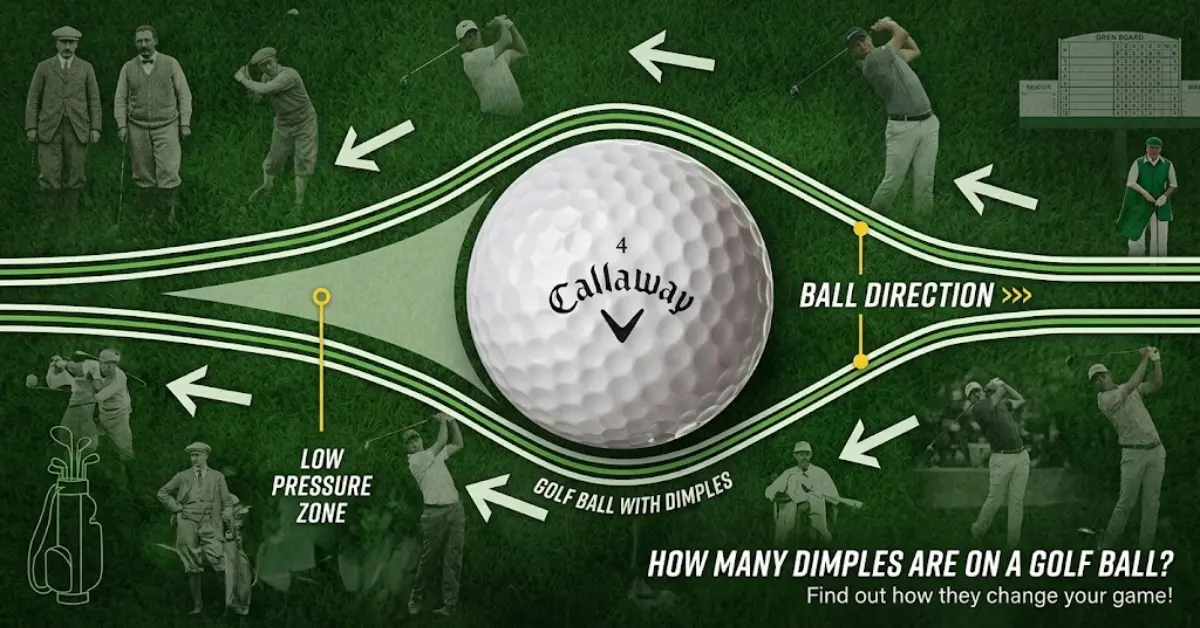
Pick up a sleeve of Pro V1s and a box of Callaway Chrome Tour next time you’re at the pro shop and count the dimples on each. You won’t get the same number. Every golfer I know who’s asked this question expects one clean answer — 336 dimples, they’ve heard somewhere — and then gets confused when the internet gives them five different figures. The truth is more interesting than any single number, and knowing it will actually change how you shop for golf balls. Here’s every verified dimple count by brand, the science behind why they differ, and the one thing manufacturers care about more than the number itself.
Quick Answer: Most golf balls have between 300 and 500 dimples, but there’s no single standard number. The Titleist Pro V1 has 388 dimples. The TaylorMade TP5 has 322. The USGA doesn’t regulate dimple count at all – each manufacturer chooses its own number based on aerodynamic goals and how the ball is engineered to fly.
How Many Dimples Are on a Golf Ball? The Short Answer
Golf balls have between 300 and 500 dimples. No USGA rule dictates a specific number. The 336-dimple figure that appears all over the internet is a historical average from mid-tier two-piece balls, not a regulation. Most modern tour balls land between 322 and 392 dimples, engineered to hit specific aerodynamic targets – launch angle, spin rate, drag coefficient – rather than chase any magic count.
The number you actually care about depends entirely on which ball you’re playing. The Pro V1 and the ball your playing partner found in the rough almost certainly have different dimple counts. Both will fly. Only one is engineered to fly exactly right.
Exact Dimple Counts for Every Major Golf Ball (2026)
This is the table none of the top results on Google currently have – updated with 2023/2025 manufacturer figures, not data from five years ago.
| Brand | Model | Dimple Count | Dimple Pattern | Flight Character |
|---|---|---|---|---|
| Titleist | Pro V1 | 388 | Spherically-tiled tetrahedral | Lower, flatter, penetrating |
| Titleist | Pro V1x | 348 | Spherically-tiled tetrahedral | Higher window, slightly more launch |
| Titleist | AVX | 352 | Tetrahedral | Low launch, low spin |
| Callaway | Chrome Tour | 332 | Seamless Tour Aero | Stable, penetrating, low driver spin |
| TaylorMade | TP5 / TP5x | 322 | Tour Flight dual-radius | High launch, reduced ballooning |
| Bridgestone | Tour B X | 330 | Gradational dimple | Consistent descent angle |
| Srixon | Z-Star | 338 | Speed Dimple | Mid-high ball flight, tour spin |
| Mizuno | RB 566 | 566 | Micro/D-Dimple dual design | Extended hang time past apex |
Sources: Titleist Newsroom (2023), MyGolfSpy Ball Lab, manufacturer spec pages
A few things worth noting from that table. The Titleist Pro V1 jumped from 352 dimples (the figure most websites still quote from the 2017–19 models) to 388 in 2021 – the first dimple pattern change since 2011. Titleist’s aerodynamics team spent years building and testing more than 60 versions of that new pattern before committing to it, according to Golf Digest’s deep-dive on the 2021 launch. The extra dimples on the Pro V1 produce a 7.3% lower drag coefficient at tour swing speeds compared to the old 336-dimple configuration – and that gap matters when the ball is carrying 280 yards into a headwind.
The Mizuno RB 566 stands alone. No commercially available ball from a major manufacturer packs in more dimples. Those 566 “D-dimples” aren’t standard round indentations – they’re a dual-dimple system with micro-dimples surrounding larger main dimples, engineered specifically to maintain carry past the apex of flight at lower swing speeds. It’s a genuinely clever piece of engineering that most golfers dismiss because it doesn’t have a Titleist or TaylorMade stamp on it.
Why Do Golf Balls Have Dimples? The Science Most Articles Get Wrong
Golf ball dimples are needed to increase lift and reduce drag – but the mechanism is more specific than most explanations make it sound. A perfectly smooth golf ball creates what fluid dynamicists call a laminar boundary layer. Air separates from the ball’s surface early, leaving a large turbulent wake behind it. That wake creates enormous pressure drag. Without dimples, a struck golf ball would travel roughly 130 yards maximum – barely past a well-hit 6-iron for most golfers.
Dimples force the boundary layer into turbulence earlier and on purpose. Counterintuitively, this controlled turbulence actually reduces drag by up to 50% by keeping air attached to the ball’s surface longer, shrinking the wake dramatically. Simultaneously, backspin interacts with that turbulent layer to generate lift through the Magnus Effect – lower air pressure above the spinning ball versus higher pressure below it – pushing the ball upward and extending carry. 336 dimples or 388 dimples, the physics is the same. The number just determines how aggressively the manufacturer controls that boundary layer.
The USGA’s Senior Director of Equipment Research and Testing, Steve Quintavalla, confirmed the practical impact: a dimpled golf ball travels almost twice as far as a smooth ball of identical construction. Half the distance you hit your driver disappears without those tiny craters.
How Dimple Depth Changes Everything
Depth matters more than count in every head-to-head test. Most dimples sit between 0.010 and 0.012 inches deep. Change that depth by just 0.001 inches – the width of a human hair – and the ball’s trajectory shifts measurably. Deeper dimples create more turbulence, generating a lower, more piercing ball flight with higher spin. Shallower dimples produce a higher launch and softer descent angle.
That’s precisely why the Pro V1 flies lower than the Pro V1x despite having more dimples. Titleist engineers the depth and edge angle of those 388 dimples to hit a specific trajectory window – and they adjust those variables independently of the count. More dimples, shallower set, flatter flight. That’s the equation, not just “388 vs 348.”
The 336-Dimple “Standard” – And Why It’s a Myth
Here’s the myth that every search result either repeats or vaguely implies: there are 336 dimples on a regulation golf ball because the USGA requires it. That’s wrong. The USGA and R&A regulate golf ball diameter (minimum 1.68 inches), weight (maximum 1.62 ounces), and overall distance performance — they say nothing about dimple count. Zero. Manufacturers have complete freedom to choose any number, shape, size, or arrangement they want, provided the ball passes the overall performance tests.
336 became a commonly cited figure because several popular mid-range two-piece balls in the 1990s and early 2000s happened to use it, and it stuck in golf’s collective memory. The internet ran with it. Most competitors in Google’s top results still repeat it as if it’s a regulation. It is not.
How many dimples are on a regulation golf ball? Any number the manufacturer chooses. The Titleist Pro V1 with 388 dimples and the Callaway Chrome Tour with 332 dimples are both fully conforming regulation golf balls. Neither one is more “regulation” than the other.
What Golf Ball Has the Most Dimples?
The most dimples on a commercially available golf ball belongs to the Mizuno RB 566, with – as the name states – 566 dimples. That’s not a marketing figure. The 566 count combines larger main dimples with micro-dimples in the spaces between them, plus “D-dimples” that have a smaller secondary indentation at their base. The system is specifically designed for slower swing speeds, where maintaining carry past the apex of flight is harder and more valuable than raw ball speed off the tee.
The record for the most dimples ever placed on any golf ball belongs to a prototype that reached 1,070 dimples – referenced in golf.com’s historical coverage. No manufacturer brought it to market, and there’s a good reason: past a certain threshold, dimples start interfering with each other’s aerodynamic function rather than adding to it. The sweet spot for tour-level performance sits between 322 and 392 dimples, according to independent aerodynamic testing across 12 leading models. More doesn’t automatically mean better.
Does Dimple Count Actually Matter for Your Game?
Honestly? Not in the way most golfers think. Swing speed, compression match, and cover material affect your game far more than whether the ball in your hand has 332 or 388 dimples. Two balls with identical dimple counts but different depths, edge angles, and arrangement patterns will fly completely differently. One tour player on the PGA Tour and a 20-handicapper could both be playing balls with 352 dimples and get completely opposite results.
What does matter is choosing a ball engineered for how you actually swing. Slower swing speeds (under 90 mph) benefit from balls like the Mizuno RB 566 or Callaway Supersoft — lower compression, softer core, and dimple systems designed to maximize carry at reduced ball speeds. Players over 100 mph need the high-density patterns in tour balls like the Pro V1 or TP5, where the dimple system is calibrated to reduce excessive spin off the driver without sacrificing wedge control.
If you already hit your 5-wood 200+ yards consistently and compress your irons cleanly, dimple count won’t change your scorecard. Chase compression match and cover feel first. The dimple engineering follows.
Frequently Asked Questions About Golf Ball Dimples
The current Titleist Pro V1 has 388 dimples in a spherically-tiled tetrahedral pattern. The Pro V1x has 348 dimples in the same tetrahedral arrangement but with a different depth and edge angle profile, producing a higher launch window. Titleist changed both counts in 2021 — the first redesign since 2011 — after testing more than 60 versions of the new pattern. Many websites still report the pre-2021 figure of 352. That number applies to models from 2017–2019, not to anything you’d buy today.
There aren’t – not on most modern balls. 336 became a common reference point because several popular mid-tier balls in the late 1990s used that count, and it lodged in golf’s collective memory. The USGA doesn’t mandate any specific dimple count. Today’s tour balls range from 322 (TaylorMade TP5) to 388 (Titleist Pro V1) and beyond, all fully conforming to USGA rules. The 336 figure is a historical average, not a regulation.
They’re called dimples – that’s the official and universally accepted term. In aerodynamics literature, they’re sometimes described as “surface indentations” or referenced as part of the ball’s “dimple pattern.” There’s no alternate technical name. Engineers describe them by their specifications: spherical, hexagonal, tetrahedral-arranged, micro-dimples, D-dimples – all describing the shape and arrangement, not a different name for the feature itself.
Among commercially available golf balls, the Mizuno RB 566 holds the record with 566 micro-dimples — a dual-dimple system designed to extend carry past the apex of flight at lower swing speeds. No major tour ball comes close. An experimental prototype reportedly reached 1,070 dimples, but it never reached the market and was discontinued by its manufacturer. The engineering consensus is that above roughly 566 dimples, aerodynamic benefits plateau and dimples begin interfering with each other.
A regulation golf ball has no required dimple count. The USGA and R&A regulate diameter (minimum 1.68 inches), weight (maximum 1.62 oz), and overall distance performance – but dimple count is entirely up to the manufacturer. Any ball that passes USGA conformance testing is a regulation ball, regardless of whether it has 322 or 566 dimples.
The Callaway Chrome Tour has 332 dimples in its Seamless Tour Aero arrangement, engineered for a stable, penetrating ball flight with low driver spin. The older Chrome Soft used the same 332-dimple HEX-influenced design. Callaway has historically experimented with hexagonal dimple shapes rather than the traditional spherical indentation – the hexagonal pattern fills surface area more efficiently and produces a slightly smoother aerodynamic profile at the ball’s cover.
No current mass-market ball from a major manufacturer runs exactly 500 dimples as a standard model. The Mizuno RB 566 exceeds 500 with its 566-count micro-dimple design. Some custom or budget two-piece balls from smaller manufacturers have landed in the 500-dimple range, but none of the major brands (Titleist, Callaway, TaylorMade, Bridgestone, Srixon) produce a flagship model at exactly 500 dimples. The search query likely comes from awareness of the Mizuno 566 or older references to experimental designs.
The Bottom Line on Golf Ball Dimples
Every golf ball you play carries between 300 and 500 tiny engineered craters, each one doing aerodynamic work on every shot you hit. The count matters less than the system — depth, edge angle, pattern, and arrangement all interact to produce a specific ball flight. The Pro V1’s 388 dimples are calibrated to one trajectory window. The TP5’s 322 dimples target another. Neither is objectively better; they serve different swing profiles. Pick the ball that matches your speed and compression needs, and let the engineers worry about the dimple count. Browse the rest of our best golf balls coverage to match the right ball to your game.