
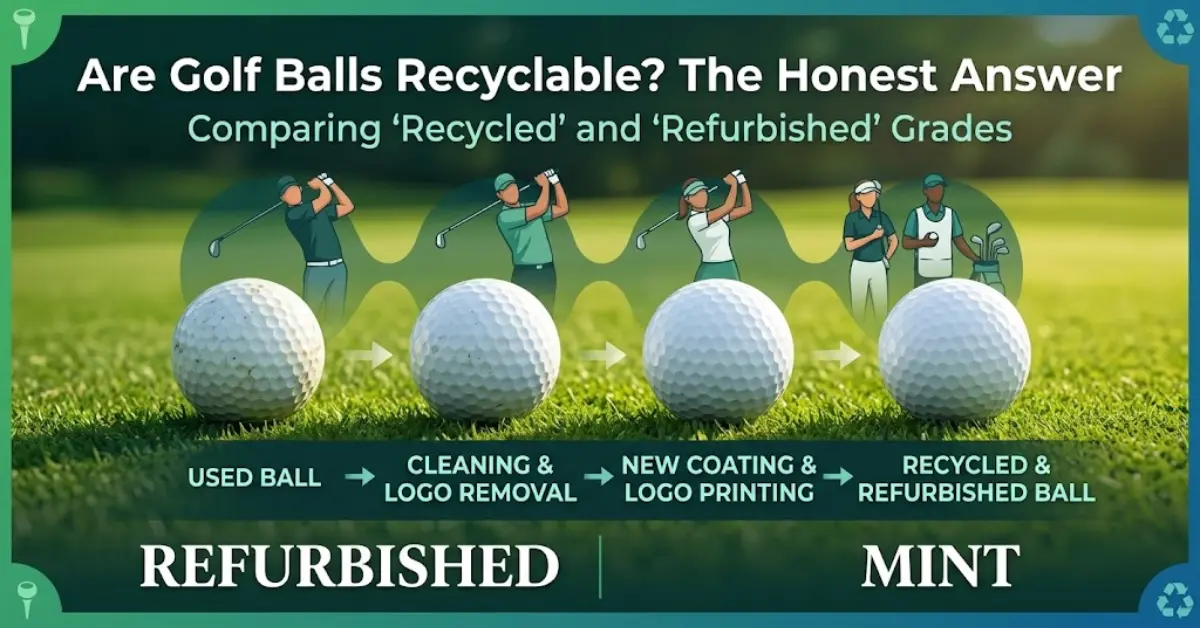
I’ve got a mesh bag in my garage with probably 200 dead golf balls in it – scuffed Pro V1s, a few range balls that snuck home in my bag, balls so chewed up you can see the core through the cover. For years I just tossed the worst ones in my recycling bin without thinking twice. Turns out that was the wrong move, and the reason why is more interesting than you’d expect.
Quick Answer: No, golf balls aren’t recyclable through standard curbside bins. Their rubber cores and Surlyn or urethane covers can’t be melted down and reprocessed the way plastic bottles can. Your best options are reusing them, donating them to junior golf programs, or selling playable ones to a used-ball retailer.
Are Golf Balls Recyclable? The Short Answer
No. Don’t throw golf balls in your curbside recycling bin.
Golf balls aren’t made of a single material your local recycling facility can sort and reprocess. They’re a layered combination of synthetic rubber, plastic, and resin, fused together in a way that’s basically impossible to separate at a materials recovery facility. The majority of golf balls are neither recyclable nor biodegradable, which is exactly why they pile up as waste instead of getting baled with your milk jugs and cardboard.
That doesn’t mean every old ball is destined for a landfill, though. It just means “recycling” in the curbside-bin sense isn’t the path. Reuse, resale, and donation are.
Why Golf Balls Can’t Go in Your Recycling Bin
Here’s where most articles wave their hands. I want to actually explain it.
A modern golf ball isn’t one material – it’s several, bonded together on purpose so the ball performs a specific way off the clubface. The core is typically a synthetic rubber, often polybutadiene, chosen because it compresses and snaps back with explosive energy at impact. Wrapped around that core is the cover, almost always either Surlyn (an ionomer resin prized for durability and distance) or urethane (softer, used on premium tour balls for spin and feel around the green).
Cast thermoset urethane – the stuff on a Pro V1 – chemically cures inside the mold. Once it’s formed, it can’t be melted back down and reshaped. That’s the entire problem in one sentence. Curbside recycling depends on materials that can be shredded, melted, and reformed into something new. A golf ball cover that’s chemically locked in place the moment it’s made simply doesn’t fit that process, no matter how clean or sorted it arrives.
Layer on top of that the fact that a golf ball is fused, not assembled — you can’t pop the cover off and separate it from the core the way you’d peel a label off a bottle. Recycling facilities don’t have a process for that, and building one just for golf balls isn’t economically viable when the volume is a tiny fraction of what plastic bottles or aluminum cans represent.
This is also why a lost ball in the rough sticks around so long. Estimates put golf ball decomposition at anywhere from 100 to 1,000 years in soil or water, slowly leaching the rubber and resin compounds into the surrounding environment. If you’ve ever pulled a ball out of a pond that’s gone chalky and cracked, that’s the breakdown process — just an extremely slow one.
One golf course in Sweden actually measured this at scale. Kristianstads Golf Klubb partnered with a recycling company and processed 14,337 old balls, totaling 660 kg of material and cutting roughly 3,226 kg of CO2 emissions compared to letting them sit in the rough or landfill. That’s one course, one season — multiply that across the roughly 38,000 golf courses worldwide and the lost-ball problem stops looking trivial.
What to Do With Old Golf Balls Instead
If “recycle” is off the table, here’s where your old balls should actually go, depending on condition.
| Condition | Best Option | Where It Actually Goes | Worth Doing? |
|---|---|---|---|
| Scuffed but round, still flies straight | Practice/range balls | Stays in your bag for the driving range | Yes — free practice balls |
| Mint or near-mint, premium brand (Pro V1, Chrome Soft, TP5) | Sell to a used-ball retailer | Resold to other golfers at 40-60% off retail | Yes — real cash value |
| Decent condition, mixed brands | Donate to junior golf | Distributed to youth golf programs | Yes — tax-deductible in the US |
| Cracked, waterlogged, or core exposed | General trash | Landfill (same as it would be in a recycling bin, minus the contamination) | Last resort only |
I run my own balls through this exact sort every spring. Anything with a visible scuff but a round profile goes straight into my range bag – I’d rather lose a $1 mishit ball at the range than a $4 one on the course. Anything mint goes into a box for resale. Anything cracked or waterlogged goes in the trash, because pretending it’s recyclable just means a sorting facility throws it out for me later, possibly after it’s jammed a piece of equipment.
Sell Them (Even Beat-Up Ones Have Value)
This is the part most golfers skip, and it’s leaving money on the table. Used and recycled golf balls have an active resale market, and current pricing makes it worth sorting your stash before you bin anything.
A new dozen Titleist Pro V1s runs around $58 at retail in 2026. The same model in mint used condition sells for roughly $22-29 a dozen depending on whether it’s graded Mint or Near-Mint. Even individually, used premium balls typically resell for $0.50 to $4.00 each depending on brand, model, and how beat-up they are. If you’ve got a bag of 50 mixed Pro V1s sitting in your garage, that’s not garbage – that’s potentially $30-50 if you bother to sort and list them.
I’m not saying build a side business out of it. I’m saying don’t throw away balls that someone will pay you for, especially when the alternative – putting them in a recycling bin – does nothing for the environment anyway since they’ll just get pulled out and landfilled regardless.
Donate Them to Junior Golf Programs
If sorting and selling sounds like too much hassle, donation is the lower-effort option, and it solves a real problem: junior golf programs constantly run short on practice balls because kids lose them at roughly the same rate adults do, just with smaller wallets to replace them.
Most donation programs accept balls in playable-to-decent condition – they don’t need to be mint, just not cracked or waterlogged beyond recognition. If you’re shipping fewer than 500 balls, USPS is usually fine; for larger donations, some organizations will schedule a pickup. It’s a five-minute task that clears out a garage shelf and gives a kid more reps on the range.
Frequently Asked Questions
Sort by condition first. Scuffed-but-round balls become practice or range balls. Mint and near-mint premium balls (Pro V1, Chrome Soft, TP5, and similar) can be sold to used-ball retailers for real money – often $0.50 to $4 each depending on brand and grade. Decent-condition balls in any brand can be donated to junior golf programs. Only cracked, waterlogged, or visibly degraded balls should go in the trash, since those can’t be reused, sold, or donated.
Golf balls are one of the more surprising entries on this list, right alongside things like greasy pizza boxes, plastic bags and film, and ceramics. The common thread is materials that are either contaminated, made of mixed/bonded layers that can’t be separated, or simply don’t have an economically viable recycling market — golf balls check the “mixed and bonded” box, since their rubber core and resin cover are chemically fused and can’t be melted down separately.
Bright yellow and orange golf balls are the easiest to spot in grass and rough, since green and white — the most common ball colors — blend directly into turf and fairway backgrounds. If you tend to lose balls in long grass or struggle to track your shots against a green backdrop, switching to a high-visibility color is one of the simplest changes you can make, and it has the side benefit of making your lost balls easier to find and recover (rather than leaving them to slowly break down in the rough).
Yes, in a limited, temporary-relief way. Rolling a golf ball under your foot applies gentle pressure and massage to the plantar fascia, which can help with blood flow, muscle tension, and short-term pain relief. It’s a popular at-home technique because a golf ball is firm, small, and already sitting in most golfers’ garages. That said, it’s a complementary tool, not a treatment – if plantar fasciitis pain is persistent, see a podiatrist or physical therapist rather than relying on ball-rolling alone.
The Bottom Line on Golf Ball Recycling
Golf balls aren’t recyclable in the way your aluminum cans or plastic bottles are, and tossing them in the blue bin doesn’t help anyone – it just shifts the sorting problem downstream. The good news is that “not recyclable” doesn’t mean “worthless.” Between range-ball reuse, resale at $0.50-4 a ball, and donation to junior programs, there’s a productive home for almost every ball in your garage except the truly cracked ones. Sort your stash this weekend and you’ll probably find more value in it than you expected.