
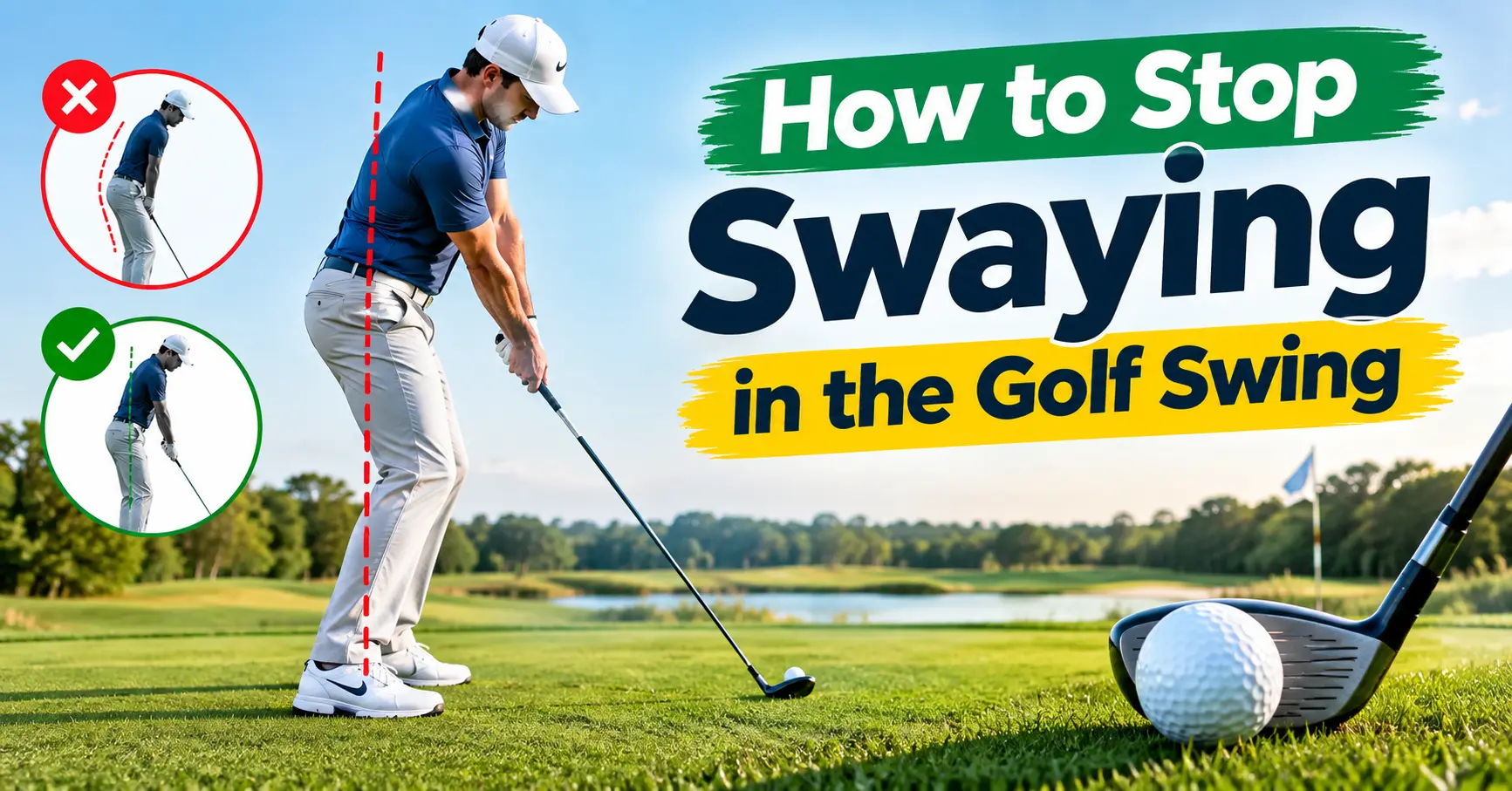
Quick Answer: Swaying happens when your lower body slides sideways instead of rotating around a fairly fixed spine. Stop it by keeping pressure on the inside of your trail foot during the backswing and letting your hips turn, not shift. The feet-together drill exposes a sway inside five swings, since any lateral slide breaks your balance immediately at that stance width.
Golfers and instructors blame swaying for almost every bad shot in golf, and half the time that blame lands on the wrong movement. A small lateral bump toward the target on the downswing isn’t a swing fault at all. It’s how good players generate power.
The actual problem shows up when your hips slide away from the target in the backswing instead of turning, or when your whole body slides past the ball before your hips ever open. Covering how to stop swaying in the golf swing means covering both faults, not just one. You’ll get the weight-transfer checkpoints tour players hit at each swing position, plus the specific drills that fix each version without turning your swing into a stiff, rotation-only motion that kills your distance.
What Swaying Actually Is (And Why It’s Not the Same as a Weight Shift)
Ask five instructors how to stop swaying in the golf swing and you’ll get five slightly different answers. Strip away the jargon and it comes down to this: your hips and upper body move sideways, away from the ball, instead of turning around a relatively stationary spine. Your head drifts several inches toward your trail side during the backswing, and your body never fully resets over your lead leg before impact.
A weight shift is a completely different move, and confusing the two causes most of the bad advice you’ve probably already tried. Pressure genuinely does move into your trail foot on the backswing and into your lead foot on the downswing. The difference lies in what carries that pressure. Rotation carries it in a real swing, while a slide carries it in a sway.
Golfers often phrase this as how to stop moving off the ball in golf swing, and it describes the identical fault from a different angle. You set your spine’s distance from the ball and your shoulder angle at address. Shift your hips three inches toward your trail side and every one of those measurements changes before you’ve even started the club back. That’s why a sway can feel completely fine in the moment and still produce a shank, a chunk, or a weak block right.
| Term | When It Happens | What It Looks Like |
|---|---|---|
| Weight shift (good) | Backswing and downswing | Pressure moves foot to foot while the hips rotate around a stable spine |
| Sway | Backswing | Hips and pelvis slide laterally away from the target instead of turning |
| Slide | Downswing | Hips and upper body move toward the target before the rotation starts |
Why You’re Swaying in the First Place
Most swaying starts with a coaching cue gone wrong, not a mechanical flaw. Tell a golfer to “shift your weight” or “make a big turn” without showing them what that looks like, and sliding sideways is the easiest way their body finds to obey the instruction. Shifting is simpler than rotating around a fixed axis, so the body takes the path of least resistance.
Physical limitations cause just as many sways as bad coaching cues do. Limited internal rotation in your trail hip forces your pelvis to slide sideways because it can’t turn far enough on its own. Restricted ankle mobility does the same thing from the ground up. TPI’s mobility screening research backs this up directly: golfers who can’t evert their trail ankle properly are left with sliding onto the outside of that foot as their only option for loading the backswing.
Weak glute activation adds a third layer. Your glute medius stabilizes your pelvis during rotation, and when it’s underactive, your hips lose their platform and drift sideways looking for stability somewhere else. Add an overactive lower back stepping in to compensate, and you get exactly the side-to-side sway that shows up on video.
Your wrists play a role too, and almost nobody mentions this one. Golfers who reach the top of the backswing with too much wrist extension need extra time to square the clubface before impact. Swaying buys them that time. It’s a compensation for a face that isn’t ready, not a standalone lower body problem.
Fixing these root causes, not just the symptom on the range, is how to prevent swaying in the golf swing for good.
What Does Swaying in the Golf Swing Cause?
Swaying doesn’t just look sloppy on camera. It moves your swing’s low point away from the ball, and it moves to a different spot practically every time you swing.
Slide too far in the backswing and you’ll typically catch the ball fat, because your low point shifts behind the ball instead of staying centered under your sternum. Fail to get all the way back over your lead side by impact and you’ll block shots low and right, often with a weak slice mixed in. Neither miss is random. Both trace directly back to where your pressure sits the moment the clubhead reaches the ball.
Distance suffers the most, and it’s not close. A body that slides instead of rotating can’t use the ground for leverage, so your arms and hands end up doing work your legs and core should be doing instead. Tour players generate most of their clubhead speed from the ground up, through a stable base that lets the hips fire ahead of the shoulders. Take that base away and you’re swinging with a fraction of the power sitting right there for the taking.
Swaying often travels with other faults, since your body searches for extra time or extra room to compensate for whatever else is going wrong. Keep that in mind if your misses still skew right after the sway itself is gone.
The Weight-Transfer Checkpoints That Actually Fix a Sway
Feel and reality rarely match on weight transfer, and that mismatch is exactly why golfers never figure out how to stop swaying in the golf swing even after someone’s told them to turn more. Pressure-plate data from teaching studios and tour players gives you real numbers to check against instead of a vague feeling. These ranges shift slightly by instructor and by player, but the overall pattern holds up across nearly every study on the subject.
| Swing Position | Pressure on Lead Foot (Rotating Correctly) | What a Sway or Slide Looks Like Instead |
|---|---|---|
| Address | Roughly 50-55 percent | Already favoring the outside edge of one foot before you even start back |
| Top of backswing | Drops to roughly 25-35 percent, while pressure stays inside the trail foot | Pelvis has slid 3 to 4 inches toward the trail side, and the trail knee has straightened |
| Downswing transition | Climbs back through 50 percent as the lead hip starts to clear | The whole body drifts toward the target before the hips open at all |
| Impact | 80 to 90 percent | Pressure is stuck on the trail foot, or the upper body has slid ahead of the ball |
Pressure never sits still in a real swing. Movement is the whole point, all the way from address to impact. Tour players don’t keep their weight from shifting any more than you do. Rotation carries their hips through it, while a slide carries yours instead.
How to Stop Swaying in Golf Backswing: 4 Drills That Actually Work
Whether you’re focused on how to stop swaying back in golf swing terms specifically, or just want the best drill to stop swaying in golf swing situations overall, these four cover almost every cause golfers run into.
- The feet-together drill. Stand with your heels touching and make half-speed swings back and through. Any lateral slide throws you off balance immediately at this stance width, so your body has no choice but to find the sway and correct it on the spot. Start with a wedge, then work up to a 7-iron once you can hold your balance through five swings in a row.
- The trail-foot pressure drill. Set a headcover or a rolled towel just outside your trail foot at address. Make your normal backswing and notice whether you touch it. Touching the object means your pelvis has slid outside its base instead of turning your weight into the instep of that foot. Hit 10 balls with the drill in place, then check your natural swing again without it.
- The arms-crossed turn. Cross your arms over your chest, take your golf posture without a club, and rotate back and through in front of a mirror or a window. Removing the club takes away the temptation to lift your arms to fake a turn you haven’t actually made. Watch your lead shoulder. It should move down and behind you, not out to the side, when your rotation happens around your spine instead of away from it.
- The alignment-stick boundary. Push an alignment stick into the ground just outside your trail hip, angled straight up. Make backswings that stop just short of touching it. This gives you the same instant physical feedback as a coach standing behind you at the range, using a training aid most golfers already own.
How to Stop Sliding Forward on the Downswing (and Actually Rotate)
A slide is a sway’s mirror image, and it’s the movement golfers mean when they say swaying forward on downswing. Instead of moving away from the target in the backswing, your hips and upper body move toward the target on the downswing before they’ve rotated at all. You’ll recognize it by a lunging feeling into impact and a lead knee that buckles forward past your toes.
Golfers usually start searching for how to stop sliding forward in the golf swing and rotate right after they’ve already fixed their backswing sway and found a brand new problem waiting on the way down. The fix isn’t “don’t move.” Elite players shift their hips several inches toward the target during the downswing, and that lateral bump is exactly where a lot of their power comes from. The problem only shows up when the bump replaces the turn instead of starting it.
Watch any tour player on face-on video and you’ll see the lead hip clear open almost immediately after the lateral bump begins, not several tenths of a second later. That’s hip-first downswing sequencing in action. The lead hip fires before the shoulders and arms follow, and it’s one of the clearest differences separating elite ball strikers from everyone else on the range.
These three drills are the most direct answer to how to stop sliding in the golf swing without losing the power a healthy lateral bump provides.
- The step-turn drill. Set up normally, then lift your lead foot an inch off the ground during the backswing. Plant it back down right as you start the downswing, a beat before your arms begin dropping. This exaggerates the sequence so your hips have to lead instead of your shoulders.
- The trail-heel-down drill. Keep your trail heel on the ground a fraction longer than feels natural as you start down. This slows your pelvis’s lateral drift just enough to let your hips rotate instead of slide, then let the heel rise naturally through impact.
- The bag-behind-the-hip drill. Set your golf bag or a chair just outside where your lead hip sits at address. Swing down and rotate your hip into the bag instead of past it. Feeling the bag before impact means you’ve slid instead of turned.
Driver vs. Irons: How Much Lateral Movement Is Actually Normal
Not every lateral move deserves the sway label, and treating every club the same is a mistake plenty of instructors make. A driver swing, with the ball forward in your stance and a wider base, naturally allows more lateral motion than a pitching wedge does. The longer the club, the more room your swing needs to load and release without forcing an overly rotational motion that saps your speed.
If you already rotate well and only shift an inch or two through the ball, chasing a completely stack-and-tilt, zero-lateral-move image will make your swing worse, not better. That model works well for some players. It flattens the natural power move for plenty of others, especially once a driver is in their hands.
The real test isn’t whether you move. Turning while you move is what matters, along with getting back over your lead foot by the time the club reaches the ball. A 2-inch shift with full rotation beats a frozen lower body every single time.
How to Stop Swaying in Golf Swing Slow Motion Checks (Phone Camera Setup)
Real-time swings hide a sway from your own eyes. Your brain processes a full swing in under a second and a half, which isn’t enough time to consciously register a 3-inch hip slide while it’s happening. A camera removes that blind spot completely.
- Set your phone on a tripod or a bag at hip height, directly in front of your toe line, far enough back to fit your entire swing in frame.
- Lay a spare club or an alignment stick on the ground just outside your trail foot before you swing. This becomes your reference line in the video.
- Record five swings at three-quarter speed. Full speed hides a sway because everything happens too fast to track with the naked eye.
- Scrub to the top of your backswing and pause. Check whether your trail hip has crossed outside the reference line you laid down.
- Scrub to impact and check the same reference line on your lead side. Your belt buckle should sit close to, or slightly ahead of, where it started at address, not several inches behind it.
That same three-quarter-speed camera trick spots a sway just as well as it rebuilds tempo in slow motion practice reps. Slow the swing down, not just the club.
Frequently Asked Questions
Why am I swaying in my golf swing?
You’re most likely swaying because your body is compensating for one of three things: a coaching cue like “shift your weight” that nobody ever demonstrated properly, limited internal rotation in your trail hip that makes turning difficult, or a clubface that needs extra time to square before impact. Face-on video usually reveals which one applies to you.
How to turn instead of sway in golf swing?
Feel your trail hip climb and rotate under your shoulders instead of shifting sideways, keeping pressure on the inside of your trail foot at the top of the backswing. The feet-together drill and the alignment-stick boundary both force this feeling within a handful of swings, since any lateral slide becomes impossible to ignore at that stance width.
What’s the 70/30 rule in golf?
People use “70/30” as shorthand for a weight-distribution checkpoint, not as an official rule. Different instructors mean different things by it, most often roughly 70 percent of your pressure on the lead foot at impact, or 70 percent on the trail foot at the top of the backswing. The exact number shifts depending on which coach and which swing position you’re asking about, so treat it as a rough feel check rather than a fixed target.
What’s the difference between swinging and swaying?
A golf swing rotates your body around a relatively fixed spine while pressure moves from foot to foot. Swaying replaces that rotation with a lateral slide, carrying your hips and head away from the ball instead of turning around them. Weight still shifts in both versions. A sway just carries that weight sideways instead of letting your body turn around it.
Final Thoughts
Whether you typed how to stop swaying in your golf swing or came here already knowing the term, the fix is the same: turn, don’t slide. Swaying isn’t really about moving too much. It’s about moving in the wrong direction relative to your spine, at the wrong point in your golf swing.
Fix the backswing slide with the feet-together and alignment-stick drills. Fix the downswing slide by feeling your lead hip clear before your arms drop. Check both against real weight-transfer numbers instead of a guess, and the extra clubhead speed shows up almost immediately once rotation replaces the slide for good. Once you understand how to stop swaying in the golf swing at both ends, backswing and downswing, the fix holds up under pressure, not just on the range.
If a stubborn slice or block is still showing up after your sway is gone, an open clubface at impact is usually the next thing worth checking.