
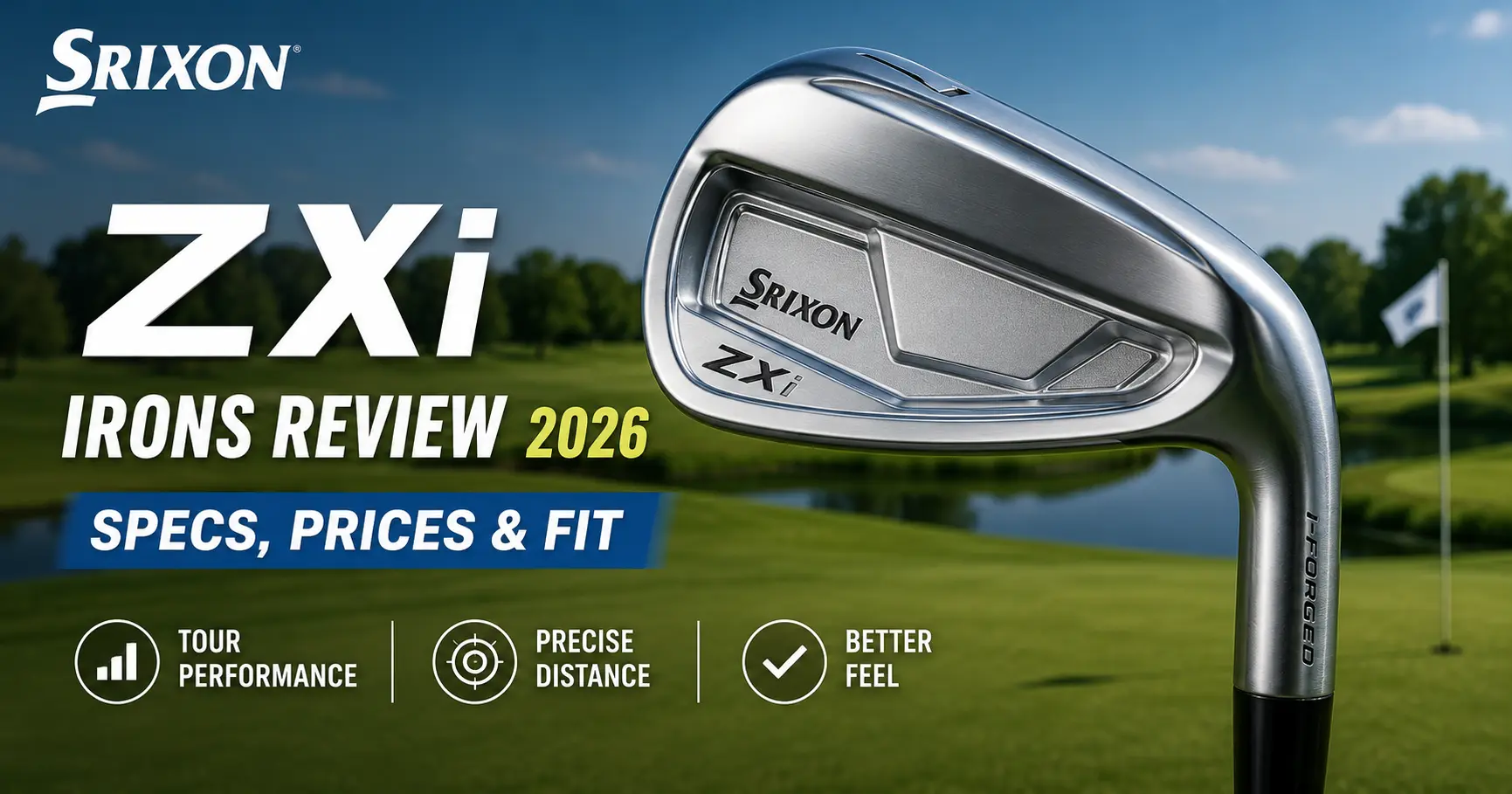
Srixon’s ZXi irons are a four-model 2025-2026 lineup: the forged ZXi7 for tour-level control, the two-piece ZXi5 for low-to-mid handicaps, the hollow ZXi4 for forgiveness, and the game-improvement ZXiR. Sets run $199.99 to $1,499.99 depending on configuration, and the ZXi7 uses the softest steel Srixon has ever forged.
Four models. Two different forging processes. A price gap between a used ZXi7 and a new ZXi5 combo set wide enough to buy a decent driver. Srixon Golf’s ZXi lineup looks simple from the outside, just three numbers and a letter, but the family has actually grown to six distinct iron sets since launch, and picking the wrong one is an easy way to spend $1,400 on a club that fights your swing instead of helping it. This review breaks down every current ZXi model by spec, price, and handicap fit, pulled straight from Srixon’s own engineering data rather than marketing copy.
What Is the Srixon ZXi Lineup, Exactly?
Srixon opened preorders on the ZXi4, ZXi5, ZXi7, and ZXiU utility iron on January 13, 2025. The Srixon ZXi irons release date for retail arrival was January 24, 2025. The launch price for a 7-piece steel set landed at $1,299, with the utility iron priced separately at $239.99 per club. That original three-model split, plus the utility iron, held for most of 2025.
Then Srixon expanded the family. The ZXiR and ZXiR HL arrived as dedicated game-improvement models. Srixon builds them around a new steel called i-ALLOY, softer and lighter than the 431 stainless most competitors use in that category. In February 2026, Srixon added a black chrome limited-edition finish to the ZXi7 and ZXi5, using the same i-FORGED construction under a darker, glare-reducing coating.
Six iron models now carry the ZXi name: ZXi7, ZXi5, ZXi4, ZXiU, ZXiR, and ZXiR HL. Most articles covering srixon zxi irons only talk about the original three. That’s a real problem if you’re a mid-to-high handicapper, because the ZXiR family is arguably a better fit for you than the ZXi4.
Srixon ZXi Irons Specs and Lofts
Here’s where most reviews get vague. Srixon publishes exact loft, lie, length, offset, and swing weight data for every iron in the ZXi4 and ZXi5 sets on its own configurator, and almost nobody reproduces the full table. Below is the complete spec sheet for both, pulled directly from Srixon’s site.
ZXi5 Iron Specs
| Iron | Loft | Lie | Offset | Length (steel) | Steel Swing Weight (S/R) |
|---|---|---|---|---|---|
| 3 | 20° | 60° | 4.2mm | 39.25″ | D3 / D2 |
| 4 | 22° | 60.5° | 4.0mm | 38.75″ | D3 / D2 |
| 5 | 24° | 61° | 3.8mm | 38.25″ | D3 / D2 |
| 6 | 27° | 61.5° | 3.6mm | 37.75″ | D3 / D2 |
| 7 | 31° | 62° | 3.2mm | 37.25″ | D3 / D2 |
| 8 | 35° | 62.5° | 3.0mm | 36.75″ | D3 / D2 |
| 9 | 39° | 63° | 2.7mm | 36.25″ | D3 / D2 |
| PW | 44° | 63.5° | 2.2mm | 35.75″ | D3 / D2 |
| AW | 50° | 63.5° | 1.9mm | 35.75″ | D4 / D3 |
| SW | 56° | 63.5° | 1.5mm | 35.75″ | D4 / D3 |
ZXi4 Iron Specs
| Iron | Loft | Lie | Offset | Length (steel) | Steel Swing Weight (S/R) |
|---|---|---|---|---|---|
| 4 | 21° | 60.5° | 4.1mm | 38.75″ | D2 / D2 |
| 5 | 23° | 61° | 3.9mm | 38.25″ | D2 / D2 |
| 6 | 25.5° | 61.5° | 3.6mm | 37.75″ | D2 / D2 |
| 7 | 28.5° | 62° | 3.2mm | 37.25″ | D2 / D2 |
| 8 | 33° | 62.5° | 3.0mm | 36.75″ | D2 / D2 |
| 9 | 38° | 63° | 2.7mm | 36.25″ | D2 / D2 |
| PW | 43° | 63.5° | 2.2mm | 35.75″ | D2 / D2 |
| AW | 49° | 63.5° | 1.8mm | 35.75″ | D3 / D3 |
| SW | 56° | 63.5° | 1.0mm | 35.75″ | D3 / D3 |
Two things jump out from that table. The ZXi4’s 7-iron carries 28.5 degrees of loft, three full degrees stronger than the ZXi5’s 31-degree 7-iron. That’s the real difference-maker if you’re deciding between the two on distance alone. The gap shrinks toward the wedges, since both sets share a 56-degree sand wedge.
One note on club length. Srixon updated how it measures and publishes iron length in 2025 to match new USGA and R&A guidelines, which makes published lengths look about a quarter-inch longer than older ZX models show. Nothing in the actual clubs changed. Only the measurement standard did, so don’t panic if a ZXi5 7-iron looks longer on paper than your old ZX7.
Srixon hasn’t published the same granular table for the ZXi7 on its consumer configurator the way it has for ZXi4 and ZXi5. What’s confirmed is that the ZXi7 runs the most traditional, weakest loft progression of the three, which tracks with its single-piece forged, tour-oriented design.
If you want the full picture of how loft affects distance and trajectory before comparing these numbers to your current irons, our loft strengthening breakdown explains why a “7-iron” from one brand can be five degrees different from another brand’s 7-iron.
Which ZXi Model Fits Your Handicap Range?
Srixon built a fitting chart that sorts all six ZXi models across the full handicap range by forgiveness, trajectory, workability, and distance. It’s the clearest single data point for choosing between them, and it’s the piece almost every ZXi review skips, because most only cover three of the six models.
| Model | Category | Handicap | Forgiveness | Workability |
|---|---|---|---|---|
| ZXi7 | Players | Low | Low-Mid | High |
| ZXi5 | Players Distance | Low-Mid | Mid-High | Mid-High |
| ZXi4 | Players Development | Mid-High | High | Low-Mid |
| ZXiR | Game Improvement | Mid-High | Highest | Low |
| ZXiR HL | Super Game Improvement | High | Highest+ | Low |
| ZXiU | Utility | Low-High | High | Mid |
Notice that ZXi4 and ZXiR occupy the same mid-to-high handicap zone but land in different categories entirely. ZXi4 keeps a compact, players-inspired hollow shape with more offset than any other model in the family. ZXiR trades some of that clean address-position look for outright forgiveness and a higher launch, which matters if you struggle to get long irons airborne.
If you play to a single-digit handicap and strike the ball consistently, the ZXi7 is the only model built for you. Mid-handicappers in the 5-to-15 range fit the ZXi5’s profile best. Above 15, you’re choosing between the ZXi4’s compact forgiveness and the ZXiR’s higher-launch forgiveness, and that choice usually comes down to how badly you struggle to get the ball airborne.
Handicap alone won’t tell you your real carry distances with each iron. Our golf club distance chart by skill level breaks down realistic 7-iron and 5-iron carry numbers by handicap bracket, which is worth checking before you commit to a specific loft.
Are Srixon ZXi Irons Forged?
Yes and no, depending on the model, and this is the question most competing articles answer badly.
The ZXi7 is a genuine single-piece forging. Srixon presses it from a solid billet of S15C carbon steel, the softest steel the company has ever used in a forged iron. That’s a true forging in the traditional sense, the same basic process Mizuno and Titleist use for their blade-style irons.
The ZXi5 is a two-piece forged construction. Srixon forges the body from S20C steel, then adds a separate SUP10 steel face insert that’s roughly 14 percent softer than the face material on the outgoing ZX5 Mk II. Srixon calls the whole system Condensed Forging, using a second forging pass to concentrate strength in specific zones so the rest of the head can run softer without losing durability.
The ZXi4 is not a forging in the traditional sense at all. It’s a hollow, multi-piece construction that pairs a softer SUS17-47 steel body with a forged-feel face insert. Srixon markets “forged feel” honestly here rather than claiming a true forged construction, and the distinction matters if you’re comparing it against a one-piece forged iron like the ZXi7 or a Mizuno blade.
The ZXiR follows the ZXi4’s pattern. It uses the new i-ALLOY steel in a hollow, cavity-back body that Srixon built for feel rather than for true forged construction. None of the marketing copy on Srixon’s site claims otherwise, but it’s easy to miss if you’re only skimming the “i-FORGED” branding that covers the whole family.
Srixon ZXi Irons Prices: New, Used, and What They Actually Cost in 2026
Whether you’re shopping srixon zxi irons for sale new or hunting the used market, pricing has drifted upward since launch, and used values vary more by model than most buyers expect.
| Model | New (per club) | New (7-piece steel set) | Used, starting price |
|---|---|---|---|
| ZXi4 | $199.99 | ~$1,400 | $550.99 |
| ZXi5 | $199.99 | ~$1,400 | $670.99 |
| ZXi7 | $199.99 | $1,399.99 | $595.99 |
| ZXiU (per club) | $249.99 | N/A, sold individually | $159.99 |
At launch in January 2025, Srixon priced a 7-piece ZXi4, ZXi5, or ZXi7 steel set at $1,299, working out to roughly $186 per club. If you’re buying new Srixon ZXi irons today, current retail sits closer to $1,400, an increase of about $100 to $150 over 18 months, in line with broader iron pricing trends across the industry.
The used market tells an interesting story here. ZXi5 sets hold their used value better than ZXi4 sets, starting around $120 higher at 2nd Swing despite launching at the same retail price. That gap points to stronger demand for players-distance shapes over pure game-improvement models once a newer generation arrives.
If you’re specifically shopping used ZXi7 sets, know that at least one major retailer, 2nd Swing, no longer stocks new ZXi7 sets at all, only pre-owned. That’s worth factoring in if you want a fresh, unhit set rather than a used one.
Srixon ZX vs ZXi Irons: What Actually Changed
The single biggest engineering change between the ZX and ZXi generations is i-FORGED, Srixon’s Condensed Forging process introduced with the 2025 lineup. It lets Srixon run a second forging pass to reinforce specific zones of each clubhead, which frees up the rest of the head to run on softer steel without sacrificing durability. That’s how the ZXi7 ended up 7 percent softer than its predecessor, and the ZXi5 face ended up 14 percent softer.
Visually, the ZX and ZXi families look nearly identical at address. Reviewers who’ve tested both back to back consistently describe the ZXi5 as sharing the same general silhouette as the ZX5 Mk II, just with cleaner branding and a slightly refined finish.
Here’s the honest opinion most brand-friendly reviews won’t give you: this is an iterative upgrade, not a reinvention. If you already own a set of ZX irons in good condition and aren’t chasing marginal feel gains, the ZXi generation won’t transform your ball-striking. The upgrade makes the most sense if you’re coming from irons two generations back or older, where the cumulative technology gap is bigger.
ZXi4 vs ZXi5 vs ZXi7: The Full Comparison
| Fact | ZXi4 | ZXi5 | ZXi7 |
|---|---|---|---|
| Construction | Hollow, forged-feel face | Two-piece forged | Single-piece forged |
| Steel | SUS17-47 body | S20C body, SUP10 face | S15C, softest ever |
| Handicap fit | Mid-High | Low-Mid | Low |
| Forgiveness | High | Mid-High | Low-Mid |
| Workability | Low-Mid | Mid-High | High |
| New price (7-pc) | ~$1,400 | ~$1,400 | $1,399.99 |
Srixon builds the three models to blend into each other in a bag, and actively encourages combo sets rather than pushing every golfer toward one model straight through. The “Tour Preferred” combo pairs ZXi5 in the 4-through-6-irons with ZXi7 from the 7-iron through pitching wedge, giving you extra forgiveness where mishits cost the most distance and tour-level control in the scoring clubs. The “Players Forgiveness” combo does the same trick with ZXi4 long irons and ZXi5 short irons.
You’ll see this exact approach on tour. Even tour pros build combo sets to blend forgiveness in the longer clubs with feel in the scoring irons, which is worth remembering if you assumed combo sets were purely a beginner’s compromise.
Ping G440 vs Srixon ZXi5 Irons: Two Different Philosophies
Ping released the G440 in January 2025, the same month Srixon launched the ZXi family, at $170 per club with a steel shaft or $185 with graphite. The two irons target overlapping price points but almost opposite golfers.
Ping built the G440 as a cast, thin-face game-improvement iron for mid-to-high handicappers. Ping thinned the face 9 percent compared to the G430 and pushed the center of gravity low and back in the head, which produces a higher, easier launch and spreads forgiveness well beyond the center of the face. It’s not trying to feel like a forged players iron, and it doesn’t need to.
The ZXi5 is a forged players-distance iron. Srixon aims it at low-to-mid handicappers who already strike the ball reasonably well and want more feel and workability than a pure game-improvement iron offers. You’ll pay more per club for it, and it won’t launch the ball as high or as easily as the G440 will for a genuinely high handicapper.
Neither iron is objectively better. A 20-handicapper who struggles to get the ball airborne will play better golf with the G440. A 9-handicapper who wants more shot-shaping control than a G440 allows will prefer the ZXi5. Match the iron to your actual strike pattern, not to which one has better reviews. The same logic applies if you’re cross-shopping Ping G440 vs Srixon ZXi irons more broadly against the ZXi4 or ZXi7.
Are Srixon ZXi Irons Good? My Honest Take
The ZXi5 is the best players-distance iron Srixon has built, and it’s not close. The combination of a forged S20C body, a genuinely softer SUP10 face, and Condensed Forging solves a problem that’s plagued the players-distance category for years: making a forgiving iron that doesn’t feel hollow and hot off the face.
Here’s an unpopular opinion, though. If you’re avoiding Srixon because you assume the badge carries less weight than TaylorMade or Titleist on the used market, you’re missing the point entirely. Buy these irons because the metallurgy is genuinely better than most of the category, not because the price undercuts the big brands. The ZXi5 rivals irons that cost $150 to $200 more per club, and that gap is the actual reason to consider it.
The honest limitation: the ZXi4’s long irons still ask a lot from players who struggle to launch the ball. If your swing speed sits under 85 mph with a 7-iron, the ZXiR or ZXiR HL will get the ball airborne faster and more consistently than the ZXi4, even though both sets sit in the same general handicap bracket on paper. Don’t assume “mid-to-high handicap” automatically means the ZXi4 is your best fit within that range.
Frequently Asked Questions
What handicap should play Srixon ZXi5?
Srixon built the ZXi5 for golfers in the low-to-mid handicap range, roughly 5 to 15, who make consistent center-face contact but still want more forgiveness than a full players iron offers. Official Srixon fitting data classifies it as a low-to-mid handicap, mid-to-high forgiveness iron, positioned directly between the ZXi7 and ZXi4.
What type of golfer are Srixon ZXi irons best for?
The ZXi family now spans nearly every handicap range through its six models. Tour-level players fit the ZXi7, low-to-mid handicappers fit the ZXi5, mid-to-high handicappers split between the compact ZXi4 and the higher-launching ZXiR, and high handicappers seeking maximum forgiveness fit the ZXiR HL. The ZXiU utility iron works as a long-iron replacement across a wide handicap range.
What are the differences between Srixon ZXi5 and ZXi7 irons?
Srixon builds the ZXi7 as a single-piece forged iron for low-handicap players who want tour-level workability, with less built-in forgiveness. The ZXi5 is a two-piece forged, players-distance iron with a wider sole, more offset, and noticeably more forgiveness. It targets low-to-mid handicappers who want extra help without sacrificing feel.
What are the differences between the ZXi5 and ZXiR clubs?
The ZXiR is newer. Srixon builds it from i-ALLOY steel as a dedicated game-improvement iron with the highest forgiveness and launch in the family, but noticeably less workability than the ZXi5. Srixon designed the ZXiR as a standalone set and doesn’t recommend blending it into a combo set with the ZXi4, ZXi5, or ZXi7.
Final Verdict
Srixon’s ZXi lineup earns its reputation on metallurgy, not marketing. The i-FORGED process genuinely delivers a softer feel across all four core models, and the family now covers a wider handicap range than most golfers realize, thanks to the ZXiR and ZXiR HL additions.
Buy the ZXi7 if you’re a single-digit player who wants tour-level feedback. And buy the ZXi5 if you’re a solid mid-handicapper who wants forgiveness without giving up shot-shaping. Buy the ZXi4 or ZXiR if forgiveness matters more than workability, and use the handicap and swing-speed cues above to pick between those two. Whatever you choose, check the exact loft numbers against your current irons first using our loft guide, since a stronger loft on paper doesn’t always mean a longer club in your hands.