
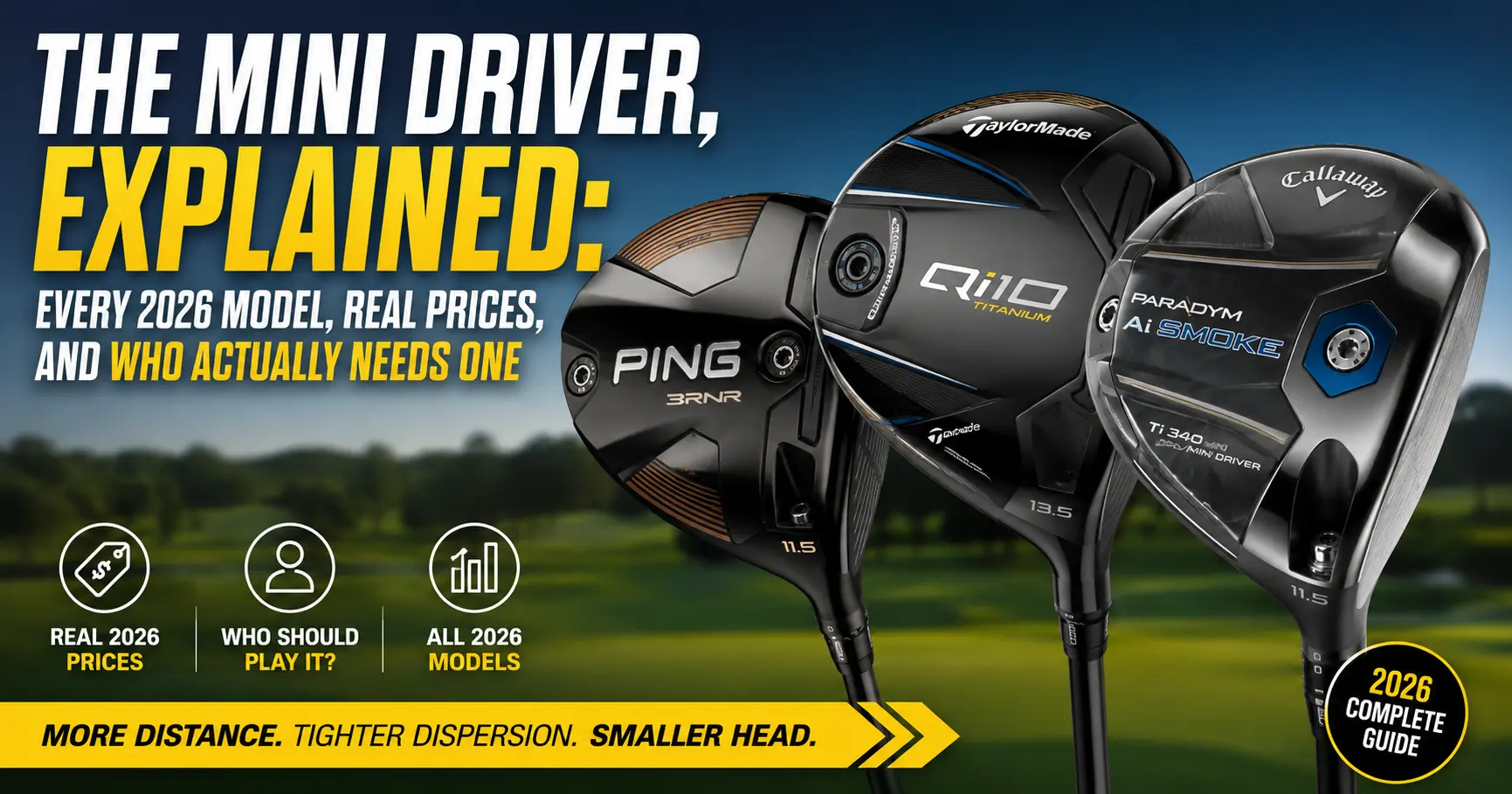
A mini driver is a golf club between 270cc and 340cc that sits between a full-size driver and a 3-wood. It carries 11.5° to 13.5° of loft on a 43″ to 44″ shaft. Every major brand sells one in 2026, priced $399.99 to $549.99, and roughly 1 in 6 to 1 in 4 players on Tour now carries one.
You have probably seen one in a pro’s bag on TV and wondered what it actually was. It’s not a toy 3-wood and it’s not a marketing gimmick either. A mini driver is a real club category that grew from a handful of Tour outliers in 2022 into something almost every manufacturer builds now.
Justin Thomas plays one. Tommy Fleetwood plays one. Adam Scott has carried one since the middle of 2023. Today covers every current model, what it actually costs, and whether it solves a problem you have or just adds another club to a bag that doesn’t need one.
What Is a Mini Driver in Golf?
A mini driver sits between a 460cc driver and a fairway wood. Head volume runs 270cc to 340cc depending on the brand, against 460cc for a full-size driver and roughly 150cc to 200cc for a typical 3-wood. Loft usually sits between 11.5° and 13.5°, close to what you’d find on a strong 3-wood. Shaft length runs 43″ to 44″, about two inches shorter than a standard driver.
Think of it less as “small driver” and more as “driver-shaped 3-wood replacement.” The shorter shaft does most of the work. Two fewer inches means less clubhead speed at impact, but it also means a shorter swing arc and less room for the face to twist open or closed before you make contact.
That’s the entire case for the club in one sentence. You trade a little ball speed for a lot more control over where the face points.
Golf club lofts explain the rest of the gap. A mini driver’s 11.5° to 13.5° sits right between a 9° to 10.5° driver and a 15° to 16.5° 3-wood. For the full breakdown of how loft affects every club in the bag, our golf club lofts guide covers it in more detail.
Mini Driver vs Driver vs 3-Wood
| Spec | Driver | Mini Driver | 3-Wood |
|---|---|---|---|
| Head volume | 460cc | 270cc–340cc | 150cc–200cc |
| Loft | 9°–10.5° | 11.5°–13.5° | 15°–16.5° |
| Shaft length | 45″–45.75″ | 43″–44″ | 42″–43″ |
| Best for | Maximum distance off the tee | Accuracy off the tee, still playable off the deck | Distance and consistency off the turf |
Every Mini Driver You Can Buy Right Now (2026 Price and Spec Comparison)
Nobody puts every current mini driver side by side with real prices, so here’s every model on shelves in August 2026. Prices reflect standard retail as of this writing and move with sales and trade-in promotions.
| Model | Price | Head Size | Loft | Length | Best For |
|---|---|---|---|---|---|
| Titleist GTS300 | $549.99 | 305cc | 13° | 43.5″ | Golfers who want the most forgiving, most fitted-feeling mini on the market |
| Callaway Quantum Mini | $549.99 | 340cc | 11.5° / 13.5° | 44″ | The biggest head in the category, best for golfers who miss the center of the face a lot |
| Cobra King Tec-MD | $479.99 | 303cc | 13.5° | 43.75″ | Golfers who want the most hosel adjustability (33 loft/lie combinations) |
| TaylorMade R7 Quad Mini | $479.99 | 305cc | 11.5° / 13.5° | 43.75″ | Golfers who want to shape shots with movable weights |
| PXG Secret Weapon | $449.99 | 300cc | 13° (11.5°–14° adjustable) | 43.75″ | Better players treating it as a 3-wood replacement, not a driver crutch |
| Titleist GT280 (previous gen) | $399.99 | 280cc | 13° | 43.5″ | Best value new option, discounted since GTS300 replaced it |
| Tour Edge Exotics Mini Driver | $399.99 | ~300cc | 13° | 43.5″ | Budget-focused golfers who don’t need a premium brand name |
The Titleist GTS300 is the best all-around mini driver on the market right now, and it’s not particularly close. It replaced the GT280 in July 2026 with a larger 305cc head, a deeper center of gravity, and the same forged L-Cup face technology from Titleist’s GT fairway woods, and Justin Thomas switched into one within weeks of its release. If you want the biggest margin for error on off-center hits, though, Callaway’s 340cc Quantum Mini is the largest head in the category by a wide margin. Every model here uses adjustable weighting to shift the center of gravity forward for lower spin or backward for more forgiveness, which is standard now, not a premium feature.
Why the Mini Driver Trend Exploded in 2026
This isn’t a one-season fad. Golf Monthly tracked mini driver usage at 16% of the field at the DP World India Championship and 25% at the BMW PGA Championship at Wentworth, which are big numbers for a club category that barely existed three years ago. When that many Tour players start putting the same tool in the bag, recreational golfers start asking questions, and manufacturers respond by flooding the category with new releases.
The pro usage isn’t just a handful of names, either. Justin Thomas games a Titleist GTS300 and uses it specifically so he can play a longer 46-inch shaft in his driver for extra distance, knowing the mini driver covers the accuracy gap that creates. Cameron Young gave direct feedback to Titleist during GTS300 development.
Tommy Fleetwood carried a 13.5° BRNR Mini at the 2023 RBC Heritage and has been candid about the tradeoff: roughly 3 to 4 mph less ball speed than his driver, with spin running close to 3,000 rpm higher. PXG’s Secret Weapon picked up its own Tour win at the Zozo Championship in the bag of Nico Echavarria, and Jake Knapp has carried one since.
Adam Scott has used a mini driver since the middle of 2023, well before the category had this many entries. That’s a longer runway than most equipment trends get before going mainstream, and it’s a big part of why nearly every major brand now has one in the lineup instead of treating it as a novelty release.
Mini Driver Pros and Cons
Pros:
- Tighter dispersion off the tee than a driver, thanks to the shorter shaft and higher loft
- More total distance than most 3-woods, especially for players with faster swing speeds
- Playable off the turf on approach shots, unlike a true driver
- Lower ball flight that holds up better in wind than a standard driver
Cons:
- Real distance loss compared to a 460cc driver. PXG’s own internal testing showed the Secret Weapon landing roughly 20 yards shorter than its driver, even though it beat the 3-wood by about 10 yards
- Reduced forgiveness compared to a full-size driver on off-center hits, since the head is smaller by design
- Almost nobody gets custom fit for a mini driver, and stock specs rarely match a random golfer’s swing as well as a properly fitted driver does
- One more club competing for a spot in your 14-club limit
Who Should NOT Buy a Mini Driver
Here’s the part every brand page skips, because every brand page is trying to sell you their club. If you already hit a 3-wood more than 230 yards off the deck with confidence, a mini driver just gives you a more expensive way to do something you already do. The whole appeal of the category is filling a gap between your driver and your 3-wood, and if that gap doesn’t actually exist in your bag, you’re buying a solution to a problem you don’t have.
The same logic applies if your miss with a standard driver is a pure timing issue rather than a swing-path issue. A mini driver tightens dispersion by shortening the shaft and reducing twist at impact, but it won’t fix a driver swing that’s fundamentally inconsistent in tempo. That’s a coaching problem, not an equipment problem. If you’re not sure which camp you fall into, our fairway wood vs. hybrid breakdown is a good next stop before you spend $400 to $550 on a club that might just sit in the garage.
Where to Buy a Mini Driver: New vs Used Prices
New pricing across every current 2026 model runs from $399.99 (Titleist GT280, Tour Edge Exotics) up to $549.99 (Titleist GTS300, Callaway Quantum Mini). Golf Galaxy and PGA Tour Superstore both carry the full current lineup, and Golf Galaxy’s price-match guarantee is worth checking before you buy at full retail anywhere else.
The used market tells a different story, mostly because of TaylorMade’s discontinued BRNR Mini. It launched in 2023 at $449. TaylorMade has since replaced it with the R7 Quad Mini, and the BRNR now only exists secondhand. Expect to pay roughly $300 to $450 for a good-condition BRNR Mini through retailers like 2nd Swing or Golf Avenue, with pristine or rare copper-finish copies running higher on eBay.
It’s the best mini driver bargain in golf right now, and TaylorMade doesn’t even sell it anymore. The current-generation Titleist GT280 is the closest thing to that value proposition in a brand-new club, since retailers dropped it from $499.99 to $399.99 the moment GTS300 launched.
TaylorMade’s Mini Driver History: From BRNR to R7 Quad
TaylorMade has the longest history in this category by a wide margin, and it traces straight back to the original R7 driver from 2004, which won more than 30 tournaments worldwide including that year’s U.S. Open with Retief Goosen. TaylorMade brought that name back twice.
First came the BRNR Mini Driver in 2023, a deliberate throwback to the late-90s Burner Ti Bubble 2 drivers, complete with copper styling and a sock-and-barrel headcover. It ran a 304cc head at $449 with Twist Face, a Speed Pocket, and a split-weight system letting golfers switch between a balanced setup and a low-spin setup. TaylorMade has since discontinued it in favor of the R7 Quad Mini Driver, which launched in 2025 at $479.99 with a 305cc head and a four-weight system (two 13-gram, two 4-gram) instead of BRNR’s two-weight split. The R7 Quad Mini remains TaylorMade’s current mini driver as of this update, and if you see “TaylorMade 300 mini driver” or “TaylorMade mini driver burner” search results pointing at either club, both share the same rough 300-to-305cc footprint that defines the middle of this category.
How to Pick the Right Mini Driver for Your Game
Start with your actual miss, not the club that looks best in photos. If your driver miss is wild left-right dispersion, prioritize head size and forgiveness first. The 340cc Callaway Quantum Mini gives you the largest margin for error in the category. If your issue is more that your 3-wood feels underpowered off the tee on tighter holes, a smaller, more workable head like the PXG Secret Weapon or Titleist GTS300 will feel more natural, since both reward players who already strike the ball consistently.
Swing speed matters more than most golfers assume. Slower swing speeds generally do better with more loft, so lean toward the 13° to 13.5° options like the Cobra King Tec-MD or Titleist GTS300. Faster swingers who want a lower, more penetrating flight should look at the 11.5° settings available on the Callaway Quantum and TaylorMade R7 Quad.
Get fitted if you can. MyGolfSpy’s own testing team has pointed out that almost nobody gets fitted for a mini driver despite spending $400-plus on one, which is backwards given how much these clubs vary in stock weight settings and hosel adjustability. Twenty minutes with a launch monitor will tell you more than any spec sheet, including this one.
Frequently Asked Questions
What is the point of a mini driver?
A mini driver exists to fill the accuracy gap between a driver and a 3-wood. Its shorter shaft and higher loft tighten dispersion off the tee, while its larger head and driver-style face still out-distance most 3-woods for golfers who already hit those clubs well off the deck.
Is a mini driver basically a 2 wood?
Close, but not exactly the same thing. A traditional 2-wood meant a low-lofted fairway wood, usually 12° to 13°, built on a full fairway wood platform, often under 200cc. A modern mini driver borrows far more from driver engineering: titanium construction, adjustable hosels, and driver-derived face technology.
Titleist even marketed its own GT280 under a “2-wood” label at launch. The loft overlaps. The underlying engineering doesn’t.
What are the disadvantages of a mini driver?
The biggest one is real distance loss against a full 460cc driver, sometimes 20 yards or more depending on swing speed. Mini drivers also offer less forgiveness than a full-size driver on off-center strikes, since the head is smaller by design, and most golfers never get properly fitted for one, which limits how well it actually performs versus its potential. It also takes up a 14-club slot that might be better spent on a wedge or hybrid if your 3-wood already covers the same yardage gap.
Do any pros use a mini driver?
Yes, and usage is climbing fast. Justin Thomas plays a Titleist GTS300, Tommy Fleetwood has carried a TaylorMade BRNR Mini, and Adam Scott has used one since 2023. PXG’s Secret Weapon has already won on Tour in the bag of Nico Echavarria, and Jake Knapp carries one too. Golf Monthly tracked mini driver usage at 16% of the field at the DP World India Championship and 25% at the BMW PGA Championship at Wentworth.
How much does a mini driver cost?
New mini drivers from major brands run $399.99 to $549.99 in 2026. The Titleist GTS300 and Callaway Quantum Mini sit at the top of that range at $549.99. Budget options like the Titleist GT280 and Tour Edge Exotics run $399.99. Used models, especially the discontinued TaylorMade BRNR Mini, typically sell for $300 to $450 depending on condition.
What loft should a mini driver be?
Most mini drivers ship between 11.5° and 13.5°. Higher swing speed players who want a flatter, more penetrating flight closer to a driver usually go with 11.5°. Golfers planning to hit it off the turf as much as the tee usually want 13° to 13.5° for an easier launch from a fairway lie.
The Bottom Line
A mini driver isn’t a gimmick, but it isn’t automatically an upgrade either. It solves one specific problem: a gap between your driver and your 3-wood that’s costing you fairways. If that gap is real in your bag, the Titleist GTS300 or Callaway Quantum Mini are the strongest current options depending on whether you want maximum forgiveness or maximum head size.
If it’s not real, save the $400 to $550 and spend an afternoon with our best fairway woods for every handicap guide instead. Test one on a launch monitor before you buy, and let your actual miss decide instead of what’s in Justin Thomas’s bag.