
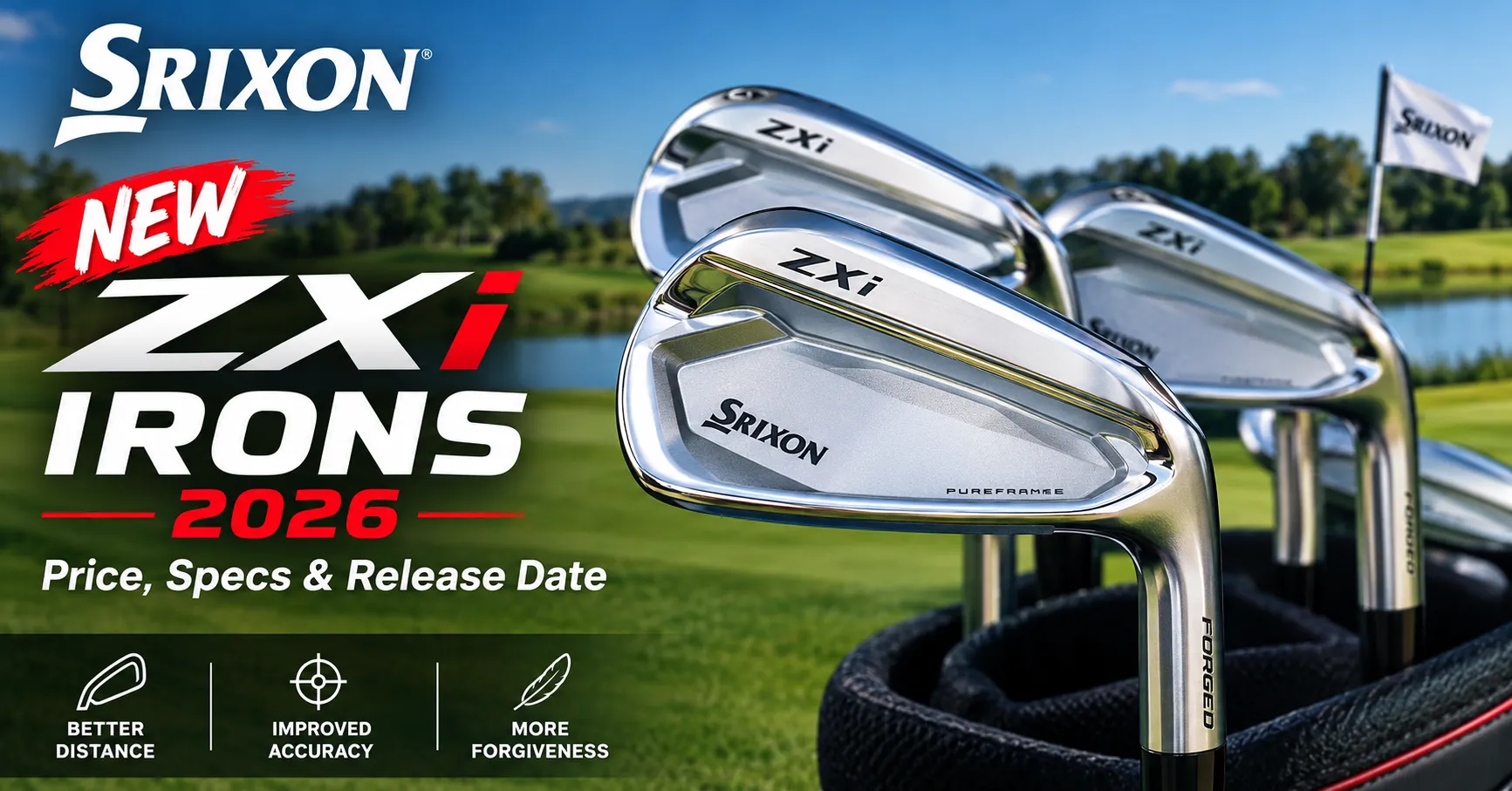
Quick Answer: Srixon’s second-generation ZXi irons launched September 8, 2026, with four models: the compact ZXi7, the players-performance ZXi5, the all-new players-distance ZXi5+, and the ZXiU utility iron. Endo Manufacturing forges all four in Japan. Steel sets start at $1,499.99, with retail availability October 16.
Srixon didn’t wait for January to drop its biggest iron release of the year. On September 8, the brand pulled the wraps off the second-generation ZXi family, and the headline isn’t just a new coat of paint. Endo Manufacturing, the same Japanese house that shaped Tiger Woods’s 681T blades, now forges every ZXi7, ZXi5, ZXi5+ and ZXiU head from start to finish. This piece breaks down what actually changed, what the early numbers say, and which model earns a spot in your bag before the October 16 retail date.
What’s Actually New in the Second-Generation ZXi Irons
Srixon calls its design approach “Kaizen,” a Japanese term for incremental, generational improvement. That word matters here because Srixon didn’t reinvent the ZXi shape. The company refined it.
The biggest structural change is the i-FORGED process. Engineers pack extra material into specific high-stress zones during the early forging stage, then compress it to tighten the grain structure exactly where the head needs it. In the ZXi7, that reinforcement sits around the hosel.
Reinforcement shifts to the high toe and topline in the ZXi5, ZXi5+ and ZXiU. The rest of the head then gets a softer heat treatment, which is how Srixon claims a more durable groove area without sacrificing the soft feel golfers expect at impact.
AI-assisted design shows up twice in this lineup, under two different names. MainFrame iQ, used in the ZXi5, ZXi5+ and ZXiU, runs thousands of simulated strikes to shave up to eight percent off face mass, then redistributes that weight around the perimeter for more forgiveness and ball speed. PureFrame iQ, exclusive to the ZXi7, does the opposite job. It expands the forged ridge behind the sweet spot to stiffen the impact zone and cut down on face deformation, which is what a single-piece players iron actually needs.
Toplines got thinner across the board, and the transition from top edge to cavity looks cleaner than on the first-generation ZXi. None of that is a cosmetic afterthought. Srixon’s tour staff pushed for it directly, and every model still shares enough visual DNA to build a clean combo set.
Meet the Lineup: ZXi7, ZXi5, ZXi5+ and ZXiU
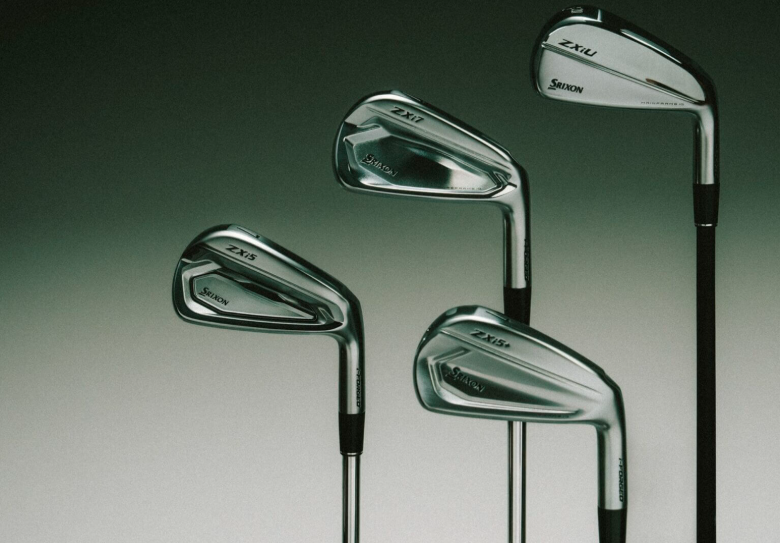
Four models cover a wider spread of players than the outgoing range did, mostly because the new ZXi5+ takes over ground the old ZXi4 used to hold. Tour players already mix and match within the family, too. LPGA winner Miyu Yamashita games a combo ZXi5 and ZXi7 set, which is a good sign of how well these heads blend visually and in feel across the range.
It helps to see where these four sit in Srixon’s full iron catalog. The ZXi7, ZXi5, ZXi5+ and ZXiU cover the players and players-distance categories, while game-improvement duty falls to the separate ZXiR and ZXiR HL irons that launched back in January 2026 and aren’t changing today. If a fitter mentions a ZXi4, that model no longer exists, replaced by the ZXi5+.
Srixon ZXi7
This is the control-first option. A single-piece S15C forging with toe-area tungsten keeps the ZXi7 the narrowest-soled, shortest-bladed, least-offset iron in the family. The 7-iron sits at 32 degrees and the pitching wedge at 46 degrees, so lofts stay traditional rather than jacked up for yardage. If you already flush a players iron and just want better feedback, start here.
Srixon ZXi5
The ZXi5 blends speed with a players profile. Body and face split into two forged pieces this time: S20C for the body, SUP10 high-strength steel for the face, with tungsten added through the long and mid irons. A 7-iron carries 31 degrees of loft and measures 78.6mm from heel to toe. It’s the pick for golfers who want more launch and forgiveness than the ZXi7 without stepping into a distance-first shape.
Srixon ZXi5+
Here’s the new one, and it’s the most interesting release of the four. The ZXi5+ shares its materials with the ZXi5 but stretches the blade length to 80.6mm and widens the functional sole to 21.0mm, up from 18.6mm. Loft drops to 29.5 degrees in the 7-iron. Srixon built it to replace the old ZXi4 and to give fitters a genuine players-distance option that still looks like a Srixon iron at address, not a game-improvement slab.
Srixon ZXiU
The utility model rounds out the range at 18, 20 and 23 degrees, aimed at anyone who wants a high-launching long-iron replacement instead of a hybrid. It shares the ZXi5’s SUP10 face and S20C body construction, plus a wide sole and tungsten weighting for extra forgiveness on mis-hit long shots.
ZXi7 vs. ZXi5 vs. ZXi5+ vs. ZXiU: How to Choose
None of the launch-day coverage puts these four models side by side in one table, so here’s the quick version.
| Fact | ZXi7 | ZXi5 | ZXi5+ | ZXiU |
|---|---|---|---|---|
| Category | Players | Players performance | Players distance | Utility |
| Best for | Workability and feedback | Launch plus forgiveness | Speed in a players shape | Long-iron replacement |
| 7-iron loft | 32° | 31° | 29.5° | n/a |
| Blade length (7-iron) | Shortest in family | 78.6mm | 80.6mm | Blade-like profile |
| Sole width (7-iron) | Narrowest in family | 18.6mm | 21.0mm | Widest in family |
| Construction | Single-piece forged S15C | Forged S20C body, SUP10 face | Forged S20C body, SUP10 face, hollow | Forged S20C body, SUP10 face |
| Steel price (7-pc) | $1,499.99 | $1,499.99 | $1,499.99 | $259.99 per club |
A simple way to think about it: pick ZXi7 for feel and workability, ZXi5 if you want a blend, ZXi5+ if distance is the priority but you still want a players look, and ZXiU when you’d rather see a blade-style long iron than a hybrid at the top of the bag.
Price, Release Date and Global Availability
Pre-sale opened September 8 in the US, with free personalization (20 paint-fill colors, multiple ferrule options, color-matched Golf Pride MCC Plus4 grips) running through October 15. Retail stock lands everywhere on October 16. Full specs live on Srixon’s official site.
| Model | US price | UK price | Notes |
|---|---|---|---|
| ZXi7 | $1,499.99 (7-pc steel) | £1,099 | Steel only at launch |
| ZXi5 | $1,499.99 steel / $1,599.99 graphite | £1,099 | |
| ZXi5+ | $1,499.99 steel / $1,599.99 graphite | £1,099 | Replaces the ZXi4 |
| ZXiU | $259.99 per club | £249 per club | 18°, 20°, 23° |
Worth flagging: the UK listings describe the sets as six pieces, while the US pricing is quoted for seven, so confirm exact set composition with your fitter before comparing sticker prices across regions. Srixon hadn’t published Australian and Canadian pricing at launch, so check with a local retailer rather than trusting a straight currency conversion.
The Tech Behind i-FORGED, MainFrame iQ and PureFrame iQ
Srixon is leaning hard into its Endo Manufacturing partnership this generation, and that’s a legitimate story, not just marketing. Endo has forged irons for Titleist, Bridgestone and Nike, and this is the first ZXi line built entirely under that single roof.
The two AI systems solve different problems, and it’s worth understanding why Srixon split them instead of using one system across the board. MainFrame iQ chases ball speed and forgiveness by pulling mass out of the face and pushing it to the perimeter. PureFrame iQ does the opposite: it adds structure behind the sweet spot to control deformation. PureFrame iQ is the more meaningful update of the two, honestly, because control is the entire point of buying a single-piece players iron in the first place.
Progressive grooves carry over from the previous generation. Wider grooves run through the 3- through 7-irons for long-shot spin, then the 8-iron through wedges switch to tighter, deeper grooves for scoring-club bite. Laser milling between grooves adds a bit more grab on approach shots.
What Early Testing Numbers Show on the ZXi5+
MyGolfSpy got early hands-on time with the ZXi5+ and published launch-monitor numbers worth repeating here, credited to their testing rather than ours. At a 77 mph swing speed, their 29.5-degree 7-iron produced ball speeds around 114 mph, a smash factor of 1.48, carry near 168 yards, spin just under 4,100 rpm, an 81-foot peak height and a 43-degree descent angle.
That smash factor is genuinely high for an iron. A 1.48 smash factor on a sub-30-degree 7-iron is closer to what you’d expect from a stronger-lofted game-improvement head, not a forged players-distance iron. The trade-off shows up in spin. Most fitters like to see 4,500 to 5,000 rpm out of a 7-iron for consistent greenside stopping power, so 4,100 rpm on soft or medium greens should still hold, but firm summer conditions will likely release more than that number suggests.
Should You Upgrade From the First-Generation ZXi?
If you’re already gaming the first-generation ZXi5 or ZXi7, the honest answer is no, not yet. Lofts barely moved, the shaping is close enough that most golfers won’t feel a dramatic difference at address, and Srixon’s own “Kaizen” framing admits this is refinement rather than reinvention.
One honest limitation worth stating plainly: the ZXi7 and ZXi5 are players irons first, and a compact head with minimal offset punishes off-center strikes more than it forgives them. If your handicap sits in the double digits, that trade-off can cost you strokes rather than save them, the same fit gap we flagged in our Lydia Ko WITB breakdown for her Titleist T150s. The ZXi5+ and ZXiU close that gap somewhat, but a true game-improvement iron from Srixon’s ZXiR line will still serve a higher handicap better.
The upgrade case gets stronger in two specific situations. First, if you’ve been eyeing a players-distance iron and never found one that didn’t look bulky, the ZXi5+ genuinely fills that gap in a way the old ZXi4 didn’t. Second, if your current irons are three or more seasons old and the grooves have worn past their spin window, a fresh forged face solves a real problem instead of chasing a marginal one.
Frequently Asked Questions
What is the difference between the Srixon ZXi5 and ZXi5+?
The ZXi5+ uses the same S20C body and SUP10 face as the ZXi5 but adds a longer blade (80.6mm vs. 78.6mm in the 7-iron), a wider sole (21.0mm vs. 18.6mm) and stronger lofts. It’s built for more ball speed and forgiveness, while the ZXi5 keeps a bit more workability and spin.
How much do the new Srixon ZXi irons cost?
Steel seven-piece sets of the ZXi7, ZXi5 or ZXi5+ run $1,499.99 in the US, or £1,099 in the UK. Graphite adds $100 on the ZXi5 and ZXi5+. The ZXiU utility iron is $259.99 per club in the US and £249 in the UK.
When can I buy the new Srixon ZXi irons?
Pre-sale started September 8, 2026, in the US, with UK pre-sale beginning October 2. Full retail availability hits everywhere on October 16, 2026.
Are the new Srixon ZXi irons forged?
Yes. Endo Manufacturing in Japan forges every head in the ZXi7, ZXi5, ZXi5+ and ZXiU lineup, using the i-FORGED process to reinforce high-stress zones while keeping the rest of the head soft.
Is the ZXi5+ replacing the ZXi4?
Yes. Srixon retired the ZXi4 and moved that players-distance role to the ZXi5+, while game-improvement duties now sit with the separate ZXiR and ZXiR HL lines.
How does the Srixon ZXi5+ compare to Mizuno’s forged irons?
Both brands build their reputation on forged feel, and Srixon is explicitly leaning into its Endo pedigree to close that gap. Early testing numbers on the ZXi5+ show real ball speed, so the two are close on performance. Feel is genuinely subjective, and you should hit both before deciding.
The Bottom Line
Srixon didn’t need to blow up the ZXi family to make it better, and that restraint is the right call for a lineup that was already winning on Tour and at retail. The ZXi5+ is the one to watch if you’ve outgrown a game-improvement set but never liked how bulky most distance irons look, while the ZXi7 and ZXi5 carry the torch for players who just wanted a cleaner, more consistent version of what already worked. If you’re building a bag around irons right now, our breakdown of golf club lofts and set gapping is worth a read before you get fitted, since a stronger-lofted iron like the ZXi5+ can leave an ugly gap to your wedges if nobody checks the numbers.