
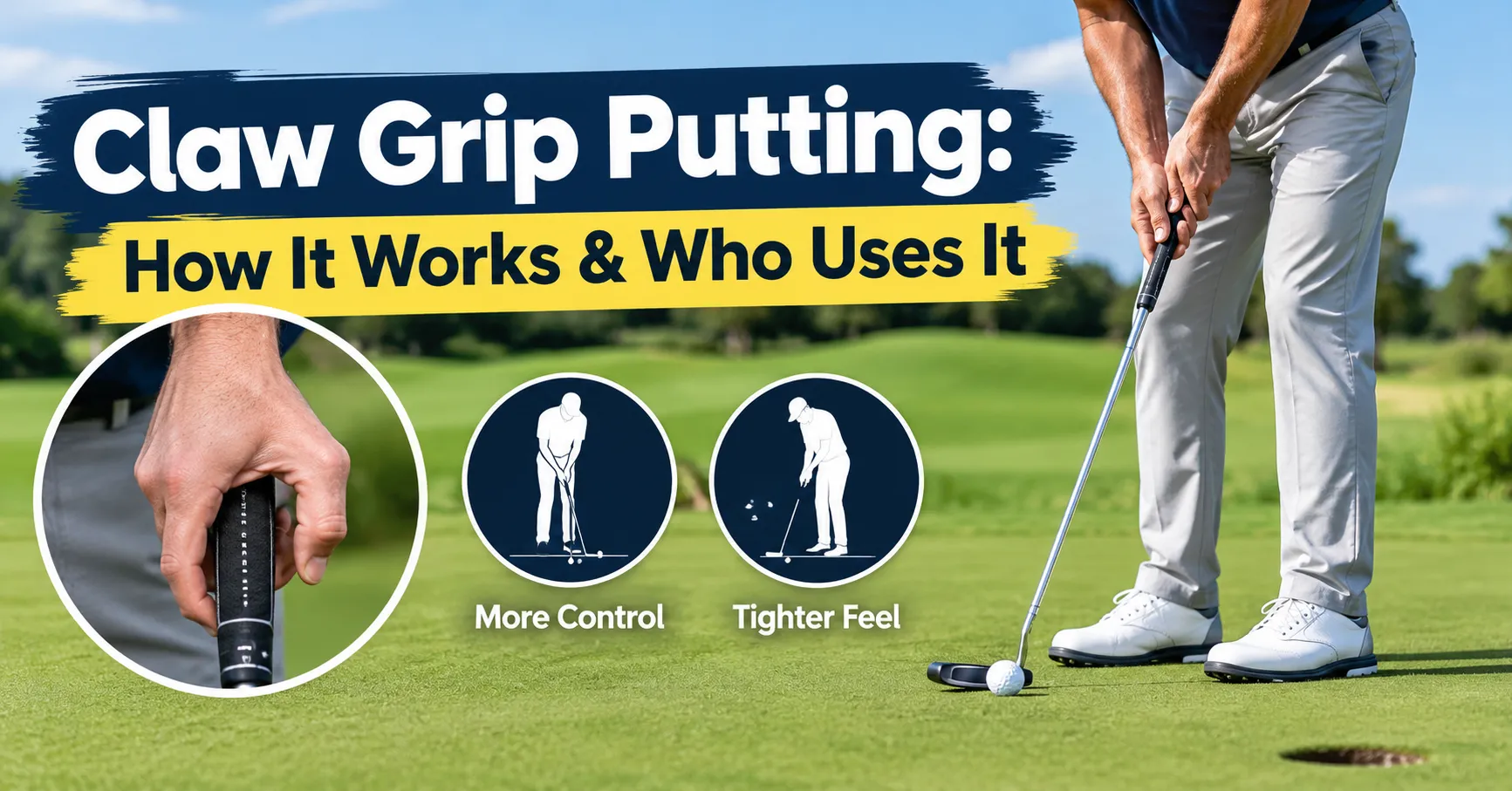
Quick Answer: Claw grip putting isn’t universally better, it’s a fix for a specific problem. It works best when a golfer’s trail hand takes over the stroke and causes the yips or a pulled face at impact. Scottie Scheffler, Justin Rose, and Tommy Fleetwood all use it. It tends to break down on putts over 25 feet, where a quieter trail hand makes it harder to add pace.
Read on for the mechanics, the real pros using it right now, the reverse version nobody else explains, and the specific point where the grip runs out of road.
How The Claw Grip Actually Works
Start with your lead hand exactly like a standard grip. For a right-handed golfer, that’s the left hand near the top of the handle, palm facing the target, thumb running straight down the front of the grip.
Your trail hand is where the claw grip earns its name. Let it hang loose at your side first, fingers pointing at the ground. Bring it up so the webbing between your thumb and index finger presses against the grip just below your lead hand, fingers extended rather than wrapped around the handle.
Grip pressure should sit almost entirely in the lead hand. Your trail hand is a passenger, not a driver. If you feel your right thumb pressing hard against the shaft, you’re doing a soft version of a normal grip with extra steps, not the claw grip.
The stroke itself comes from your shoulders and lead arm. Your trail hand’s job is to stay quiet and let the putter swing on a level path back and through.
The Reverse Claw Grip (And Why Some Golfers Switch To It)
Nobody covering the standard claw grip in the current search results mentions this variation, and it solves a real problem for a specific type of miss.
In the reverse claw grip, the roles flip. Your trail hand takes the standard, top-of-grip position, and your lead hand forms the claw shape underneath it. Golfers who fight a push, rather than a pull, sometimes find more control this way, because it’s the lead hand causing their face to stay open through impact, not the trail hand shutting it.
It’s a rarer setup than the standard claw, and you won’t find it in most instructional content. That’s exactly why it’s worth trying if the normal claw grip fixes one miss but creates another. Golfers who’ve struggled with an open face at impact report better results from the reverse version than from tinkering with the standard claw’s hand pressure.
Claw Grip Putting For Left-Handed Golfers
Every instruction above mirrors directly for a left-handed golfer. Your trail hand becomes your left hand, and it forms the claw. Your lead hand becomes your right hand, and it takes the standard top-of-grip position.
Nothing about the mechanics changes based on which hand is naturally dominant on the course. A left-handed golfer with a dominant trail hand gets the exact same benefit from this grip as a right-handed golfer does. Swap “left” for “right” throughout this article and you have the complete instruction set.
Why The Claw Grip Breaks Down On Long Putts
Here’s the honest limitation most coached guides skip entirely. The claw grip removes your trail hand from the stroke on purpose, and that’s exactly what makes long putts harder.
A 30-foot putt needs more clubhead speed than a 5-footer, and normally your hands help generate that speed through a slightly firmer grip and a bit more wrist hinge. With the trail hand deliberately passive in a claw grip, that extra pace has to come almost entirely from a bigger shoulder turn. Golfers who’ve made the switch report exactly this on longer putts: the stroke feels like it’s running out of gas before the ball gets there.
Don’t abandon the claw grip over this. Lengthen your backstroke instead of trying to muscle the ball with your hands. If you still can’t find enough pace after a real backstroke adjustment, that’s a legitimate sign to switch back to a conventional grip for anything outside 25 feet, saving the claw for the scoring zone.
Which Pros Use Claw Grip Putting
Scottie Scheffler adopted the claw grip at the 2024 Hero World Challenge, shot a 4-under 67 in his first competitive round with it, and kept using it through a season that included a Masters title and Olympic gold. He’s still using it now.
Justin Rose has used a version of the claw since 2016 and has credited it with simplifying a stroke that used to involve too much fine motor control from his trail hand. Tommy Fleetwood, Collin Morikawa, and Nick Taylor all currently use their own variations on tour.
Phil Mickelson has used the claw situationally rather than as a permanent switch, including a 4-under 67 the first time he played an entire round with it at a FedEx Cup playoff event, and again on a single putt at the 2021 PGA Championship specifically because it let him take a more vertical path into a ball sitting in a rough patch on the green. Mark O’Meara was one of the earliest tour adopters, dating back to 2003.
Claw Grip vs. Other Putting Grips
| Grip | Hand Position | Fixes A Dominant Trail Hand? | Best For |
|---|---|---|---|
| Reverse Overlap | Lead hand’s index finger overlaps trail hand fingers | No | Golfers with no specific miss, the most common tour grip |
| Claw | Trail hand forms a claw below the lead hand | Yes | Golfers who yip short putts or pull the face closed |
| Reverse Claw | Lead hand forms the claw, trail hand is standard | Partially (open-face miss) | Golfers who push putts rather than pull them |
| Left-Hand Low | Lead hand moves below trail hand | No | Golfers who want a stronger, lower follow-through |
| Cross-Handed | Trail hand goes below lead hand | Somewhat | Golfers fighting inconsistent shoulder alignment |
Reverse overlap is still what most tour pros use, full stop. The claw grip is a fix for a specific miss, not a wholesale replacement for it. Some pros build genuinely unusual setups around their own particular miss. Lucas Glover games a 45-inch broomstick putter with a split grip, which is its own answer to keeping a dominant hand quiet during the stroke, just solved through equipment instead of hand position.
Best Claw Grip SuperStroke Grips (Priced For 2026)
If you’re set on trying the claw grip, the grip you put it on matters more than most golfers assume. SuperStroke’s Traxion Claw Putter Grip currently sells for $29.99 direct from SuperStroke, and it’s worth knowing the backstory. The company discontinued an earlier “Claw” model for a stretch, which is why some older buying guides still say the grip doesn’t exist anymore. SuperStroke brought it back as part of the Traxion line, complete with the brand’s Tech-Port counterweight system, and it’s currently in stock in multiple colorways.
A wider claw-specific grip gives your trail hand’s webbing more surface area to rest against without gripping, which matters more here than on a standard grip. Players moving to a full SuperStroke setup often pair the Claw putter grip with a Zynergy 2.0PT grip on a mallet-style putter, similar to the setup Callaway’s own tour staff have used, which our SuperStroke Zynergy 2.0PT grip breakdown covers in more depth. On the LPGA side, the SuperStroke Flatso grip shows a different design philosophy entirely, flat-fronted rather than claw-shaped, built for a lighter grip pressure without removing a hand from the stroke.
Claw Grip Putting Benefits (And Who It’s Actually For)
This grip exists to solve one specific problem: a trail hand that’s too active in the stroke. If yours is, the benefits are real and immediate. It quiets a wristy, handsy stroke, reduces the odds of a last-second face rotation, and gets your shoulders doing the work they should be doing anyway.
If your putting problem is something else entirely, alignment, green reading, speed control on a stroke that’s already mechanically sound, the claw grip won’t fix it. I’ll say it plainly: switching grips because your putting is bad in general, without knowing which specific miss you’re fighting, is a waste of a practice session. Diagnose the miss first. If it’s a dominant trail hand, the claw is one of the most well-proven fixes in the game, and if it isn’t, you’re solving the wrong problem.
Frequently Asked Questions
Is claw grip better for putting?
Not universally. Claw grip putting is better specifically for golfers whose trail hand takes over the stroke and causes a pulled or yipped putt. For a golfer with a mechanically sound stroke and no specific miss, switching to the claw grip doesn’t offer an advantage and can introduce new problems, like the pace issues on long putts we cover above.
Which pros use claw grip?
Scottie Scheffler, Justin Rose, Tommy Fleetwood, Collin Morikawa, and Nick Taylor all currently use the claw grip on the PGA Tour. Phil Mickelson and Mark O’Meara both used versions of it earlier in their careers, and Mark Calcavecchia and Kevin Sutherland have used it on the Champions Tour.
Does Scottie Scheffler use the claw grip?
Yes. He switched to the claw grip at the 2024 Hero World Challenge and has continued using it since, including through his seven-win 2024 season.
What grip do most pros use for putting?
The reverse overlap grip is still the most common putting grip on tour by a wide margin. Claw grip variations remain a distinct minority, chosen by pros solving one specific stroke problem rather than picked as a default.
How does the claw grip work for left-handed golfers?
It mirrors exactly. A left-handed golfer’s trail hand is their left hand, and that’s the hand that forms the claw. Every instruction in this guide applies unchanged once you swap which hand plays which role.
What do golfers on forums like Reddit actually say about switching to the claw grip?
The most consistent, honest theme across real golfer discussion is that the claw grip helps close-range consistency but gets harder to control on longer putts, exactly the tradeoff this guide walks through. That kind of firsthand feedback from golfers who’ve actually made the switch is often more reliable than a single coached demo.
Should You Switch To Claw Grip Putting?
Try it on the practice green before you try it in a round, and be specific about what you’re testing. Hit 20 putts from 6 feet with your current grip, then 20 with the claw, and count makes. If the claw grip wins that test and your longer putts hold up too, it’s a legitimate switch and not a gimmick, but if you’re still missing the same way you did before, the grip was never your actual problem. For more on how tour pros build putter setups around their specific miss, our breakdown of Lydia Ko’s 2026 bag is worth a look.