
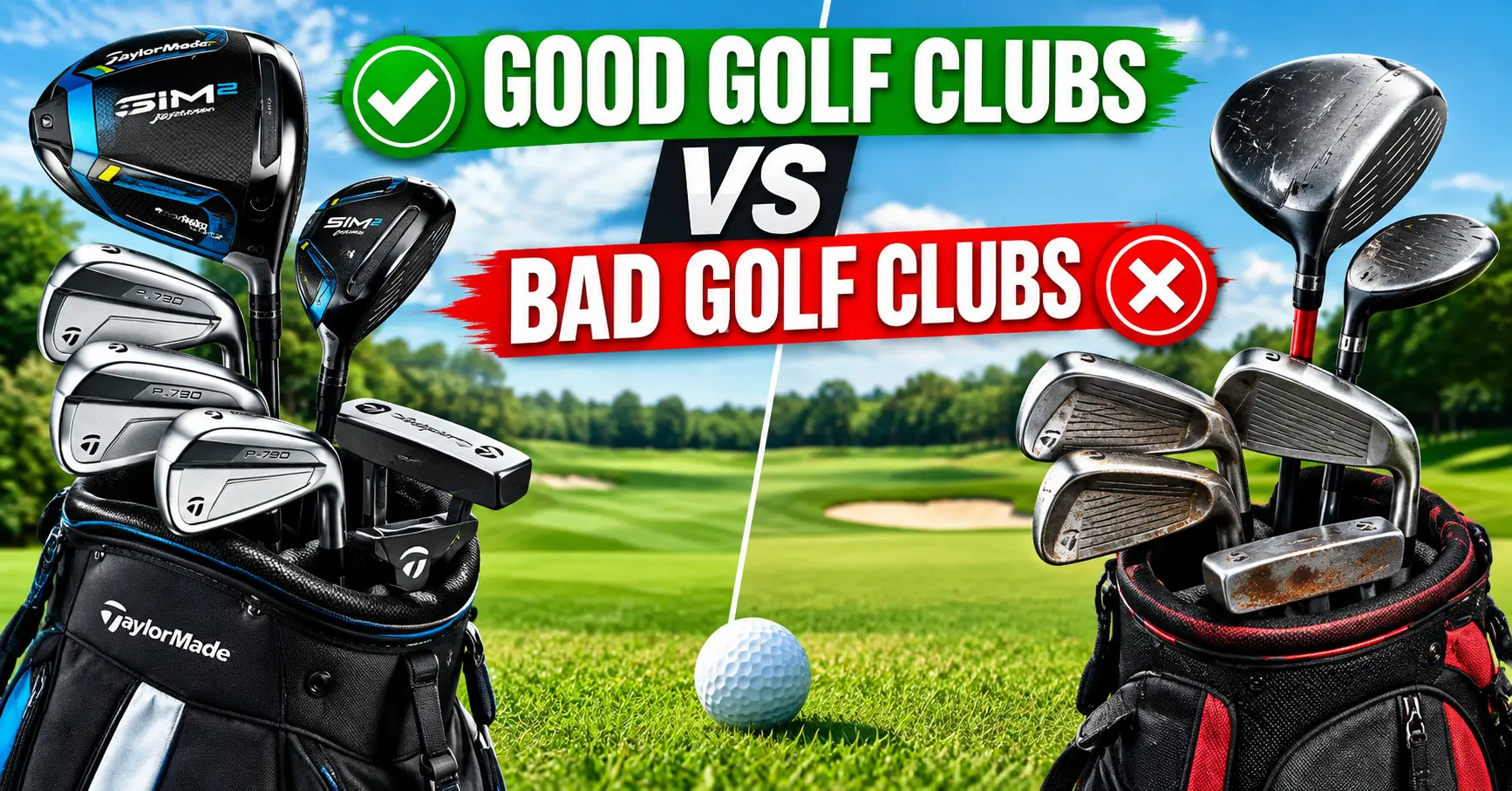
Quick Answer: A good golf club has a smooth, clean face. It has sharp grooves and a shaft that matches your swing speed. A bad club looks different. It has a caved-in face, worn-down grooves, or a bent, cracking shaft. Sometimes the specs just don’t match the listing. Weight and balance almost always tell the truth.
Most golfers can’t tell a good club from a bad one just by looking at it. Even most pro shop workers can’t either. The real differences between good golf clubs vs bad golf clubs show up in swing weight, groove depth, shaft bend, and face shape. Shiny paint under bright store lights won’t tell you a thing.
This update shows you the same checks a professional fitter uses. Run them before you trust any club in your bag.
The 60-Second Weight and Balance Check
Pick up the club. Don’t swing it yet. Just hold it by the grip. Let the head hang down.
A good club feels balanced from end to end. It shouldn’t feel too heavy in the head or too heavy in your hands. Makers measure this balance with a scale called swingweight. It runs from A0 (very light) to F0 (very heavy).
Most men’s clubs fall between C8 and D3. Bad clubs, especially cheap copies, often fall outside that range. The maker padded the head to hit a marketing number. That number looks good on paper, but it doesn’t play well.
You don’t need a scale to catch a serious problem. Waggle the club like you would at address. A club that feels like a sledgehammer is a bad sign. So is one that feels like a floppy fishing rod.
Real clubs stay within half a point of their listed swingweight. Fake clubs often miss by three to five points. That gap is enough to throw off your timing on every single swing.
Modern clubs also use something called MOI, short for moment of inertia. It measures how much a clubhead resists twisting when you hit off-center. Cavity-back irons spread weight around the edge of the head. This trick is called perimeter weighting, and it raises MOI.
Blades do the opposite. They pack weight behind a small sweet spot for extra feel and control. Neither design is bad. A perimeter-weighted iron just forgives more when you miss the center, and a blade rewards a perfect strike but punishes a bad one.
Good Clubface vs. Bad Clubface: Grooves, Dents, and the Sound Test
Here are the clearest signs of a bad golf club. Let’s start with the part that takes the most abuse: the face.
Grooves wear down slowly over time. That’s why your eyes might miss the damage, even when your fingernail won’t. Run a fingernail or a wooden tee across the grooves near the center of the face. On a good club, each groove catches your nail cleanly.
On a worn or fake club, your nail just slides across smooth, rounded channels with no bite at all.
Shine a flashlight across the face at a low angle. Look for ripples, a caved-in look, or a center that curves inward. Any of these means real structural damage, not just cosmetic wear. Small paint scuffs and sky marks on top of a driver don’t hurt performance.
A face that looks pressed inward is a different story. It hurts your shot every single time you swing.
| What you’re checking | Good sign | Bad sign | 10-second test |
|---|---|---|---|
| Grooves | Sharp edges catch your nail | Smooth and rounded, no grip | Drag a tee across the face |
| Face shape | Flat and even | Dented or curved inward | Shine a flashlight at a low angle |
| Sound at impact | Sharp, high-pitched crack | Dull, flat thud | Tap the face with a coin |
| Adjustable sleeve (if any) | Turns smoothly, screw looks fine | Stripped threads, feels gritty | Turn the wrench by hand |
None of this takes expensive tools. A three-dollar tee and your phone’s flashlight catch more fake wear than five minutes of chatting with a seller.
Shaft Flex and Condition: The Difference That Actually Costs You Yards
Getting your shaft flex right matters more than the brand name on the badge. People treat shaft flex like a status symbol. It shouldn’t work that way.
Shaft letters run from L (Lady) to A (Senior) to R (Regular) to S (Stiff) to X (Extra Stiff). These letters loosely match your swing speed. Golfers who swing in the 70s and low 80s mph usually do better with A or R flex. Faster swingers, up around 100 mph, can properly load a Stiff or X shaft.
Buying a shaft two steps stiffer than you need won’t make you look better. It kills your launch. It adds spin you don’t want either.
Good and bad shafts differ mostly in consistency. A good shaft performs the same on swing one and swing one thousand. Condition matters just as much as the label. Roll a steel shaft on a flat surface and watch for a wobble.
A wobble means a bend. On a graphite shaft, check near the tip for splintering or a dull, chalky patch under the paint. Both signs point to damage inside the fibers.
Lynx Golf’s shopping guide says a shaft mismatch can cost you 15 to 25 yards of distance. Fitters see this same pattern on launch monitors every day. Want to see how shaft weight changes launch and spin? Our fairway wood buying guide breaks down the exact gram ranges for different swing speeds.
Grip, Loft, and Lie: The Fit Factors Everyone Skips
Grip wear is the easiest fix in golf. It’s also the most ignored one. A slick, hard, or cracked grip forces you to squeeze harder than you should. That extra tension spreads into your forearms and ruins your tempo.
Regripping costs $10 to $15 per club at most shops. There’s no reason to keep playing on grips that feel like a dried-out garden hose.
Loft and lie are trickier. The number stamped on the club doesn’t always match reality. A 7-iron loft can run from 27 degrees on a strengthened game-improvement design to 35 degrees on a traditional players’ set. Two clubs, both labeled “7-iron,” can fly 15 yards apart because of this gap.
Bent lofts happen too. Years of hitting off hardpan or rocky ground can shift a clubhead’s angle by two or three degrees, with no visible damage at all. Our full breakdown of club lofts covers how this strengthening trend has played out across every major brand.
Lie angle problems show up as a miss that repeats in the same direction. A club that’s too upright tends to push shots left for a right-handed golfer. A club that’s too flat sends misses to the right instead. If you’ve fought the same slice or push all season despite lessons, get the lie checked before you blame your swing.
The Real vs. Fake Test: What A Counterfeit Driver Actually Weighs
Counterfeit clubs cost manufacturers hundreds of millions of dollars every year. Drivers get faked the most because of the huge markup a fake head can carry. Learning to spot a fake before you pay beats finding out after.
The gap between good golf clubs vs bad golf clubs gets huge in one case. That’s when the “bad” club is a straight-up fake, not just a worn one.
A side-by-side teardown compared a real XXIO12 driver to a fake one. No amount of clever paint could hide the differences. The real head weighed 282.7 grams. The fake weighed 294.4 grams, almost 12 grams heavier.
Swingweight told an even bigger story. The real driver measured B-4.7. The fake measured D-0.3. That gap is large enough to change how the club loads and releases through impact.
Weight isn’t the only tell. PGA professional Rick Shiels tested a fake TaylorMade M5 driver against the real version. His swing speed and distance dropped by roughly 50 yards. The fake club’s head even separated from the shaft mid-test.
That’s not just a quality problem. It’s a safety issue.
The U.S. Golf Manufacturers Anti-Counterfeiting Working Group backs this up. Titleist, Callaway, PING, and TaylorMade all support the group. It recommends buying only from a brand’s published list of authorized dealers, since even close-up photos rarely reveal a fake.
A few practical red flags catch most fakes before you ever swing them:
- The price is far below every other listing for the same club and condition
- It ships from an unfamiliar overseas seller with no return policy
- The font on the loft stamp or brand name looks slightly off compared to official photos
- The ferrule, the small collar between shaft and head, looks the wrong size
- The seller can’t or won’t answer a direct question about the serial number or dealer status
None of these checks need a lab. They just need five minutes and the will to walk away from a deal that looks too good.
Good Value vs. Bad Value: What Clubs Actually Cost In 2026
Sorting the used clubs worth buying from the ones to avoid starts with one thing. You need to know what new clubs cost right now.
A complete beginner set from Callaway Strata runs $399 to $499 new. The Wilson Profile SGI runs under $200 up to around $350, depending on the setup. Quality drops fast below that price floor. You get cheaper materials, sloppier tolerances, and stock shafts that fit almost nobody’s real swing speed.
Our review of Aspire’s budget sets found the same pattern, even among the better sub-$300 options. They work fine up to about a 15 handicap. After that, they start holding you back.
| Category | Typical 2026 Price | What You Get | Red Flag Price |
|---|---|---|---|
| Complete beginner set | $300 to $500 | Easy-to-hit design, graphite woods, stand bag | Under $150 for a “name brand” set |
| Premium new iron set | $999 to $1,399 | Forged or cast irons built for better play, custom fitting available | A “new” premium set under $400 |
| Direct-to-consumer irons | $550 to $600 | Tested performance, no retail markup | Prices 50%+ below every other direct brand |
| Used driver, 2 to 3 years old | 40% to 60% off original price | A modern 460cc head with an adjustable hosel, checked by a trusted seller | A “like new” flagship driver at 80%+ off |
That bottom row is where most bad deals hide. A used driver that normally sells for $300 isn’t a steal at $60. Someone stole it, hid real damage, or faked it completely.
Real prices drop on a predictable curve tied to new product releases. They don’t fall off a random 80 percent cliff. That predictability is exactly what separates good golf clubs vs bad golf clubs pricing from a scam.
The 5-Minute Field Test You Can Run Before You Buy
Run through these seven checks in a pro shop, at a driving range, or in someone’s garage. Do this before any money changes hands.
- Waggle it. Hold the club at address and waggle it like you’re about to swing. A balanced club feels controlled. A bad one feels weightless in the head or heavy like a hammer.
- Shine a light across the face. Use your phone’s flashlight at a low, raking angle across the face. Look for ripples, a caved-in center, or an uneven curve.
- Drag a tee through the grooves. Run a wooden tee firmly across three or four grooves near the center of the face. Sharp grooves catch and resist. Worn or fake grooves let the tee slide right through.
- Check the ferrule and hosel. Look at the collar where the shaft meets the head. It should sit flush, with no gaps, bubbles, or visible glue.
- Test the adjustable sleeve, if there is one. Turn the wrench by hand. It should move smoothly with light resistance. A gritty or stripped feel means the threads are damaged, or were never made right.
- Roll the shaft on a flat surface. Watch the tip as it spins. A visible wobble means a bend. On graphite, look for splintering or a dull patch near the tip.
- Ask for the serial number or proof of authenticity. A real seller answers right away. Hesitation, a dodge, or a story about a “warehouse deal” tells you everything you need to know.
None of this needs special gear. A phone flashlight, a golf tee, and five honest minutes catch almost every problem in this guide.
When A “Bad” Club Isn’t Actually Bad, It’s Just Not Fit For You
Not every club that feels bad is actually a bad club. This is the part most gear guides skip completely.
Picture a blade-style muscle-back iron with zero flaws and premium forged construction. It will feel terrible in the hands of a 20-handicap golfer who needs forgiveness on off-center hits. That’s not a quality problem. That’s a fit mismatch, and no amount of cleaning or regripping fixes it.
Forgiving clubs exist for players who don’t want their gear to punish an off-center strike. Matching that forgiveness to your real miss pattern matters more than any spec sheet.
The reverse is true too. A well-built game-improvement iron isn’t a downgrade just because your buddy, a scratch golfer, plays blades. The good golf clubs vs bad golf clubs question isn’t always about manufacturing quality. Sometimes it’s just about whether the tool fits the job.
What makes a club good quality comes down to five things you can check yourself: balance, face condition, groove depth, shaft condition, and honest specs. Everything else is marketing.
Frequently Asked Questions
How do I tell if a used golf club is worth buying?
Check the face for ripples or a caved-in look. Run a tee across the grooves to make sure they still bite. Roll the shaft to check for bends. A good golf clubs vs bad golf clubs comparison almost always comes down to these three checks, since cosmetic scuffs rarely hurt performance but structural damage always does. If the price looks too low for the club’s condition, treat that as a warning sign, not a bargain.
Is it bad to play with old golf clubs?
Not automatically. Putters and fairway woods age well because sharp grooves aren’t their main job. Irons and wedges lose performance as their grooves wear down, usually after 7 to 10 years of regular play. If your old clubs still launch consistently and the faces show no damage, they aren’t holding you back.
How can I tell if golf clubs are fake?
Compare the weight and swingweight against the manufacturer’s published specs. Fakes routinely miss by several grams and multiple swingweight points. Check the font on the loft stamp against official photos, and inspect the ferrule for gaps. Buy only from authorized dealers whenever a price looks unusually low.
How much should I spend on golf clubs as a beginner?
Plan on $300 to $500 for a complete new set from a trusted brand. A well-inspected used set from a reseller with a return policy can cost 40 to 60 percent less. Going below about $150 for a full “name brand” set is where quality drops enough to actually hurt a beginner’s progress.
Do more expensive golf clubs actually make you better?
The cheap golf clubs vs expensive golf clubs debate misses the point. Fit matters more than price past a certain floor. A properly fit mid-range set will outperform an ill-fitting premium set for almost every everyday golfer, and that fitting matters more once you’re above roughly $400.
How long do golf clubs last before they’re considered bad?
Irons and wedges usually hold their performance for 7 to 10 years of regular play before groove wear becomes noticeable. Drivers and fairway woods can last longer structurally, but face technology improves every 3 to 5 years. Older heads start losing ball speed compared to newer designs. Putters barely age at all, unless the face insert cracks.
The Bottom Line
Good golf clubs vs bad golf clubs isn’t a debate about brand names or price tags. It comes down to things you can actually measure: face shape, groove depth, shaft condition, and whether the specs match reality. Run the checks in this guide before your next purchase, whether that’s a $50 impulse buy on a marketplace app or a $1,200 fitted iron set. If you’re shopping the budget end of that range, our Aspire golf clubs review breaks down exactly where quality holds up and where it doesn’t.