
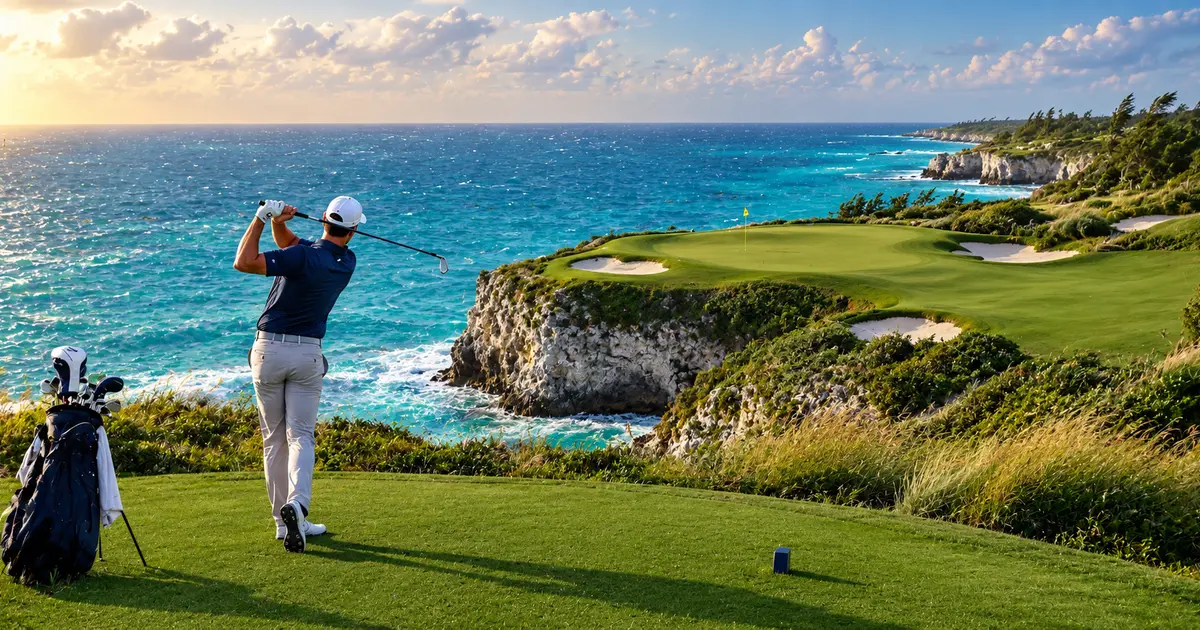
The 2026 Butterfield Bermuda Championship returns to Port Royal Golf Course this week, where one of the shortest layouts on the PGA Tour calendar is expected to provide a demanding test for players competing for a $6 million purse.
Measuring just 6,828 yards and playing to a par of 71, the Southampton course might appear manageable for professionals accustomed to much longer venues. However, strong Atlantic winds, elevation changes and exposed coastal holes can quickly turn promising rounds into difficult scoring battles.
As the tournament begins Thursday, October 22, the challenge is not simply how far players can hit the ball, but how effectively they can control their shots and adapt to changing conditions.
Why Port Royal Is Tougher Than Its Yardage Suggests
Designed by Robert Trent Jones Sr. and opened in 1970, Port Royal Golf Course features 11 par 4s, four par 3s and three par 5s.
Several holes are short enough to leave professionals with wedges or short irons into the greens, creating opportunities for birdies when conditions are favorable.
However, distance alone does not determine how difficult the course plays.
The layout features strategic bunkering, elevated putting surfaces and changes in terrain that demand accurate approach shots.
Players also face the unpredictable influence of wind coming off the Atlantic Ocean.
A hole that offers a comfortable scoring opportunity in calm conditions can become significantly more challenging when gusts increase or change direction.
That uncertainty is a defining feature of the Butterfield Bermuda Championship.
Strong Atlantic Winds Are Port Royal’s Biggest Defense
Wind has repeatedly played an important role in determining the outcome of the tournament.
According to analysis published by Golf Channel ahead of this year’s event, Port Royal has been the windiest regular PGA Tour stop since 2018, averaging approximately 15.2 mph.
The exposed location means players frequently need to adjust their ball flight, club selection and approach to individual holes.
Strong crosswinds can make it more difficult to hold the intended target line, while headwinds can turn relatively short approach shots into demanding tests of distance control.
Wind can also affect putting, particularly on exposed greens.
The 2026 championship could present similar difficulties, with forecasts ahead of the opening round indicating a greater possibility of gusty weather during the weekend.
Conditions remain subject to change, but the potential for stronger winds could play a major role in determining the winner.
The Famous 16th Hole Presents a Major Challenge
One of Port Royal’s most recognizable features is the par-3 16th hole.
Measuring 235 yards on the tournament scorecard, the hole requires golfers to strike a long approach toward a green positioned above the ocean.
The dramatic coastal setting provides spectacular views, but it also introduces considerable risk.
Bunkers protect the putting surface, while the elevated location leaves shots exposed to changing winds.
Missing the intended landing area can create a difficult recovery, even for experienced PGA Tour competitors.
The hole played as the most difficult on the course during the 2024 championship, with a scoring average of approximately 3.31 strokes.
Its influence was also evident during the 2025 final round, when eventual champion Adam Schenk needed an important up-and-down to save par.
The 16th demonstrates why a relatively short course can still demand precise execution under pressure.
Adam Schenk’s 2025 Victory Shows How Difficult Conditions Can Become
The 2025 Butterfield Bermuda Championship provided one of the clearest examples of Port Royal’s changing difficulty.
Adam Schenk claimed his first PGA Tour title with a 12-under-par total of 272, finishing one stroke ahead of Chandler Phillips.
Strong winds affected the final round, with gusts approaching 40 mph.
Schenk closed with an even-par 71, making one birdie and one bogey while relying on several crucial par saves.
His victory looked very different from the low-scoring tournaments that preceded it.
In 2023, Camilo Villegas captured the title at 24 under par. Rafael Campos followed with a 19-under victory in 2024.
The difference between those winning scores and Schenk’s 2025 result illustrates how dramatically Port Royal’s conditions can influence tournament scoring.
For this year’s competitors, course management could prove just as important as aggressive play.
Why Accurate Iron Play Matters More Than Driving Distance
Port Royal’s relatively short layout gives different types of golfers an opportunity to compete.
Long hitters can take advantage of reachable par 5s and shorter approach distances, but driving power is not necessarily the deciding factor.
Some players may choose less than driver on certain holes to improve their position and reduce the risk of finding bunkers or difficult recovery areas.
Accurate iron play becomes particularly valuable when wind makes distance control less predictable.
Golfers who can control trajectory, judge changing conditions and consistently find favorable putting positions may have an advantage.
The course also rewards effective scrambling when approaches miss their targets.
Previous champions, including Brian Gay, Brendon Todd and Seamus Power, have shown that a combination of strategic play, short-game ability and strong putting can produce success at Port Royal.
The layout does not eliminate the benefits of distance, but it places greater emphasis on using that distance wisely.
Butterfield Bermuda Championship Carries Important FedExCup Stakes
The challenges of Port Royal arrive at an important stage of the PGA Tour season.
The Butterfield Bermuda Championship is the fourth event of the eight-tournament FedExCup Fall schedule.
The winner will receive $1.08 million and 500 FedExCup points, while other competitors will be looking to improve their positions in the season-long standings.
Under the Tour’s revised eligibility system, finishing inside the top 100 provides an important route to full-field playing status for 2027.
Players outside that group may still have access through other eligibility categories or exemptions, but their schedules could become more restricted.
With valuable points available, every shot at Port Royal carries additional significance for golfers competing near the cutoff.
That pressure could become especially important if the course plays harder during the closing rounds.
Can Port Royal Challenge the World’s Best Again in 2026?
The Butterfield Bermuda Championship offers a reminder that the difficulty of a golf course cannot be measured by yardage alone.
Port Royal’s short par 4s and scoring opportunities provide the potential for low rounds, but its coastal exposure creates an entirely different challenge when strong winds arrive.
The demanding 16th hole, elevated approaches and strategic layout require players to combine precision with patience.
Defending champion Adam Schenk has already demonstrated how important those qualities can become in difficult conditions.
As the 2026 tournament unfolds from October 22–25, Port Royal will once again test whether players can adapt their games to one of the PGA Tour’s most distinctive coastal venues.
For the eventual champion, managing the course may prove more valuable than simply overpowering it.