
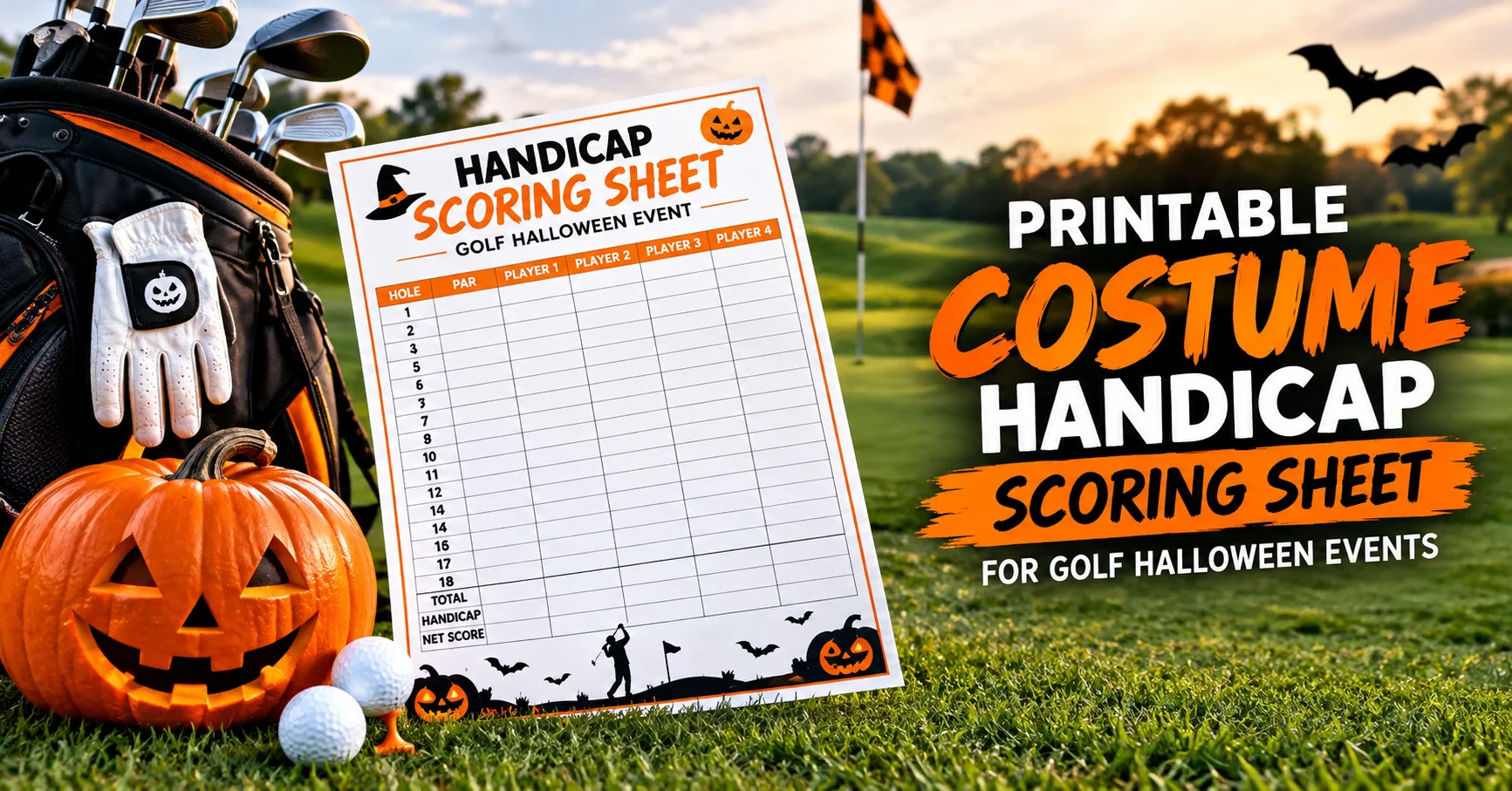
Quick Answer: Download the free printable costume handicap scoring sheet to judge golfers across five categories worth 10 points each. Add an optional 0–5 point costume difficulty bonus for safe outfits that make playing harder. Each contestant can earn up to 55 points. The sheet works for Halloween scrambles, golf leagues, and clubhouse costume competitions.
Golf Halloween events have one judging problem that regular costume parties don’t. The best-looking outfit doesn’t always survive the first tee shot.
A golfer dressed as a giant pumpkin might get the loudest applause in the clubhouse. But once that golfer addresses the ball, the oversized body might stop a proper shoulder turn. Meanwhile, somebody wearing a carefully designed zombie-caddie costume can walk 18 holes, swing freely, and still look terrific.
Both costumes deserve recognition, but for different reasons.
That’s why I’ve designed this golf costume scoring system around five judging categories and a separate difficulty bonus. You can judge the visual work, reward contestants who commit to challenging costumes, and keep the contest safe.
The printable sheet handles the numbers. This guide explains how to use it without arguments at the scoring table.
Free Printable Costume Handicap Scoring Sheet
The free sheet fits on one landscape US Letter page. It gives judges room to score 10 golfers or teams, record comments, calculate totals, and choose a winner.
Download: Free Printable Golf Costume Handicap Scoring Sheet (PDF)
The sheet includes:
- Five judging categories worth 10 points each.
- A separate 0–5 Course Costume Handicap.
- Space for 10 individual golfers or teams.
- A raw score and final score column.
- A quick scoring reference and tie-break rule.
- A notes column for recording a judge’s reasoning.
You don’t need special scoring software. Print one sheet per judge, give everyone the same instructions, and collect the sheets when judging ends.
The Course Costume Handicap is a MadKnows contest-scoring adjustment. It has no relationship to a golfer’s official Handicap Index, Course Handicap, or Playing Handicap.
The Five Categories That Decide Your Costume Score
Every contestant receives a score from 1 to 10 in each category. Judges add those five numbers to calculate a raw score out of 50.
| Judging category | Maximum | What earns a higher score |
|---|---|---|
| Creativity | 10 | A distinctive concept with thoughtful execution |
| Golf and Halloween theme | 10 | A recognizable connection to golf, Halloween, or both |
| Costume detail | 10 | Well-planned accessories, fit, and finishing touches |
| Visual impact | 10 | A memorable appearance that reads clearly on the course |
| On-course practicality | 10 | Safe movement, clear vision, and freedom to swing |
| Raw score | 50 | Add all five categories |
Here’s where organizers often make scoring harder than necessary. They give everyone an 8 or 9 because they don’t want to disappoint anybody.
That leaves almost no room to distinguish a decent costume from an exceptional one.
Use this scoring scale instead.
| Score | Judge’s interpretation | Example |
|---|---|---|
| 1–2 | Very limited effort or execution | A regular golf outfit with almost no recognizable costume |
| 3–4 | Basic | A simple Halloween accessory with little supporting detail |
| 5–6 | Good | A recognizable costume with some thoughtful additions |
| 7–8 | Very good | A convincing costume with strong details |
| 9–10 | Exceptional | One of the strongest entries in the field for that category |
A score of 6 shouldn’t feel like an insult. It means the costume does its job.
Judges should save their highest marks for genuinely exceptional work.
Creativity Should Reward Ideas, Not Spending
An expensive inflatable costume doesn’t automatically deserve more points than a homemade outfit.
Consider a golfer who turns an old white caddie bib into a ghostly yardage-book character. They add hand-drawn course notes, weathered-looking accessories, and a lightweight golf towel.
That contestant has built a specific idea around golf.
Another golfer arrives in a store-bought skeleton suit with no modifications. The skeleton looks fine, but its creative direction is limited.
Judges should reward the thought behind the first costume even if the second costs more.
Golf and Halloween Theme Should Make Sense
A costume contest at a Halloween scramble benefits from a clear theme.
Some recognizable examples include a zombie caddie, haunted club champion, ghost golfer, golf-course groundskeeper, and cursed golf instructor.
A golfer dressed as a pirate can still participate. However, a pirate holding a golf-safe treasure-map scorecard gives the costume a stronger connection to the event.
Don’t require every costume to reference a professional golfer. That would make the competition unnecessarily narrow.
Detail Matters More Than the Number of Accessories
Five matching accessories can look better than 15 unrelated decorations.
Judges should inspect the costume closely enough to notice how the golfer has secured props, combined materials, and finished the outfit.
A loose plastic sword or oversized cape might make the costume look more dramatic, but that doesn’t automatically improve its detail score. Poor attachment and awkward construction count against the final execution.
Visual Impact Should Work Beyond the Clubhouse
A golf costume needs to look recognizable from a reasonable distance.
A strong silhouette and contrasting colors help. Tiny decorative elements are nice up close, but they don’t always contribute to the overall appearance.
Picture two golfers standing beside a tee marker. One wears a bright, recognizable pumpkin-inspired outfit. The other wears ordinary clothing with a small Halloween pin.
The first makes a clearer visual statement.
That doesn’t guarantee a better total score. Visual impact is only one category.
On-Course Practicality Deserves Its Own Score
A costume that works at a party can fail on a golf course.
Long fabric can interfere with the club. Oversized sleeves can catch against the golfer’s body. A heavy hat can slip during the downswing.
Judges should focus on four practical checks: vision, swing clearance, walking movement, and secure accessories.
A golfer doesn’t need to make a perfect swing in costume. They do need enough freedom to control the club safely.
I would keep this category even at a casual nine-hole Halloween event. It rewards outfits that were designed with golf in mind.
How the Course Costume Handicap Works
The Course Costume Handicap gives contestants an optional bonus for wearing a more difficult costume during a golf round.
It adds a maximum of five points to the raw costume score.
The key rule is that the outfit must remain safe.
| Bonus | Costume difficulty | Example |
|---|---|---|
| +0 | No meaningful restriction | Normal golf attire with a small Halloween badge |
| +1 | Very light | A themed hat or lightweight accessory |
| +2 | Mild | An extra costume layer and securely attached props |
| +3 | Moderate | A bulkier outfit that requires some safe movement adjustments |
| +4 | Significant | A demanding costume that remains manageable throughout the round |
| +5 | Exceptional | One of the hardest safe, playable costumes in the competition |
Judges must assess the costume’s actual effect on movement rather than how dramatic it appears.
A bulky outfit deserves a larger bonus only when the golfer wears it as required and can continue playing safely.
The Handicap Formula
Use the following calculation:
Final Costume Score = Creativity + Theme + Detail + Visual Impact + Practicality + Costume Handicap
- Maximum raw score: 50 points.
- Maximum costume handicap: 5 points.
- Maximum final score: 55 points.
The organizer should decide before the event whether the costume handicap will apply. If the contest takes place entirely inside the clubhouse, use the five standard categories and skip the bonus.
Three Golf Halloween Costumes Scored Side by Side
A scoring example makes the system easier to understand.
These fictional contestants illustrate how judges can use the same criteria without automatically rewarding the biggest outfit.
| Category | Ghost Caddie | Zombie Golfer | Pumpkin Golfer |
|---|---|---|---|
| Creativity | 8 | 7 | 9 |
| Golf/Halloween theme | 9 | 9 | 8 |
| Detail | 8 | 7 | 9 |
| Visual impact | 8 | 8 | 10 |
| On-course practicality | 9 | 10 | 5 |
| Raw score | 42 | 41 | 43 |
| Costume handicap | +2 | +1 | +4 |
| Final score | 44 | 42 | 47 |
Under these hypothetical scores, the Pumpkin Golfer wins with 47 points.
The outcome illustrates why the costume handicap exists. The pumpkin outfit earns strong visual marks and extra difficulty credit, but its weaker practicality score prevents an automatic runaway victory.
One caution matters here. The +4 assumes the pumpkin costume passes inspection and the golfer can safely complete the required round. An outfit that restricts vision or creates a dangerous swing doesn’t qualify for the bonus.
Don’t Confuse a Costume Handicap With a Golf Handicap
This is an important distinction for Halloween scrambles.
The costume handicap measures outfit difficulty. A golf handicap helps organize competitive golf scoring.
They’re separate calculations.
Consider a golfer with an official Handicap Index who enters a Halloween scramble wearing a heavy but safe costume.
Their costume bonus belongs on the costume judging sheet. It should never change the golfer’s official handicap record or automatically reduce the team’s net golf score.
| Feature | Costume handicap | Golf handicap |
|---|---|---|
| Purpose | Reward costume difficulty | Support equitable golf competition |
| Scoring method | Organizer’s optional 0–5 bonus | Applicable golf handicap calculations |
| Used for | Costume contest | Golf competition |
| Changes official handicap | No | Governed by the handicap system |
| Can affect costume award | Yes | Only if the organizer specifically creates a separate award rule |
For most outings, I recommend keeping golf scores and costume scores completely separate.
You can announce a winning scramble team and a winning costume without one result changing the other.
The Pre-Round Costume Safety Test
The largest avoidable problem with golf costumes is approving an outfit based on appearance alone.
A costume that looks harmless beside the clubhouse can become awkward when the player bends to tee up a ball.
Before the first tee shot, ask participants to perform these checks.
- Address the ball. The costume must allow the golfer to see the ball and ground clearly.
- Make a slow practice swing. Clothing and accessories must stay away from the moving club.
- Turn both shoulders. The outfit should allow a controlled backswing and follow-through.
- Walk and bend. The golfer should walk normally and pick up a ball without catching or dragging fabric.
- Check carts and seating. Props must not interfere with entering, leaving, or operating a golf cart.
A slow practice swing alone doesn’t establish safety. Players should check their costume again if an accessory shifts or fabric loosens during play.
A costume that fails should be adjusted or removed before the golfer continues.
No points are worth risking an injury.
How to Judge Individual Golfers Fairly
For a small event, three judges provide a practical balance between fairness and simplicity.
Each judge should work independently. If judges compare numbers while filling out their sheets, one person’s opinion can influence the entire panel.
Give judges the same rubric, explain the costume handicap, and agree on the safety rule before the first contestant appears.
After judging, calculate the average score.
For example:
| Judge | Ghost Caddie score |
|---|---|
| Judge 1 | 44 |
| Judge 2 | 41 |
| Judge 3 | 46 |
| Combined | 131 |
| Average | 43.67 |
Divide the combined total by the number of judges.
If every judge uses the same maximum score, averaging works well. Don’t mix a judge scoring out of 50 with another judge scoring out of 55.
For extra consistency, the event organizer can assign one costume handicap bonus per entrant before judging begins. Every judge then applies that same approved bonus to their raw score.
This removes a source of disagreement without taking away each judge’s opinion about creativity or presentation.
How to Score Team Costumes at a Halloween Scramble
Team costume contests introduce another challenge.
Four golfers can wear excellent individual costumes without looking like a coordinated team.
For a team award, score the collective theme and execution rather than adding four individual costume scores together.
Consider a team dressed as a haunted golf course crew. One golfer is a ghostly greenskeeper, another is a zombie caddie, and the remaining two play haunted-course characters.
Their outfits have different details, but they share one theme.
Compare that with four unrelated costumes worn by another team.
The coordinated group deserves stronger theme points, provided the execution supports the idea.
Team Costume Handicap Rule
A team should not receive a +5 costume bonus simply because one member wears a difficult outfit.
For a fairer optional team calculation, assign each player’s eligible costume bonus, then average all four bonuses.
Example:
| Player | Bonus |
|---|---|
| Golfer A | +4 |
| Golfer B | +3 |
| Golfer C | +1 |
| Golfer D | +0 |
| Team average | +2 |
The team’s handicap bonus becomes +2.
Keep one decimal place if the average doesn’t produce a whole number.
This rewards genuine group commitment while discouraging teams from relying on one elaborate outfit.
Use the team version only when the organizer announces it before the event.
The Best Time to Judge Golf Halloween Costumes
Don’t wait until everyone finishes 18 holes before the judges see the contestants.
Make the first assessment before the round while costumes are clean, complete, and properly arranged.
Then confirm the required costumes remained in use during the round.
Here’s a simple schedule for a fictional 9:00 a.m. shotgun start.
| Time | Organizer’s job |
|---|---|
| 8:00 a.m. | Registration and costume entry numbers |
| 8:15 a.m. | Costume safety inspection |
| 8:25 a.m. | Judges score appearance and details |
| 8:45 a.m. | Players move to assigned starting holes |
| 9:00 a.m. | Round begins |
| After the round | Confirm practicality and costume eligibility |
| Before awards | Calculate final scores and settle ties |
For a large tournament, give each entrant a number. Judges can identify a contestant faster by number than by a nickname or complicated costume description.
The event coordinator should also specify how to handle golfers who remove major costume pieces mid-round.
A sensible rule is to allow removal for safety at any time, then reassess the final practicality and difficulty bonus. Never require someone to keep wearing an unsafe outfit to preserve points.
How to Break a Costume Contest Tie
A tie is easy to handle when the organizer sets the rule in advance.
For an on-course competition, use this order:
- Higher On-Course Practicality score.
- Higher Creativity score.
- Higher Golf and Halloween Theme score.
- Final vote by the judges.
When multiple judges participate, compare the average category scores rather than one judge’s individual card.
For a clubhouse costume contest, move Creativity ahead of Practicality.
Avoid inventing a tie-break rule while contestants wait for the results. A rule announced after scoring looks unfair even when the judges have good intentions.
How Many Scoring Sheets Should You Print?
The printable holds 10 entries per page.
Use this calculation:
Number of sheets = Entries divided by 10, rounded up, multiplied by the number of judges.
For 24 contestants and three judges:
- 24 contestants require three sheets per judge.
- Three judges require nine sheets.
- Print two extra copies as spares.
That means 11 sheets total.
For 40 contestants with three judges, print 12 sheets plus two spares.
A clipboard helps keep the paper usable outside, especially if the scoring table sits near an exposed practice area.
Print at 100% scale on US Letter paper in landscape orientation. Black-and-white printing is sufficient.
Common Costume Scoring Mistakes
Giving the Best-Looking Costume the Highest Score Automatically
Visual impact accounts for only 10 of the 50 raw points.
A beautifully decorated costume can lose points for poor execution or practical problems.
Judges should complete every category before checking the final total.
Rewarding Unsafe Difficulty
A golfer wearing a mask that blocks their view doesn’t deserve bonus points for the restriction.
They need to remove or adjust the mask.
The costume bonus exists for safe difficulty, not danger.
Letting Judges Use Different Standards
If one judge treats a 7 as excellent and another considers it average, their scores won’t be comparable.
A short briefing and the shared score scale reduce that problem.
Changing the Bonus After Seeing the Winners
The organizer should confirm whether the contest uses the 50-point or 55-point format before registration closes.
Changing the scoring method after seeing the results undermines the contest.
Mixing Costume Points With Golf Strokes
Keep the golf competition independent.
A contestant’s elaborate costume doesn’t entitle their scramble team to extra strokes unless the event explicitly creates a separate, informal game with published rules.
Frequently Asked Questions
Is the printable costume handicap scoring sheet free?
Yes. The downloadable PDF is free and designed for printing on standard US Letter paper. Each page provides space for 10 contestants or teams.
How many points can a golf costume earn?
A contestant can earn up to 50 raw points across five categories. With the optional five-point costume handicap, the maximum becomes 55 points.
What is a costume handicap in golf?
For this MadKnows contest, it is an optional 0–5 point bonus that rewards the added difficulty of wearing a safe costume during play. It is not an official golf handicap.
Can you use the sheet for a Halloween golf scramble?
Yes. Score individual contestants or use the team scoring method. Keep the costume contest independent of the scramble’s golf scores.
How many judges should a costume contest have?
Three judges work well for a small or medium event. A larger group can use more judges, provided everyone follows the same rubric.
What happens if a golfer removes part of the costume?
The event organizer should reassess the costume’s final score or bonus according to rules announced before play. Participants must always be allowed to remove unsafe clothing or accessories.
Can children use this golf costume judging sheet?
Yes, provided an adult adapts the event for their age and supervises play. For a children’s costume parade or a contest without golf swings, use the standard 50-point judging categories and omit the difficulty bonus.
What happens when two costumes finish with the same score?
Compare On-Course Practicality first, then Creativity and Theme. If the scores remain tied, the judges make a final vote under the event’s announced rules.
A Better Way to Run Your Next Golf Costume Contest
The strongest Halloween golf events give golfers a chance to be funny and creative without sacrificing safety.
Keep judging transparent. Use the same categories for everyone, decide on the costume bonus before play, and make the PDF available to the judges at registration.
You can run the entire contest with a clipboard, a pencil, and this printable costume handicap scoring sheet. The important part is making sure every golfer understands how the winners are chosen before the first tee shot.