
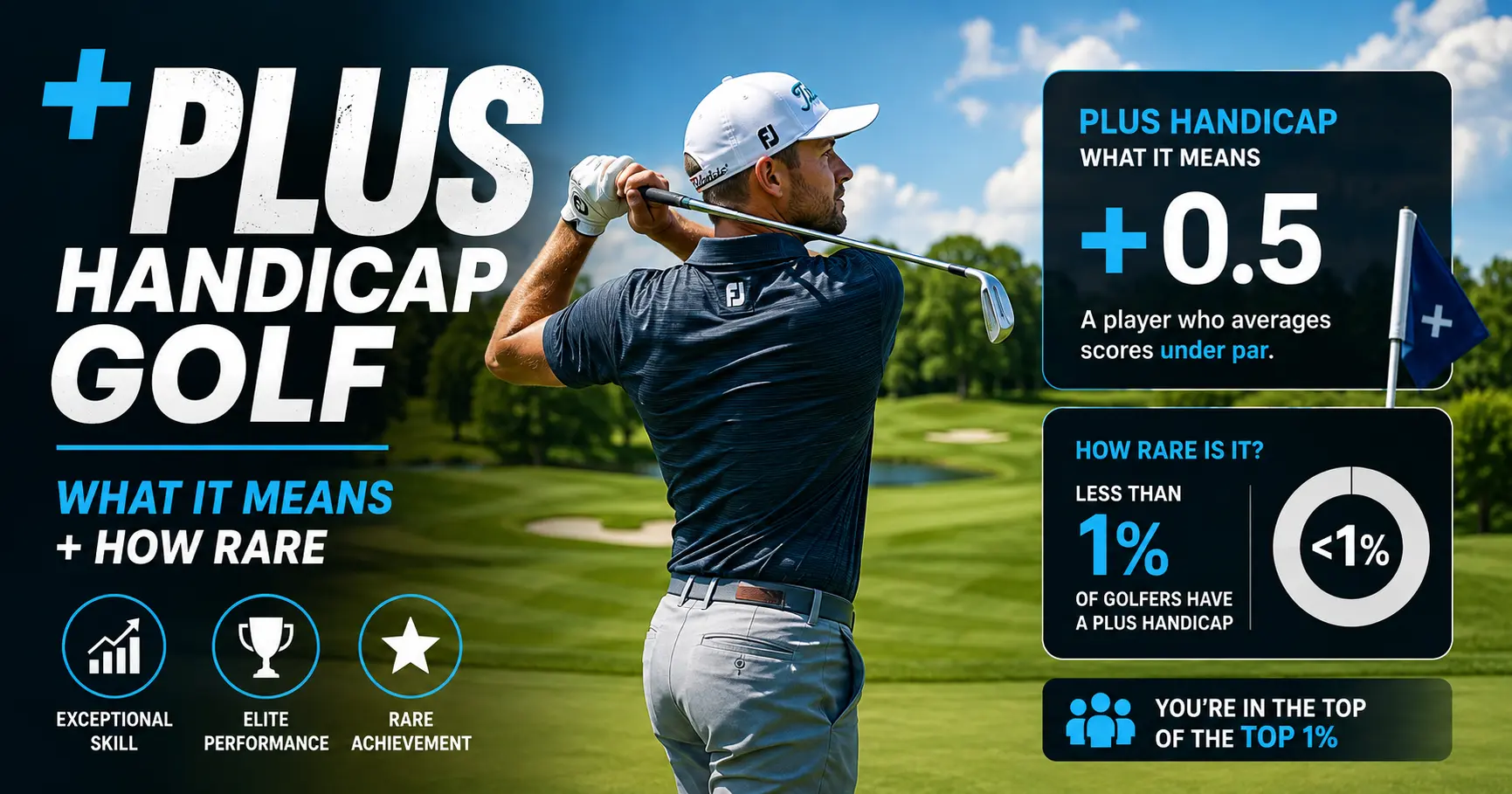
A plus handicap means a golfer’s Handicap Index sits below zero, written with a plus sign, like +2. Instead of subtracting strokes, a plus handicap golfer adds them back before comparing to par. Fewer than 2% of golfers who carry an index ever reach it.
I’ve kept the scorecard for our club championship for six years, and every year the same three names post a plus number while the rest of us post regular double digits. Watching a +3 golfer give strokes back to a course that’s already beaten me by 15 shots is one of the stranger sights in the game. This guide breaks down exactly what a plus handicap means, what separates a +1 from a +7, how rare the whole club actually is in 2026, and what it takes to get there yourself.
What a Plus Handicap Actually Means
What does plus handicap mean in golf? The plus handicap golf meaning is simpler than it looks once you separate the label from the math. A plus handicap is a Handicap Index that calculates below zero, the point golf treats as scratch.
Once your best eight scores from your last 20 rounds average out under 0.0, the World Handicap System assigns you a plus number instead of a regular one. You’ll see it written as +1, +2, +3, and so on, always with that plus sign out front.
Here’s where it gets confusing. Under the USGA’s Rules of Handicapping, a plus Handicap Index is technically a negative figure. The plus sign is a naming convention, not a math symbol. Rule 5.2c spells this out directly, encouraging plus golfers to prefix their index with a plus sign and telling handicap committees to double-check any index that shows an actual minus sign, since that’s usually a data-entry mistake rather than a genuine reading.
Practically, this means a plus handicap golfer has proven, over 20 real rounds, that they can beat the golf course itself. Scratch golfers are expected to match the Course Rating exactly. A +2 golfer is expected to beat it by two strokes on an average day. That’s the whole concept in one sentence, and it’s also the reason plus handicap golfers give strokes back instead of taking them.
Golf Handicap: Plus or Minus? Untangling the Confusing Math
Three terms get mixed up constantly: scratch, plus handicap, and everyday handicap. They’re not the same thing, and confusing them changes how strokes move in a match. Whether you call it golf handicap plus or minus, or plus or minus handicap golf, you’re asking the same question, and the table below settles it.
| Golfer Type | Handicap Index | What Happens to the Score | Share of Golfers Carrying an Index (US, 2025) |
|---|---|---|---|
| Plus handicap | Below 0.0, shown as +1, +2, +3, etc. | Strokes get added to the gross score | About 2% or fewer |
| Scratch | Exactly 0.0 | No strokes added or subtracted | Included within that 2% |
| Regular handicap | 0.1 and up | Strokes get subtracted from the gross score | Roughly 98% |
A scratch golfer sits at the exact dividing line. They don’t receive strokes and they don’t give any back in a scratch-versus-scratch match. Everyone else on the course either takes strokes from par or hands them over to it, and the plus handicap crowd is the only group doing the handing over.
What Plus 1 Through Plus 10 Actually Look Like
Plus handicap golf breaks down cleanly once you stop lumping every plus number together and look at each one on its own. A +1 and a +7 both technically qualify as “plus handicap golfers,” but they’re not remotely playing the same game. Here’s what each level actually represents, using real benchmarks from competitive amateur and college golf instead of vague rarity talk.
| Handicap | Strokes Better Than Scratch | What That Looks Like in Real Golf |
|---|---|---|
| +1 | 1 | Strong club champion, fringe college golf recruit |
| +2 | 2 | Typical entry point for NCAA Division 1 recruiting |
| +3 | 3 | Mid-to-upper Division 1 college golfer |
| +4 | 4 | State amateur championship contender |
| +5 | 5 | Multiple regional amateur titles, mini-tour ready |
| +6 to +7 | 6 to 7 | National amateur caliber, close to what golf statisticians have estimated for tour pros like Paul Casey and Martin Kaymer |
| +8 to +10 | 8 to 10 | Beyond the roughly +5.4 average one 2020 study estimated for the PGA Tour, essentially elite professional-caliber ball striking |
This table works whether you landed here searching plus 1 handicap golf, plus 4 handicap golf, or plus 7 handicap golf. It also answers plus 2 handicap golf, plus 3 handicap golf, plus 5 handicap golf, plus 8 handicap golf, plus 9 handicap golf, and plus 10 handicap golf in the same breath, because the pattern holds at every level: each extra plus number represents another full stroke of separation from a group that’s already inside the top 2% of golfers worldwide.
People search all four versions the same week: what is a plus 2 handicap in golf, what is a plus 3 handicap in golf, what is a plus 4 handicap in golf, and what is a plus 5 handicap in golf. The table above answers all four at once, number by number, instead of leaving you to guess.
How Rare Is a Plus Handicap? The Real Numbers
How many plus handicap golfers are there, and how many plus handicap golfers are there in the world once you count past the United States? Genuinely rare is the short answer, and the official numbers back it up better than any competitor site currently shows. Here’s how the data lines up once you pull it straight from the governing bodies instead of guessing.
| Region / Source | Golfers With an Official Index | Scratch or Better | Plus Handicap Specifically |
|---|---|---|---|
| United States, 2025 USGA Golf Scorecard | 3.68 million | 2% of men, 0.85% of women | Not broken out separately in the 2025 report |
| United States, end of 2024 (USGA data) | 3.4 million | About 60,000 golfers (1.6%) at 0.0 or better | Not broken out separately |
| United States, 2020 baseline | Roughly 2 million registered | Not broken out separately | 35,883 golfers, 1.85% of men and 0.69% of women, below 0.0 |
| England, England Golf 2025 data | 780,000-plus | Roughly 1.1% (below 0.4) | Not broken out separately |
| Worldwide, R&A/USGA WHS Data Report | 6.5 million submitted scores | Average index 16.9 men, 29.0 women, for scale | Not separately reported |
Put those rows side by side and a pattern jumps out. Roughly 1 in 50 golfers who keep an official handicap reaches scratch or better, and only a slice of that group crosses fully into plus territory. If you’re carrying a +2 in the United States, you’re standing somewhere inside a group of well under 40,000 people, spread across a country where millions of golfers post scores every year. That’s the entire rarity story behind plus handicap golf in one paragraph, and it’s why club members treat a plus-handicap teammate the way a rec-league basketball team would treat a Division 1 walk-on showing up for pickup games.
How a Plus Handicap Is Calculated
Your Handicap Index isn’t built from one good round. The World Handicap System pulls your best 8 Score Differentials from your last 20 rounds and averages them. Miss that standard for one hot Saturday and your index barely moves. That’s by design, and it’s the entire reason a plus handicap means something.
Every round you post gets converted into a Score Differential using this formula:
Score Differential = (Adjusted Gross Score − Course Rating) × 113 ÷ Slope Rating
Course Rating is what a scratch golfer is expected to shoot on that specific set of tees. Slope Rating measures how much harder the course plays for a bogey golfer compared to a scratch player, on a scale running from 55 to 155, with 113 sitting at the neutral middle. Shoot a gross 68 on a course rated 71.4 with a 128 slope, and your Score Differential for that round works out to about -3.0.
Once your best 8 of 20 differentials average out below zero, the plus number appears. A -2.3 average produces a +2.3 Handicap Index on your GHIN or CDH profile. From there, your Course Handicap shifts slightly at every course you play, using this formula: Course Handicap = Handicap Index × (Slope ÷ 113), rounded to the nearest whole number. That’s the number that actually gets applied on the first tee, not your raw index.
How Plus Handicaps Work in Competition
In stroke play, the math stays simple. A +3 golfer who shoots a gross 69 adds three strokes back, posting a net 72. That’s the entire calculation, and it’s why plus handicap golfers rarely dominate club net-score events. They’re already playing from spot cash, with nothing extra to spare.
Match play changes the picture entirely. Here, the plus handicap golfer gives strokes away on the easiest-rated holes on the card, not the hardest, which is the exact reverse of how everyone else’s handicap works. Say Player A carries a +2 Course Handicap and Player B carries a 14.
The gap between them comes to 16 strokes, meaning Player B gets a shot on 16 of the 18 holes, starting from the easiest stroke-index hole and working backward, leaving only the two toughest holes on the card stroke-free. I’ve watched a scratch player in our men’s league drop three of the first four holes purely because of where those stroke dots landed on an easy front nine, and it still catches good players off guard every single season.
Team formats add another layer. In a four-ball or best ball, committees commonly apply a percentage allowance, often 85% to 90% of Course Handicap, to keep the format competitive. A +2 golfer’s handicap under a 90% allowance becomes roughly +1.8, which most software rounds back to +2, while a partner’s 16 drops to 14.4, rounding to 14. If your club runs scramble events, the same logic applies to folding a plus handicap into the team’s combined number, just using the scramble-specific percentage table instead of the four-ball one.
Age Plus Handicap: The Senior Tee Rule Nobody Explains
Search for age plus handicap golf and you land in a completely different conversation. This isn’t about a Handicap Index below zero at all. It’s a tee-eligibility formula a lot of private clubs use for senior members, and almost nobody explains it clearly.
Here’s how it works at a typical club. To qualify for a forward, senior-specific tee, a member’s age plus their Course Handicap has to add up to a minimum number, commonly 75 or 80.
A 68-year-old member with a 10 Course Handicap hits 78, clearing a 75 threshold with room to spare. A 61-year-old with a 22 Course Handicap also clears it, landing at 83. Fall short on either number and the member doesn’t qualify, regardless of how much they’d rather play from up front.
Clubs use this formula because age alone doesn’t predict who needs shorter yardage, and handicap alone doesn’t either. A 65-year-old scratch golfer probably doesn’t need forward tees. A 60-year-old 24-handicapper probably does. Adding the two numbers together catches both cases without turning it into a subjective committee decision on tee day.
How to Become a Plus Handicap Golfer
What does it mean to be a plus handicap golfer on a daily basis, not just on paper? Nobody wakes up one morning and finds a plus sign on their profile. Every plus handicap golfer I’ve ever played alongside got there through years of structured, repetitive work, usually starting well before they turned 18.
The junior pathway matters more than most adult golfers realize. Players chasing college scholarships typically post their first competitive scores through programs like the AJGA starting around age 12, then spend their teenage years playing 36- and 54-hole events against the best players in their region.
By the time serious juniors reach their college recruiting years, NCAA Division 1 coaches are typically looking for a 0 to +2 Handicap Index and a tournament scoring average under 72 for men, according to recruiting services like NCSA. That’s not a beginner’s timeline. That’s a decade of reps before the plus sign ever shows up.
For an adult golfer starting from, say, a 5 handicap, the honest math is brutal. You’re not closing a gap of five strokes. You’re closing a gap of five-plus, because scratch is the floor of this conversation, not the ceiling.
I’ve played this game for over 15 years and worked my own index down to a 3.4, and I’ll say this plainly: the last three shots between a mid-single-digit handicap and scratch are harder to find than the first fifteen. Short game precision inside 50 yards, course management under real pressure, and eliminating the one blow-up hole per round that wrecks an otherwise clean scorecard, that’s where plus handicap golfers separate themselves, and it takes years, not a winter of range sessions.
If you’re playing twice a month and shooting the mid-90s, chasing a plus handicap isn’t a realistic two-year project. It won’t happen without dramatically changing how much and how seriously you play, and there’s no shortcut worth pretending exists.
For golfers who are serious about the climb, track strokes gained by category instead of just your total score, play real competitions instead of casual rounds only, and get brutally honest about which part of your game actually costs you shots. Most club golfers blame the driver. It’s almost always the scoring clubs, wedges from 100 yards in, and the putter from 10 feet.
Plus Handicaps and College Golf Recruiting
The plus handicap conversation and college golf recruiting are basically the same conversation once you get past the juniors level. On competitive NCAA Division 1 men’s teams, most roster spots go to players carrying a Handicap Index somewhere between +2 and 2, with the strongest programs skewing toward the plus side of that range. Some rosters even include a player or two sitting at a regular 2 handicap rather than a full plus number, which tells you scoring average under pressure matters more to coaches than the index itself.
Women’s Division 1 recruiting runs a similar pattern, with target handicaps generally sitting at 3 or better for top programs, according to recruiting resources like NCSA. Coaches increasingly weigh verified tournament scoring average over a casual-round handicap, since a handicap can get manipulated by cherry-picking easy events, but the players actually landing on those rosters are, in practical terms, plus handicap golfers or very close to it.
Junior college programs sit one tier below and lean on the same benchmark. Top JUCO programs recruit players who already carry a plus handicap, using that level as a feeder system into four-year NCAA rosters. If you’re a parent or a junior golfer using this article to gauge where you stand, a plus handicap by age 17 or 18 isn’t just a personal milestone. It’s roughly the entry price for a scholarship conversation at the Division 1 level.
Frequently Asked Questions
What does a +7 handicap mean?
A +7 Handicap Index means a golfer’s best rounds run a full 7 strokes better than the Course Rating on average. Golf Monthly has estimated that PGA Tour players like Paul Casey and Martin Kaymer would sit close to +7 if they still carried an amateur index. In practical terms, you’re talking about someone playing at a level just below the professional ranks, closer to US Amateur qualifying contention than a typical club championship field.
What is a +3 handicap in golf?
A +3 handicap means a golfer beats the Course Rating by three strokes on an average round, based on their best 8 of the last 20 Score Differentials. That typically puts them in mid-to-upper NCAA Division 1 college golf territory, or among the stronger players in a competitive state amateur field. Shooting a gross 69 on a par 72 course, a +3 golfer posts a net 72 once the strokes go back on.
Is a +2 handicap golfer good?
Yes, unambiguously. A +2 handicap puts a golfer inside the top 1 to 2% of everyone who carries an official index worldwide, and squarely in the range Division 1 college coaches recruit toward. Calling a +2 golfer merely good undersells it badly. They’re playing a different game than the other 98% of the golfing population.
How rare is a plus handicap?
Genuinely rare. USGA data from 2025 shows only about 2% of male golfers in the United States carry a 0.0-or-better index, and that figure includes scratch golfers, not just the plus crowd sitting below zero. England Golf’s numbers land in a similar range, at roughly 1.1%. Narrow that further to golfers specifically below zero, and the group shrinks to well under 40,000 people spread across a country of millions of golfers.
Can professional golfers officially carry a plus handicap?
Not officially. Turning pro means giving up amateur status, and Handicap Indexes only exist within the amateur system. Golf statisticians have run the numbers anyway out of curiosity, and one widely cited 2020 calculation pegged the average PGA Tour player’s handicap at somewhere around +5.4, though that estimate didn’t fully account for how much tougher tour setups play compared to an average rated course.
Is a plus handicap the same thing as scratch?
No, and the difference matters. Scratch means a Handicap Index of exactly 0.0, the dividing line itself. A plus handicap sits below that line entirely, meaning the golfer’s average performance beats scratch outright. Every plus handicap golfer has already passed through scratch on the way down, but not every scratch golfer makes it to plus.
The Bottom Line
A plus handicap isn’t a badge you stumble into. It’s the product of years of competitive rounds, brutal honesty about your weak spots, and enough Score Differentials to prove it wasn’t a fluke week. Whether you’re chasing your own plus number or just trying to understand the golfer in your Saturday group who gives strokes back instead of taking them, the math underneath a plus handicap is simpler than it looks once you separate the myth from the mechanics. If you’re working on the swing speed and distance gains that usually come before the scoring improvements plus handicap golf demands, our carry distance breakdown by handicap bracket is a good next stop.