
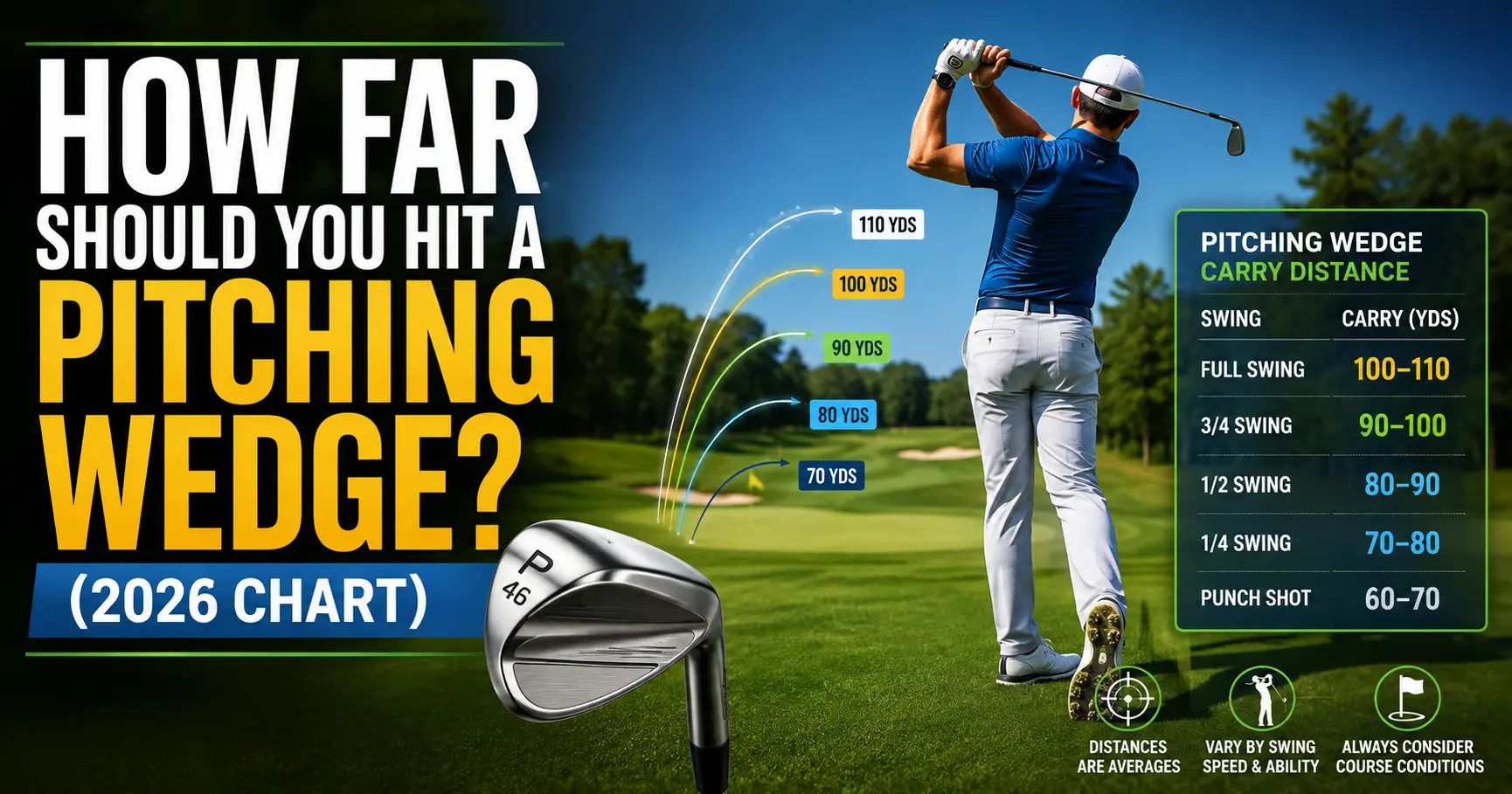
Quick Answer: How far should you hit a pitching wedge? Somewhere between 90 and 140 yards for nearly everyone, with handicap explaining most of the spread. Shot Scope’s amateur data puts a scratch golfer at 141 yards and a 25-handicapper at 90. If you’re between 100 and 130, you’re in the normal range.
A pitching wedge should be the club you trust most. Instead it’s usually the one golfers guess at hardest, because somewhere around 120 isn’t a real number, it’s a shrug. This guide replaces the shrug with an actual pitching wedge distance chart broken down by handicap, shows how that stacks up against your gap, sand, and lob wedge, and puts your number next to what the pros carry. Every figure below comes from tracked shot data, not a marketing brochure.
How Far Do You Hit a Pitching Wedge? The Real Chart by Handicap
Ask ten golfers how far they hit a pitching wedge and you’ll get ten different, mostly wrong answers. Most people remember their best shot of the year, not their average one. Shot Scope’s database, built from millions of tracked amateur rounds, tells a more honest story.
| Handicap | Scratch (0) | 5 | 10 | 15 | 20 | 25 |
|---|---|---|---|---|---|---|
| Pitching wedge carry | 141 yd | 126 yd | 127 yd | 121 yd | 108 yd | 90 yd |
That’s a 51-yard spread between a scratch golfer and a 25-handicapper, with the exact same club in their hands. Loft doesn’t explain a gap that big. Swing speed and strike quality do almost all of the work, and how far should you hit a pitching wedge really comes down to which of those two you’re missing.
Notice the 5-handicap number sits one yard behind the 10-handicap number. That’s not a typo. Lower-single-digit players often favor a controlled three-quarter wedge swing over a full release, while 10-handicappers are more likely to swing out fully because they need every yard on approach.
Here’s the part that matters more than any chart: your own number is the only one worth trusting. If you’re a 12-handicap who carries a pitching wedge 100 yards, chasing the 127-yard average for a 10-handicap will just get you flipping the clubface open at impact and thinning one over the back of the green. How far do you usually hit a pitching wedge on a clean strike, not a career-best one? Write that number down, not the chart’s.
Pitching Wedge vs. Gap, Sand, and Lob Wedge Distances
A pitching wedge distance chart on its own only tells half the story, because the club rarely works alone. Here’s the same handicap breakdown across all four wedges most golfers carry.
| Handicap | 0 | 5 | 10 | 15 | 20 | 25 |
|---|---|---|---|---|---|---|
| Pitching wedge (~45°) | 141 | 126 | 127 | 121 | 108 | 90 |
| Gap wedge (~50°) | 126 | 109 | 110 | 104 | 94 | 79 |
| Sand wedge (~54°) | 105 | 86 | 98 | 84 | 85 | 80 |
| Lob wedge (~58°) | 86 | 71 | 79 | 75 | 78 | 49 |
All figures are carry distance in yards. For how wedge lofts are actually measured and why two “56-degree” wedges from different brands rarely play the same, our golf club lofts guide breaks down the whole set.
How far should you hit a sand wedge? Based on this data, somewhere between 80 and 105 yards covers most handicaps, though a 54 degree wedge and a 56 degree wedge from two different manufacturers won’t play identically even at the same nominal loft. A separate loft-based breakdown puts full-swing sand wedge carry at 75 to 95 yards, with the three-quarter shot, the one you’ll actually use most often, landing at 55 to 75.
Wondering how far a 54 degree wedge should go versus a 56? Expect 5 to 10 yards of separation, not more, since bounce and grind matter as much as those two degrees of loft.
Gap wedge distance sits about 15 yards behind pitching wedge distance for most players, which is exactly the point of the club. Some manufacturers stamp it with an “A” instead of “GW”. Callaway, TaylorMade, and Ping have all done it at various points, and it plays the identical role. If your bag has an “A” wedge on it, that answers your a wedge distance question under a different letter.
The lob wedge column gets noisy at the higher handicaps. A 49-yard average for 25-handicappers sits well below the 78-yard number for 20-handicappers, and that’s not really a skill cliff. It’s a small-sample problem, since most higher-handicap golfers rarely take a full swing with a 58 or 60 degree wedge, so a much smaller pool of genuinely full shots builds that average.
If you’re asking how far should you hit a 60 degree wedge, treat anything from 60 to 90 yards as normal depending on swing speed, and don’t read much into the outliers on either end.
How Pros Compare: PGA Tour, LPGA, and Two Names You Know
Recreational numbers only mean so much without a benchmark at the other end of the spectrum. Trackman’s tour-tracking data puts the average PGA Tour pitching wedge carry at 142 yards, with the Champions Tour at 134 and the LPGA Tour at 111.
Tiger Woods sits on the shorter side of that PGA Tour range. Golf outlets have clocked his stock pitching wedge anywhere from 125 to 135 yards depending on the season referenced, a number that tracks with the stronger 48-degree loft he plays compared to most of his peers. Rory McIlroy hits his considerably farther. TaylorMade’s own yardage chart lists his 46-degree pitching wedge at 150 yards, and Rory himself has talked about stock numbers closer to 145 in calm conditions.
Worth flagging so you don’t chase a false number: at the 2026 US Open, McIlroy carried a pitching wedge 192 yards into the wind-aided par-5 fifth at Shinnecock Hills to set up an eagle. A 396-yard tailwind-assisted drive did most of the work on that hole, not his wedge swing. It’s not a stock yardage, and treating it like one is how amateurs end up dumping wedge shots into greenside bunkers.
Is Hitting a Pitching Wedge 130 Yards Good?
Yes, and by a comfortable margin. At 130 yards you’re sitting between the 5-handicap (126) and scratch (141) benchmarks in tracked amateur data, and well clear of the 118-yard average across all amateurs. It’s not tour-average, PGA Tour pros clear that by 12 yards, but for an amateur, 130 is a strong, fast-swing number rather than a normal one.
Pitching Wedge or 9-Iron? When the Overlap Actually Matters
How far should you hit a 9 iron compared to a pitching wedge? For the average male amateur, a 9-iron carries somewhere around 120 to 125 yards, which lands right in the middle of the 10-to-15-handicap pitching wedge range above. That overlap isn’t an accident. It’s a gapping problem hiding in plain sight.
If your 9-iron and pitching wedge carry within 8 yards of each other, you don’t really have two clubs. You have one club with two names stamped on it. That usually means your irons run stronger lofts than you think, a common result of the loft-strengthening manufacturers have leaned on for two decades to make distance claims look better on a spec sheet. Our golf club distance chart by skill level shows exactly where that overlap tends to show up across a full set.
The fix isn’t swinging the 9-iron softer forever. It’s confirming your actual lofts and, if the gap is under 8 yards, deciding whether you’d rather close it with a stronger pitching wedge or a weaker 9-iron.
Pitching Wedge Distance in Meters
Most of madknows’ readers think in yards, but plenty search for how far a pitching wedge goes in meters, especially outside the US. Here’s the same handicap chart converted.
| Handicap | 0 | 5 | 10 | 15 | 20 | 25 |
|---|---|---|---|---|---|---|
| Carry (meters) | 129 m | 115 m | 116 m | 111 m | 99 m | 82 m |
The PGA Tour’s 142-yard pitching wedge average converts to almost exactly 130 meters, which lines up with independently reported metric tour data and makes it a useful anchor number if you track your own distances in meters.
How to Find Your Real Pitching Wedge Number
A chart gets you in the right neighborhood. Only your own testing gets you an actual number, which is the honest answer to how far should you hit a pitching wedge in the first place. How should you hit a pitching wedge to get a repeatable number in the process? Center the ball, keep most test swings at three-quarters, and let the loft do the work instead of trying to scoop the ball into the air.
- Book 15 minutes on a launch monitor if your range has one. Hit ten pitching wedge shots, throw out your worst two and your best one, and average what’s left.
- No launch monitor? Use a flagged range. Hit ten balls, walk out, and eyeball the cluster against the yardage markers.
- Confirm it on the course. Range mats and range balls compress differently than real turf, so your course number often runs 5 to 10 yards short of your range number.
- Measure your three-quarter swing separately. It’s the shot you’ll actually play most often between 80 and 120 yards, and it deserves its own line in your notes.
- Retest once a season, or right after any new wedge, new shaft, or swing change. How far should you be able to hit a pitching wedge after a lesson or a fitting? Whatever your new numbers say, not whatever you remembered from three years ago.
Common Mistakes That Wreck Your Pitching Wedge Number
Most golfers who don’t know their pitching wedge number aren’t bad players. They’re just guessing instead of measuring, and it’s an easy habit to break, since how far should you hit a pitching wedge is a moving target every time your equipment or swing changes. If you carry a modern, strong-lofted pitching wedge, many now sit at 43 to 45 degrees instead of the traditional 48, your “old” mental yardage from a decade ago is simply wrong, and swinging harder won’t make an outdated number true again.
Three habits cost amateurs the most accuracy:
- Swinging full when a three-quarter shot fits the number. A full swing adds more moving parts and more ways to mishit. If the yardage matches your 3/4 carry, take it.
- Trusting range numbers on the course. As mentioned above, range surfaces and range balls almost always fly a little longer than the real thing.
- Ignoring worn grooves. A pitching wedge that’s lost its groove sharpness can shed 5 to 8 yards of spin-driven stopping distance well before it loses any real carry, which shows up as balls releasing farther than expected once they land.
If you already know your pitching wedge number cold and it isn’t moving, more range time on full swings isn’t the answer. Dial in your three-quarter and half-swing distances instead. That’s where most missed greens from 100 yards and in actually come from.
Frequently Asked Questions
Is hitting a pitching wedge 130 yards good?
Yes. At 130 yards you sit between the 126-yard average for a 5-handicap and the 141-yard scratch-golfer average, well clear of the 118-yard mark for all amateurs combined. It’s a low-single-digit-handicap number, not an average one.
How far does Tiger Woods hit a pitching wedge?
Reports place Tiger Woods’ stock pitching wedge between 125 and 135 yards, depending on the season referenced. He plays a stronger 48-degree loft than most tour pros, which keeps the number modest relative to his ball speed.
How far does Rory hit his pitching wedge?
Rory McIlroy’s pitching wedge, at 46 degrees of loft, carries around 150 yards on TaylorMade’s published stock-yardage chart, with McIlroy himself citing numbers closer to 145 in calm conditions. Given a strong tailwind, he’s carried one considerably farther, including a 192-yard eagle-setup shot at the 2026 US Open.
Is a 52 degree the same as a pitching wedge?
No. A 52-degree wedge is a gap wedge, also called an approach wedge or “A” wedge, built to fill the yardage gap between a pitching wedge and a sand wedge. A pitching wedge typically runs 44 to 48 degrees of loft, several degrees stronger than a 52-degree club, and carries noticeably farther as a result.
How far does a pitching wedge go in meters?
For amateurs, roughly 82 to 129 meters depending on handicap, with the overall average sitting close to 108 meters. PGA Tour pros average about 130 meters.
How far should you hit a sand wedge?
Most amateurs carry a sand wedge between 80 and 105 yards on a full swing, with the three-quarter shot running shorter. Lower-handicap players tend to land at the top of that range because of cleaner, more centered strikes.
How far should you hit a 9 iron?
The average male amateur carries a 9-iron around 120 to 125 yards, close enough to a mid-handicap pitching wedge that the two clubs often overlap if your set’s lofts run strong.
Final Thoughts
A pitching wedge distance chart answers “how far should you hit a pitching wedge?” in the abstract, but your real, tested carry is the only number that actually lowers your scores. Measure it properly, retest it once a season, and stop guessing at the club you should trust the most. Once you’ve got that number locked in, the next skill worth building is hitting pin high on your approach shots, so the distance you just measured actually turns into makeable putts.