
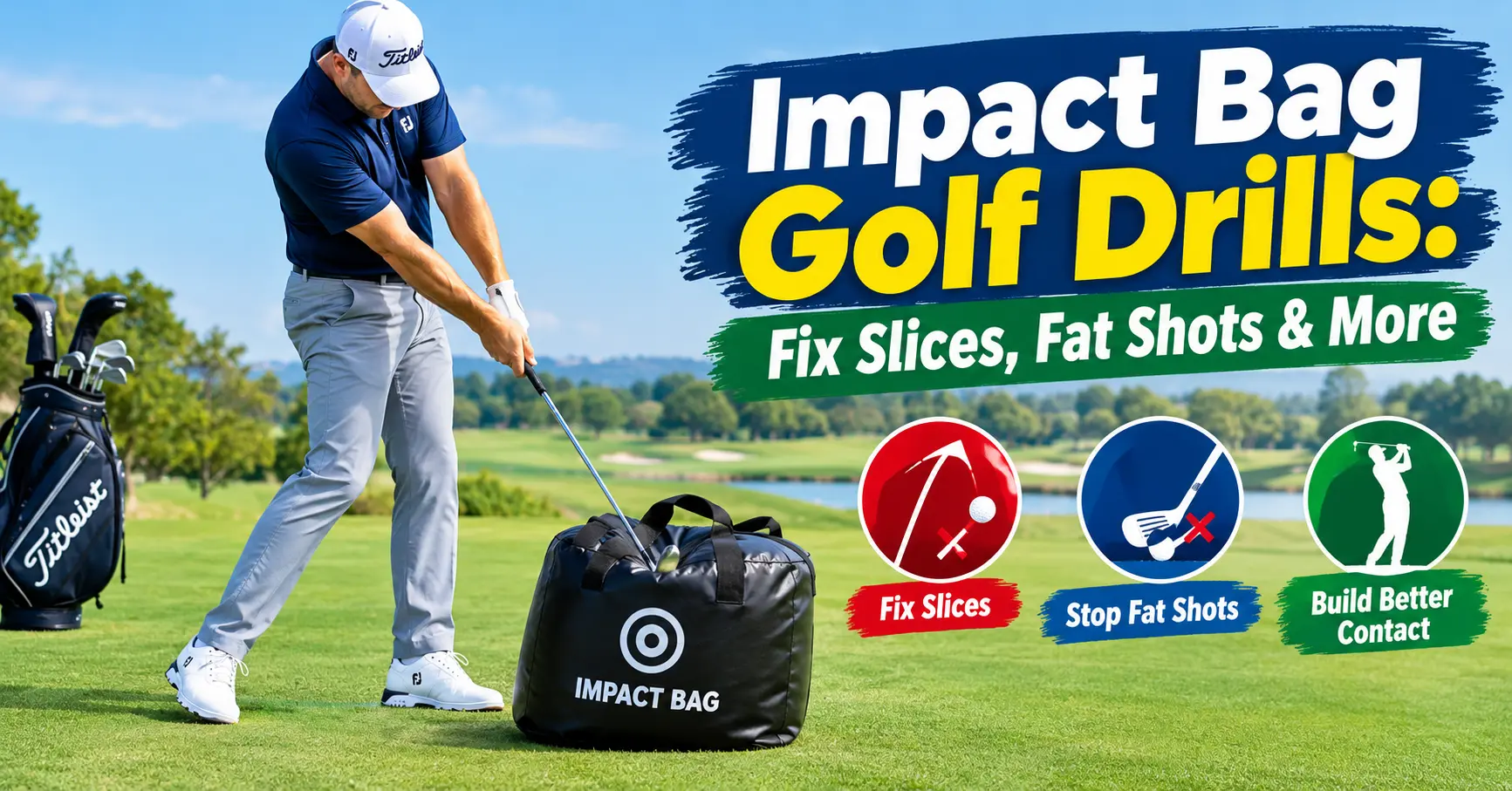
Quick Answer: An impact bag golf drill has you swing into a stuffed bag positioned where the ball would sit, so you feel forward shaft lean and a square clubface at impact instead of guessing at it. Start at 25% effort with a mid-iron, stuff the bag firmly with towels, and build up to sets of 10 reps.
Impact only lasts half a millisecond. You can’t see it happen, and you definitely can’t feel it at full swing speed, which is exactly why so many golfers repeat the same mistake for years without knowing why. An impact bag freezes that half-millisecond long enough for your body to learn it. Stuff a bag with old towels, set it where your ball would sit, and swing into it slowly enough to feel where your hands, hips, and clubface actually are the moment they arrive.
That’s the whole idea behind every one of these impact bag golf drills. This guide covers seven of them, what to stuff the bag with, how hard you should actually swing, a free way to build one from a duffel bag you already own, and which bag to buy if you’d rather skip the DIY route.
How an Impact Bag Actually Helps Your Golf Swing
A golf ball leaves the clubface in about half a millisecond. Nobody swings slow enough to consciously feel their wrist angle, hip position, or shaft lean in that window, not even tour pros. An impact bag solves that by stopping the club dead at the exact position you’re trying to learn, so instead of guessing what forward shaft lean feels like, you feel it directly against resistance.
The bag also punishes bad positions immediately. Flip your wrists early and the bag barely moves. Get your hands ahead of the clubhead with your hips clearing, and the bag shoots forward. That instant feedback is the entire mechanism, and it’s why teaching pros have leaned on impact bags for decades, including Dr. Gary Wiren, the PGA Hall of Fame instructor whose bag design popularized the drill.
Here’s the part most articles skip. An impact bag builds muscle memory for a position, but it can’t show you ball flight, clubface-to-path relationship, or curve. You still need range time, and ideally a launch monitor session, to confirm the position you grooved at home actually shows up in your ball flight. Treat the bag as the rehearsal room, not the stage.
7 Impact Bag Golf Drills That Fix Real Swing Faults
Grab a mid-iron for all seven of these impact bag golf drills. A 7-iron gives you enough shaft length to feel the position clearly, without the compressed lie angle of a wedge or the extra speed of a driver working against you.
1. The Basic Impact Position Drill
This is the drill every other one on this list builds from, and it’s the one to master first.
Set the bag where your ball would normally sit, with the target-side edge just ahead of your lead foot. Take your normal address position with a mid-iron. Make a slow, controlled swing at about 25% effort and let the club strike the center of the bag.
Check three things when the club stops. Your lead wrist should be flat, not cupped, and your hands should be ahead of the clubhead. Your hips should already be turning open toward the target. Do 10 reps at 25% effort before you even think about swinging harder.
2. The Pivot-and-Push Drill for a Stronger Turn
Most golfers who struggle for power aren’t weak. They’re using their arms to hit the bag instead of their body, and this drill exposes that instantly.
Place the back of the bag roughly even with your trail foot, a little further back than the basic drill. Set your club against the bag and grip it firmly. Instead of swinging normally, pivot and turn through like you’re moving into a real shot, pushing the bag along the ground toward your target without flipping it over.
You’ll know you did it right if the bag slides forward rather than tips. If it tips, you’re using your hands to lift instead of your body to rotate. Repeat for 10 reps, and add an extra towel or two if the bag moves too easily to give you honest feedback.
3. The Forward Shaft Lean Drill
Forward shaft lean is what separates a compressed iron shot from a scooped, high, weak one. This drill trains it directly.
Set the bag about a foot in front of where your ball would sit, closer to the target than in the first drill. Address it normally, then swing into it while consciously keeping your hands ahead of the clubhead through contact. Catch the bag cleanly with your hands leading and you’ve got the lean. Swing right through with barely any resistance and you were too shallow, and too far from the bag, to begin with.
Run 10 to 15 reps here, gradually increasing speed once the position feels automatic at slow speed.
4. The Early Release (Casting) Fix
Casting, or releasing your wrist angle too early in the downswing, is one of the most common power leaks in amateur golf. It’s also one of the hardest faults to feel without external resistance.
Set up to the bag with a mid-iron. On your backswing, let your wrists hinge naturally, the same way they would on a full shot. Coming down, focus on holding that wrist set as long as possible and turning your body hard, so the clubface squares up right at the bag, not before it.
Listen for the sound. A solid, compressed thud means you held the angle. A hollow slap usually means you released early and hit the bag with an already-square, decelerating face.
5. The Anti-Slice Path Drill
If you slice, your path is coming from outside the target line to inside it, cutting across the ball. This anti-slice impact bag drill makes that path physically impossible to repeat without noticing.
Set the bag on the inside of your target line, about a foot in front of where your ball would sit. Take your normal setup and swing at the bag as you normally would at a golf ball. Golfers who swing over the top and outside-in will catch the bag on the way down before they ever reach the ball position, and that’s the whole point. Feeling that early contact is your cue to shallow the club and approach from inside instead.
6. The Anti-Stuck Drill
Some golfers overcorrect a slice and end up too far under the plane, getting stuck and pushing shots or flipping at the ball to compensate. This drill catches that opposite fault, and if your miss has turned into a full-blown snap hook rather than just getting stuck, our breakdown of how to fix a snap hook in golf covers the deeper cause.
Place the bag on the outside of your target line, the same distance in front of the ball position you used for the slice drill. Swing normally. Miss the bag entirely on the way down and your path is running too far inside and shallow. Missing it consistently tells you to steepen your downswing slightly and get the club back on plane sooner.
7. The No-Bag Static Press (For Travel or Winter)
You don’t always have a bag on hand, and this drill gets you most of the same feeling using nothing but resistance from a solid object.
Find something that won’t move. A doorframe with a towel over the edge works, and so does the base of your own golf bag on the range. Set your club against it in a good address position, skip the backswing entirely, and apply steady forward pressure for five seconds as if you were driving the club through impact. Relax, then repeat 5 to 10 times.
Prefer to watch instead of read? Any golf impact bag drills video from a certified instructor should walk through the same three checkpoints covered above: hands ahead, hips clearing, flat lead wrist. Use video as a visual double-check, not a replacement for feeling the position yourself.
What to Fill a Golf Impact Bag With
Most impact bags, including the original Dr. Gary Wiren design, ship completely unfilled. What you stuff it with changes how it feels and how safe it is for your clubs.
Old towels are the standard choice, and for good reason. They’re soft enough to protect your clubface and shaft, dense enough to give real resistance, and free if you’ve got a linen closet. Balled-up clothing or an old blanket works just as well.
Skip sand, rice, or anything else with hard, granular texture. It compacts over repeated hits and starts to feel like hitting a solid object, which defeats the purpose and risks denting your clubface over time. Packing the bag too loosely causes the opposite problem, since a weak, mistimed swing can push a half-empty bag almost as far as a solid one. Pack it firmly enough that only a genuinely square, on-plane strike moves it cleanly.
How Hard to Swing (Without Wrecking the Bag or Your Wrists)
Full-speed swings feel satisfying, but they’re the wrong way to use an impact bag, and it’s honestly one of the most common mistakes floating around in golf forums and comment sections.
Start every session at 25% effort. That’s slow enough to actually register what your body is doing at the moment of contact, instead of reacting after the fact. Once the position feels automatic, build up in stages: 50%, then 75%.
Very few instructors recommend going past 75% effort, and for good reason. Even a well-made bag wears out faster under repeated full-speed hits, and a mistimed full-speed swing that catches the bag at a bad angle can jolt your wrist harder than something this soft looks capable of.
If you’ve got any wrist, elbow, or shoulder issue that already bothers you during a normal round, run this drill work past a physio or your doctor first. Soreness that builds up after impact bag sessions is a signal to dial the effort back down, not push through it.
Build Your Own Impact Bag for Under $5
This section covers exactly how to make a homemade impact bag out of a duffel bag sitting in your closet already, no $40 purchase required to try any of these impact bag golf drills.
Line the bottom of an old gym duffel bag with a folded towel for extra padding, then stuff it tightly with more towels, old clothes, or foam scraps if you have them. Zip it most of the way closed, leaving enough slack that it doesn’t feel rock hard when you press on it. Set it up exactly as you would a store-bought bag for any of the drills above.
The tradeoff is durability. Duffel bag seams and zippers can’t take repeated golf club impacts the way a purpose-made vinyl bag can, so expect them to wear out faster. Treat it as a way to test whether impact bag training fits your routine before you spend money on a dedicated impact bag training aid, not as a permanent replacement.
How Often to Practice Impact Bag Drills
Ten minutes, three times a week, beats a single 45-minute session on a Sunday. Impact position is a motor pattern, and motor patterns build through frequent, low-intensity repetition, not occasional marathon sessions.
A simple weekly structure works for most golfers. Pick two of the seven drills above based on your specific miss (slice, fat shots, thin shots, or lack of power). Run 3 sets of 10 reps per drill at the start of each session.
Finish with 10 to 15 slow practice swings without the bag to check that the feeling carries over. Stick with the same two drills for two to three weeks before switching, since consistency beats variety when you’re grooving a new position.
Best Golf Impact Bags to Buy in 2026
If you’d rather skip the duffel bag route and buy a dedicated impact bag golf training aid, here’s what’s actually worth buying right now, with real current pricing.
| Bag | Price (USD) | Fill Included? | Best For |
|---|---|---|---|
| Generic vinyl impact bag (budget Amazon/Walmart brands) | $15-$20 | No | Trying the drills cheaply before upgrading |
| SKLZ Smash Bag | $35-$40 | No | Most golfers, thanks to its printed target map for visual feedback |
| Me and My Golf Impact Bag | $30 (£29.99) | No | Golfers who want structured video lessons bundled in |
| Original Impact Bag® by Dr. Gary Wiren | $50-$55 (£43) | No | Golfers who want the original, most durable design |
The SKLZ Smash Bag is the best budget golf impact bag for most golfers, and it’s not close. It’s the cheapest option with genuine visual feedback built in. The printed target map on its face shows you exactly where and how skewed your contact was after every swing, and none of the unbranded budget bags offer that.
If you already own a bag, none of this matters much. The seven drills above work identically on a $15 no-name bag, a $55 Dr. Gary Wiren original, or a duffel bag stuffed with towels. Your technique is what does the actual work.
What an Impact Bag Can’t Fix for You
An impact bag will not fix your swing on its own, and any article that tells you otherwise is selling you something.
The bag can’t show you clubface angle relative to your swing path, which is the actual combination that determines whether a shot draws, fades, or slices. It can’t show you ball flight, spin rate, or where the ball would have actually finished. If you’ve been grooving a position for weeks and your ball flight on the course still hasn’t changed, the position you built at home isn’t transferring, and that usually means you need range time or a lesson to bridge the gap, not more bag reps.
Frequently Asked Questions
Do golf impact bags work?
Yes, for what they’re designed to do. Impact bags are effective at teaching the physical feel of a solid, square impact position with forward shaft lean, and decades of use by teaching pros backs that up. They don’t improve your accuracy or ball flight by themselves, since there’s no ball involved, so pair impact bag drills with regular range sessions to confirm the position transfers.
How does an impact bag help your golf swing?
An impact bag gives you resistance and instant physical feedback at the exact moment of impact, a moment that happens too fast to consciously feel during a real swing. Hit it with the wrong position and the bag barely moves or tips awkwardly. Hit it with your hands ahead of the clubhead and your body rotating through, and it shoots forward cleanly, teaching your body the correct position through repetition instead of verbal instruction.
What are the best golf impact bag drills to start with?
Start with the Basic Impact Position Drill and the Forward Shaft Lean Drill above. Together they cover the two checkpoints, hands ahead of the clubhead and a flat lead wrist, that the other five drills all build on. Add the anti-slice or anti-stuck drill only once those two feel automatic.
What do you fill a golf impact bag with?
Old towels, balled-up clothing, or a blanket work best. Pack the bag firmly so it gives honest resistance. Avoid sand or anything hard and granular, since it compacts unevenly and risks damaging your clubface over repeated hits.
Can you use a driver for impact bag drills?
Stick to a mid-iron for the seven drills above. A driver’s longer shaft and lower loft make it harder to feel the same checkpoints, and the extra clubhead speed most golfers generate with a driver raises the risk of damaging the bag or jarring your wrists on a mistimed hit. For driver-specific swing work instead, our guide on how to hit your driver straight covers the moves that matter most off the tee.
How far should the impact bag be from my feet?
For the basic impact position drill, set it roughly where your ball would sit relative to your stance for that club. For the shaft lean and path drills above, move it about a foot closer to the target, or a foot to either side of your target line for the slice and anti-stuck drills.
The Bottom Line
Impact bag golf drills work because they slow down a moment that’s otherwise too fast to feel, giving your body honest resistance instead of a guess. Start with the basic position drill at 25% effort, add the pivot, lean, and path drills as your specific miss demands, and stay consistent with short sessions three times a week rather than one long one. If you’re already working on ball-striking consistency, our guide to 3 golf swing drills that build a consistent strike pairs well with everything above.