
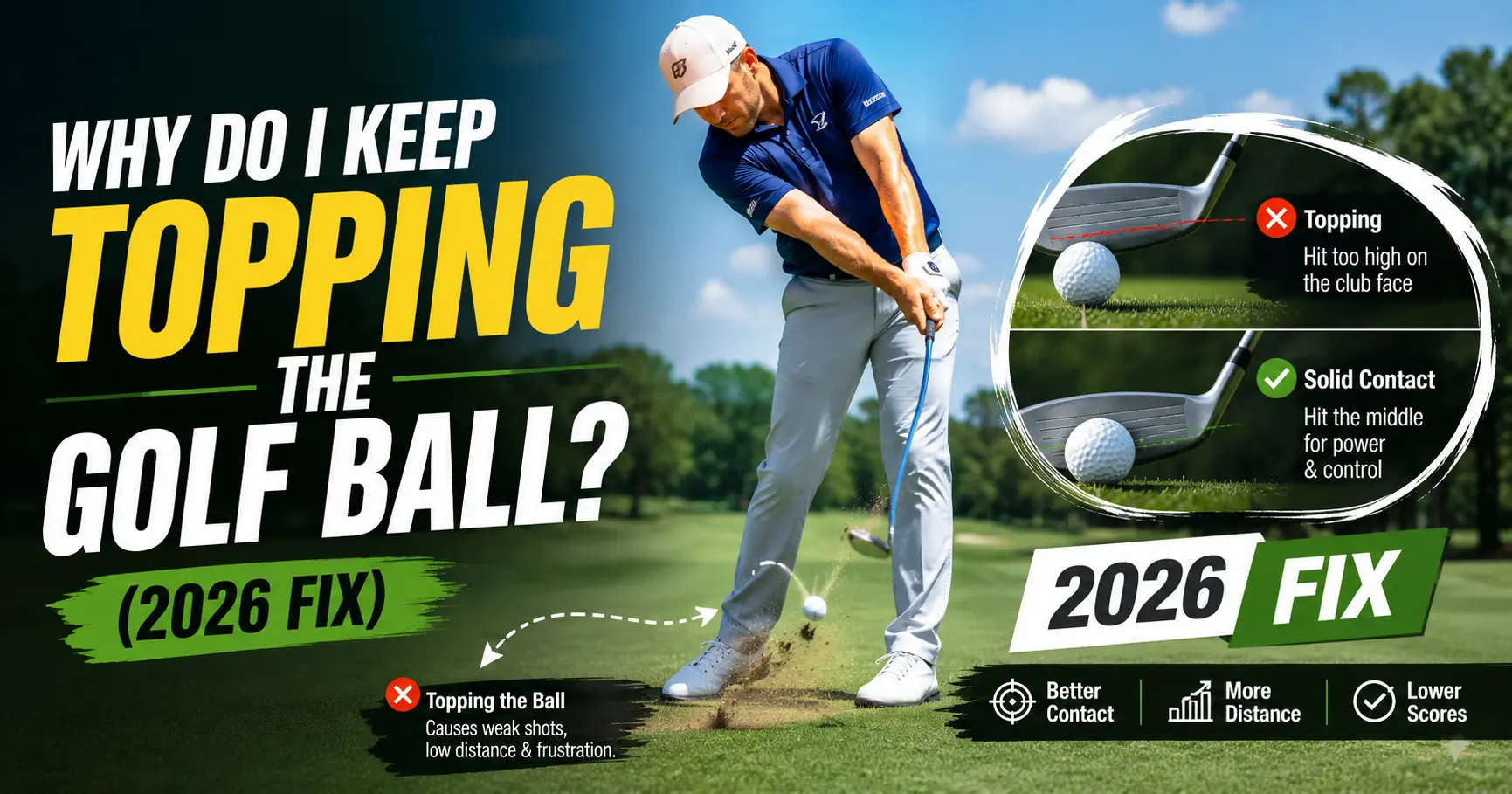
Quick Answer: You’re topping the ball because your swing’s low point happens before the club reaches it, usually from weight staying on your back foot or your body rising through impact. Fix it by shifting your weight forward and keeping your spine angle steady through the shot.
Every golfer who’s topped a ball has heard the same bad advice. Keep your head down. That’s not it, and chasing it will only make things worse. Topping comes down to one mechanical fact, the bottom of your swing arc is happening in the wrong place, and once you know where, the fix takes minutes, not months.
What “Topping” Actually Means (And Why It’s Not About Your Head)
Topping happens when the leading edge of your clubface catches the upper half of the ball instead of the center or lower third, and instead of compressing between the club and the turf, the ball skids out low and dies within a few yards. Generations of golfers have blamed this on lifting your head, and that advice is mostly wrong. Your eyes don’t control where the club bottoms out. Your body does.
The real explanation is simpler than most golfers expect. Every swing moves through an arc, and that arc has one lowest point. Reach the ball while the club is still coming down toward that low point, and you compress it into the ground for a normal strike. Catch the ball while the club is already rising past that low point, and you top it.
The One Fault Behind Most Topped Shots
Ask ten instructors why a golfer keeps topping the golf ball, and eight will point to the same root cause: early extension. The Titleist Performance Institute defines it as the hips and pelvis thrusting toward the ball during the downswing instead of rotating around a stable spine angle. Once that happens, your whole upper body stands up to compensate, and the club’s low point rises and moves backward right along with it.
Think of your setup posture as a loaded spring. Early extension releases that spring before the club ever reaches the ball. Your knees straighten, your hips thrust forward, and your arms have nowhere to go but up and out. The leading edge meets the top half of the ball instead of the center, and no amount of watching the ball fixes a hip that fires too soon.
Self-Diagnosis: Which Club Are You Topping?
Not every topped shot comes from the same mistake. A topped driver and a topped 7-iron often trace back to different setup errors, because the two clubs need different attack angles to begin with. Run through the table below and find your club before you change anything in your swing.
| Club | Most likely cause | Fastest fix |
|---|---|---|
| Driver | Ball too far back in stance, or early extension on the way up | Move the ball forward to your lead heel and tilt your spine away from the target |
| Fairway wood | Trying to “lift” the ball with a scooping motion | Play the ball just forward of center and let the club’s loft do the work |
| Hybrid | Steep angle of attack from playing it like an iron | Move the ball slightly forward and sweep it like a mini fairway wood |
| Irons | Weight hanging back on the trail foot at impact | Feel your chest stay over the ball and finish with your weight on your lead side |
Why Do I Keep Topping the Golf Ball with My Driver?
The driver is the only club in your bag that wants an upward angle of attack, and that’s why it punishes small errors more than anything else you carry. If you’re asking why you’re topping the golf ball with your driver specifically, the two most common culprits are ball position and early extension showing up at the worst possible moment, right as you’re trying to sweep up through the ball.
Start with ball position. Play it too far back in your stance and the club is still moving on a descending or level path when it arrives, and a driver’s flat face can’t compress a ball cleanly from that angle. You’ll catch it thin or top it outright. Move the ball up in line with your lead heel, tee it so half the ball sits above the top of the clubface, and let your spine tilt slightly away from the target at setup.
Early extension shows up differently with a driver than with an iron. Because you’re already trying to swing up and through the ball, standing up early sends the clubhead even higher at the worst moment, catching the top half instead of the center. Keep your rear end back through impact and resist the urge to help the ball into the air. The clubface’s loft already does that job for you.
How to Stop Topping the Golf Ball with Your Driver
- Move the ball forward to line up with your lead heel.
- Tee it high enough that half the ball sits above the top edge of the clubface.
- Tilt your spine slightly away from the target at address, and keep your rear end back through impact instead of standing up early.
If you keep topping the golf ball with your driver specifically and not your irons, ball position is almost always the first place to look.
Why Do I Keep Topping the Golf Ball with My Irons?
Irons work backward from the driver. You want a descending strike, ball first, then turf, with the low point of your arc landing just after the ball rather than before it. Miss that timing and you’ll either chunk it fat or catch the top half and top it.
Ball position matters here too, just in the opposite direction from the driver. Play the ball too far forward in your stance and the club is already rising by the time it arrives, which is a textbook way to top a mid-iron. For most players, center of stance is the right starting point for a 7-iron, moving slightly back as the clubs get shorter.
The other repeat offender is what coaches call the chicken wing. That collapse happens when your lead arm folds and pulls away from your body right through impact, and it shortens your swing radius at the exact moment you need it longest, so the clubhead rises just enough to catch the top of the ball. Keep your lead arm extended through the strike, not stiff, just connected, and finish with your hands ahead of the clubhead.
How to Stop Topping the Golf Ball with Your Irons
- Play the ball at the center of your stance for a 7-iron, moving it slightly back as the clubs get shorter.
- Keep your lead arm extended through impact instead of letting it fold into a chicken wing.
- Finish with your hands ahead of the clubhead and your weight fully on your lead side.
A small divot starting just in front of where the ball was sitting is proof you compressed it correctly. If you’re only skimming the grass or missing it entirely, your low point is still happening too early.
Why Do I Top the Golf Ball with My Fairway Woods and Hybrids?
Fairway woods and hybrids sit in an awkward middle ground, and that’s exactly why golfers who top the ball with their woods often can’t figure out why the same swing works fine with a 6-iron. These clubs need a sweeping, shallow strike rather than the steeper downward hit that works with a short iron.
Play a fairway wood like a driver, ball forward and hips leading, and you’ll often catch it high on the face or top it outright. Play it like an iron instead, ball centered and hitting down hard, and you’ll frequently stub it into the ground before the ball or skip the top edge across it. The fix sits in between. Play the ball just forward of center, and swing with a wide, sweeping motion instead of a steep chop.
Hybrids behave more like a shorter, more forgiving fairway wood than like an iron, even though they often replace long irons in your bag. Treating a hybrid with the same steep, ball-then-turf swing you use for a 6-iron is one of the fastest ways to top it. If you keep topping the golf ball with your fairway woods specifically while your irons feel fine, the swing shape is the problem, not raw mechanics. Move the ball slightly forward of your iron position and let the club brush the grass rather than dig into it.
How to Stop Topping the Golf Ball with Fairway Woods and Hybrids
- Play the ball just forward of center, splitting the difference between your driver and iron positions.
- Swing with a wide, sweeping motion instead of the steeper, ball-then-turf strike you use on a short iron.
- Let the clubhead brush the grass after contact rather than dig into it, especially with a hybrid.
Quick Fix for Topping the Golf Ball (Do This on the Course Right Now)
Whether you’re wondering what to do, what you should do, or what you can do to stop topping the golf ball mid-round, these four checks take about thirty seconds and fix most in-round tops.
- Check your ball position first. Move it slightly forward if you’re playing an iron and topping it thin, or slightly back if you’re playing a driver and still catching it low.
- Set your weight forward at address. Feel roughly 55 to 60 percent of your weight on your lead foot before you ever start the swing.
- Make a slower backswing. Rushing the transition is one of the fastest ways to trigger early extension under pressure.
- Finish in balance. If you can’t hold your finish for a full two seconds, your weight never made it to your lead side, and that’s your answer.
Why It Keeps Happening Even After You “Fixed” It
Here’s the frustrating part nobody mentions. Fixing the cause on the range doesn’t mean it’s gone for good. A new move needs hundreds of repetitions before it holds up under real pressure, and the moment you face a hazard, a tight tee shot, or a bad lie, your body reverts to the old pattern because that’s still the one it trusts. That’s usually why you keep topping the golf ball on certain holes and not others, especially right after a good stretch of clean contact.
Nerves and fear both accelerate early extension specifically, since standing up out of the shot is a natural, protective reaction to a swing you don’t fully trust yet. Watch what happens the next time you’re staring down water on the tee. If you catch yourself pulling up out of the shot before you even swing, that’s the same fault showing up under pressure instead of on command.
Reddit threads on this exact frustration tend to trade tips about grip and stance, but almost nobody mentions that the fault comes and goes with pressure, tempo, and fatigue, not just setup. If your range swing looks fine but your on-course swing keeps producing tops, pressure is doing more damage than your setup ever will.
Practice Drills That Actually Groove the Fix
Understanding the cause doesn’t automatically fix your swing. You need reps that give you instant feedback, and these three do exactly that.
The towel drill. Place a towel about four inches behind your ball and make practice swings without touching it. Hitting the towel means your low point is arriving too early, which is the same fault that causes chunked shots. Missing it while striking the ball cleanly means your low point has moved to the right spot.
The headcover drill. Tuck a headcover under your lead armpit and make half-swings without letting it drop. This trains the connected arm position that stops the chicken wing from creeping into your irons and prevents the collapse that turns a good swing into a topped one.
The feet-together drill. Hit short irons with your feet nearly touching. This narrows your base enough that any early extension throws off your balance immediately, so your body learns to stay in posture just to stay upright. Once you can hit these shots solidly, widen your stance back to normal.
When It’s Not a Swing Problem
Sometimes you’re doing everything right and still catching it heavy or thin. If your irons are too long for your height and swing mechanics, or your lie angle runs more upright or flat than it should, no amount of practice will fully fix inconsistent contact. A launch monitor session or a proper fitting will show you dynamic loft and attack angle numbers a phone camera never will.
If you’ve worked through ball position, posture, and tempo for a few weeks and you’re still topping shots at the same rate, book a fitting before you spend more time chasing a swing change. Equipment that fights your natural motion will beat good technique every time.
Frequently Asked Questions
How do I stop topping the ball in golf?
Move your weight forward at address, keep your spine angle steady through impact instead of standing up, and let the club’s loft lift the ball rather than trying to scoop it yourself. Most topped shots come from early extension, so fixing your posture through the strike solves the majority of cases without any equipment change.
How to stop getting on top of the ball in golf?
“Getting on top of the ball” describes the same fault as topping. Your body rises and the club’s low point moves up and back before it reaches the ball. Keep your rear end back through the downswing, finish your swing in a balanced position, and check that your ball position matches the club you’re hitting.
Why do I keep hitting the top of the ball with my driver?
With a driver, this almost always comes down to ball position or standing up early while trying to help the ball into the air. Move the ball forward to your lead heel, tee it a little higher, and trust the loft on the face to do the lifting instead of your body.
How to fix driver if you are topping?
Start with ball position before you touch your swing. Play it off your lead heel, tee it so about half the ball shows above the clubface, and keep your spine tilted slightly away from the target at setup. If you’re still topping it after that change, work on keeping your weight moving forward through impact instead of hanging back on your trail foot.
The Bottom Line
Topping the golf ball feels random when you’re standing over it wondering what went wrong this time. It isn’t. Every topped shot traces back to the same handful of causes, early extension, poor ball position, or a chicken wing collapsing your lead arm at the worst possible moment. Work through the fix for your specific club, groove it with the drills above, and you’ll stop asking why you keep topping the golf ball and start trusting your strike instead.