
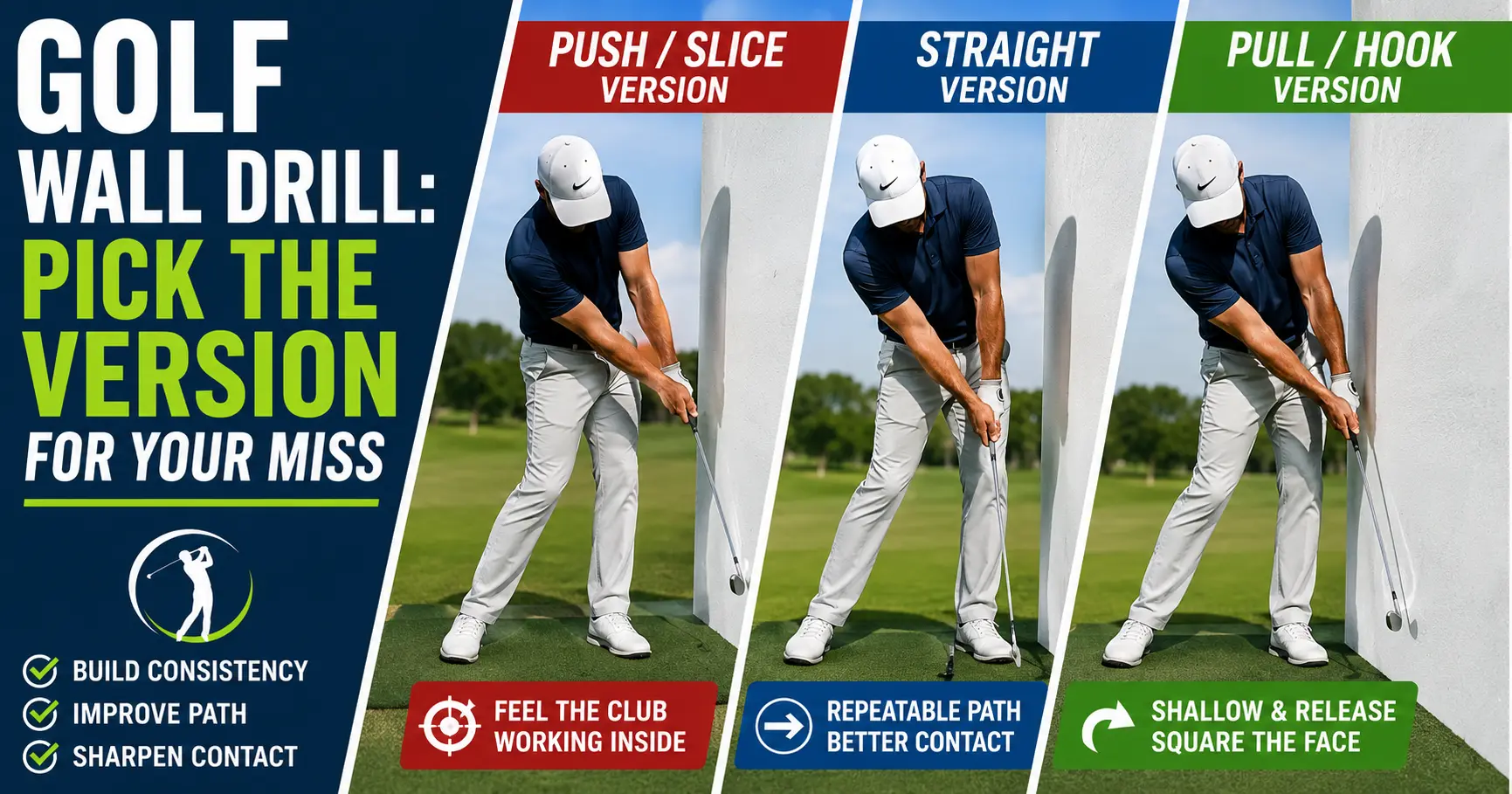
Quick Answer: A golf wall drill uses a wall as a hard stop so you can feel plane, posture, lag, or depth. Stand 6 to 18 inches from the surface, pick the version that matches your miss, and move slowly. The wall is feedback, not a target you smash.
Search “golf wall drill” and you get six different moves wearing the same name. One coach wants your trail glute glued to the paint. Another wants the clubhead to kiss the wall on the way down. A third wants you six inches off the baseboard so the club never touches on the way back. Treat those as one drill and you either punch a hole in the drywall or groove the wrong pattern.
This page sorts the versions by miss, gives you the setup distances coaches actually use, and tells you which one to skip. No ball required for the first block of reps.
There Is No Single Golf Wall Drill
The wall does one job. It gives your body a boundary you cannot argue with. What that boundary checks depends on where you stand and which part of the club or body is allowed to touch.
Use this table before you take a club back.
| Your miss | Version to use | Wall distance | What is allowed to touch | Skip this if |
|---|---|---|---|---|
| Hips thrust toward the ball, thin and fat mixed | Back-to-wall early extension | Heels ~6 in off the baseboard, glutes light on the wall | Trail glute on the backswing, lead glute as you turn through | You already sit too far into your heels and fall backward |
| Over the top, weak slice, steep chop | Shallow / club-on-wall downswing | ~18 in (a foot and a half) | Shaft or grip slides down the wall in transition | You already get stuck inside and block or hook it |
| Casting, no compression, early release | Flipped-club lag drill | ~12 in | Butt of the inverted club stays on the wall into the slot | You already hold the angle so long the face stays open |
| Club sucks inside, flat backswing | Trail-side / Porzak / Caminiti backswing | Heels 6–8 in off the wall | Nothing on the takeaway. Trail arm and shaft may rest at the top | You already lift the club steep and across the line |
| Early extension plus loss of spine angle | Head-on-wall | Crown lightly on the wall at address | Crown slides a touch down the wall in transition | Neck issues or you press your forehead into the plaster |
| No hip depth, early stand-up in the backswing | Athletic Motion hip-depth brush | Heels set off the wall by one clubhead | Glutes brush, never shove | You already sit so deep you cannot rotate |
Most amateurs click a shallowing short and copy it while their real problem is the hips running at the ball. That is why the first 20 reps should follow the row that matches the shot you hate, not the video with the most views.
How to Set Up Any Golf Swing Wall Drill Without Wrecking the House
A 7-iron will mark paint. A driver will crack drywall. Set the room up like you mean to still live there.
- Pick a clear stretch of wall with no hanging frames, light switches, or baseboard heaters in the club’s arc.
- Tape a folded towel, a headcover, or a couch cushion at shaft height. Clay Ballard’s shallow version starts about a foot and a half from the wall. Nathalie Filler’s lag version and the SwingStation over-the-top version start about one foot out. Adam Porzak’s backswing version starts with the heels about six inches off the wall. Those three numbers are not interchangeable.
- Use a mid-iron. A 7-iron is the right club for every version below. Flip it grip-down only for the lag drill.
- Take your real address posture. Bend from the hips. Soften the knees. Do not stand tall “because it’s a drill.”
- Make the first 10 reps at rehearsal speed with no ball. If the club hits the pad hard, you are too close or you picked the wrong version.
The golf swing plane wall drill is a checkpoint drill. You want a click or a slide, not a thud.
Golf Wall Drill for Early Extension (Back to the Wall)
Early extension is the hips and pelvis driving toward the ball before impact. The chest stands up. The arms run out of room. You flip or stall. The golf early extension wall drill, also called the golf back to wall drill, is the version that belongs in most living rooms.
- Stand with your back to the wall. Set your heels about six inches off the baseboard.
- Hinge until both glutes lightly graze the wall. Unlock the knees after the hinge, not before.
- Take the club to the top. The trail glute should stay on the wall. If it leaves, you spun your hips toward the target too soon or you stood up.
- Start down by shifting into the lead side. The lead glute takes over the contact. The trail cheek can peel off as you rotate.
- Stop at a half finish with the belt buckle left of the ball and your chest still over the space where the ball would sit.
You will feel hamstring tension at address if the hinge is real. That tension is the point. Lose it in transition and you have early extended.
This pairs cleanly with the wall bump-and-turn for hip clearance. The bump is the small lateral shift. The wall tells you whether the shift turned into a slide.
The limitation is real. Golfers who already hang on their heels will jam the wall and lose the ability to rotate. If your miss is a weak push with your weight stuck back, do not glue both cheeks to the paint for a full swing. Use the brush-contact version Athletic Motion Golf teaches instead.
Golf Wall Drill Shallow and the Lag Version
These two get searched as separate keywords. They use the same piece of drywall and they fix different releases.
Golf wall drill shallow
Clay Ballard’s short is the cleanest public demo. Stand about a foot and a half from the wall, trail side closer to it. Swing to the top. On the way down, let the club drop onto the wall and ride it as you rotate open.
The feel you want is left-arm internal rotation and trail-arm external rotation. The shaft shallows. The path comes from inside instead of over the top. Tyler Ferrell’s Golf Smart Academy version makes the same demand in different words: the club stays more parallel to the wall into delivery instead of kicking out toward it.
Do not blast through. Slide. If the head digs the pad at chest height, you threw the club outside. If you never find the wall, you either stood too far away or you are already stuck so far inside that this version is the wrong medicine.
Once the slide feels dull and boring, step off the wall and make three-quarter 7-iron rehearsal swings with the same forearm feel. Then go to the drills that flatten a steep downswing and hit balls.
Golf wall drill for lag
Casting is the opposite problem. The angle between the lead arm and the shaft opens too early. Nathalie Filler’s indoor drill on GOLF.com is still the version worth copying.
- Flip a 7-iron upside down and grip the shaft.
- Stand about one foot from the wall in posture.
- Rest the grip on your trail shoulder, turn to the top, then extend so the butt of the club presses the wall behind you.
- Shift into the lead foot. Keep that butt end on the wall until the hands get back near the trail thigh.
- Let it release past that point and finish with the club near the wall on the other side.
Ten slow reps a day beat one angry session. The inverted club is lighter and safer on paint. It also removes the urge to hit something, which is how casting sneaks back in.
Golf Wall Drill Backswing, Depth, and the Named-Coach Versions
This is the section page 1 never writes in one place.
Porzak golf wall drill.
Adam Porzak sets the heels about six inches off the wall, sometimes 8–9 inches if the player needs a more realistic top. The club stays in front of the hands. The trail elbow stays closer to the lead arm. If the takeaway sucks inside, the club taps the wall immediately. The point is a turn up the wall, not a lift up the wall. Xander Schauffele’s camp has used this family of feels. You are training width and a high-enough set without rolling the face shut behind you.
Dom Caminiti golf wall drill.
Trail side against the wall. Take the club back slowly so the clubhead does not smash the surface. At the top, the back of the trail arm, the trail hand, and the shaft sit on or very near the wall. Lead arm matches the shoulder plane. Hands sit over the heels. That is the golf wall drill for depth. A flat, inside takeaway cannot get there without putting a dent in the house. Start at rehearsal speed. Flip the club if you do not trust your drywall.
Mike Bender wall drill.
Mike Bender has used a wall for decades as a hand-path and lag station. One Bender version sends the hands higher at the top. Another keeps the student on the wall to feel added lag in transition. Bender’s name shows up in Golf Digest teacher rankings for a reason. The wall is not a gimmick in that room. It is a fence for hand path.
Athletic Motion Golf wall drill.
Mike Granato and Shaun Webb start with hip depth. Heels sit off the wall by roughly one iron head. You hinge and brush the wall with the glutes. You do not shove it. Early extension in the backswing shows up as a hard push. From there they will use the wall as a depth gauge for the clubhead going back, about the length of a fairway-wood shaft as a measuring stick. That 3D-informed version is the one to use if your pelvis runs out of room before the club reaches waist high.
The golf wall drill backswing family is not a downswing drill. Do not rip through to a full finish with your trail side pinned to plaster. The trail elbow will find the wall, and so will your mood.
Head Against the Wall, and When This Drill Makes You Worse
The golf head against wall drill, sometimes called the golf head on wall drill, puts the crown of your head on the wall at address. Not the forehead. Eyes stay down on the imaginary ball. You turn to the top. In transition the head is allowed to slide slightly down the wall as pressure moves into the lead heel. Rise off the wall and you stood up. Drive the forehead into the plaster and you invented a new fault.
Use it when posture dies in transition and the shallow-on-wall version still leaves you thrusting.
Now the honest part. The popular “drop the club on the wall and keep it there” shallow drill will make a stuck-inside player worse. If your stock miss is a block to the right or a snap hook from a club that got trapped behind you, do not train more depth on the way down. Use the Porzak or Caminiti backswing versions to get the club in front of the body first. Add shallowing later, or not at all.
The wall also fails golfers who turn the drill into a hit. A wall is a reference. The second you start trying to bury the grip in the paint, you are training a stall and a flip.
From the Wall to the Range
A pattern that only lives next to a hallway does not lower scores.
- Own the slow-motion version at home for two or three short sessions.
- Replace the wall with an alignment stick in the ground against your lead foot (compression / lead-side versions) or just outside your trail hip (backswing depth). That is your portable golf club wall drill.
- Hit 10 balls at half speed with a 7-iron. Same feel, smaller swing.
- Only then go to a normal stance and a normal ball position.
Indoor work pairs well with the ball-striking drills you can do without a range. The wall gives you the boundary. Those drills give you contact once the boundary is gone.
Leave the driver in the bag until the mid-iron strike is boring. A long shaft turns a useful checkpoint into a repair bill.
Frequently Asked Questions
What is the golf wall drill?
It is any swing rehearsal that uses a wall as a physical boundary for posture, plane, lag, or depth. The same name covers opposite setups, so the version has to match the miss.
How do you do a golf wall drill at home?
Pad the wall, use a 7-iron, stand 6 to 18 inches away depending on the version, and make slow reps with no ball. Stop when the club hits hard. That impact means the setup is wrong.
Does the wall drill fix early extension?
The back-to-wall version does, because a glute that leaves the wall is early extension you can feel. The shallowing version does not fix early extension by itself.
How do you shallow the club with a wall?
Stand about 18 inches from the wall, swing to the top, and let the shaft slide down the surface as you rotate. Forearms turn. The club does not chop.
What is the Mike Bender wall drill?
Bender uses a wall as a hand-path and lag station. Students learn a higher, more on-plane top and a delayed release with the wall as the fence. It is a coaching station, not one magic pose.
Is the disc golf wall drill the same thing?
No. A disc golf wall drill is a putting or throwing rehearsal against a wall or practice net. It is a different sport. Do not mix the two searches.
Pick One Version and Repeat It
Pick the row in the table that matches the shot that costs you strokes. Pad the wall. Make the slow reps. Take the same feel to an alignment stick and a 7-iron on the range.
The wall will not build a swing for you. It will tell you the truth about the one move you keep lying to yourself about.