
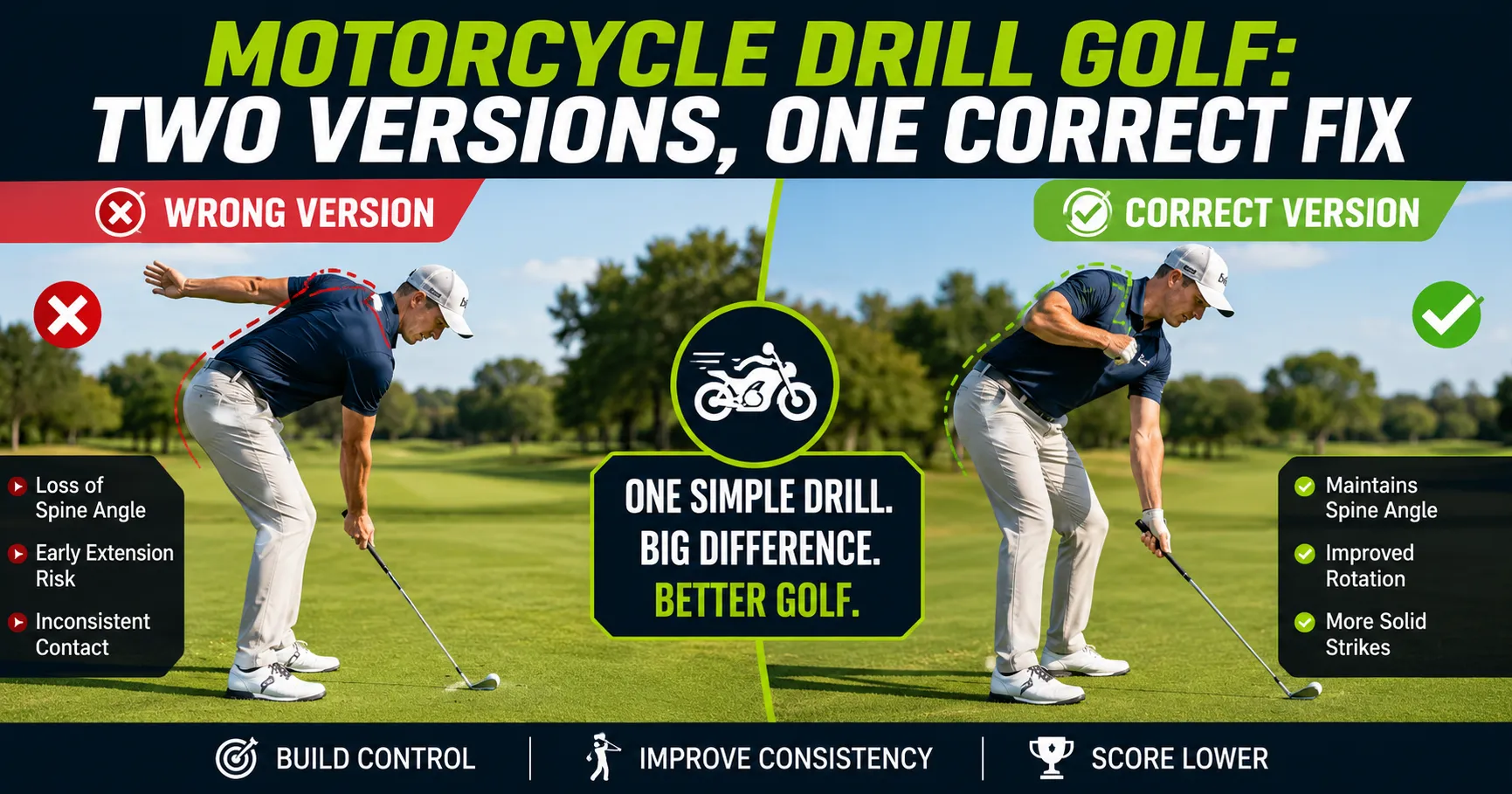
Quick Answer: The motorcycle drill flexes your lead wrist starting at the top of the backswing, like twisting a motorcycle throttle in reverse, to square the clubface. TPI’s original version used the trail hand instead. Master it with an iron before trying it with a driver.
Type “motorcycle drill golf” into YouTube and you’ll get two completely different physical movements, both called the same name. One instructor tells you to twist your lead wrist like you’re revving a throttle backward. Another tells you to do the exact same twisting motion with your trail hand instead. Titleist Performance Institute published the original version years ago, back when this drill barely had a name, and it used the trail hand.
Every video that made this drill famous since then flipped it to the lead wrist. Nobody explains why, or which one you should actually trust. This guide clears that up, walks through the real step-by-step motion, and gives you a slow-motion progression you can actually take to the range.
What Is the Motorcycle Drill in Golf?
The motorcycle drill is a swing feel that syncs your wrist action with your body rotation, so the clubface arrives square at impact instead of open. Picture gripping a motorcycle throttle with your lead hand at the top of your backswing. Instead of twisting it forward like you’re accelerating, you twist it backward, like you’re slowing the bike down. That backward twist moves your lead wrist from extension, or cupping, toward flexion, or bowing.
A cupped wrist at the top usually means an open clubface coming into the ball, and an open face is the single biggest reason recreational golfers slice. HackMotion’s wrist sensor data, drawn from more than a million recorded swings, shows most amateurs carry 20 to 30 degrees more wrist extension at the top than they actually need. That extra cup is exactly what this drill is built to remove.
Coaches have used the throttle analogy for over a decade because it gives golfers something they can feel. “Increase lead wrist flexion by 20 degrees during transition” means nothing to a Saturday golfer standing over a ball. “Rev the throttle backward” does.
Two Different “Motorcycle” Cues Are Floating Around
Here’s what almost nobody tells you when they teach this drill. TPI’s original instruction tells you to grab your trail hand and give it gas in reverse, feeling your trail-hand knuckles turn down toward the ground right as the downswing starts. That’s a completely different hand than the version most coaches teach today for the motorcycle drill.
Most modern content, including sensor brands and popular swing channels, teaches the lead hand instead. You flex your lead wrist toward the ground starting in transition, and that flexion is what closes the face early. Both cues chase the same outcome: a square clubface earlier in the downswing. They just feel nothing alike, and if you’ve tried one cue after hearing about the other, that’s probably why it hasn’t clicked yet.
| Faxt | Trail-Hand Version (TPI original) | Lead-Hand Version (modern standard) |
|---|---|---|
| Hand that moves | Trail hand (right hand for right-handers) | Lead hand (left hand for right-handers) |
| The feel | Knuckles turn down, “giving it gas in reverse” | Knuckles rotate toward the ground, wrist bows |
| Wrist action | Trail wrist stays extended and supports the move | Lead wrist moves from extension into flexion |
| Works best for | Golfers who feel more connected through the trail arm | Golfers who feel more connected through the lead arm |
| Who teaches it | TPI (the original source) | HackMotion, most current instruction, GolfWRX community consensus |
I’d start with the lead-hand version if this is your first time trying it. It matches what almost every current teaching resource, wrist sensor, and forum discussion of this drill describes, so you won’t confuse yourself cross-referencing videos later.
Your grip plays into this too. A weak or neutral grip makes the lead-hand version easier to feel, while a strong grip already pre-sets some of that flexion for you. Check your grip before you assume the drill isn’t working.
What “Reverse Motorcycle Drill” Actually Means
The reverse motorcycle drill isn’t a separate drill. It’s the same lead-wrist flexion move, just named for the direction of the twist. You’re revving the throttle in reverse, not forward, which is the exact motion that bows the wrist and closes the face. Searching for it as a different technique just leads you back to the same instruction.
A few longtime GolfWRX posters have pointed out that the name is physically backward anyway, since nobody actually twists a real motorcycle throttle that direction to slow down. They’re not wrong about that detail. But the name has stuck for well over a decade, and every coach using either phrase means the same lead-wrist bowing motion. Don’t waste range time hunting for a second drill that doesn’t exist.
How to Do the Motorcycle Drill, Step by Step
- Set up normally. Address the ball with your regular grip and posture. A small amount of wrist extension at address is normal and fine.
- Swing to the top. Complete your backswing the way you always do. Pause there for a beat so you can feel your current wrist position.
- Start the “rev.” As your downswing begins, rotate your lead forearm so your lead knuckles turn toward the ground, like twisting a throttle backward. This should start right at transition, not earlier and not late.
- Check P6. By the time your club shaft reaches parallel to the ground on the way down, a position coaches call P6, your lead wrist should have moved from cupped toward flat or slightly bowed.
- Keep rotating your body. The wrist move only works if your chest and hips keep turning through impact. Stop rotating while you’re still twisting the wrist and you’ll pull the ball left or hook it outright.
- Release through the ball. Let your forearms keep rotating naturally into and through impact. Don’t hold the face closed. Let it release.
The Slow-Motion Practice Protocol That Actually Builds the Feel
Every source that mentions the motorcycle drill tells you to “go slow” without saying how slow, for how long, or when to speed back up. That vague advice is why most golfers quit after one bad range session. Build the feel in three stages instead.
- Stage one, no ball, half speed. Take the club to the top, pause, then rehearse the transition move at roughly half your normal speed. Do this 10 times before you hit a single ball. You’re grooving the pattern, not testing it yet.
- Stage two, half-speed 7-iron. Hit 15 to 20 shots with a 7-iron, swinging at about half speed, focused only on the wrist feel. Distance and ball flight don’t matter here. Contact quality does.
- Stage three, full speed, same club. Once the half-speed reps feel automatic, swing the same 7-iron at full speed and watch your ball flight. A push means you rotated your body but didn’t add enough wrist flexion. A hook means the opposite.
Only move on to your driver once stage three is consistent with an iron. This kind of slow motion practice works for a lot more than just this one drill, and it’s worth building into your regular range routine rather than pulling out only when you’re mid-slice-crisis.
Motorcycle Drill With a Driver: Why It Doesn’t Always Feel the Same
The motorcycle drill feels different with a driver than it does with a 7-iron, and that catches a lot of golfers off guard. A driver shaft is longer, your swing speed is higher, and the timing window to add flexion before impact shrinks. Golfers who nail the feel with irons often lose it completely the moment they tee up a driver.
Real golfers working through this move on instructional forums report something worth knowing before you try it. Several describe genuine physical strain: tightness through the trail tricep and shoulder, and one longtime poster specifically noted lasting stress in the lead knee and lower back after leaning on this move hard with a driver. If you already carry any wrist, elbow, or back sensitivity, ease into this drill instead of cranking it into full-speed driver swings on day one.
Here’s my honest take: if you already hit your driver reasonably straight and your miss isn’t a slice or a block, don’t force this drill into your driver swing just because it exists. Save it for the club that’s actually giving you trouble, and check out our driver drill roundup if distance and start line are your bigger issue off the tee.
Troubleshooting: Fixing the Drill When It Goes Wrong
Most golfers either overdo the motorcycle drill or barely do it at all, and both misses have a specific fix.
| Your Miss | Likely Cause | Fix | Alternate Feel to Try |
|---|---|---|---|
| Still slicing | Not enough flexion added, face still open at impact | Add more twist, feel your lead knuckles pointing further down by P6 | “Screwdriver” feel: imagine screwing in a lightbulb with your lead hand |
| New hook or pull | Over-bowed the wrist, or stopped rotating the body while still twisting | Keep turning your chest and hips through impact, ease off the wrist twist slightly | “Hanger” drill: keep the lead wrist flat, like it’s resting on a clothes hanger |
| Ball starts right and stays right (block) | Body rotated but wrist didn’t add enough flexion in time | Add flexion earlier, right at the start of transition instead of mid-downswing | “Towel” drill: wrap a towel around the clubhead to exaggerate the feel of the twist |
| Tense trail tricep or shoulder | Over-gripping, or forcing flexion with the whole arm instead of the forearm and wrist | Loosen your grip pressure, isolate the movement to the forearm | Rehearse one-handed, with only your lead hand on the club |
Elite players typically show 20 to 30 degrees of added lead-wrist flexion between the top of the backswing and impact. If you’re just starting to feel this move, aim smaller, somewhere around 10 to 15 degrees, and build from there. Trying to match a tour player’s full range on your first range session is how most golfers end up with the exact hook this drill warns against.
Does the Motorcycle Drill Actually Work? An Honest Look at Its Limits
Not everyone agrees this drill does everything it claims. Golf swing analysts who study 3D biomechanics data point out that lead-wrist flexion mostly closes the clubface relative to the clubhead’s own arc, not necessarily relative to your actual ball-to-target line. In plain terms, bowing your wrist doesn’t automatically guarantee a square face at the ball. Tour players still add forearm rotation right before impact to finish squaring the face, even after making the motorcycle move earlier in the downswing.
That doesn’t make the drill useless. It makes it one piece of a bigger sequence, not a complete fix on its own. I’ll say it plainly: if your slice comes from a swing path that’s severely outside-in rather than an open face, the motorcycle drill alone won’t fix it, and you’ll need to address your path first.
Motorcycle Drill vs. Speed Drills: Are They the Same Thing?
They’re not the same category, even though golfers often lump every range drill together. Speed drills for golf, like overspeed training with lighter weighted clubs, exist to increase how fast you swing the club. The motorcycle drill exists to control where the clubface points when you get there.
One builds power. The other builds direction.
You can use both in the same practice session. Plenty of golfers pair overspeed training with clubface control work like the motorcycle drill, since a faster swing with an open face just means a bigger slice, faster. Work on face control first if you’re spraying shots, then layer speed training in once your misses tighten up.
Frequently Asked Questions
What is the motorcycle drill in golf?
It’s a swing feel where you flex, or bow, your lead wrist starting at the top of the backswing, like revving a motorcycle throttle in reverse. The move squares the clubface earlier in the downswing and helps eliminate slices, blocks, and weak, high shots.
Does the motorcycle drill fix a slice?
It can, if your slice comes from an open clubface at impact. It won’t fix a slice caused purely by an outside-in swing path. Most slices involve both problems, so pair this drill with path work for the best results.
What’s the difference between the motorcycle drill and the reverse motorcycle drill?
Nothing meaningful. Both names describe the same lead-wrist flexion movement. “Reverse” refers to twisting the throttle backward, not to a separate technique.
Should I use my lead hand or trail hand for the motorcycle drill?
Start with the lead hand. It matches what most current instruction, including sensor-based coaching, teaches. TPI’s original version used the trail hand, and it still works, but it’s the less common version in today’s teaching.
Can beginners use the motorcycle drill?
Yes, but get your grip and setup right first. Adding wrist flexion on top of a shaky grip usually creates a new miss instead of fixing your old one.
How do you carry a golf club on a motorcycle?
A different question entirely, but worth a straight answer since people search for both. Strap your golf bag to the pillion seat or a rear rack with ratchet straps, keep the weight balanced and under roughly 20 percent of your bike’s rated carrying capacity, and skip it in heavy rain or high wind. It has nothing to do with your swing, but if you rode in to play, now you know.
Conclusion
The motorcycle drill isn’t magic, and it isn’t the only fix for a bad miss. But if your clubface is open at impact and you know it, this is the most direct feel-based drill out there for closing it early. Start with your lead hand, keep it slow at first, and don’t skip straight to full-speed driver swings before your irons cooperate. Build the feel with our slow motion practice guide before you ever take it to the tee box.