
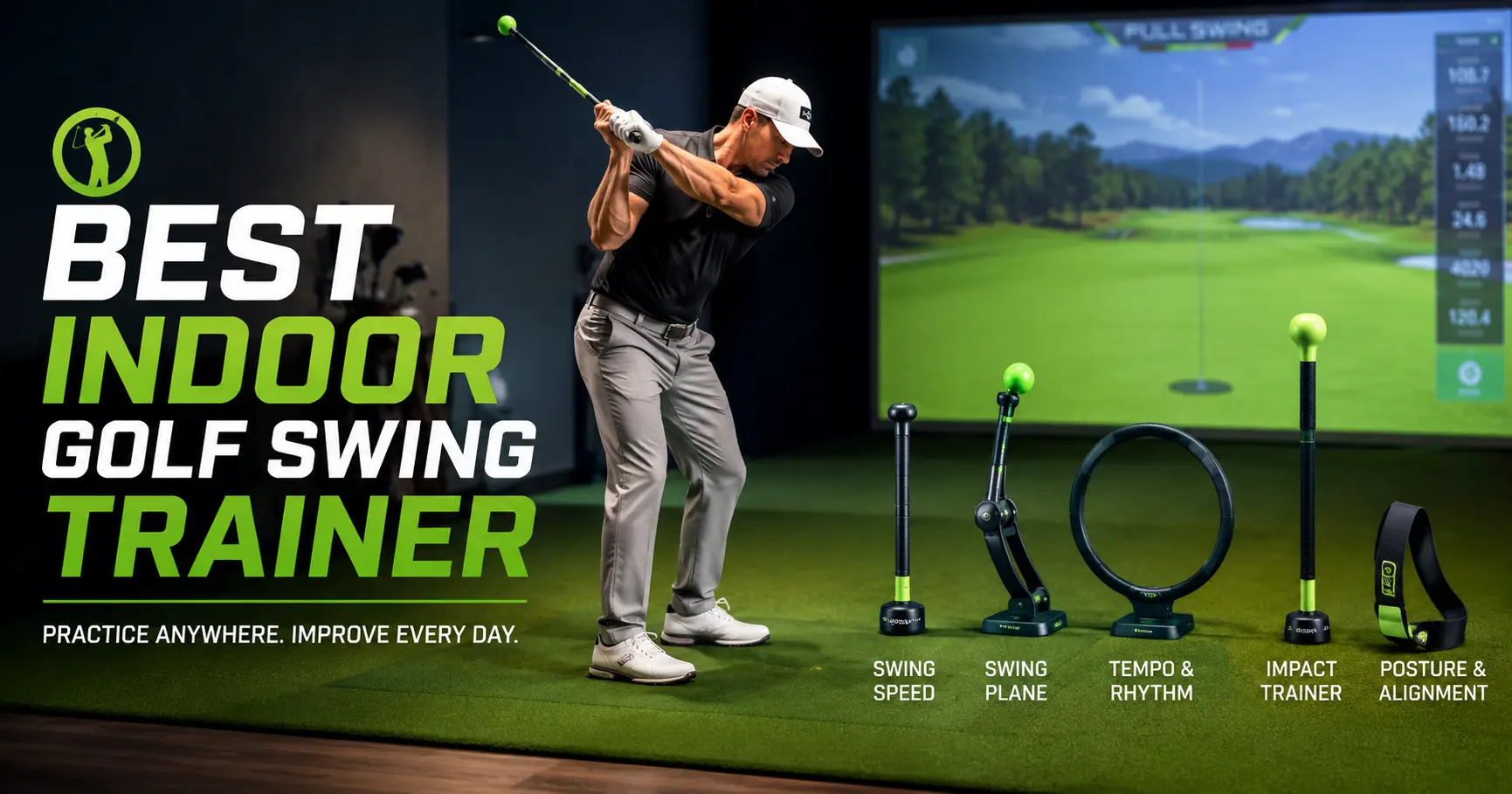
Quick Answer: The Tour Striker Smart Ball ($39) is the best indoor golf swing trainer for most golfers, since it needs no extra swing radius and fixes arm disconnection, the fault that ruins the most indoor sessions. With a 9-foot ceiling, the Orange Whip ($99.99) builds better tempo over time.
Winter cuts your range time in half. So does a newborn, a new job, or living somewhere the nearest range sits 40 minutes away. An indoor golf swing trainer solves a narrower problem than most buying guides admit: it has to work in the square footage you actually have, not the garage bay or backyard net a product photo assumes you own.
Six trainers below made the cut because they hold up to that test. Each one gets a price, the exact swing space it needs, and the specific fault it fixes. Jump to the fault-matching table if you already know what’s broken in your swing. Otherwise, start with how much room you’re really working with, because that number rules out half the market before price ever enters the conversation.
What Actually Matters When You’re Practicing Indoors
A driving range doesn’t care if your backswing clips a ceiling fan. Your living room does.
Most buying guides rank indoor golf swing trainers the same way they’d rank range-only training aids: by feel, by price, by what a tour pro uses. That approach misses the constraint that actually determines whether you’ll use the thing more than twice. Room height and swing radius matter more indoors than anywhere else on this list.
Golf simulator builders generally recommend 9 to 10 feet of ceiling clearance and roughly 7 feet of open radius around the golfer for a full swing with a driver. Most home offices, bedrooms, and apartment living rooms don’t clear that bar. That’s not a reason to skip indoor training. Picking a trainer built for the room you have, not the room a product photo assumes, solves it instead.
Noise matters too. A weighted club whistling through a small room at full speed will wake a sleeping baby or annoy a downstairs neighbor in ways a foam ball never will. Floor surface matters as well, since carpet grips a mat differently than hardwood does. None of that shows up on a spec sheet for indoor golf practice equipment, but it decides whether you actually use the trainer past week one.
The 6 Best Indoor Golf Swing Trainers, Compared
Every indoor golf swing trainer on this list earns its spot for a specific fault or a specific space constraint. None of them do everything, and that’s the point. A tool that claims to fix your slice, your tempo, and your distance all at once usually does none of the three particularly well.
| Trainer | Price (New) | Best For | Swing Space Needed | Legal to Carry On-Course? |
|---|---|---|---|---|
| Tour Striker Smart Ball | $39 | Arm connection, ball striking | Standard full-swing clearance | No, practice only |
| SKLZ Gold Flex | $69.99 to $79.99 | Tempo and strength, budget pick | Standard full-swing clearance | Yes, per SKLZ |
| Orange Whip Trainer | From $99.99 | Rhythm and sequencing | Standard full-swing clearance | No, practice only |
| TRS Slider | $89.99 | Flying right elbow, arm disconnect | Minimal, works at half speed | No, practice only |
| Compression Ball | $44.99 to $64.99 | Tiny rooms, travel | Minimal, no full swing required | No, practice only |
| Divot Board | $99.99 to $129.99 | Contact and strike pattern | Needs a hitting net or open lane | No, practice only |
“Standard full-swing clearance” means the 9 to 10-foot ceiling and 7-foot radius covered above. “Minimal” means real value comes from slow, deliberate reps in a hallway or home office, no driver-length swing required.
Tour Striker Smart Ball: Best Overall
An inflatable ball on a strap, the Smart Ball sits between your forearms and does one job. It punishes any gap between your arms and your torso, the root cause of the chicken wing and a lot of inconsistent ball striking.
At $39, it costs less than most golfers spend on a single dozen premium balls. You can use it with a putter, a wedge, or a driver, and it deflates flat enough to travel in a suitcase. Stick with the original if durability matters to you, since the strap is the weak point on cheaper knockoffs.
It won’t teach you swing plane, and it does nothing for clubhead speed. Buy it to fix connection, not to fix everything.
SKLZ Gold Flex: Best Budget Tempo Trainer
Costing $69.99 to $79.99 depending on length, the Gold Flex is a 40 or 48-inch club with a flexible fiberglass shaft and a weighted head. The exaggerated flex forces a slight lag at the top of the backswing, exactly the feeling most golfers with a quick, handsy transition need to groove.
Swing it continuously back and forth without stopping at impact, ten to twenty reps at a time. That continuous motion teaches swing tempo, not a single isolated rep. You’ll need the same ceiling and radius as a normal driver swing to get full value, since the shaft runs close to driver length.
Orange Whip Trainer: Best for Tempo, If You Have the Room
Orange Whip’s counterbalanced design puts weight at both ends of a flexible shaft, and the trainer starts at $99.99 direct from the manufacturer. It forces a specific sequence, lower body first, then arms and club, because the weighted ball at the tip will yank you off balance if you rush the transition.
Coaches like this trainer because the feedback is physical rather than visual, so you feel the fault instead of just seeing it in a mirror. It’s the most-recommended golf swing trainer for tempo across the sites we reviewed for this guide, and the reputation is earned. Space is the catch, though.
This isn’t a trainer you use standing three feet from a bookshelf. Reach for the Gold Flex or the Smart Ball first if your indoor setup is a corner of a bedroom, then graduate to this one once your room allows it.
TRS Slider: Best for a Flying Right Elbow
Robert Rock designed the TRS Slider to keep your trail arm connected to your body through the downswing, and it sells for $89.99. You wear it across your shoulders and upper arms like a harness, and it physically restricts the arms from separating from the torso on the way down.
This is one of the few trainers here you can use meaningfully without swinging a full-length club at all. Slow-motion rehearsal moves, done in a hallway with no club in your hands, still groove the connected feeling the harness teaches. That makes it one of the better picks if your indoor space is genuinely tight.
Compression Ball: Best for Tiny Rooms and Travel
A foam ball you squeeze between your forearms or your knees, this is the simplest tool on the list, priced at $44.99 to $64.99 depending on the retailer. It teaches connection the same way the Smart Ball does, but without any inflation or strap to manage, and it fits in a jacket pocket.
Most drills happen at address or during a slow rehearsal move, so you don’t need anywhere near the space a full swing requires. Pack this one if you live in a studio apartment or you’re working on your swing during a hotel stay, since it travels without excuses.
Divot Board: Best for Contact and Strike Pattern Feedback
You strike balls off a flat panel with the Divot Board, and the divot pattern shows exactly where your low point sits. Pricing runs $99.99 on sale and $129.99 at full price, and the company sells replacement hitting pads separately once the surface wears out.
This is the one trainer here that genuinely needs a hitting net or a clear lane, since the whole point is striking real or foam balls off the board. Set it up in a garage or a room with a net, and it will teach ball-first contact faster than any drill that relies on feel alone. Set it up in a carpeted bedroom with nowhere for the ball to go, and you’ll be retrieving shanks from behind the couch within five swings.
Which Swing Trainer Fits Your Specific Problem
Buying by brand reputation instead of by symptom is how golf training aids end up in a closet after three sessions. Match the trainer to the fault first.
| Your Swing Fault | What It Looks Like | Trainer to Use | Why |
|---|---|---|---|
| Chicken wing / early extension | Arms fold or straighten too early, weak contact | Tour Striker Smart Ball | Punishes any gap between arms and torso instantly |
| Flying right elbow | Trail elbow separates from the body on the downswing | TRS Slider | Physically restricts arm separation through impact |
| Rushed, handsy transition | Quick backswing, no pause, inconsistent tempo | SKLZ Gold Flex or Orange Whip | Weighted, flexible shaft forces a sequenced transition |
| Inconsistent low point | Fat and thin shots on the same swing | Divot Board | Divot pattern shows exactly where the club bottoms out |
| No room to swing anything | Studio apartment, shared office, hotel room | Compression Ball | Delivers value through squeeze drills with almost no swing arc |
How Much Space (and Ceiling Height) You Actually Need
Most buying guides skip this entirely, which is strange given that it’s the single biggest reason a training aid ends up in a closet. Aim for 9 to 10 feet of ceiling height and roughly 7 feet of clearance in every direction if you want to swing a driver-length trainer at full speed indoors.
Under that? Options still exist. The TRS Slider and Compression Ball deliver real value at half speed or through drills that never require a full backswing. You can even work the Smart Ball through slow rehearsal swings in a hallway, since the goal is connection, not clubhead speed.
What you lose in a cramped room isn’t the trainer’s usefulness. You lose the ability to rep it at full speed, and for tempo trainers like the Gold Flex or Orange Whip, tempo work at quarter speed defeats the purpose.
Measure your actual ceiling and swing radius before you buy anything on this list. A $99 trainer that clips your ceiling fan on rep two isn’t a bargain.
Are These Trainers Legal to Use During a Round?
Most of them, no, and that surprises golfers who assume “training aid” automatically means “legal anytime.” Under USGA Rule 4.3, players can’t use most artificial devices or unusual equipment during a round if the device is designed to help their play. That rule knocks out the Smart Ball, the Slider, the Compression Ball, and the Divot Board from on-course use entirely. They’re practice-only, full stop.
The Gold Flex is the exception here. SKLZ markets it as legal to carry in your bag during a round, since it functions as a weighted warm-up club rather than a swing-correcting device once you’re playing. That dual legality is worth factoring in if you like the idea of a pre-round warm-up routine that doubles as your indoor practice tool.
New vs. Used: What You’ll Actually Pay
| Trainer | New Price | Used Price (Typical) | Notes |
|---|---|---|---|
| Tour Striker Smart Ball | $39.00 | Roughly $10 to $17 on resale sites | Inflatable, check the strap before buying used |
| SKLZ Gold Flex | $69.99 to $79.99 | Often $30 to $50 secondhand | Fiberglass shaft can fatigue with heavy use |
| Orange Whip Trainer | From $99.99 | Around $70 secondhand | Sold direct by the maker, so used savings stay modest |
| Divot Board | $99.99 to $129.99 | Limited resale market | Replacement hitting pads sold separately instead |
| TRS Slider | $89.99 | Rarely resold | Newer product, secondhand supply is thin |
| Compression Ball | $44.99 to $64.99 | Rarely resold | Low original cost makes resale uncommon |
Buying used makes the most sense for the Orange Whip and the Gold Flex, since both have been on the market long enough to build a real secondhand supply. The newer or cheaper items on this list barely show up on resale sites, so don’t count on saving much there.
Do Golf Swing Trainers Actually Work?
Yes, but only for the specific fault they target, and only if you use them enough to build the feeling into muscle memory. A trainer built for tempo won’t fix a grip problem, and a trainer built for connection won’t add clubhead speed. Buy for the one thing you’re actually trying to fix, not for the promise the box makes.
Consistency matters more than the trainer itself. Do ten focused minutes with a $39 Smart Ball four times a week, and you’ll move your swing further than an expensive trainer that sits untouched after the first weekend. Save the money if you’re honestly not going to use it more than a couple of times.
Frequently Asked Questions
Do golf swing trainers actually work?
Yes, for the specific fault each one targets, and only with consistent use. A tempo trainer like the Orange Whip won’t correct your grip, and a connection tool like the Smart Ball won’t add swing speed. Match the trainer to your actual fault and use it several times a week for real results.
What is the best golf swing trainer for beginners?
Start with the Tour Striker Smart Ball. It’s cheap, it works with every club in the bag, and it targets the arm disconnection that shows up in almost every beginner’s swing. There’s no setup and no batteries involved, just strap it on and swing.
How much space do I need to use a swing trainer indoors?
Plan on 9 to 10 feet of ceiling height and about 7 feet of clearance in every direction for a full-speed swing with a driver-length trainer. Compact tools like the Compression Ball and the TRS Slider need far less, since most of their drills work at half speed or without a full backswing at all.
Is the Orange Whip worth the money?
For golfers with the room to use it properly, yes. The weighted, counterbalanced design gives you physical feedback on sequencing that a mirror or a video can’t replicate. Skip it if your indoor space can’t accommodate a full driver swing, since the trainer needs that clearance to do its job.
Can I use a golf swing trainer every day?
For most trainers on this list, yes, and daily short sessions beat occasional long ones. Ten to twenty reps with the Gold Flex or a few minutes of connection drills with the Smart Ball won’t overtax your body the way heavy speed training might. Speed-focused trainers that use overload protocols are the exception and typically follow a structured weekly schedule instead of daily use.
What is the best swing trainer for fixing a slice?
Start with the TRS Slider if your slice comes from a flying right elbow and an over-the-top move, since it physically blocks that separation. Reach for the SKLZ Gold Flex or Orange Whip instead if a rushed, handsy transition is the real cause, since fixing that sequencing removes the out-to-in path that creates the slice in the first place.
The Bottom Line
Buy the Tour Striker Smart Ball first if you’re not sure where to start. Cheap and needing no more room than your normal swing, it fixes the fault, arm disconnection, that quietly ruins more indoor practice sessions than any other single issue. Add the Orange Whip once your ceiling and your budget allow for it, since tempo work compounds once connection stops getting in the way.
Measure your space before you buy anything on this list. The best indoor golf swing trainer is the one that fits the room you actually have, not the one with the best highlight reel. Once your swing feels grooved indoors, our golf club distance chart will show you what those improved reps should translate to on the course.