
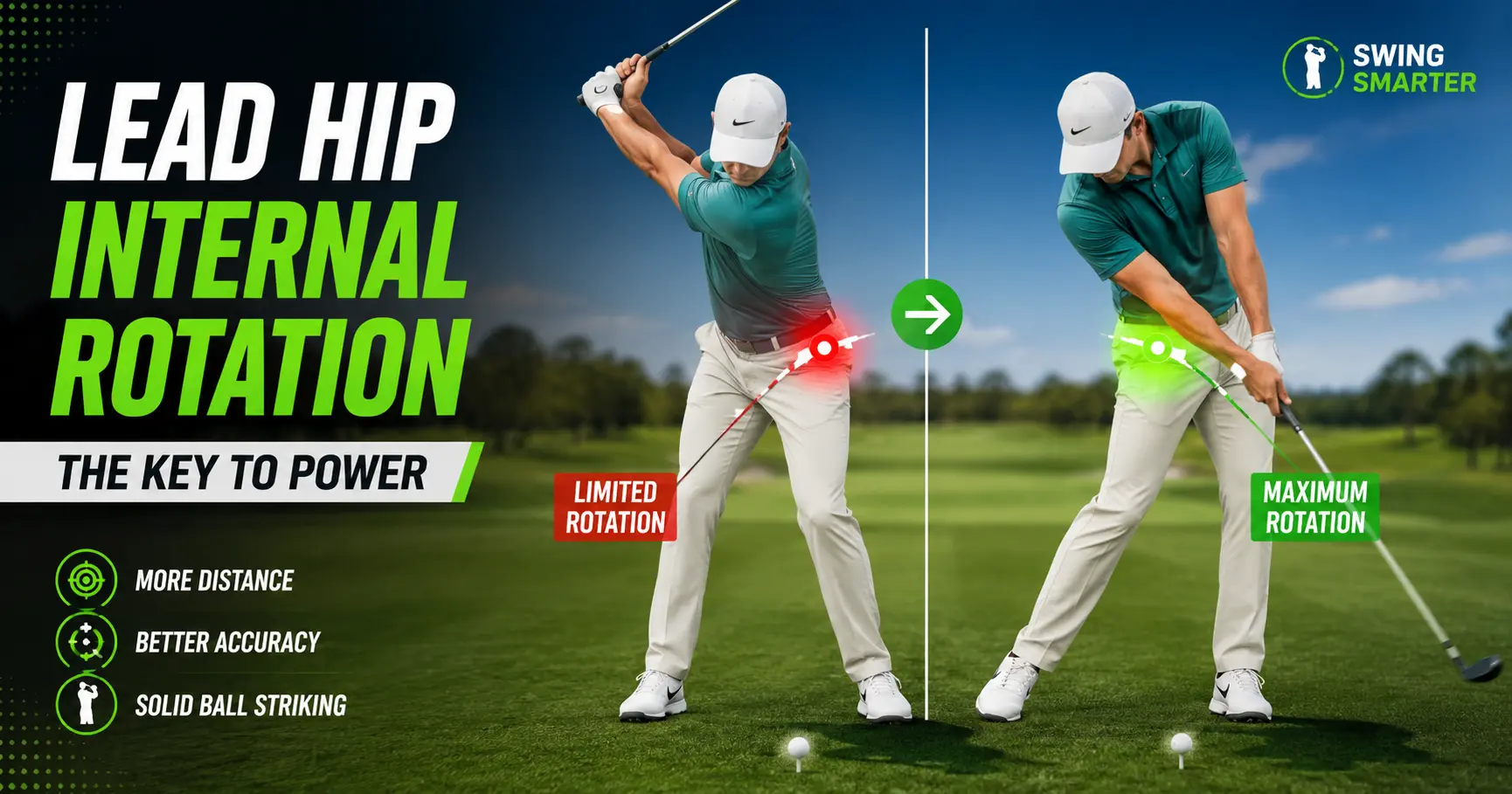
Quick Answer: Lead hip internal rotation is the inward turn of the front hip through impact and into the finish. Most golfers need about 40 to 45 degrees of it. Tour players sit near the top of that range. If you have less, the low back steals the turn, the pelvis stalls, and the lead foot spins out. Test it in a chair first. Then train the range under your feet, not only on a yoga mat.
Watch a weekend player hold the finish and you can usually see the problem before they say a word. The belt buckle is still staring at the ball. The lead heel is rolling out. The chest has stood up. That is not a “clear your hips” cue failing in isolation. That is a lead hip that ran out of internal rotation and made the spine finish the swing.
This piece is the working version of that problem. You will get the degrees that actually matter, a chair test you can do tonight, the swing misses that show up when the hip is stuck, and drills that transfer to turf. No invented range session. No fake before-and-after yardages. Just the mechanics and the work.
Why Lead Hip Internal Rotation Matters in the Golf Swing
For a right-handed player, the lead hip is the left hip. Through the downswing that hip has to accept pressure and turn inward at the same time. The femur rotates toward the midline while the pelvis opens to the target. That combination is lead hip internal rotation. Without it, the pelvis cannot clear, so the arms have nowhere to go.
TPI screening and most golf physio targets sit at 40 to 45 degrees of internal rotation on each hip. PGA Tour players commonly test around 45 degrees. A lot of desk golfers live closer to 25 to 35. That gap shows up as a short turn, a slide, or a finish that never posts.
You do rotate your hips in the golf swing. The useful detail is how much of your available range the swing actually uses. A 2016 Medicine & Science in Sports & Exercise poster by Menta and colleagues found golfers used about 95 percent of their passive lead-hip internal rotation during the swing. They were already at the wall of the joint. Adding a “turn harder” thought on a hip that has no spare degrees just dumps the leftover rotation into the lumbar spine.
The lumbar spine is a terrible substitute. It only has about 5 to 13 degrees of natural rotation. Vad and colleagues measured 42 male professionals in the American Journal of Sports Medicine in 2004 and found a clear link. Players with a recent history of low back pain had less lead hip internal rotation and less lumbar extension than the pain-free group. Thirty-three percent of that sample had already dealt with back pain that affected their play.
So why is hip internal rotation important? It is the joint that lets the pelvis finish the turn so the low back does not have to. It is also the joint that lets you clear the hips instead of thrusting them at the ball.
Tour hips at impact are usually 30 to 40 degrees open from address, per GOLFTEC’s data on PGA Tour players. Amateurs often stall around 20. That stall is not always a sequencing problem. Plenty of players cannot physically get there.
Lead Hip vs Trail Hip: The Rotation Flip Most Golfers Mix Up
Lead hip rotation golf talk gets sloppy because both hips rotate, just not in the same direction at the same time. Mix the two and you stretch the wrong side for six weeks.
| Swing phase | Lead hip (left for a righty) | Trail hip (right for a righty) | What you should feel |
|---|---|---|---|
| Address | Near neutral, slight ER if the foot is flared | Near neutral | Both feet quiet, pelvis level |
| Backswing | External rotation as the pelvis turns away | Internal rotation as you load the trail glute | Pressure inside the trail heel, lead knee kicking in |
| Transition | Starts flipping toward internal rotation | Starts flipping toward external rotation | Pressure arriving in the lead toe, then the heel |
| Impact | Deep internal rotation while the hip clears back | External rotation as the trail heel peels up | Belt buckle left of the ball, lead glute posted |
| Finish | Max internal rotation over a posted lead leg | Full external rotation | Chest facing the target, lead foot not spinning out |
The trail hip’s internal rotation is the backswing load. The lead hip’s internal rotation is the downswing clear and the finish. Training only trail-hip IR leaves the impact hip exactly where it was on Saturday.
Kalamazoo’s clinic write-up gets this sequence right and then stops before giving you anything to do. The next sections pick it up from there.
Hip Internal Rotation Symptoms You Can See in Your Swing
Hip internal rotation symptoms in golfers rarely start as a neat medical label. They show up as a miss, a finish, or a back that tightens on the back nine.
| What you see | What the lead hip is doing | Typical miss |
|---|---|---|
| Early extension (hips thrust at the ball) | Cannot internally rotate, so the pelvis stands up to finish | Thin shots, blocks, two-way miss |
| Slide toward the target | Pressure stays in the lead toe and never rotates | Fat irons, loss of distance, open face |
| Lead foot spinning open after impact | Joint ran out of IR, so the foot completes the turn | Weak fade or push, no post |
| Chicken wing on the lead elbow | No space for the arms because the hip never cleared | Pulls and held-off blocks |
| Low back tightness after 12 holes | Lumbar spine is rotating to make up the missing hip degrees | Stiffness the next morning, not a one-swing stab |
| Sharp pinch in the front of the hip or groin | Possible impingement, not just “tightness” | Pain on the follow-through, not a stretch burn |
Hip internal rotation problems also hide in the setup. A player who flares the lead foot 30 degrees at address is often buying extra IR the joint does not have. That can be a smart playing fix. It can also mask a hip that needs work.
One more on-course tell. If your practice swing finish looks posted and your real swing finish looks like you are falling toward the target, the hip had range in slow motion and lost it under speed. Range on a table is not range in a downswing.
What Causes Hip Internal Rotation Problems
What causes hip internal rotation loss in golfers is usually a stack, not one villain.
Sitting is the everyday one. Hours in a chair park the hip in flexion and shut the glutes off. The capsule and the deep external rotators get short. Internal rotation is the motion those tissues block first.
The next layer is the swing itself. The lead hip takes fast internal rotation plus compression at impact. Do that 70 to 90 times a round, then do it again on the range, and the external rotators on that side adapt by tightening. Tight external rotators steal internal rotation. That is the loop Vad’s group pointed at in professionals.
Anterior pelvic tilt makes it worse. A pelvis dumped forward changes the socket angle and shortens the room the femoral neck has to turn. Some cohort data puts the drop in lead-hip IR around 14 percent when tilt is excessive. You feel “tight hips.” Part of that tightness is a pelvis that will not sit under you.
Age and arthritis belong on the list. Capsules dry out. Cartilage wears. Range shrinks. That is one reason swing speed after 40 falls even when the arms still feel fine.
The honest structural cause is femoroacetabular impingement, usually a cam bump on the femoral neck. Elite golf MRI work in the British Journal of Sports Medicine has shown side-to-side hip differences in players. A bony block does not stretch out because you did 90/90s for a month. Forcing IR into a pinching hip is how golfers turn a mobility project into a labral tear.
How to Test Lead Hip Internal Rotation at Home
Do this before you pick a drill. Guessing is how people stretch the wrong tissue.
1. Seated chair test (best home screen)
Sit tall on a firm chair. Both knees bent to 90 degrees. Feet hanging or lightly touching the floor. Keep the thigh still and swing the lower leg outward. The foot traveling out is internal rotation at the hip. You want the shin to drop 40 to 45 degrees from vertical. Under 30 is a clear restriction. Film it from the front so you cannot cheat by leaning the torso.
2. Seated 90/90 eyeball test
Same chair. Knees together. Try to drop the lead knee inward while the pelvis stays level. If the pelvis rolls or the opposite hip lifts, the range is coming from the low back. That cheat is the same cheat you use in the downswing.
3. Standing heel-pivot test (Golf Digest screen)
Stand with both feet pointing straight. Pivot one foot inward off the heel without spinning the pelvis. Thornton’s pass line is at least 40 degrees per hip. This one overestimates if you let the pelvis turn with the foot.
| Test | Pass | Fail | Cheats the test if… |
|---|---|---|---|
| Seated chair, lower leg swings out | 40–45° | Under 30°, or pain | You lean the trunk or lift the sit bone |
| 90/90 knee drop | Knee drops without pelvis roll | Pelvis tilts first | You collapse the opposite hip |
| Standing heel pivot | 40° inward foot turn | Foot barely moves | The belt buckle turns with the foot |
Test both hips. A 10-degree gap between lead and trail is common in golfers with back pain. Murray’s amateur data put lead-hip IR about 10 degrees lower in players who reported low back pain.
Stop the test if you get a sharp front-hip or groin pinch. That is not a stretch sensation. That is a joint complaint.
Can Internal Hip Rotation Be Fixed?
Yes, if the limit is soft tissue, motor control, or a weak rotator. No, if the limit is bone.
Most amateur restrictions are the first group. Short external rotators, sleepy glutes, a pelvis stuck in tilt, and a nervous system that will not use the last 10 degrees under speed. Those respond to daily mobility plus loaded rotation. P4S-style timelines are realistic. You feel a little more range the same day. Structural change takes 3 to 4 weeks of consistent work. Strength that holds the new range takes 6 to 8 weeks.
Hamada’s group gave the cleanest golf-specific evidence we have. In a 2023 randomized crossover trial in Healthcare, foam rolling plus dynamic stretching to the lead hip increased lead-hip IR during the actual swing. Practice swings alone did not. The same group’s 2024 Journal of Strength and Conditioning Research follow-up found the foam-roll-plus-stretch warm-up improved carry more than extra swinging, and it raised lead-hip IR strength. That is the opposite of “just hit another bucket.”
Can internal hip rotation be fixed when the hip is bony? Only inside the space the socket allows. Billy Horschel’s hip surgery is the public extreme. Surgeons moved his internal rotation from about three degrees to a usable range after a torn labrum, microfractures, and bone-on-bone impingement. Stretching was never going to do that.
If rotation is stuck and the front of the hip pinches, get imaging and a clinician who sees golfers. Keep playing on a grinding cam and you will donate the labrum next.
How to Improve Lead Hip Internal Rotation
How to improve hip internal rotation is not one stretch. And how to increase hip internal rotation that shows up in a swing takes three layers. Open the joint. Own the end range. Then rotate it with ground pressure.
Do the first four drills on non-round days. Use drill 5 as the first-tee warm-up.
1. 90/90 hip switch (mobility)
Sit on the floor. Front shin across, back shin behind, both knees near 90 degrees. Stay tall. Switch sides without using your hands if you can. Pause two seconds each time the lead hip is the internally rotated one. 2 sets of 6 slow switches.
2. Seated windshield wipers (the one that looks like the chair test)
Sit, lean back on your hands, feet wide, knees bent. Drop both knees side to side. When the lead knee drops in, keep that sit bone down. 2 to 3 sets of 8 per side. This is the Golf Digest seated pattern, done with a rule: no lumbar rolling.
3. Half-kneeling lead-hip clear (the lead hip rotation drill that matches impact)
Half-kneel with the lead foot forward. Front knee over the ankle. Rotate the belt buckle toward the lead thigh without the front knee diving in. Hold 2 seconds. 2 sets of 8. If the knee collapses, you are sliding, not rotating.
4. Toe-to-heel pressure drill (the one that transfers)
Take your setup without a ball. Make a small backswing. Shift pressure into the lead toe, then immediately roll it to the outside of the lead heel as the hip turns behind you. The heel pressure is what spins the hip open. Toe pressure alone is a slide. Rehearse 10 times, then hit 8 wedges with the same feel.
5. Foam roll plus dynamic stretch warm-up (Hamada protocol, shortened)
Roll the lead glute and the back of the lead thigh, about a minute each zone. Then do 8 slow internal-rotation pulses in the seated windshield position and 8 half-kneeling clears. Then hit balls. That sequence beat extra practice swings for carry in the 2024 study.
How to improve hip rotation in golf after the range is simple. Two short sessions a week will not outrun five days of sitting. Ten minutes on the floor most nights beats a heroic Sunday session.
Skip the long static holds if the front of the hip pinches. Pulse inside a pain-free range and get the joint screened.
The Saturday Band-Aid: Flare the Lead Foot
You cannot rebuild a capsule between the first tee and the tenth. You can give the lead hip a head start.
Flare the lead foot toward the target about 15 to 25 degrees. That pre-sets some internal rotation so the joint does not have to find every degree from a square foot. A lot of better players already do this without calling it rehab.
Keep the trail foot quieter. Flaring both feet just opens the whole stance and you lose the trail-side load.
Use the flare as a playing fix, not a personality trait. If you need 40 degrees of flare to finish the swing, the hip still needs the weekday work. The flare hides the restriction. It does not remove it.
Frequently Asked Questions
Why is hip internal rotation important?
It lets the lead hip accept pressure and turn inward so the pelvis can open through impact. Without it, the lumbar spine rotates in a joint that only has about 5 to 13 degrees of turn. Power drops and the back takes the leftover work.
What causes hip internal rotation problems?
Sitting, short external rotators, weak glutes, anterior pelvic tilt, age-related stiffness, and in some players a bony cam or arthritis. Golf itself can tighten the lead side because that hip repeats high-speed IR under load.
Hip internal rotation symptoms?
On the course you see early extension, a slide, a spinning lead foot, a chicken wing, and a blocked or two-way miss. Off the course you feel groin pinching, outside-hip tightness, or low-back stiffness that builds through the round.
Do you rotate your hips in the golf swing?
Yes. The trail hip internally rotates on the backswing. The lead hip internally rotates through impact and the finish. The downswing starts with a pressure shift, then that lead-hip turn. Spinning the pelvis with no shift is not the same move.
How to improve hip internal rotation?
Test it first. Then use 90/90 switches, seated windshield wipers, and half-kneeling clears to add range. Add the toe-to-heel pressure drill so the new range shows up in the swing. Foam roll the lead glute and thigh before you stretch if you want the warm-up that beat extra swinging in Hamada’s research.
How to increase hip internal rotation?
Same work, done often. Daily 10-minute sessions beat weekend marathons. Expect a small same-day bump and a more stable change after 3 to 4 weeks. Strength that holds the range takes closer to 6 to 8 weeks.
How to improve hip rotation in golf?
Train both directions, but bias the lead hip if your finish will not post. Pair mobility with a pressure-shift drill and a slightly flared lead foot on the course. Stretching alone does not teach the hip to rotate under speed.
Can internal hip rotation be fixed?
Soft-tissue and control limits usually can. Bony impingement and advanced arthritis cannot be stretched away. Sharp front-hip pain is the stop sign. Get that hip examined before you grind more IR into it.
Get the Hip Turning Before You Buy Another Lesson
A new swing thought will not invent degrees a joint does not have. Get 40 degrees on the chair test, then teach that range to accept pressure through the lead heel. The finish starts posting when the hip can actually turn. The back quietens down for the same reason.
If the hip clears and the strike still wanders, then take the lesson. Fix the joint first.