
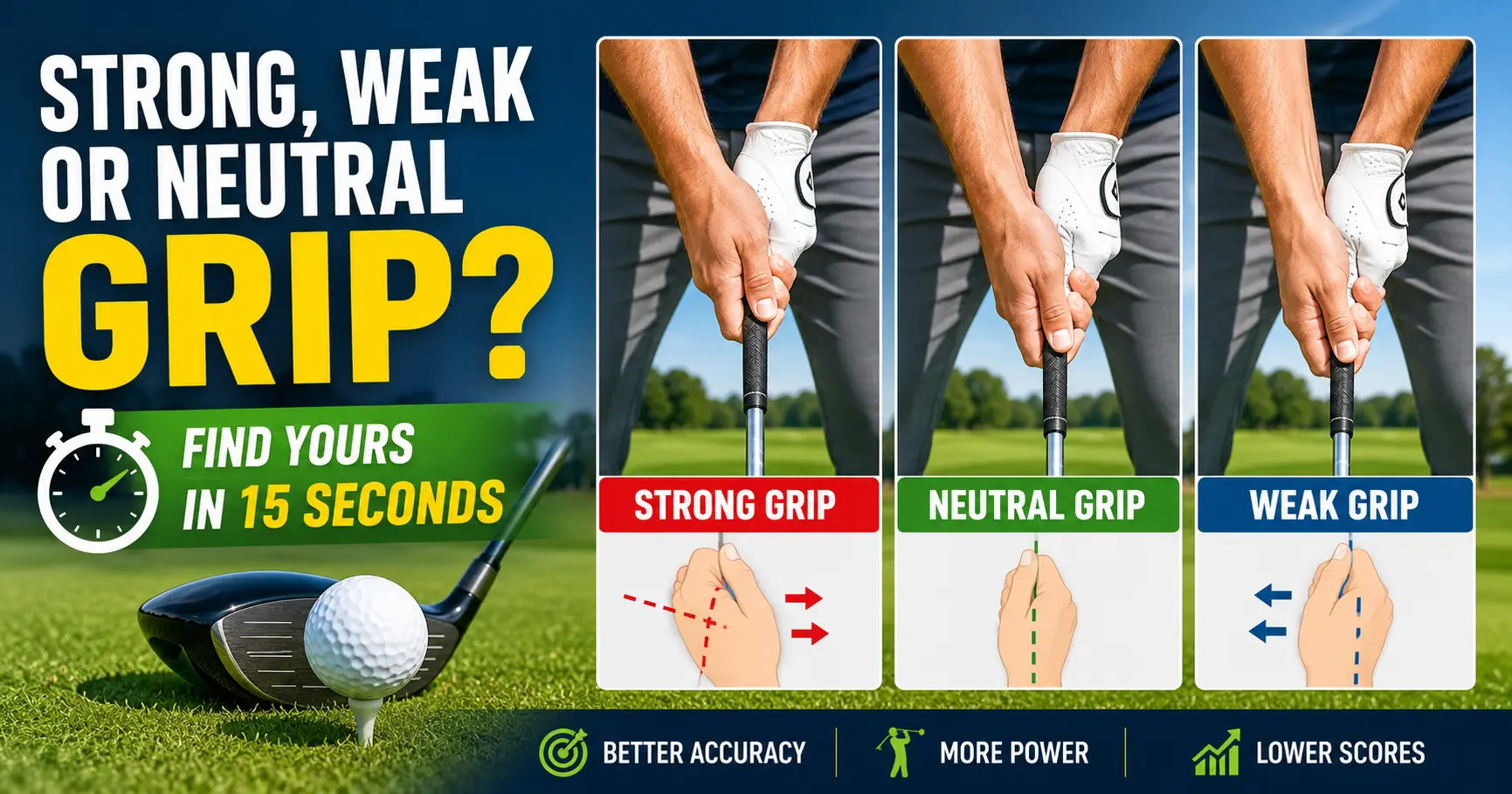
Quick Answer: A strong grip shows 3+ knuckles on your lead hand and closes the face at impact. A weak grip shows 0-1 knuckles and opens it. Neutral shows two and squares up on its own. Check both hands, since many tour pros run a different position in each.
Look down at your hands right now. If you can only see one knuckle on your lead hand, you’re playing a weak grip, whether you meant to or not. Most golfers have never actually checked, they just grip the club the way they always have and blame the swing when shots miss. This piece walks through a fast way to identify your strong, weak, or neutral golf grip, what Rory McIlroy, Tiger Woods, and Scottie Scheffler actually do with their hands, and two situations, left-handed golfers and putting, where the standard advice doesn’t quite apply.
The Two-Hand Check: Find Your Grip in 15 Seconds
Forget swing theory for a second. Grip the club the way you normally would and look straight down at your lead hand. Zero or one knuckle visible means weak. Two means neutral. Three or more means strong.
That single check identifies your strong, weak, or neutral golf grip more reliably than any swing thought. Now do the same thing with your trail hand. Most golfers skip that part entirely, and it’s the piece that explains a lot of confusing tour grips.
What Your Lead Hand Tells You
The lead hand controls most of what the clubface does through impact. A strong lead hand rotates the palm on top of the grip, and the V formed by your thumb and index finger points past your trail shoulder. Rotate it the other way and you get a weak position, with the V pointing up near your chin.
If you’ve never gripped a golf club correctly in the first place, start there before you diagnose anything. The lead hand position alone explains most slices and most hooks.
What Your Trail Hand Tells You (Most Golfers Never Check This)
Here’s what almost nobody tells beginners: your trail hand can sit in a completely different position than your lead hand, and some of the best ball-strikers alive use exactly that combination. Check your trail hand’s knuckles the same way, looking down from address.
A weak right hand grip position, common among golfers who only ever check their lead hand, sits more on top of the grip with the palm facing down. A strong trail hand sits further underneath, palm facing up, almost like offering a handshake from below. Later in this piece you’ll see why strong lead hand paired with weak trail hand describes one of the best drivers of the ball on the planet.
Strong, Weak, and Neutral: A Side-by-Side Snapshot
Here’s the fast version of strong, weak, or neutral golf grip identification, side by side, checking both hands instead of just one.
| Grip Type | Knuckles (Lead Hand) | Knuckles (Trail Hand) | Clubface at Impact | Real-World Example |
|---|---|---|---|---|
| Strong | 3 or more | Often weaker than the lead | Tends to close | Rory McIlroy’s lead hand |
| Neutral | 2 | 2 | Squares up on its own | Scottie Scheffler |
| Weak | 0–1 | Often stronger than the lead | Tends to stay open | Ben Hogan (his career-defining fix) |
Already know you’re fighting a slice or a hook? Our full strong vs weak grip breakdown walks through exactly which direction to move and how far.
Why Some of the Best Ball-Strikers Don’t Grip It the Same in Both Hands
The three questions golfers search most about pro grips all have the same twist: none of these three players uses one simple label for both hands.
Does Rory McIlroy Have a Strong or Weak Grip?
Rory answers his own question by being both at once. His lead hand sits in a strong position, while his trail hand runs weak, as if his hands are twisting toward each other on the grip. Golf instructors interviewed by Golf Digest sum it up simply: strong lead hand, weak trail hand.
That strong lead hand matches his fast hip turn. The weaker trail hand is what lets him hit it as straight as he does despite that speed. It isn’t a combination you’d teach a beginner on day one, but it’s proof strong and weak aren’t an either/or choice.
Did Tiger Woods Have a Strong or Weak Grip?
Tiger’s answer depends on which decade you’re asking about. As a junior, and through his win at the 1997 Masters, his lead hand grip was strong enough that the club sat visibly across the line at the top of his swing. Butch Harmon weakened it back toward neutral in the early 2000s to make the swing more repeatable, and Hank Haney weakened it further in 2004 to help Tiger hit a controlled fade.
When Sean Foley took over in 2010, Tiger’s grip strengthened slightly again to support a new position at the top. In his own writing, Tiger has described the shift himself: a strong junior grip that gradually gave way to something closer to neutral as his hands and forearms got stronger. Two knuckles has been closer to his true baseline than either extreme.
Does Scottie Scheffler Use a Neutral Grip?
Yes, with an asterisk. His base position sits right around two knuckles, close enough to neutral that different outlets have called it slightly strong and others slightly weak depending on the week, which is part of the neutral golf grip benefits everyone points to: predictability without needing to time a compensation.
Scheffler himself has said the real story isn’t the exact position, it’s that he adjusts constantly and uses a molded rubber grip trainer before every session to keep finding that same spot. His longtime coach Randy Smith has also had him focus on a longer left thumb down the shaft, a small tweak that stopped the clubface from closing too early. World number one status backs up whichever label you want to put on it.
Strong vs Weak vs Neutral Grip for Left-Handed Golfers
If you searched strong vs weak golf grip lefty because every diagram online assumes a right-hander, here’s the direct swap. For a left-handed golfer, the right hand is your lead hand and the left hand is your trail hand. Flip every direction in this article and you’ve got it.
A strong lefty grip rotates both hands to the left, away from the target, showing three or more knuckles on your right hand at address. A weak lefty grip rotates both hands to the right, toward the target, showing zero or one knuckle on that same right hand. The V shapes point the mirror-opposite direction too.
One honest note for lefties: right-handed diagrams are so much more common online that plenty of left-handed golfers end up copying a photo backward without realizing it. If a strong-grip photo shows a right-hander’s V’s pointing at their right shoulder, don’t copy that direction onto your right hand. Flip it. If you’re also exploring grip styles rather than just grip strength, our 10-finger grip guide covers the style question separately.
Does Your Grip Need to Change for Putting?
Everything above describes your full-swing grip, and putting runs on different rules. A full-swing grip manages how much the clubface opens and closes through impact. A putting stroke isn’t supposed to have much rotation at all, so strong-versus-weak barely applies the same way.
Most tour pros use a neutral-ish putting grip specifically because they want quiet hands through the stroke, with the shoulders doing the work instead of the wrists. That’s part of why Tiger swapped his full-swing interlock for a reverse-overlap grip on the greens, and why plenty of players who run a strong full-swing grip still putt with a square, neutral hand position.
If your putting stroke has a hook or a push you can’t explain, check whether you’ve carried your full-swing hand position onto the putter. None of this fixes a stroke with a bad path, though. If your misses stay random after squaring up your hand position, the problem is tempo or face control, not grip.
What the Research Actually Says About Grip Position
Most grip advice online is opinion, including plenty of what’s written above. Two peer-reviewed studies have actually measured it.
A 2019 study in the European Journal of Sport Science put 12 professional male golfers through weak, neutral, and strong grip conditions using 3D motion capture on every shot. Clubface angle only differed significantly between the weak grip and the other two, coming out more open relative to the target line. That matches what every instructor already tells you about weak grips and slices, except this time it’s measured, not guessed.
A larger 2021 study in the Journal of Sports Sciences went further. Researchers had 28 amateur golfers hit drives with five grip positions, from thirty degrees strong to thirty degrees weak, and tracked every shot on a Trackman launch monitor. Grip position significantly changed clubface angle, swing path, launch direction, clubhead speed, and total distance, and the neutral and stronger positions produced the best combination of accuracy and distance. Weaker positions carried a real accuracy and distance cost. That’s an amateur sample, not tour pros, so treat it as directional rather than gospel.
If you’re chasing extra yards off the tee specifically, our driver-specific breakdown covers exactly how much a stronger grip can add and where it starts working against you.
Frequently Asked Questions
Is a strong or neutral grip better in golf?
Neither is universally better. Neutral gives most golfers the most predictable ball flight and is the safer long-term default. A strong grip is better specifically if you’re currently fighting a slice, since it closes the clubface for you. If you already draw or hook the ball, a strong grip usually makes things worse, not better.
Does Rory McIlroy have a strong or weak grip?
Both, depending on which hand you look at. His lead hand runs strong and his trail hand runs weak, a combination that suits his fast hip turn and helps him control a very fast swing.
Did Tiger Woods have a strong or weak grip?
It changed throughout his career. He played a strong grip as a junior and through his first major wins, weakened it under coaches Butch Harmon and Hank Haney, then strengthened it slightly again under Sean Foley. Two knuckles, close to neutral, describes his grip more often than either extreme.
Does Scottie Scheffler use a neutral grip?
Close to it. His hand position sits right around two knuckles, which different sources describe as slightly strong or slightly weak depending on the week, and he adjusts it constantly with a training aid to stay consistent.
The Bottom Line
Check both hands, not just the one every other article tells you to check. Two knuckles on each is a fine place to live if nothing about your ball flight is screaming at you to change it. If it is screaming at you, strong fixes a slice and weak fixes a hook, and our full strong vs weak golf grip guide walks through exactly how far to move and what the pros do about it.