
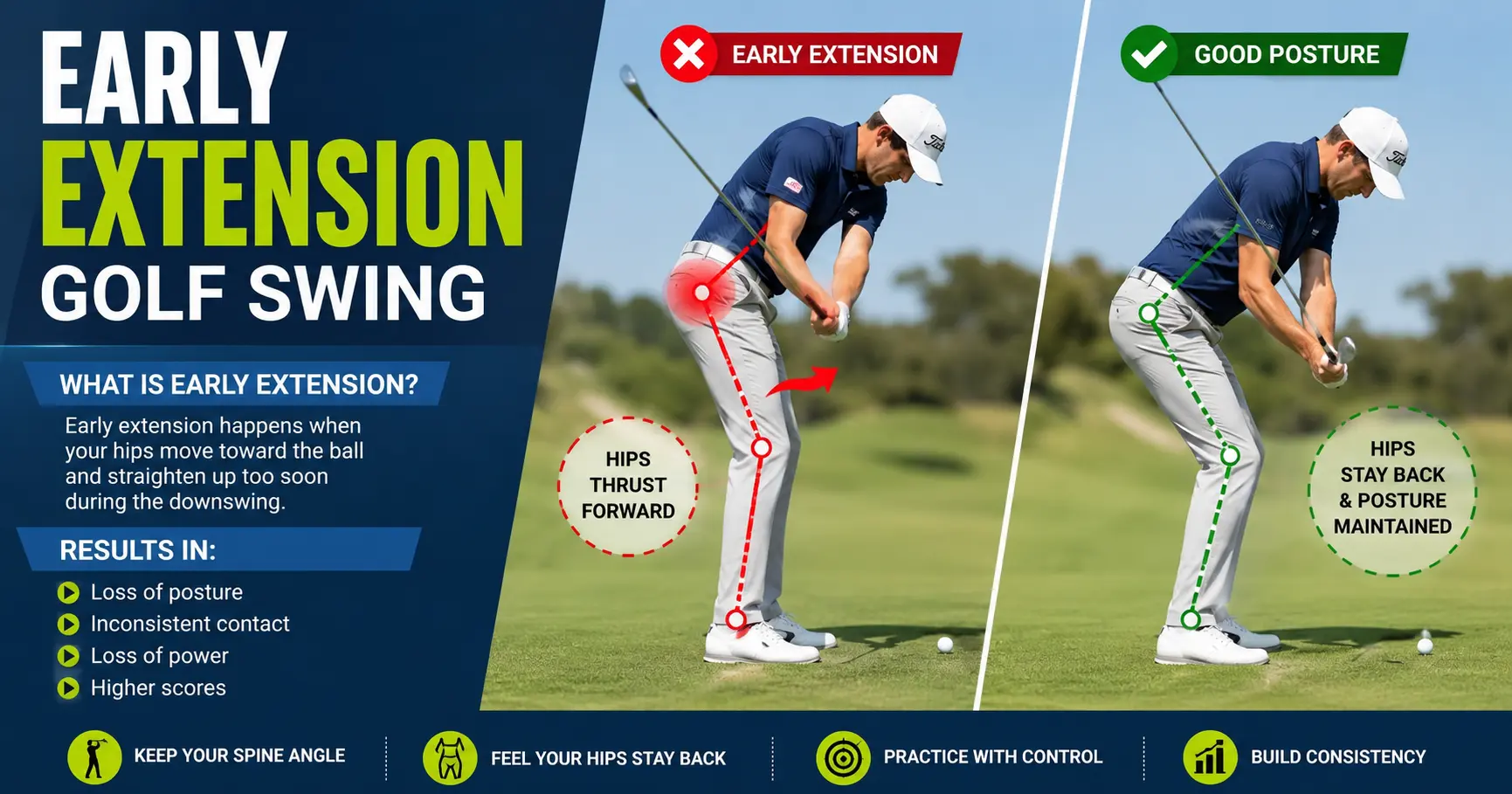
Quick Answer: Early extension is when your hips and pelvis drift toward the ball during the downswing instead of rotating in place. Your spine straightens, your arms run out of room, and you’re left with thin contact, blocks, or a snap hook. TPI’s own screening data puts this in roughly 67% of amateur golfers. The fix starts at address, not in the downswing: clean up your grip and posture first, then retrain the pattern with a wall or chair drill.
Your hips shoot toward the ball. Your chest pops up a beat before impact. The ball goes thin, or it goes dead right, or it snap hooks forty yards left, and you never know which miss is coming until the club’s already through the zone. That’s an early extension golf swing, and it’s the single most common physical fault TPI finds when it screens golfers.
We’re going to cover what’s actually happening in your body, why the miss looks completely different with a driver than it does with a 7-iron, and the drills worth your practice time. No fluff, no “just keep your butt back” advice that ignores why your butt is moving in the first place.
What “Early Extension” Actually Means in a Golf Swing
Picture a straight line running up your tailbone at address. Good players hold roughly that same distance from the line all the way to impact. An early extension golf swing loses that line early, the pelvis pushes forward toward the ball, and the spine has nowhere to go but up.
That’s the whole mechanism. Your hips move closer to the ball than they were at setup, and your upper body straightens to compensate. Some instructors call it “losing the tush line,” others call it hip thrust or standing up through impact. All three phrases describe the same movement.
Here’s what it isn’t: it’s not lifting your head. Your head rises because it’s attached to a torso that’s straightening underneath it, but the head was never the cause. Chasing “keep your head down” fixes a symptom two steps removed from the real problem.
What Causes Early Extension in Your Golf Swing
Most instruction treats this as one problem with one cause. It isn’t. Four separate issues can all produce the same pelvis-toward-the-ball pattern, and you likely have more than one of them stacked together.
A Grip That’s Fighting Your Body
This is the most underrated cause on the internet, full stop. A grip that’s too weak leaves the clubface open coming into impact, and your hands know it. To square that face in time, they have to flip and release the club early, which throws the clubhead ahead of your body. Your body’s answer to a club that’s outrun it is to stand up and create room for your arms to catch up. That’s early extension, and the grip started it three feet earlier in the swing than most golfers ever look.
A grip that’s too strong causes a milder version of the same problem in reverse: the face closes too fast, and some golfers early extend slightly just to keep from smothering the ball into the ground. Neither extreme is stable. If you’ve never actually checked where your hands sit on the club, our breakdown of strong vs weak golf grip walks through how to find neutral and adjust from there.
Posture That’s Broken Before You Ever Swing
Stand too far from the ball with an over-rounded spine, and your body has almost no choice but to lunge forward to reach the ball on the way down. Stand too close and too upright, and you’ll run out of room even faster. Good posture isn’t a straight back, it’s a relaxed, athletic tilt from the hips with the spine staying long, not stiff.
Golfers who set up with an anterior pelvic tilt (hips tucked, chest up, chin jutting toward the horizon) are almost guaranteed to early extend, because that posture leaves the pelvis nowhere to go but forward when the swing speeds up.
Limited Hip and Ankle Mobility
TPI’s screening research is blunt about this one. Across more than 90,000 golfers tested, roughly 67% showed some degree of early extension, while only about 1% of the PGA, European, and LPGA Tour players TPI has tested showed the same pattern. The single physical marker that correlates most strongly with the fault is an inability to perform a full, deep squat. If your ankles, knees, or hips can’t get you into that position off the course, your body will find a shortcut on it, and the shortcut is early extension.
Trying to Create Power From the Ground Too Soon
Some golfers early extend because they’re aggressively pushing off the ground at the start of the downswing, almost like a vertical jump. That upward and forward force has to go somewhere, and if your core and glutes aren’t strong enough to redirect it into rotation, it pushes your pelvis straight at the ball instead. This is a timing issue as much as a strength one.
Early Extension With Driver vs. Irons: Why the Miss Looks Different
Nobody covers this, and it matters more than any single drill. Early extension doesn’t feel or look the same with every club in your bag, because the swings themselves aren’t the same motion.
A biomechanics study comparing driver, 5-iron, and 7-iron swings in low-handicap golfers found real kinematic differences between the clubs. Irons reach their peak rotational speed earlier in the downswing but with a smaller overall angular velocity, while the driver produces a bigger horizontal turning force through the same window. In plain terms: the driver asks your body to hold its structure through a longer, faster-building rotation, which gives early extension more time and more force to show up in.
| Swing Element | Driver | Irons |
|---|---|---|
| Typical miss | Push or block right, or a low snap hook left | Thin contact, fat contact, or a shank |
| Why it shows up | Longer swing arc and later peak speed give the fault more time to build | Ball is played closer to center, so even a small hip thrust changes the low point |
| Ball position effect | Forward, off the lead heel, amplifies any loss of posture into a pulled or pushed shot | Center-ish, so early extension usually shows up as a bottomed-out or skulled strike first |
| Fix priority | Grip and setup width, since the longer swing exposes any flaw | Ball-position and low-point control first, grip second |
If you’ve ever wondered why your irons look “not that bad” on video but your driver swing looks like a completely different, worse golfer, this is the reason. The longer lever and the higher speeds of a driver swing don’t create early extension, they just expose it. For more on how the club itself changes the demands on your swing, our guide to dynamic loft covers how angle of attack shifts between a driver and a short iron, which directly affects how forgiving each club is of a hip thrust.
How to Tell If You Actually Early Extend
Don’t fix a problem you don’t have. Film yourself from directly behind (down-the-line), not from face-on, using a mid-iron at about 80% speed. A driver swing at full speed moves too fast to read accurately on a phone camera without a slow-motion setting.
Once you’ve got the clip, slow it down and check three things:
- Draw or imagine a vertical line at your tailbone at address. Does your pelvis stay on that line, or move past it, by the top of the downswing?
- Watch your belt buckle. If it’s pointing at the ground at address and pointing more at the ball by impact, that’s the pelvis rising and thrusting forward at the same time.
- Check your spine angle. A good swing holds roughly the same forward tilt from address to just past impact. Standing up early is early extension showing up in your upper body.
If you’re building this into a regular practice habit, working through swings at reduced speed is worth doing on its own. Our full slow motion golf swing breakdown covers the right tempo ratio to use so your slow-speed reps actually transfer to full speed instead of just feeling different.
Drills to Fix an Early Extension Golf Swing
The best early extension golf swing fix isn’t one drill, it’s building awareness first and adding speed second. Skip straight to full-speed range balls and you’ll just groove the same fault faster.
- The wall drill, done correctly. Set up in your normal posture with your rear end lightly touching a wall. Make a backswing and feel your trail hip work back toward the wall as you turn. On the way down, let your lead hip clear back toward the wall instead of your whole pelvis lunging into it. The goal isn’t to freeze against the wall, it’s to feel one hip working back in the backswing and the other clearing back in the downswing.
- The chair drill, with a real caveat. Place a chair’s edge an inch behind your glutes at address and swing slowly, focusing on your trail hip touching first, then your lead hip continuing to work back through impact. This drill gets more credit than it deserves online. Pinning your backside to a chair teaches you to fake stillness, not to actually rotate, and plenty of golfers finish the drill with a great-looking position and a worse golf swing underneath it. Use it for five minutes to build awareness, not as your main practice tool. It also loads the trail knee hard, so if you’ve had any knee issues, stop the moment you feel joint pressure rather than muscle fatigue.
- The choke-down drill. Slide your hands three to four inches down the grip and make slow, full swings with a mid-iron. Shortening the club removes your margin for error, if your pelvis thrusts forward, you’ll swing over the top of the ball instead of through it. Start on a low tee so you’re not lowering your whole body just to reach the ball.
- The alignment stick gate. Thread an alignment stick through your front belt loops, resting roughly 50/50 across your hips. Make slow air swings first, feeling the stick stay back through the backswing and transition. Add a ball only once you can complete slow half-swings without the stick jabbing into your trail side.
- The grip check, before any of the above. Take your normal grip and check your lead hand knuckles in a mirror. Two to three knuckles visible is neutral. If you can barely see one, or you can see four, that’s likely contributing to the flip-and-stand-up pattern described in the causes section above. Fix this one first, since it can make the other drills unnecessary.
Drills to Do at Home (No Range Needed)
You don’t need a golf ball to build this pattern. These work in a living room with enough ceiling clearance for a practice swing.
Why You Can’t Stop It, Even When You’re Trying
If you’ve fought this for years and nothing sticks, here’s the part almost nobody tells you: early extension is usually a solution, not the actual problem. PGA Tour pro Michael S. Kim put it well when he described the move on social media as something closer to duct tape holding an already-compromised swing together, not a root fault by itself.
That lines up with what we see constantly. Golfers who lack backswing depth, lose pressure off their trail foot, or never learned proper pelvic rotation will find early extension on their own, because their body needs somewhere to send the club. Telling that golfer to “keep your hips back” without fixing the depth or sequencing problem underneath it just removes their only compensation, and the results usually get worse before they get better.
This is exactly the kind of question that shows up constantly in golf forums and threads like the ones on r/golf, golfers asking what the “feel” should be instead of what the position should look like. The most useful answers in those threads tend to agree on one thing: chase the feeling of your trail hip working back and around, not the image of a still pelvis. Stillness is the side effect of good sequencing, not the goal itself.
Is Early Extension Always a Problem?
No, and any article telling you to chase a textbook-zero amount of pelvis movement is overselling it. Some amount of forward hip movement shows up in plenty of hall-of-fame swings if you look closely enough at down-the-line footage from past decades. The line between “some” and “too much” is whether it’s costing you consistent contact and whether it’s causing pain, not whether it matches a diagram exactly.
If you already manage a two-way miss well enough to break 80 regularly, spending an entire off-season chasing a picture-perfect pelvis position probably isn’t the best use of your practice time. Fix it if it’s costing you strokes or hurting your lower back. Leave it alone if it’s not.
Frequently Asked Questions
What is early extension in a golf swing?
Early extension is forward movement of your pelvis toward the golf ball during the backswing or downswing, which forces your spine to straighten and your arms to lose the room they need to deliver the club.
What causes early extension in a golf swing?
The most common causes are a grip that’s forcing your hands to flip at impact, poor posture at address, limited hip or ankle mobility, and pushing off the ground too aggressively early in the downswing.
How do you stop early extension in a golf swing?
Start by checking your grip and posture at address, since both can cause the fault before the swing even starts. Then retrain the movement pattern with a wall drill, a choked-down iron drill, and a resistance band, building speed gradually instead of jumping straight to full-speed shots.
Is early extension bad for your back?
It can be. Because the lower back muscles aren’t built to generate power, early extension forces them into that role, which is a common contributor to lower back soreness for recreational golfers who swing this way for years.
Do pro golfers early extend?
Almost never in a meaningful amount. TPI’s testing found that around 99% of the PGA, European, and LPGA Tour players screened showed no significant early extension, compared to roughly 67% of amateurs.
Can a strong or weak grip cause early extension?
Yes. A weak grip often causes a hand flip at impact that the body compensates for by standing up, and an overly strong grip can cause a milder version of the same pattern in the opposite direction.
What’s the best drill for early extension?
There isn’t one single best drill, since the right one depends on the cause. A grip check first, followed by the wall drill for awareness and the choked-down iron drill for feedback under real impact, covers the most common causes without wasting range time.
Is early extension a swing fault or a compensation?
Usually a compensation. It’s frequently your body’s way of getting the club back into a hittable position after a different breakdown earlier in the swing, which is why simply “keeping your hips back” without fixing the earlier issue rarely holds up under pressure.
What does Reddit say about fixing early extension?
Most useful discussion in golf communities centers on feel over position, describing the trail hip working back and around rather than a frozen pelvis, since chasing stillness directly tends to create new compensations of its own.
How long does it take to fix early extension?
Expect weeks, not days, if the cause is a physical mobility limitation, and closer to a few focused range sessions if the cause is purely a grip or setup issue. Golfers who skip straight to full swing speed before the new pattern feels automatic almost always regress within a round or two.
Final Thoughts
Early extension isn’t one flaw with one fix, it’s your body solving a problem you probably created somewhere else in the swing. Check your grip and posture before you touch a single drill, because those two things cause more early extension than any mobility limitation ever will. Once those are clean, the wall drill and the choked-down iron drill will do more for you in two weeks than a season of “keep your butt back” reminders ever has.
If your grip’s never actually been checked against a mirror, that’s the fastest fifteen minutes you can spend this week. Our full strong vs weak golf grip guide will tell you exactly where your hands should sit.