
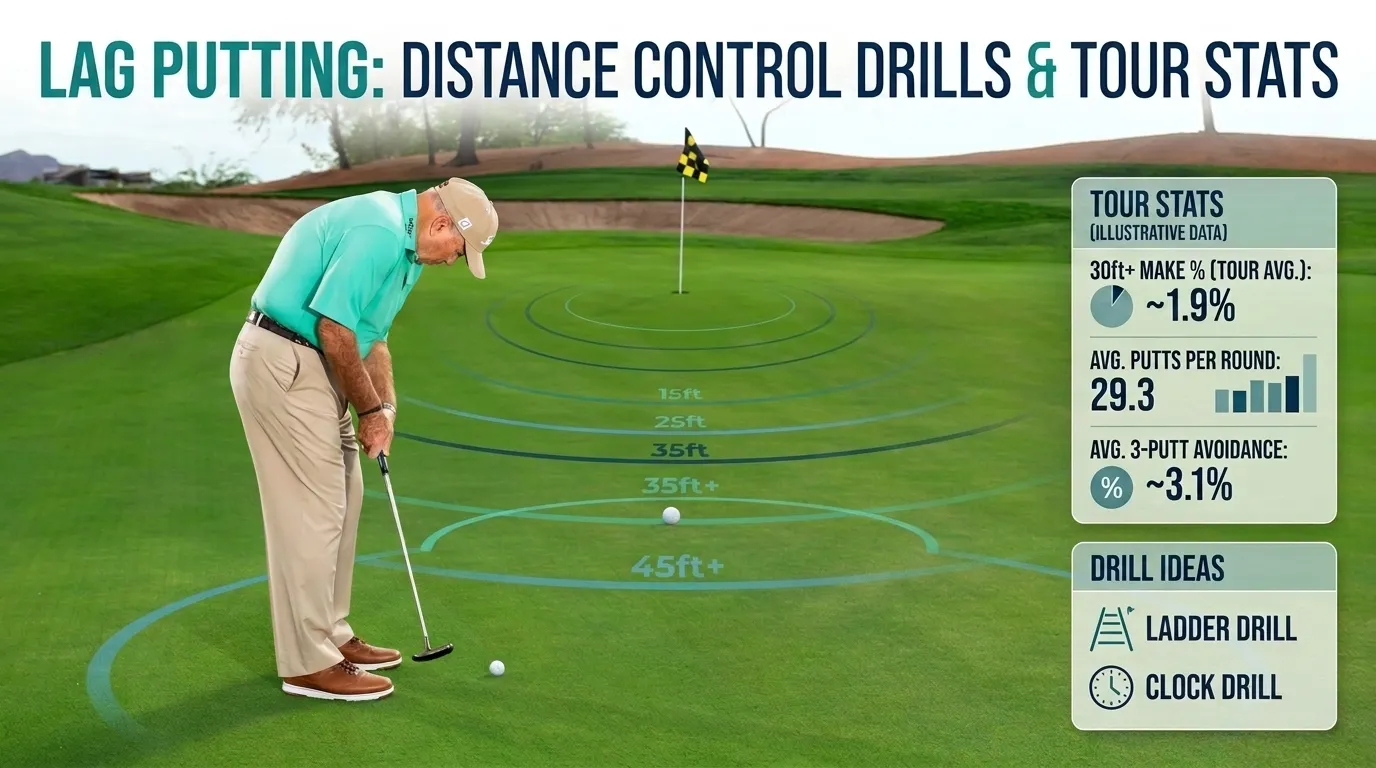
Quick Answer: A lag putt is a long putt, usually 20 feet or more, where the goal is leaving the ball inside a 3-foot circle around the hole, not making it. Speed matters more than line. PGA Tour pros sink just 7% of 30-footers, which is exactly why lagging well prevents three-putts.
I’m a mid-single-digit handicap, and I three-putted the same 45-foot birdie chance three times in one summer before I figured out what I was actually doing wrong. It wasn’t my line. I was reading those putts fine.
I was hitting them like I wanted to make them, and that mindset alone was costing me a stroke a round. Once I started treating anything over 20 feet as a speed problem instead of a makeable putt, my three-putts dropped from something like six a month to one or two.
That’s what a lag putt really tests, and it’s the most underrated skill in amateur golf. This guide covers what the term actually means, where it came from, the real PGA Tour numbers behind it, and the drills that actually move the needle, including one used by the Swedish national golf team and Ludvig Aberg.
What Is Lag Putting?
A lag putt is any putt long enough that making it isn’t realistic, so your only job is getting the ball close enough to the hole for a stress-free second putt. Most instructors put the threshold somewhere between 20 and 25 feet, though the exact number depends on your speed and the green.
Golfers use “lag” and “lagging” interchangeably with “lag putt.” You’ll also hear it used as a verb: “just lag this one up there” means don’t force it, get it close.
The mental shift matters more than the mechanical one. A 40-foot putt with a “make it” mindset produces an aggressive stroke and a much bigger miss. The same putt with a “get it inside 3 feet” mindset produces a smoother stroke and a tap-in almost every time.
Why Is It Called “Lag” Putting?
Nobody on page one of Google actually answers this, which is strange, because the origin makes the strategy easier to understand.
Golf almost certainly borrowed the term from an older sport. In billiards and pool, “lag” has referred for well over a century to a pre-game contest: each player shoots a ball down the table and back off the far rail, and whoever’s ball stops closest to the near rail wins the choice of who breaks first. Nobody is trying to sink a pocket. The entire skill being tested is distance control, rolling a ball toward a target and stopping it as close as possible.
Nobody has pinned down the exact date golf adopted the word, but that’s the same skill a lag putt tests. You’re not aiming at a 4.25-inch cup, you’re rolling a ball toward a general area and trying to stop it close. The golf usage shows up in instructional writing by at least the early-to-mid 1900s, and it stuck because it described the stroke perfectly: a putt where speed judgment, not aim, decides the outcome.
How Far Is a Lag Putt? Distance Thresholds That Matter
Most instructors set the lag putt threshold at 20 to 25 feet, though the real answer depends on the shape of the green and how confident you feel from that range.
| Putt Length | Strategy | PGA Tour Make Rate | Why |
|---|---|---|---|
| Under 15 feet | Attack it | 23%+ | Even a miss usually stays inside 3 feet |
| 15 to 25 feet | Lean toward lag | 15 to 23% | Make rate drops fast past 15 feet |
| 25 to 40 feet | Full lag mindset | 4 to 7% | This is genuine lag territory, even for tour pros |
| 40 feet and beyond | Pure speed drill | Under 4% | Three-putt risk climbs fast past here |
A 15-footer on a flat green is a different decision than a 15-footer on a severely tiered green. When in doubt, treat anything you wouldn’t bet a beer on making as a lag putt.
The Real Numbers: PGA Tour Lag Putting Stats
This is the part most lag putting articles skip, and it’s the part that actually changes how you practice.
Strokes-gained researcher Mark Broadie’s data shows how often tour pros make putts, and how often they three-putt, by distance:
| Distance | Make % | 3-Putt % |
|---|---|---|
| 5 feet | 77% | 0.4% |
| 10 feet | 40% | 0.7% |
| 15 feet | 23% | 1.3% |
| 20 feet | 15% | 2.2% |
| 30 feet | 7% | 5% |
| 40 feet | 4% | 10% |
| 50 feet | 3% | 17% |
| 60 feet | 2% | 23% |
Look at that 3-putt column. From 30 feet, tour pros still three-putt one time in twenty. From 50 feet, it jumps to nearly one in six. These are the best putters alive, and the data says lag putting stays genuinely hard even at that level.
Here’s a stat that reframes the whole conversation. Course-management coach Scott Fawcett, founder of the Decade Golf system, once ran an experiment with PGA Tour winner Aaron Wise: 20 putts, all aimed at a spot 20 feet away, no hole involved, just distance. Wise’s shot pattern came out 48 inches deep front-to-back but only about three cups wide side-to-side. That’s a dispersion pattern 3 to 6 times deeper than it is wide, and Fawcett says that ratio holds for nearly every golfer he’s tested.
Translation: your line is fine. Your distance control is what’s actually costing you strokes.
Fawcett’s other core number is what Decade calls “approach putt performance,” the average distance your first putt finishes from the hole. From 30 feet, tour players average 2.0 total putts and typically leave that first putt inside 3 feet. Amateurs leave it several times farther away on average, and that gap is the entire difference between two-putting and three-putting from long range.
Lag Putting Technique: The 3-Foot Circle and Why Speed Beats Line
This is the lag putting circle strategy, and nearly every credible source agrees on it: picture a 3-foot circle around the hole instead of the 4.25-inch cup, and your only job on a lag putt is stopping the ball somewhere inside it.
The circle works because it removes the pressure to make a putt you were never likely to hole anyway. You stop steering the ball and start rolling it.
Speed matters more than line on long putts, and the numbers back it up:
| Error Type | Typical Result | How to Fix It |
|---|---|---|
| Speed error | Ball finishes 5 to 8 feet from the hole | Lengthen or shorten your backstroke, keep the same tempo |
| Line error | Ball finishes 1 to 3 feet from the hole | Trust your read and commit to the stroke |
Misjudge your line by a few degrees and the circle still catches you most of the time. Misjudge your speed and you can end up in three-putt range even with a perfect read.
Green speed changes the math too. Firm, fast greens need a shorter backstroke and lighter grip pressure. Soft, slow greens need a longer stroke at the same tempo. Give yourself a few practice putts before your round so you’re not guessing at pace on the first green.
Common mistakes that wreck lag putts:
- Decelerating through impact. Slowing the putter down at the ball kills your distance control and usually pushes the putt offline too. Make a shorter backstroke instead and accelerate through it.
- Rushing the stroke. A quick, jabby tempo on a 40-footer is almost impossible to repeat. Let the length of your swing, not the speed of it, control distance.
- Target panic. Staring at the cup on a putt you’re not trying to make creates tension. Aim for the front edge of your 3-foot circle instead.
- Ignoring the comeback putt. Leaving the ball above the hole on a fast green sets up a slippery second putt. When you’re between two speeds, take the one that leaves you below the hole.
I’ve three-putted more comebackers from above the hole than I care to admit, usually on the same green at my home course, where the false front sends anything left short rolling all the way back to my feet. It’s an easy fix once you notice the pattern, and it costs nothing to build into your routine.
Which Putting Grip Actually Helps Your Lag Putts?
Golfers treat putting grips like a short-putt problem, but grip choice matters just as much for lag putting, maybe more.
The conventional reverse-overlap grip is still the right call for lag putting specifically, full stop. It keeps both hands fully involved in the stroke, which is where your feel for distance actually comes from. Take that feel away and speed control gets harder to trust.
Players like Scottie Scheffler have popularized the claw grip, which quiets the right hand and helps under pressure on short putts. On long putts, though, it can work against you. With the right hand mostly along for the ride, you lose some of the touch that tells your body how hard to hit a 45-footer, and on slower greens you sometimes need to add a conscious hit with the wrists to make up the difference. Cross-handed carries a similar tradeoff, trading feel for face control.
None of this means golfers who putt claw or cross-handed should switch grips before every long putt and back again for the short ones. That’s a recipe for worse results, not better ones. But if you’re building your grip from scratch and lag putting is your weak spot, start conventional and only change it if short putts turn out to be the actual problem.
Lag Putting Drills That Build Real Distance Control
Reading about speed control and actually building it are two different things. These are the drills worth your practice time.
The Ladder Drill
Place tees at 10, 20, 30, and 40 feet along the same line. Putt one ball to each tee in order, trying to stop each one within a putter length of its marker. Miss short of any tee, and you start the whole ladder over from 10 feet.
This lag putting ladder drill builds progressive feel faster than almost any other practice method because it forces your brain to recalibrate stroke length four times in a row. The first time I ran it, I whiffed the 30-foot tee three times running before I realized I was decelerating into every putt past 25 feet, the same habit that had been wrecking my scores on the course.
The Decade Speed Drill
Scott Fawcett built this Decade putting speed drill around exactly the dispersion problem his Aaron Wise data exposed. Set up gates at 1, 2, and 3 feet past your target using tees, then putt from 20, 30, and 40 feet, trying to finish inside progressively tighter zones. It isolates distance, not direction, since that’s where almost all your strokes actually disappear.
The Swedish National Team 18-Green Challenge
Jon Karlsen, a coach for the Swedish national golf team, built a putting drill that Ludvig Aberg and several other tour pros still use. Set up 18 putts of varying lengths that mimic the average first-putt distance a PGA Tour player faces across a full round, everything from short tap-ins to 50-footers, and try to finish all 18 as fast as possible.
The PGA Tour average for this challenge sits right around 29 total putts. When French pro Matthieu Pavon ran it under Karlsen’s supervision, he finished in 23. Swedish pro Fredrik Lindblom posted 28 on his own attempt. Run it once to get your baseline, then chase your own number down every time you practice.
The Fringe-to-Fringe Drill
Skip the hole entirely. Putt from 30-plus feet and try to stop the ball right at the fringe on the far side of the green. Removing the hole removes the anxiety that makes people rush their stroke, so you build pure speed feel without any outcome pressure.
Rotate through two of these drills as a daily putting drill routine, even just five or ten minutes before you tee off, and three-putts start disappearing within a few weeks.
How to Practice Lag Putting at Home
You don’t need a green to build real distance control. A hallway, a basement, or a decent stretch of carpet works fine, as long as the surface rolls consistently.
- Carpet ladder drill: Same setup as the green version, tees or coins at 5, 10, and 15 feet along a hallway. Distances feel different indoors, so don’t expect your green numbers to transfer directly. You’re training tempo and stroke length here, not exact yardage.
- Distance-matching to a sticky note: Place a playing card or sticky note as your target instead of a cup. Hit five putts trying to stop the ball on top of it, then move the target back a few feet and repeat.
- Eyes-closed feel drill: Take your practice strokes with your eyes open, then close them right before you hit the actual putt. Call out “short,” “long,” or “on line” before you look. This trains the connection between what your hands feel and what the ball actually does.
One honest limitation here: indoor practice builds tempo and touch, but it can’t replicate real green speed, grain, or slope. Treat it as reps for your stroke mechanics, then confirm your actual distances the next time you’re on a real green.
Best Putters for Lag Putting in 2026
A putter won’t fix a bad speed decision, but the right head can make mis-hits cost you less distance, and that matters more on a 40-footer than a 4-footer.
| Putter | Style | Price (2026) | Best For |
|---|---|---|---|
| Cleveland Huntington Beach Soft | Blade and mallet options | ~$129 to $179 | Budget-conscious golfers who still want a soft, forgiving face |
| Odyssey White Hot OG | Mallet | ~$199 to $250 | Golfers who want proven feel with real forgiveness |
| TaylorMade Spider GTX | High-MOI mallet | ~$250 to $450 | Anyone chasing maximum forgiveness on off-center lag putts |
| L.A.B. Golf DF3 | Lie Angle Balance mallet | ~$399 to $499 | Golfers who struggle to keep the face square on long strokes |
| Bettinardi BB6.0 | Milled mallet | ~$500 | Players who want tour-level milling with no compromise on feel |
I tested a low-MOI blade against a Spider GTX from 40 feet on my practice green last spring, mishitting toward the toe on purpose both times. The blade came up six feet short. The Spider finished two feet long. That gap is the entire argument for a forgiving head on long putts.
High-MOI mallets like the Spider GTX or the DF3 earn their price tag here more than they do on short putts, since a toe or heel strike from 40 feet with a low-MOI blade can leave you 8 feet short or long, while the same mis-hit with a high-MOI head might only cost a foot or two. It’s also worth checking your putter loft is dialed in. Too much forward lean, or too little, changes how consistently the ball starts rolling in the first place.
If you’re fighting something closer to the yips than a distance problem, a broomstick-length model like the L.A.B. Golf Mezz.1 Max is worth a demo day, though it’s a specific fix for a specific issue rather than a free upgrade for everyone.
Frequently Asked Questions
What is lag in putting?
Lag, or a lag putt, is a long putt where the goal is distance control instead of making it. You’re trying to leave the ball inside a 3-foot circle around the hole so your next putt is a tap-in, not trying to hole out.
What’s the secret to good lag putting?
Length of stroke, not force. Control distance by making your backswing bigger or smaller while keeping the same smooth tempo every time. Golfers who try to control distance by swinging harder or softer with the same stroke length end up wildly inconsistent.
How far is a lag putt?
Most instructors consider anything over 20 to 25 feet a lag putt, though a severely sloped or tiered green can turn even a 15-footer into one.
How often should I practice lag putting?
A few minutes before every round, plus one focused practice session a week using drills like the ladder drill or the Decade speed drill. Most amateurs spend nearly all their practice time on putts inside 10 feet and almost none on the putts that actually cause three-putts.
What are some drills for lag putting?
The ladder drill, the Decade speed drill, the Swedish national team’s 18-putt challenge, and the fringe-to-fringe drill all target distance control specifically. Rotate between them so you’re not just memorizing one green’s speed.
What distance is considered a lag putt?
Somewhere past 20 feet for most golfers, though the real threshold is whatever distance you wouldn’t confidently bet on making.
What is the goal of lag putting?
Getting the ball inside a 3-foot circle around the hole so your second putt is essentially automatic, not sinking the first putt.
Lower Your Score Without Changing Your Swing
Lag putting is the fastest stroke you’ll ever gain without touching your full swing. You already have it. What’s missing for most golfers is treating anything past 20 feet as a distance problem instead of a putt you’re trying to make.
Start with the ladder drill this week, add the Decade speed drill once that feels comfortable, and track your three-putts per round for a month. If hitting more approach shots pin high is also on your improvement list, better lag putting is what turns those closer approaches into real birdie chances instead of two-putts from 30 feet.