
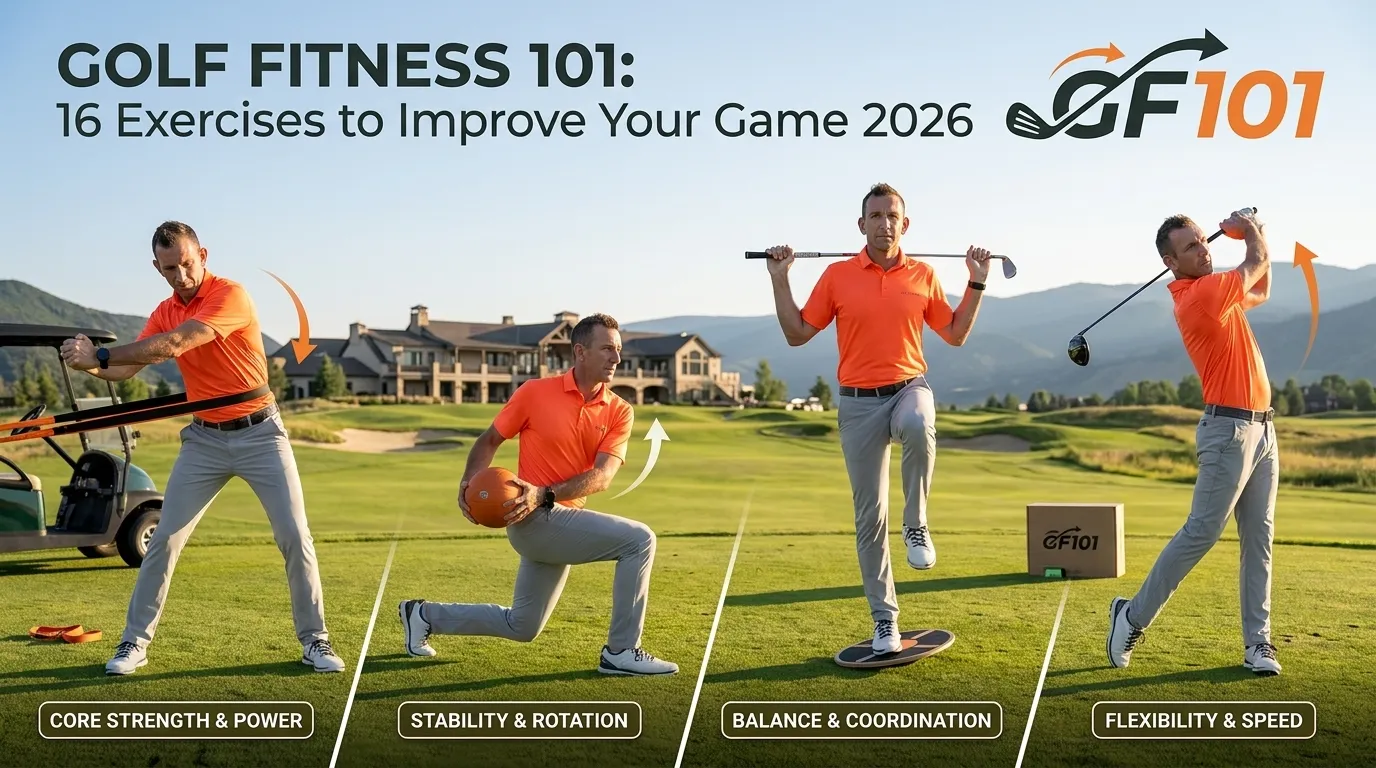
Quick Answer: Golf fitness means training rotational power, core stability, hip and shoulder mobility, and grip endurance, the specific physical qualities the golf swing demands. Sixteen exercises below cover all five categories with exact sets, reps, and hold times. Most golfers see real swing speed gains within six to eight weeks of two to three sessions a week.
I play to an 8 handicap at a windy municipal course, and for years I treated fitness as something other golfers did. Then I added three specific exercises to my week last off-season and watched my driver swing speed climb from 96 mph to 104 mph in about ten weeks. My carry distance went from 235 yards to roughly 251. Nothing about my technique changed. My body just stopped getting in its own way.
That’s what this guide is about. Golf Fitness 101 covers sixteen golf exercises across five categories, mobility, core stability, strength and power, balance, and grip, with the exact sets, reps, and hold times nobody else bothers to give you. You’ll also get a weekly schedule you can actually follow and a table that matches specific exercises to the swing faults they fix.
Why Golf Fitness Actually Moves Your Scorecard (Not Just Your Waistline)
Golf looks slow from the clubhouse patio. A four-and-a-half-hour round with a cart looks like the opposite of athletic. But the swing itself is one of the most one-sided, high-speed movements in any sport most amateurs attempt, and your body pays for that mismatch whether you notice it or not.
I felt this gap personally last May, standing on a par-5 that a couple of my playing partners were reaching in two while I was still punching a hybrid from 210 yards out. Not a swing problem. A physical one.
Why TPI Exists
The Titleist Performance Institute, known as TPI, was founded in 2003 specifically because golf had no dedicated fitness discipline before that. Every trainer had been borrowing drills from baseball or tennis and hoping they’d transfer. TPI built a screening system around one idea: the golf swing has specific physical requirements, and most golfers fail two or three of them without knowing it.
Consider the gap between tour professionals and the average amateur. PGA Tour players carried the ball 300.5 yards on average in 2025, according to TrackMan and PGA Tour data, while the average male amateur carries about 224.7 yards (Arccos, 2025). Some of that 76-yard gap comes from technique and equipment. A meaningful chunk of it comes from rotational power, hip mobility, and core strength most weekend golfers never train, and it’s worth a look at our golf club distance chart by skill level, which breaks down realistic yardages by swing speed and notes that golfers who commit to a structured fitness routine over three to six months regularly add 5 to 15 mph of clubhead speed.
None of this is guesswork, either. A study published in the Journal of Strength and Conditioning Research (Lephart et al., 2007) put recreational golfers through an eight-week golf-specific exercise program and found real improvements in physical characteristics, swing mechanics, and overall golf performance, not just gym numbers. Eight weeks. That’s shorter than most golfers spend chasing a swing thought that never sticks.
Here’s my honest opinion after years of treating fitness as an afterthought: the single highest-leverage thing a mid-to-high handicapper can do for their scoring average isn’t another lesson. It’s two focused fitness sessions a week for two months.
The 5-Minute Screen: Are You Actually Ready to Train for Golf?
Before you touch a single exercise on this list, run yourself through a quick physical check similar to a real TPI screen. TPI-certified trainers use a longer, more thorough version of this same test, but you can get a useful read on your own body in about five minutes.
- Toe touch: Stand with straight legs and reach for your toes. Can’t get within a few inches? Your hamstrings and low back are probably limiting your posture at address.
- Overhead deep squat: Squat down while holding a club overhead with straight arms. Knees cave inward or heels lift off the ground? Your ankles and hips need mobility work before you load them with strength training.
- Single-leg balance: Stand on one leg with your eyes closed for 20 seconds. Wobbling everywhere? Stability, not strength, is probably costing you consistency on the course.
- Seated torso rotation: Sit in a chair, cross your arms over your chest, and rotate your torso as far as you can each way without your hips following. Less than about 45 degrees per side? That’s a mobility restriction showing up as a shorter backswing, not a swing flaw.
Fail two or more of these and lead with mobility work for two to three weeks before adding real strength load. Pass all four and you can jump straight into the strength and power section further down. Either way, don’t skip the check. Loading a rotational power exercise onto a hip that can’t rotate is exactly how golfers end up hurt instead of longer off the tee, and golf injury prevention starts with knowing your restrictions before you load them.
How Often Should Golfers Actually Train?
Every one of the sixteen exercises below works. None of them work if you do them once and never touch them again. The bigger question, and the one nobody selling you a workout list wants to answer specifically, is how many days a week you actually need.
| Golfer type | Off-season | In-season |
|---|---|---|
| Casual (plays once a week or less) | 2 sessions/week, 20-30 min | 1 session/week, 15-20 min |
| Regular (plays 2-3 rounds a week) | 3 sessions/week, 30-40 min | 2 sessions/week, 20-30 min |
| Competitive (plays 4+ times a week or in leagues) | 3-4 sessions/week, 40-60 min | 2-3 sessions/week, 30 min |
A structured routine at this frequency is where the 5 to 15 mph clubhead speed gains mentioned above actually come from over three to six months. You don’t need to live in a gym. Consistency across two to three months at two or three sessions a week matters far more than any single workout, and that consistency is the entire idea behind Golf Fitness 101.
The 16 Exercises
Here are the sixteen golf exercises, grouped by what they actually train instead of thrown together in a random order. Every entry gives you sets, reps or hold time, the muscles doing the work, and a difficulty tag so you know whether to start here or build up to it.
Mobility & Flexibility
These golf mobility exercises target the hips and shoulders that most amateurs restrict without realizing it.
1. Torso Rotation Stretch
Sets/reps: 2 sets of 10 rotations per side Muscles: obliques, thoracic spine, lats Difficulty: Beginner
Hold a golf club across the back of your shoulders like a barbell. Rotate your torso to the right as far as it’ll go without your hips turning, pause a beat, then rotate left. This is the easiest way to find out whether your body or your technique is limiting your backswing.
2. Kneeling Hip Flexor Stretch
Sets/reps: 2 sets of 30-45 seconds per side Muscles: hip flexors, psoas Difficulty: Beginner
Kneel on one knee with your other foot flat in front of you, then shift your hips forward until you feel a stretch down the front of the kneeling leg’s hip. Keep your torso tall instead of leaning forward, or you’ll stretch your lower back instead. Tight hip flexors are the quiet reason a lot of golfers lose posture and stand up out of their swing through impact.
3. 90/90 Hip Rotation
Sets/reps: 8-10 reps per side Muscles: hips, glutes, adductors Difficulty: Intermediate
Sit on the ground with your front leg bent at 90 degrees in front of you and your back leg bent at 90 degrees to the side. Rotate through your hips to bring your back leg around to the front, then switch which leg leads. Golfers with restricted hip rotation almost always compensate with their lower back, and that compensation is where a lot of golf-related back pain starts. Combined with the hip flexor stretch above, these are two of the most useful golf exercises for hip mobility you’ll find, and neither one needs equipment.
4. Thread the Needle
Sets/reps: 2 sets of 8 reps per side, hold 2 seconds at end range Muscles: thoracic spine, shoulders Difficulty: Beginner
Start on your hands and knees, then slide one arm underneath your body and rotate your shoulder toward the floor. Reach that same arm back up toward the ceiling to reverse the motion. This one directly targets the mid-back rotation you need for a full shoulder turn, so your lower back doesn’t have to pick up the slack.
Core & Stability
These core exercises for golf train stability first, not six-pack aesthetics.
5. Front Plank
Sets/reps: 3 sets of 30-45 seconds Muscles: rectus abdominis, transverse abdominis Difficulty: Beginner
Hold a straight line from your shoulders to your heels, forearms on the ground, and resist the urge to let your hips sag or pike upward. A strong plank transfers directly into a spine angle that holds up over eighteen holes instead of breaking down on hole 14.
6. Side Plank
Sets/reps: 3 sets of 20-30 seconds per side Muscles: obliques, glute medius Difficulty: Intermediate
Stack your feet, prop yourself up on one forearm, and lift your hips until your body forms a straight line. Side planks build the lateral core stability that keeps your spine angle from collapsing during the downswing, and that collapse is exactly where a lot of thin and fat contact comes from.
7. Anti-Rotation Pallof Press
Sets/reps: 2 sets of 10-12 per side Muscles: obliques, deep core Difficulty: Intermediate
Anchor a resistance band at chest height, stand sideways to the anchor, and press the band straight out from your chest while resisting the urge to rotate toward it. Your core fights rotation here, the exact opposite job it does during your swing. Training both directions builds a trunk that holds up better under real swing loads.
8. Bird Dog
Sets/reps: 2 sets of 10 reps per side Muscles: erector spinae, glutes, core Difficulty: Beginner
On hands and knees, extend your right arm and left leg at the same time while keeping your back flat and hips level. Lower with control and switch sides. Bird dogs teach your core to stabilize while your limbs move, which is a fair description of what your body does through impact.
Strength & Power
These are the exercises to increase golf swing speed fastest, once your mobility screen checks out.
9. Goblet Squat
Sets/reps: 3 sets of 10-12 Muscles: quads, glutes, core Difficulty: Beginner
Hold a dumbbell or kettlebell vertically at your chest and squat down until your thighs are at least parallel to the ground, then drive back up through your heels. Squats build the ground force your legs need to generate clubhead speed. I’d put this at the top of the list if I could only keep one strength exercise, and it’s not close.
10. Single-Leg Romanian Deadlift
Sets/reps: 3 sets of 8 per side Muscles: hamstrings, glutes, lower back Difficulty: Intermediate
Stand on one leg, hinge at your hips while your other leg extends behind you, and lower a dumbbell toward the ground while keeping your back flat. Return to standing with control. This builds the posterior chain strength that keeps your spine angle locked in from address to impact, and it trains the single-leg stability golf actually demands, since you never stand on two feet evenly during the swing.
11. Reverse Lunge
Sets/reps: 3 sets of 10 per side Muscles: quads, glutes, hamstrings Difficulty: Beginner
Step backward into a lunge until your front thigh is parallel to the ground, then push through your front heel to return to standing. Reverse lunges are easier on the knees than forward lunges, and they build the single-leg strength your downswing relies on.
12. Medicine Ball Rotational Throw
Sets/reps: 3 sets of 6-8 per side Muscles: obliques, hips, shoulders Difficulty: Advanced
Stand side-on to a wall, load your weight into your back hip, then explosively rotate and throw a medicine ball into the wall at chest height. Catch the rebound and reload. This is the closest movement on this list to your actual golf swing, and it’s where the mobility and strength you built elsewhere finally turn into clubhead speed.
Balance
13. Single-Leg Balance Reach
Sets/reps: 2 sets of 8 reaches per side Muscles: glute medius, ankle stabilizers Difficulty: Beginner
Stand on one leg and reach your opposite hand toward your toes, then return to standing tall without touching your other foot down. Balance work like this trains the small stabilizer muscles that never show up on a bathroom scale but absolutely show up in your strike quality.
14. Lateral Bound
Sets/reps: 2 sets of 8 per side Muscles: glutes, calves, ankles Difficulty: Advanced
Balance on one leg, jump sideways to land on the other leg, and hold that landing for a full three-second count before bounding back. Save this one until you can comfortably hold a single-leg balance for 20 seconds without wobbling, since landing control matters more here than jump distance.
Grip & Forearm
15. Farmer’s Carry
Sets/reps: 3 sets of 40-yard walks Muscles: forearms, grip, traps, core Difficulty: Beginner
Pick up a heavy dumbbell or kettlebell in each hand and walk 40 yards with your shoulders back and your core braced. Farmer’s carries are the single most underrated exercise on this list, and it’s not close. They build the grip endurance that keeps your hands from weakening on hole 16, plus real trap and core strength, all in one unglamorous movement.
16. Band Finger and Wrist Extension
Sets/reps: 2 sets of 15 reps Muscles: forearm extensors, wrist Difficulty: Beginner
Wrap a light rubber band around your fingers and thumb, then spread your fingers against the resistance before returning to the start. Follow it with slow wrist extensions using a light dumbbell. Golfers train grip strength constantly and almost never train the opposing extensor muscles, and that imbalance is a common, quietly overlooked overuse injury waiting to happen at the elbow.
If you’re picking through this list for the best golf exercises for beginners, stick to anything tagged Beginner above and build from there before you touch the Advanced tier.
Match the Exercise to Your Swing Fault
A generic exercise list only answers half the question. The more useful question is which specific exercise fixes the specific miss you’re actually fighting on the course.
| Swing fault | Likely physical cause | Exercises that help |
|---|---|---|
| Early extension (standing up through impact) | Weak core and glutes, poor hip hinge | Goblet Squat, Bird Dog, Anti-Rotation Pallof Press |
| Losing posture or a chicken wing at impact | Limited thoracic and shoulder mobility | Thread the Needle, Torso Rotation Stretch |
| Casting or an early release | Weak anti-rotation core, poor sequencing | Anti-Rotation Pallof Press, Medicine Ball Rotational Throw |
| Inconsistent, thin or fat contact | Poor balance and lower-body stability | Single-Leg Balance Reach, Lateral Bound |
| Short or inconsistent driving distance | Limited hip and rotational power | Single-Leg Romanian Deadlift, Reverse Lunge, Medicine Ball Rotational Throw |
| Grip fatigue late in the round | Weak forearms and grip endurance | Farmer’s Carry, Band Finger and Wrist Extension |
Building Your Weekly Golf Fitness Routine
Here’s the actual weekly split I used during the off-season that took my swing speed from 96 to 104 mph. I’m a Regular-frequency golfer by the table above, playing two to three rounds a week most of the year.
| Day | Focus | Exercises | Time |
|---|---|---|---|
| Monday | Mobility + Core | Torso Rotation Stretch, Hip Flexor Stretch, Front Plank, Bird Dog | 20 min |
| Tuesday | Strength | Goblet Squat, Single-Leg RDL, Reverse Lunge, Farmer’s Carry | 35 min |
| Wednesday | Rest or walk | – | – |
| Thursday | Mobility + Balance | 90/90 Hip Rotation, Thread the Needle, Single-Leg Balance Reach | 20 min |
| Friday | Power | Medicine Ball Rotational Throw, Lateral Bound | 25 min |
| Saturday | Play golf | – | – |
| Sunday | Play golf or full rest | – | – |
That’s five weeks I’d repeat before retesting my single-leg balance and toe touch from the screen earlier in this guide. Better numbers meant adding weight. No change meant holding the load steady and fixing mobility first, because a golf specific workout at home only pays off if you’re honest about which one you actually need. Track how your handicap responds over a full season, and if you want a refresher on what your number actually measures, our golf handicap guide breaks down every detail.
Who This Isn’t For (Honest Limitations)
Golf Fitness 101 won’t fix everything, and I’d rather say that upfront than have you find out after a wasted month.
If you’re nursing a current low-back or wrist injury, don’t start here cold. Get cleared by a physio or a TPI-certified professional first, because several of these movements, the medicine ball throws and lateral bounds especially, will aggravate an existing issue instead of helping it.
And if you already play to a low single-digit handicap with a swing coach and a structured program, sixteen general exercises probably won’t move your game much further. What actually helps at that level is an individualized screen that finds your specific restriction, not a list built for the much larger group of golfers who never train at all.
Frequently Asked Questions
What type of fitness is needed for golf?
Golf demands rotational power, core and hip stability, shoulder and thoracic mobility, and grip endurance more than raw strength or cardio. A golfer who rotates freely and stabilizes through impact will usually out-drive a stronger golfer who can’t do either.
Can I improve golf fitness at home?
Yes, a golf specific workout at home needs nothing more than a resistance band, a couple of dumbbells, and floor space. The plank, bird dog, both hip stretches, and all the balance work above need zero equipment at all.
Will regular exercise make me a better golfer?
For most golfers, yes, and the research backs it up. An eight-week golf-specific training program produced measurable improvements in swing mechanics in a controlled study, which is a shorter commitment than most golfers already put into lessons that never quite stick.
What is the best golf workout?
The best golf workout matches your actual restrictions from the 5-minute screen above, not a generic program copied from a tour pro’s Instagram. A casual golfer chasing consistency needs a different mix than a competitive player chasing 10 more yards.
Is hip mobility important in the game of golf?
It’s arguably the single most important physical quality in the entire swing. Nearly every major power leak, from early extension to a restricted backswing, traces back to a hip that can’t rotate freely, and the 90/90 and hip flexor stretches above target exactly that.
How many days a week should golfers work out?
Two to three focused sessions a week covers most golfers, more during the off-season and fewer once the season’s in full swing. Consistency across two to three months matters more than the exact number on the calendar, and that’s the core rule behind Golf Fitness 101.
Final Thoughts
Golf Fitness 101 was never about turning yourself into a bodybuilder who happens to play golf. It’s about fixing the handful of physical restrictions quietly capping your swing speed, your consistency, and your enjoyment of the back nine. Run the screen, pick your frequency from the table above, and give it eight weeks before you judge the results. Once your body can actually deliver the swing you’re trying to make, pair these gains with real time at the range, our best golf driver drills guide is a good next stop.