
I play to an 8 handicap on a course with firm Bermuda fairways and postage stamp greens. Two summers ago I switched my 56 degree wedge from 8 degrees of bounce to 12, chasing more spin off tight lies. It cost me three up and downs in a single member guest before I figured out why.
The extra sole kept skidding into the ball on my normal, slightly steep strike instead of catching just enough turf to compress it. Get the number wrong and the club fights your swing every time you pull it out of the bag. This guide breaks down what that number actually does, gives you a real chart with 2026 model numbers and prices, and tells you exactly what to buy for your swing and your course.
Quick Answer: Wedge bounce is the angle between the leading edge and the sole, and it keeps the club gliding through turf instead of digging. Low bounce (4°-6°) suits shallow swingers on firm ground. High bounce (10°-14°) suits steep swingers and soft turf. Most golfers play best around 10°-12°.
What Is Wedge Bounce?
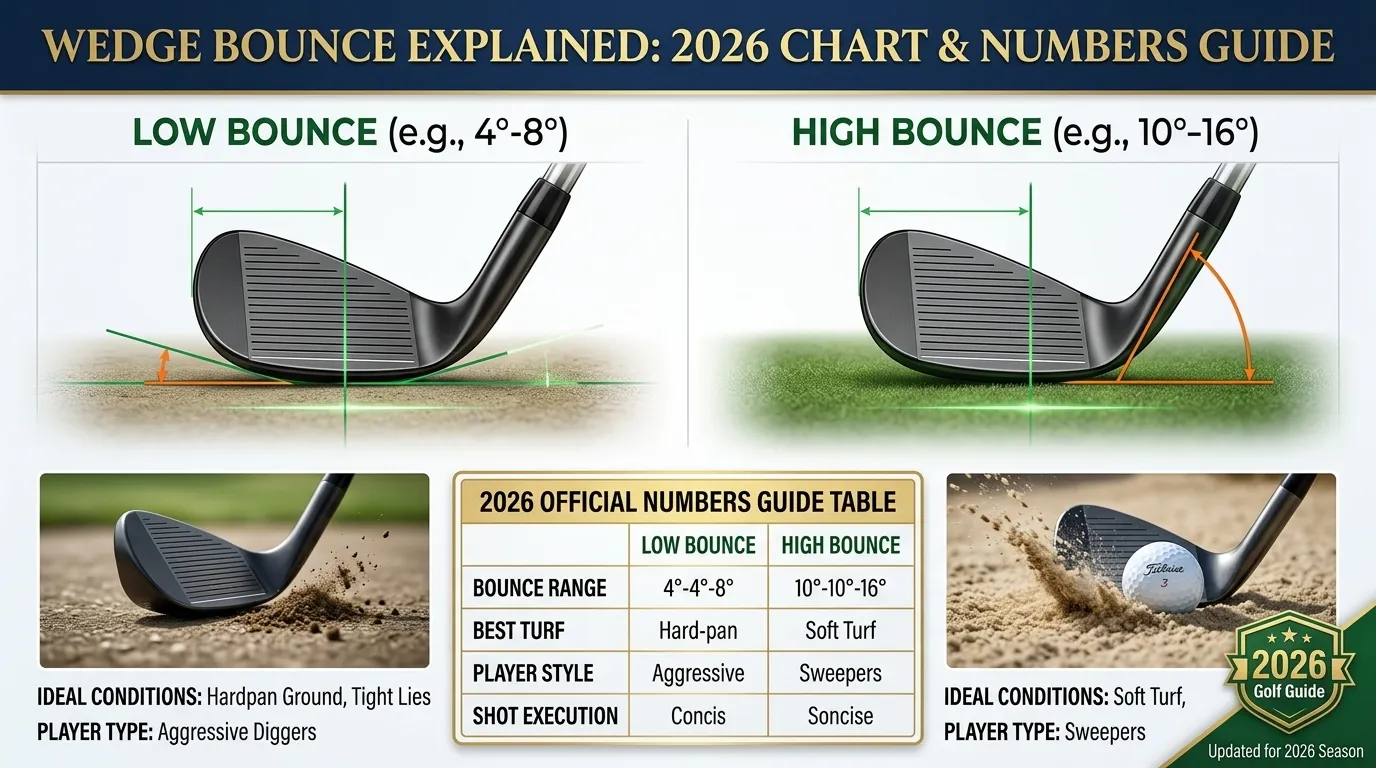
Wedge bounce is the angle between a wedge’s leading edge and the lowest point of its sole when the club rests flat on the ground. Titleist’s Bob Vokey, the man most club fitters credit with popularizing the concept, calls bounce your friend because it stops the leading edge from digging straight into the ground. Rest a wedge on a table and you’ll see the gap. That gap is bounce.
Manufacturers stamp the number in degrees right next to the loft, so a wedge marked 56.10 carries 56 degrees of loft and 10 degrees of bounce. More degrees means more sole sits below the leading edge, and the club rides higher off the turf at address. Fewer degrees means the leading edge sits closer to the ground, ready to slide underneath the ball on a clean strike.
This single number decides whether your club skips through impact or buries itself. Get it wrong on a soft course and you’ll chunk chips all day. Get it wrong on a firm one and you’ll blade them across the green instead.
Low, Mid, and High Bounce: The Degree Ranges That Actually Matter
Every major manufacturer breaks bounce into three rough bands, and they agree with each other closer than you’d expect. Low bounce runs from about 4 to 6 degrees. Mid bounce sits around 7 to 10 degrees. High bounce covers 11 degrees and up, sometimes reaching 14 on the widest sand wedge soles.
Low bounce rewards a sweeping, shallow strike and firm turf. Mid bounce is the safest starting point for almost anyone, since it plays acceptably on both firm and soft ground. High bounce protects steep swingers who take a real divot, especially out of soft turf or fluffy bunker sand.
Here’s the breakdown in one place:
| Bounce Range | Degrees | Best Swing Type | Best Conditions |
|---|---|---|---|
| Low | 4°-6° | Shallow, sweeping | Firm turf, hardpan, coarse sand |
| Mid | 7°-10° | Neutral, moderate divot | Mixed or average conditions |
| High | 11°-14° | Steep, deep divot | Soft turf, fluffy sand, thick rough |
None of this replaces an actual fitting, and I’ll say that plainly because most articles won’t. But if you’ve never had your swing measured, these three bands get you within a few degrees of correct, and a few degrees rarely ruins a shot. It’s the wrong band, not the wrong degree, that costs you strokes.
How to Find Your Bounce Without a Launch Monitor
You don’t need a Trackman session to get in the right neighborhood. Grab a few range balls and your current wedge, then hit ten shots off real turf, not a mat. Look at the divots, not the ball flight.
Deep divots that remove a real chunk of turf mean you swing steep and need more bounce, toward the high end of the range. Shallow scuffs or no mark at all mean you sweep the ball and should lean low. A moderate, dollar-bill-sized divot puts you in the mid range, which covers most recreational golfers.
Next, think about where you actually play. A muni with hard, dry fairways all summer pushes you toward less bounce than the same swing would need on a soft, well-watered course. Match the swing test to the turf test, and you’ll land within a degree or two of a real fitting result without paying for one.
Wedge Bounce and Grind, Explained
Golfers lump bounce and grind together constantly, and they’re related, but they’re not the same measurement. Bounce is the angle we’ve been discussing, a single number in degrees. Grind is the physical shaping of the sole itself, how much metal a manufacturer removes from the heel, toe, or trailing edge.
Picture two wedges stamped with identical 10 degrees of bounce. One has a full, wide sole. The other has material ground away from the heel. Both measure 10 degrees on a bounce gauge, but they behave completely differently the moment you open the face, because grind decides how much of that stated bounce actually reaches the ground.
Vokey uses six letter codes on the current SM11 lineup: F, S, M, D, K, and T. Ping uses its own set of grind letters on the S259, including S, W, B, E, and T, spread across 25 loft and grind combinations. Cleveland skips letters entirely on the RTZ line and just labels soles LOW, MID, FULL, or the newer ADAPT grind. A “10 bounce, M grind” Vokey and a “10 bounce, S grind” Ping can feel like two different clubs in your hands even though the number on the sole matches.
The 2026 Bounce Chart: Vokey SM11 vs Ping S259 vs Cleveland RTZ
Every wedge guide on the internet tells you bounce runs low, mid, or high. Almost none of them show you what that actually looks like on the wedges sitting on a store shelf this month. Here’s the wedge bounce chart for the current Vokey SM11 lineup, straight from retailer spec sheets, current as of July 2026.
| Loft | Bounce | Grind |
|---|---|---|
| 50° | 8° | F |
| 50° | 12° | F |
| 52° | 8° | F |
| 52° | 12° | F |
| 54° | 8° | M |
| 54° | 10° | S |
| 54° | 12° | D |
| 54° | 12° | F |
| 56° | 9° | M |
| 56° | 10° | S |
| 56° | 12° | D |
| 56° | 14° | F |
| 58° | 4° | T |
| 58° | 6° | K |
| 58° | 8° | M |
| 58° | 10° | S |
| 58° | 12° | D |
| 58° | 12° | K |
| 60° | 4° | T |
| 60° | 6° | K |
| 60° | 8° | M |
| 60° | 10° | S |
| 60° | 12° | D |
| 60° | 12° | K |
Wedge Guide
Titleist also builds the F grind down to 44 degrees at 10 degrees of bounce for players who want a Vokey pitching wedge. A new SM11 wedge runs $199.99 to $209.99 depending on finish. Worth noting: the SM11’s high-bounce K grind actually dropped from 14 to 12 degrees compared to the previous SM10, a detail most gear sites still haven’t updated.
Ping’s S259 spans 46 to 62 degrees across six grinds, with the S grind sitting around 10 to 12 degrees for most of the lineup, the W grind running as high as 14 at the gap wedge lofts, and the B grind dropping to 8 degrees for shallow, firm-turf players. It retails for $199 to $217.50 MSRP, with the outgoing S159 discounted to around $179.99 while stock lasts.
Cleveland skips the letter system on the RTZ line and spans 46 to 64 degrees across four sole options, LOW, MID, FULL, and ADAPT, each carrying a different effective bounce built into the shape rather than a single stamped number. A new RTZ runs about $159.99 to $179.99, and the outgoing RTX 6 ZipCore is already discounted to $129.99 to $139.99 at most retailers, the same clearance pricing Lucas Glover just took advantage of on Tour, which makes it one of the better values in wedges right now if the grind fits your swing.
| Model | Bounce Range | Grind Options | Price (2026) |
|---|---|---|---|
| Titleist Vokey SM11 | 4°-14° | F, S, M, D, K, T | $199.99-$209.99 |
| Ping S259 | 8°-14° | S, W, B, E, T | $199-$217.50 |
| Cleveland RTZ | Varies by sole | LOW, MID, FULL, ADAPT | $159.99-$179.99 |
| Cleveland RTX 6 (clearance) | Varies by sole | LOW, MID, FULL | $129.99-$139.99 |
Titleist still sells more wedges on tour than anyone else, and the SM11’s spec sheet shows why. Nobody else offers this many loft, bounce, and grind combinations off the rack. But Ping’s S259 isn’t far behind on performance for less money in most configurations, and I think it’s the better value for anyone who isn’t precious about the Vokey name on the back of the club.
How to Read the Numbers Stamped on Your Wedge
Pick up almost any modern wedge and you’ll find a small stamp on the sole that looks like a code, something like 56.10M or 58.08S. That’s not random. It’s loft, then bounce, then grind, in that exact order, across every major brand.
56.10M breaks down as 56 degrees of loft, 10 degrees of bounce, M grind. Lydia Ko’s own Vokey SM11 setup includes a 58 degree stamped 08M, meaning 8 degrees of bounce on the M grind, which she uses because it lets her manipulate the face without excess sole getting in the way.
Once you can read that stamp, you can compare any two wedges on a shelf in about five seconds, no salesperson required.
What Bounce Do I Need? By Wedge Type
The right number also depends on which wedge you’re talking about, since a gap wedge and a lob wedge do very different jobs in your bag.
Gap Wedge
A gap wedge, usually 50 to 52 degrees, sees mostly full or three-quarter swings from the fairway. Match it to your irons rather than to soft-condition logic. Most golfers do fine with 8 to 12 degrees here, and the F grind on the Vokey chart above covers this loft cleanly.
Sand Wedge
Sand wedges carry more bounce than any other club in the bag for a reason. Traditional models run 12 to 14 degrees because the sole needs to slide under the ball through sand instead of digging a trench.
I carry a 56 degree, 12 bounce sand wedge specifically for greenside bunkers on my home course, where the sand stays soft and fluffy most of the year. Drop below 10 degrees in soft sand and you’ll catch the leading edge and skull it over the green more often than you’d like.
Lob Wedge
Lob wedges split golfers into two camps on bounce. Players who open the face for flop shots want a low number, often 4 to 8 degrees, since opening the face already adds effective bounce back in. Players who use a 58 or 60 mostly for full shots or bunker work want more, typically 10 to 12.
A 60 degree wedge with 4 degrees of bounce is a specialist’s tool, not a beginner’s safety net. Most 20-handicappers who buy the low-bounce Tour version end up chunking more chips than they save, because they don’t have the face control to make that thin sole work for them.
Bounce for High Handicappers and Beginners
If you’re working on breaking 100 or 90, bounce is one of the cheapest strokes you can save without changing your swing at all. Higher handicappers typically take steeper, less consistent divots than better players, and forgiveness matters more than shot-shaping options at this stage.
Getting bounce right matters more for high handicappers and beginners than for any other group in the game. Wedges with high bounce, 10 degrees and up, forgive the fat and chunked shots that cost most mid-to-high handicappers strokes around the green. A wide sole does the work that a precise strike would otherwise need to do.
Skip the low-bounce specialist grinds entirely at this stage. A 56 degree sand wedge at 10 to 12 degrees of bounce and a 58 or 60 degree lob wedge at 10 to 12 degrees cover the vast majority of shots you’ll actually face, and both are far more forgiving than anything a Tour player would choose for themselves.
When Bounce Doesn’t Matter As Much As You Think
Bounce gets treated like a magic fix online, and it isn’t one. If your strike is wildly inconsistent, from three inches fat to clean contact to thin, no bounce number solves that by itself. Bounce narrows your margin for error. It doesn’t remove the need to practice.
I’ve also found that once you’re playing a mid-bounce wedge in the 10 to 12 degree range, the real-world difference between 10 and 11 degrees is nearly impossible to feel on the course. Chase the correct band, not the exact number, and spend the extra time hitting balls instead of researching spec sheets.
Frequently Asked Questions
What does wedge bounce mean?
Wedge bounce means the angle between a wedge’s leading edge and the lowest point of its sole, stamped in degrees right next to the loft. It’s the spec that determines whether the club digs into turf and sand or glides through it.
What’s the difference between bounce and grind?
Bounce is the angle measurement. Grind is the physical shaping of the sole that decides how much of that stated bounce actually touches the ground once you open or close the face.
What bounce should my sand wedge have?
Most sand wedges perform best at 10 to 14 degrees of bounce, since the wide sole needs to slide through sand rather than dig into it. Firmer, coarser sand can drop that number toward 10, while soft, fluffy sand rewards 12 to 14.
What’s the best bounce for a 60 degree wedge?
For most golfers, 8 to 12 degrees on a 60 degree wedge balances forgiveness with versatility. Save the 4 to 6 degree Tour grinds for players who already open the face confidently on tight lies.
Is 8 degrees of bounce too low?
Eight degrees sits at the upper edge of the low bounce range, so it isn’t too low for firm turf and a shallow, sweeping swing. It gets riskier on soft ground or if you take a real divot, since the leading edge gets less help staying out of the turf.
Is 12 degrees of bounce too much?
Twelve degrees is high bounce but far from excessive. It’s the standard spec on most stock sand wedges and works well for the majority of recreational golfers, especially in soft turf or bunker-heavy conditions.
Does wedge bounce matter for beginners?
Yes, more than for any other group. Beginners take less consistent divots than experienced players, and higher bounce forgives the fat and chunked shots that come with an inconsistent strike.
Can you change the bounce angle on an existing wedge?
A qualified club fitter can grind bounce down slightly by removing material from the sole, but nobody can add bounce to a wedge that doesn’t already have it. Get the number right at purchase instead of trying to fix it afterward.
Conclusion
Bounce isn’t a spec you can afford to ignore, but it’s also not something to overthink. Figure out your swing type from your actual divots, match it to the conditions you play most, and pick a number in that range from a current wedge like the SM11, S259, or RTZ. Once your bounce is dialed in, the next question is usually gapping your wedges correctly, which our golf club lofts guide covers in full. Get the band right, keep practicing your strike, and the rest takes care of itself.