
You stand on the tee box. You hit one perfect drive. Then you inexplicably slice the next one into the woods. You feel like you made the exact same swing. Golfers drown in complex swing tips.
Most of these tips fail to address the root cause of the ball flight. Golf coach Danny Maude teaches one timeless principle. This principle dictates ball flight completely. It is called face to path.
You can fix your golf slice at setup before you even make a backswing. Keep reading for the best driver setup tips to hit driver straight every time.
Face to Path: The One Rule That Controls Every Drive

Many golfers try to change their entire swing. But you just need to fix one thing. That thing is face to path. What does this mean? It is the relationship between two things. First is where your clubface points. Second is the direction your clubhead travels through impact.
Trackman and Foresight Sports data prove a key fact. The starting direction of your golf ball is mostly dictated by the clubface. For a driver, this is about 85 percent of the start line. The curve of the ball comes from the face to path ratio.
If you slice the ball, your face and path do not match. A right handed golfer will have the face pointing right. But the club path will travel left. This creates a slice. The ball curves wildly to the right of the target.
A hook happens when the opposite is true. The clubface points left of the club path. The path goes one way. The face points left of that direction. This causes the ball to curve sharply to the left.
To hit driver straight, you must control this relationship. Good golf swing mechanics require a neutral path. You do not need to change how you swing. You can fix this before you even move the club.
The Setup Mistake That Causes 99% of Slices

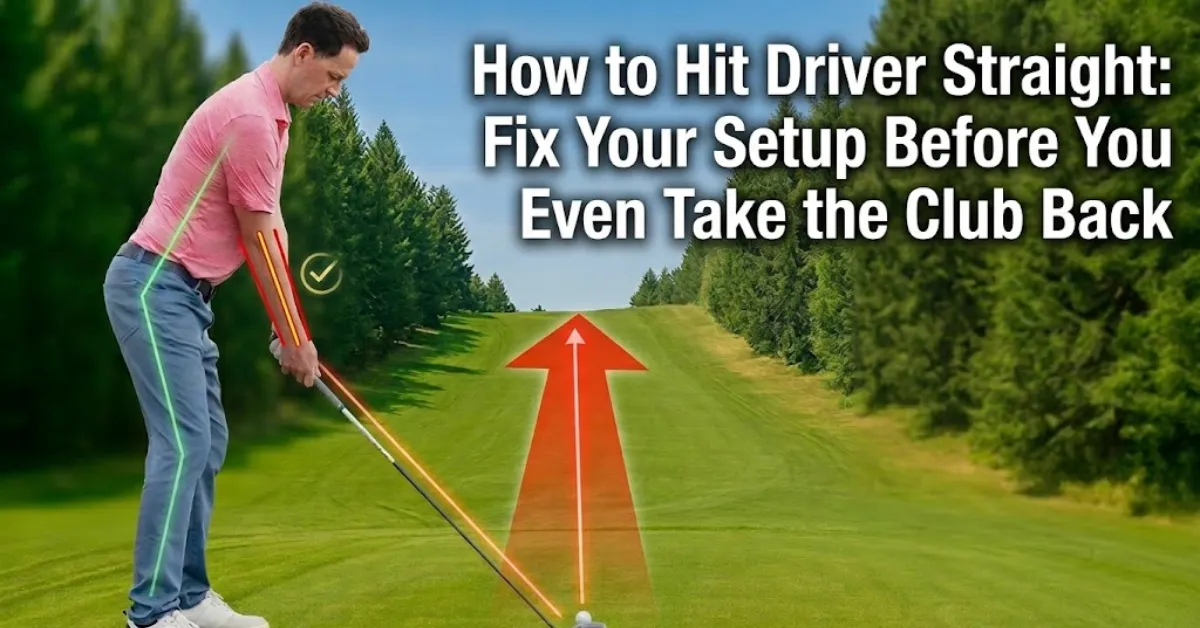
Most people who slice the ball make one big mistake. They set up to the ball incorrectly. Look at a typical slicer at address. The trail elbow points outward. The trail arm sits visibly higher than the lead arm. This is what 99 percent of slicers do every single time.
They look down at the clubface behind the ball. It looks perfectly square to the target. But this view is completely deceptive. The arms are out of proper position. This bad position misaligns the forearms completely. The forearms aim left. The clubface points to the right of that path. This naturally opens the face to the path. It creates a massive open face at impact.
You can test this yourself. Grip the club normally. Let your trail elbow point out to the side. Make sure your trail arm sits higher than your lead arm. Take a normal golf swing. You will hit a massive slice. Your forearms force the club to swing left. The clubface stays open to the right. This destroys your chance to hit a straight shot.
These driver setup tips will fix your golf slice fast. You must check your forearms before every shot. Stand behind the ball. Look down the target line. You should be able to see your lead arm underneath your trail arm. If you cannot see it, your forearms are misaligned. This bad setup ruins your drive before you even pull the club back. Fix this mistake first.
The Setup Drill: How to Find Neutral and Stop the Slice

You need to find a neutral grip to hit driver straight consistently. This simple drill will help you feel the correct position. It works like tuning an old radio dial. You go too far one way. Then you go too far the other way. Finally, you find the perfect signal in the middle.
Follow these exact steps to fix your alignment:
Alignment Calibration
Exaggerate the Opposite
Turn your trail arm under your lead arm. Make your lead hand sit higher. This creates an extremely closed setup that actively promotes a hook.
Feel the Curve
Hit a few practice shots from this extreme position. Feel how the ball wants to curve left to teach your body what a closed face-to-path feels like.
Tune the Dial
Tune the dial back to the middle. Keep your trail elbow pointing to the ground and turn your trail palm so it faces the target. Avoid pointing it outward.
Neutralize Forearms
Look down the line at your setup. To ensure completely neutral forearms, make sure your lead arm is clearly visible underneath your trail arm.
- Exaggerate the opposite feeling first. Turn your trail arm under your lead arm. Make your lead hand sit higher than your trail hand. This creates a closed setup. It promotes a hook.
- Hit a few practice shots from this extreme position. Feel how the ball wants to curve left. This teaches your body what a closed face to path feels like.
- Tune the dial back to the middle. Keep your trail elbow pointing to the ground. Turn your trail palm so it faces the target. Do not let your elbow point outward.
- Neutralize the forearms completely. Look down the line at your setup. Make sure your lead arm is clearly visible underneath your trail arm.
This new position neutralizes your forearms. It creates a square clubface. Your path will follow your forearms. Your face will match your path. This gives you a much straighter drive. Practice the extreme hook feeling if you normally slice.
Practice the extreme slice feeling if you normally hook. Learn to feel the difference between the two extremes. Then you can find the perfect middle ground for your swing.
Ball Position: The One Thing Most Golfers Get Wrong at Address
Ball position sounds simple. Most golfers assume they have it right. Most do not.
For every other club in your bag, the ball sits roughly in the middle of your stance or slightly forward. The driver is different. Because you are hitting the ball off a tee and you need to strike it on the way up, the ball must sit further forward than you think — directly inside the heel of your lead foot.
Here is why this matters for straight drives. If the ball is too far back in your stance, your clubhead is still descending when it reaches the ball. That creates a downward strike. A downward strike with a driver adds spin, closes the face angle, and sends the ball low and left or causes a weak push to the right.
If the ball sits too far forward — past your lead heel — you reach the bottom of your arc before impact and the face has already started rotating closed. This promotes a hook for most golfers.
The correct position is just inside the heel of your lead foot. Not toe. Not middle of the stance. Just inside the heel. Check this every single time before you swing. Many golfers who fix their forearm alignment but keep the ball in the wrong position will still struggle. Ball position and forearm alignment work together. Get both right and your face-to-path relationship immediately improves.
Quick check: At address, look down and make sure the ball lines up with the logo on your lead shoe. That is the correct driver ball position for most golfers.
Tee Height for Driver: Why Getting This Wrong Kills Your Strike
Tee height is one of the most overlooked parts of the driver setup. It takes five seconds to get right. Most amateur golfers tee the ball too low, which forces them to hit down on it — and that creates the same spin and slicing problems as poor ball position.
Here is the rule: when you place your driver behind the ball at address, roughly half the golf ball should sit above the top edge of the clubface. If the whole ball is below the top of the face, the tee is too low. If you can barely see the top of the clubface at all, the tee is too high.
Why does this matter for hitting driver straight? When the ball is teed at the correct height, you naturally catch it on the upswing. Hitting up on the driver reduces backspin and side spin. Less side spin means a straighter ball flight. It also means more distance. You get both benefits from one five-second setup adjustment.
A simple way to remember it: you should feel like you are hitting the bottom half of the golf ball at impact. The driver face should catch the ball just above its equator. That is the sweet spot for a penetrating, straight drive.
Grip Check: How Grip Pressure Affects Your Face Angle at Impact
Your forearm alignment controls the path. Your grip controls the face. Both must work together for a straight drive.
The most common grip mistake among slicers is a weak grip — where both hands are rotated too far towards the target. This keeps the face open through impact, which is the exact cause of a slice. You do not need a dramatically strong grip, but you need a neutral one.
How to check your grip:
When you look down at your lead hand at address, you should see two to three knuckles. If you can only see one, your grip is too weak and your face is likely open. If you can see four knuckles, your grip is too strong and you may be fighting a hook.
Your trail hand should sit underneath the handle, with the palm facing the target. The V formed by your thumb and index finger on both hands should point roughly to your trail shoulder.
Grip pressure is equally important. Most slicers grip the club far too tightly. Tight hands tighten the forearms. Tight forearms restrict rotation through impact. Restricted rotation leaves the face open. That is a slice.
Think of grip pressure on a scale of one to ten. One is barely holding on. Ten is strangling the club. You want to be at around four or five. Firm enough to control the club. Relaxed enough to let the face rotate naturally through impact.
Check your grip before every driver shot. It takes three seconds and it directly controls where the face points when it meets the ball.
Attack Angle: Why You Must Hit Up on Your Driver
Here is something most golfers are never taught. With every iron in your bag, you hit down on the ball. The ball is sitting on the ground and a descending blow creates compression and spin, which is exactly what you want.
The driver is the complete opposite.
Because the ball is on a tee, you must hit up on it. A positive attack angle — where the clubhead is travelling upward at the moment of impact — launches the ball higher with less spin. Less spin means less curve. Less curve means straighter drives.
Trackman data shows that the average amateur golfer hits down on their driver by two to three degrees. PGA Tour professionals hit up by two to three degrees. That difference alone accounts for significant distance and accuracy improvements.
How do you achieve a positive attack angle? Most of it comes from the setup work already covered in this article. Ball position inside your lead heel naturally promotes an upward strike. Tee height set correctly encourages it further. Keeping your upper center — your chest — behind the ball through impact is the final piece. When your chest stays behind the ball as you swing through, the lowest point of your swing arc occurs before the ball, and the club is already rising when it reaches the tee. That is the precise contact you are looking for with a driver.
You do not need to consciously try to hit up. If your setup is correct, it happens naturally.
How Your Body Position Controls Driver Path — The Chest and Pelvis Rule

Your hands and arms control part of the club. But your body positioning controls the rest. You can easily control your path with your torso. Keep this incredibly simple. Do not overthink your body movements.
Think about two dots on your body. The first dot sits right in the center of your chest. This is your upper center. The second dot sits in the middle of your pelvis. This is your lower center.
The big slice culprit happens when your upper center gets ahead of your lower center. Golfers lunge forward during the downswing. The chest moves past the pelvis. This forces the club to swing across the ball. It creates a path that goes left. Add an open face to this path. The result is a weak slice.
You can fix this with one simple thought. Keep your upper center behind your lower center as you swing through the ball. Feel like your head stays behind the golf ball through impact. Proper driver setup tips always include good spine tilt. Your spine should tilt slightly away from the target at address. This keeps your chest behind your pelvis.
It promotes a swing path that moves outward. A neutral path creates straight shots. Practice hitting shots with this exaggerated feeling. You will learn to control your path with your body.
Why Mastering This Setup Saves You Thousands of Hours
Most golfers make things worse by jumping from tip to tip — a new fix every week, none of them sticking. The problem is never the swing tips themselves. It is the absence of one clear principle to come back to. Face to path is that principle. You just need to master your setup.
Controlling your face and path changes everything. It fixes your driver. But it also improves every single club in your bag. A student named Tina proved this. She hit terrible sky shots. And she pulled the ball left. She sliced it right. Then she fixed her setup before she even swung the club.
She started hitting laser straight drives the exact same week. You will save thousands of hours of useless practice. Stop changing your swing. Start fixing your setup instead.
Mastering This Setup Saves You Thousands of Hours
The Random Advice Trap
Most golfers waste time trying a new tip every time they play. This actively ruins their golf game and causes profound confusion on the tee box.
The Universal Fix
You can avoid this trap completely. Controlling your face and path perfectly fixes your driver, but it also improves every single club in your bag.
Rapid Transformation
A student named Tina proved this. By fixing her setup before she even swung, she went from terrible sky shots to hitting laser straight drives the exact same week.
Stop Changing Your Swing
You will save thousands of hours of useless practice. Stop aggressively changing your swing mechanics and start fixing your setup instead.
Quick Setup Guide: Find Your Ball Flight
Use this simple chart to check your setup position before you hit your next drive.
| Setup Type | Trail Arm Position | Upper Body Position | Resulting Ball Flight |
| The Slicer Setup | Elbow points out, arm sits higher than lead arm | Chest gets ahead of the pelvis | Massive slice to the right |
| The Hook Setup | Tucked far under lead arm | Head stays far behind the golf ball | Sharp hook to the left |
| The Neutral Setup | Elbow points to ground, palm faces target | Chest stays just behind the pelvis | Laser straight drive |
Frequently Asked Questions: Hitting Driver Straight
On the range, you are relaxed and focused on mechanics. On the course, tension creeps into your grip and shoulders. Tighter muscles restrict your forearm rotation through impact, which leaves the face open and creates a slice. Before your next tee shot, take a slow practice swing, consciously relax your grip pressure, and check your forearm alignment before you step up to the ball.
Face to path is the relationship between where your clubface points at impact and the direction your clubhead is travelling. Trackman data confirms the face angle controls roughly 85 percent of the starting direction of your ball with a driver. The difference between where the face points and the direction of the path creates the curve. A face that is open to the path creates a slice. A face that is closed to the path creates a hook. Match the two and you hit it straight.
Looking down the target line at your address position, your lead arm should be clearly visible underneath your trail arm. If your trail elbow is pointing outward and your trail arm sits higher than your lead arm, your forearms are misaligned. This forces the club to swing left of the target while keeping the face open to the right — a textbook slice setup. Drop the trail elbow toward the ground, rotate the trail palm so it faces the target, and check that your lead arm is visible from behind.
Yes, significantly. Ball position too far back in your stance forces a downward, in-to-out path that often leaves the face open at impact. Ball position too far forward can cause the face to rotate excessively. The correct position — just inside the lead heel — promotes the shallow, slightly upward strike that keeps the face square and the path neutral. Check your ball position every time you tee up.
The sensation you are looking for is keeping your chest behind the golf ball through impact. Think of a dot on the centre of your chest — that dot should stay behind the ball as you swing through. If your chest overtakes the ball before impact, your path goes left and your face stays open. Practice hitting balls with the feeling that your head is staying behind where the ball was at address. Exaggerate it on the range until it feels natural.
Conclusion: Two Changes, Straighter Drives
Hitting your driver straight does not require rebuilding your swing from scratch. It starts before you even take the club back.
Check your forearm alignment. Make sure your trail elbow points down, your trail palm faces the target, and your lead arm is visible underneath your trail arm when you look down the line. Then check your ball position — just inside your lead heel. Tee the ball so half of it sits above the top edge of the face. Keep your grip pressure at a relaxed four or five out of ten.
Those adjustments control your face-to-path relationship before the swing begins. Add the body awareness from this article — chest staying behind the ball through impact — and you have a complete pre-shot setup routine that addresses the root cause of most bad drives.
Go to the range and work through the extreme drill first. Feel the hook. Feel the slice. Then dial back to neutral. Once you can find that middle ground deliberately, you own it.
When your drives are finding the fairway more often, the next step is distance. Read our guide on how to add distance to your driver to find extra yards without changing anything about your swing mechanics.