
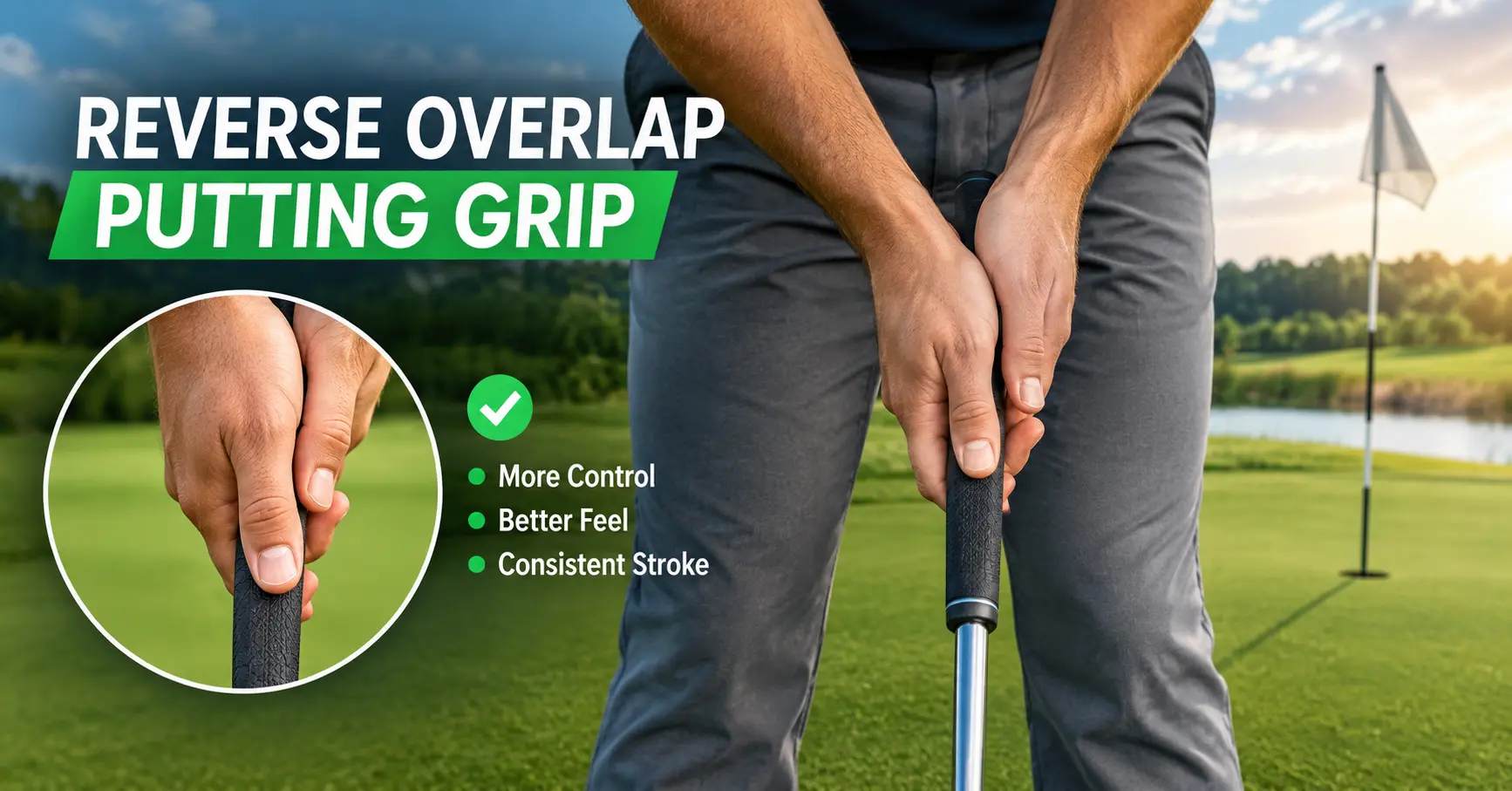
Quick Answer: The reverse overlap putting grip has your lead hand’s index finger resting on top of the trail hand’s fingers, the opposite of a full-swing overlap grip. It runs the putter across your palms instead of your fingers, which quiets the wrists. Tiger Woods, Rory McIlroy, and Jordan Spieth all use it.
Pick up a stranger’s putter at any pro shop and check their grip. Odds are good you’ll see the reverse overlap, the quiet, unglamorous setup that dominates the PGA Tour without anyone making a fuss about it. Nothing flashy about it, and nothing new either. It just works.
Once you understand why, the actual hand positioning takes about ninety seconds to learn. This guide walks through the exact setup, the three mistakes that cancel out its benefits, and how it stacks up against left-hand low, claw, and the other grips fighting for space on the putting green.
What Is the Reverse Overlap Putting Grip?
Every full-swing grip, whether that’s overlap, interlock, or the 10-finger baseball grip, links your hands so they release the club together through impact. Putting asks for the opposite. You want the hands locked out, not working together to generate speed, because a putting stroke has almost no wrist action at all.
The reverse overlap flips the standard full-swing overlap grip. Instead of your trail hand’s pinky resting on top of your lead hand’s index finger, your lead index finger comes off the grip entirely and lays across the fingers of your trail hand. Right-handed golfers rest the left index finger over the right hand. Left-handed golfers do the exact opposite, right index finger over the left hand.
That single change moves the club from your fingers into your palms. Note that this is a different concept from strong vs. weak grip, which describes hand rotation on a full-swing grip, not finger placement on a putter. Your lead hand grips more of the shaft in the meaty part of the palm rather than the finger pads, and that’s what locks the wrists out of the stroke.
How to Set Up the Reverse Overlap Grip, Step by Step
Grab a putter and work through this in front of a mirror the first few times. Seeing the position matters more than feeling it, at least until the feel becomes automatic.
Step 1: Place your trail hand first. Rest the putter grip diagonally across your right palm (left palm if you’re a lefty), running from the base of your pinky to the first knuckle of your index finger. Point your thumb straight down the flat top of the grip.
Step 2: Add your lead hand above it. Your left hand goes on top, thumb also pointing straight down the grip, palm facing your target line. The two thumbs should sit close together, almost stacked.
Step 3: Lift your lead index finger and lay it across. This is the actual “reverse overlap.” Take your left index finger off the grip and rest it along the top of your right hand’s fingers, right around the base of the fingers or across the first knuckle. Some golfers feel it land on the pinky, others feel it between the pinky and ring finger. Either is fine.
Step 4: Check your pressure. Grip pressure should sit low, somewhere around a 3 or 4 out of 10. If your knuckles are white, you’re choking the stroke before you’ve even taken it back.
Left-handed golfers: mirror every instruction above. Your right hand goes on first, your left hand goes on top, and your right index finger is the one that lifts and overlaps.
Why the Reverse Overlap Grip Works
Wrist action is the enemy of consistent speed control on the greens. Every extra bit of hinge or flip adds a variable to a stroke that should have as few moving parts as possible.
The reverse overlap fights this two ways. First, running the grip through the palms rather than the fingers reduces your ability to hinge the wrists, since fingers are where fine wrist articulation happens, not palms. Second, the overlapping index finger physically bridges your two hands into one connected unit, so one hand can’t dominate or roll independently of the other.
Compare that to a standard ten-finger grip on the putter, where both hands sit next to each other with nothing linking them. Nothing stops your trail hand from taking over the stroke, which is exactly the kind of hand-dominance problem that shows up as pulled putts under pressure. The reverse overlap removes that failure point by design, not by willpower.
Putting Grip Comparison: Reverse Overlap vs. Left-Hand Low, Claw, and More
Reverse overlap isn’t the only option, and it’s worth knowing where it sits next to the alternatives before you commit to it.
| Grip Style | Hand Connection | Where You Feel the Grip | Wrist Restriction | Notable Tour User |
|---|---|---|---|---|
| Reverse Overlap | Lead index finger overlaps trail hand | Mostly in the palms | High | Tiger Woods |
| Left-Hand Low | Hands swapped, lead hand below trail hand | Palms, shifted lower | High | Jordan Spieth |
| Claw | Trail hand rests flat on top, thumb underneath | Fingers of trail hand | Moderate | Scottie Scheffler |
| Ten-Finger (Baseball) | No connection, hands sit side by side | Fingers of both hands | Low | Rare on tour |
| Interlock | Trail pinky hooks lead index finger | Fingers | Moderate | Rare for putting, common in full swing |
If you already use the reverse overlap and still fight a pull under pressure, left-hand low is the next logical step, since it restricts the lead wrist even further. If your trail hand takes over no matter what you try, the claw removes it from the stroke almost entirely.
Who Uses the Reverse Overlap Grip (and Who It’s Not For)
The list of pros using this grip reads like a career-major leaderboard. Tiger Woods, Rory McIlroy, Jordan Spieth, Dustin Johnson, Ben Crenshaw, and Brad Faxon have all rolled putts with a version of the reverse overlap. Crenshaw and Faxon in particular built entire reputations as some of the best putters of their generation using this exact setup.
That track record doesn’t mean it’s mandatory. If you already putt well and you’re not using the reverse overlap, changing now is solving a problem you don’t have. Grip changes take weeks to feel natural, and mid-season experimentation has cost more good putters strokes than it’s saved.
PGA of America’s own suggested test for finding the right grip is worth running before you commit to any putting grip, reverse overlap included. Hit the same flat, mostly straight 10-foot putt three times using only your trail hand, then three times using only your lead hand, and compare which hand controlled the line better. Whichever hand wins that test should stay dominant in your final grip, and the reverse overlap is built specifically to let your lead hand lead.
The reverse overlap tends to help most if your trail hand is overpowering your stroke right now, which usually shows up as pulled putts that miss left of the hole for a right-handed golfer. If your issue is distance control rather than direction, the grip alone won’t fix it. Speed problems live in your practice routine, not your hand position.
3 Mistakes That Cancel Out the Reverse Overlap Grip’s Benefits
Setting up the grip correctly and holding it correctly through the stroke are two different skills, and most golfers only practice the first one.
Mistake 1: Letting the grip creep back into the fingers. Under pressure, hands tend to slide the club deeper into the fingers because that’s where you’re used to holding a full-swing grip. Check your setup every few putts during a practice session until the palm position becomes the default, not something you have to think about.
Mistake 2: Squeezing harder on short putts. The scarier the putt, the tighter golfers grip it, and tension travels straight into the wrists no matter how good your hand position is. A quick self-check: if you can’t wiggle the putter head slightly with your fingertips at address, you’re gripping too hard.
Mistake 3: Letting the trail thumb creep off center. Both thumbs should point straight down the flat top of the grip. Once the trail thumb drifts to the side, the putter face tends to twist through impact even with a technically correct reverse overlap.
Fix these three and the grip does the job it’s designed to do. Skip them, and you’re holding the right grip while still making the same mistakes it was supposed to solve.
Frequently Asked Questions
Why do golfers use a reverse grip for putting?
Because it moves the putter into the palms and locks the wrists out of the stroke. Full-swing grips are built to generate speed and hinge. Putting strokes need the opposite, and the reverse overlap delivers that by design.
Do professional golfers actually use the reverse overlap putting grip?
Yes, and it remains one of the most common putting grips on the PGA Tour. Tiger Woods, Rory McIlroy, Jordan Spieth, Ben Crenshaw, and Brad Faxon all use or used a version of it.
Can left-handed golfers use the reverse overlap putting grip?
Yes, just mirror every instruction. The right hand goes on first, the left hand goes on top, and the right index finger becomes the one that lifts and overlaps.
Is the reverse overlap putting grip good for beginners?
It’s a solid starting point precisely because it’s the grip most instructors teach first. New golfers who learn it early skip the awkward transition that golfers who start with a full-swing grip on the green have to go through later.
What’s the difference between the reverse overlap and left-hand low grip?
Reverse overlap keeps your hands in their normal order, lead hand on top. Left-hand low swaps the hands so your lead hand sits below your trail hand, restricting the wrists even further. Most golfers try reverse overlap first and move to left-hand low only if they still fight excess wrist action.
What’s the difference between the reverse overlap and the traditional full-swing overlap grip?
The direction of the overlap flips. In a full-swing overlap, the trail hand’s pinky rests on top of the lead hand’s index finger. In the reverse overlap, the lead hand’s index finger comes off the grip and rests on top of the trail hand instead.
The Bottom Line
The reverse overlap putting grip isn’t complicated, and that’s the whole point. Ninety seconds to set up, a few practice sessions to make it automatic, and you’ve adopted the same foundation Tiger Woods, Rory McIlroy, and generations of great putters built their short games on. Get the setup right, then get out of your own way, watching grip pressure and keeping that lead index finger locked in place under pressure.
If a grip change alone doesn’t fix a stubborn miss, the problem might not be your hands at all. Lucas Glover fought the putting yips for a decade before the fix turned out to be his putter, not his grip, which is worth remembering before you blame your hands for something that started somewhere else.