
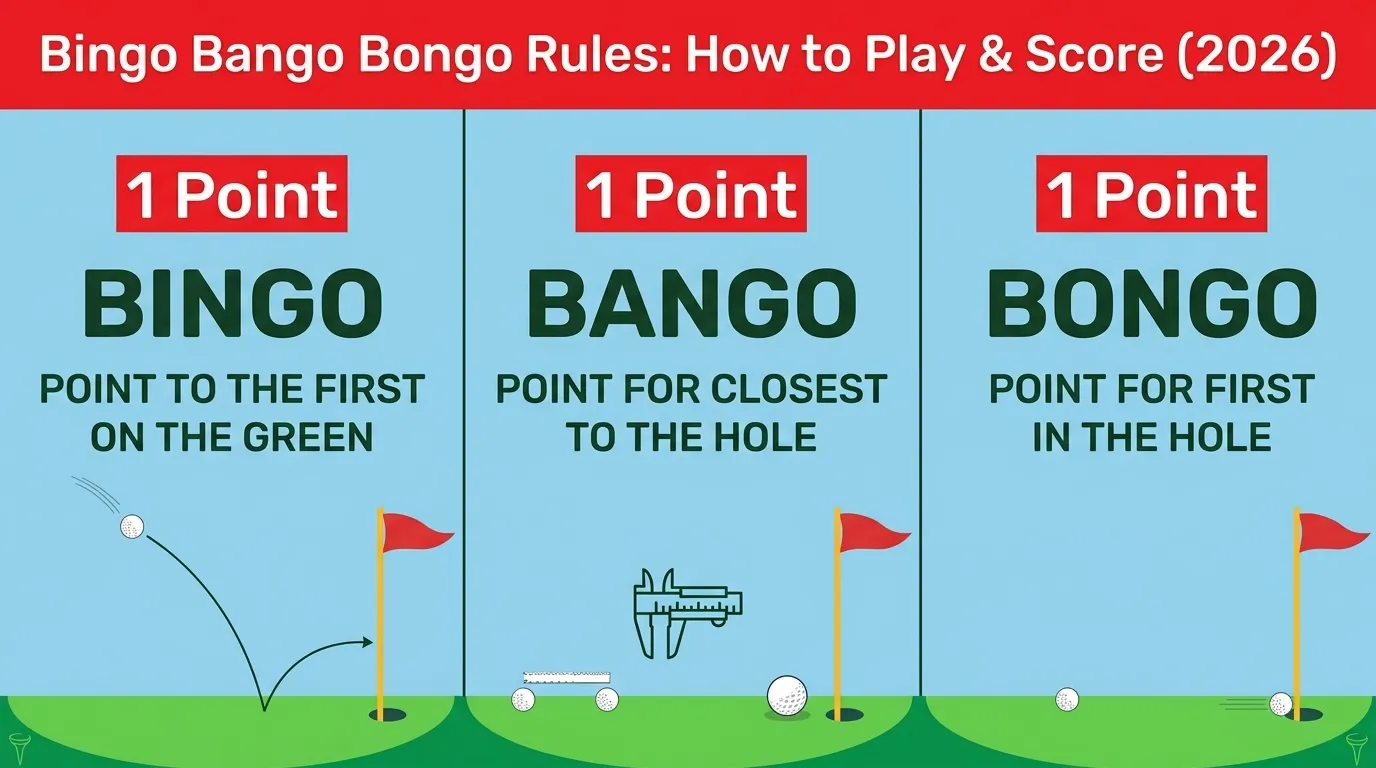
Quick Answer: Bingo Bango Bongo awards three points every hole: Bingo for reaching the green first, Bango for finishing closest to the pin once everyone’s on, and Bongo for holing out first. Players tally points after 18 holes — most groups play $1 to $5 per point, gross, with strict play order enforced throughout.
I’m a 9-handicap who’s played Bingo Bango Bongo more than any other side game in my regular rotation. Last summer, in a mixed foursome with two members I’d just met, I watched my 22-handicap partner sweep Bingo and Bongo on three straight holes while I was still climbing out of a greenside bunker. That’s the entire appeal of this game, and it’s why it deserves a spot in your rotation even if Wolf and Skins already live there.
What Bingo, Bango, and Bongo Actually Stand For
Some golfers call it a dots game instead, since you’re literally marking a dot on the scorecard for each point won. Three separate points are up for grabs on every hole, and none of them care about your actual score. You can make a triple bogey and still out-earn a playing partner who pars the hole, and that’s the whole design.
| Point | What earns it | Who tends to win it |
|---|---|---|
| Bingo | First ball on the green | Whoever’s closest off the tee — but a bunted layup can beat a blown-through-the-green bomb |
| Bango | Closest to the pin once every ball is on the green | The best wedge and mid-iron players, regardless of how they got there |
| Bongo | First ball in the cup | The best putter under pressure, or the luckiest one |
Each point is worth the same, so a hole is worth three points total — or four, in the bonus variation covered below. Groups usually agree on a dollar value per point before the first tee shot, commonly between $1 and $5.
Why Order of Play Decides Everything
Here’s the part that trips up first-timers. This game only works if the player farthest from the hole always plays next, with zero exceptions, on every shot.
Skip that rule and the whole format falls apart. A player sitting 12 feet away could sprint up and tap in before the group’s 40-foot putter even gets a look, stealing Bongo through nothing but bad manners.
Nobody gets a gimme, either. Most groups wave in a 3-foot putt during a casual round, but here you mark it and wait, because someone still has to attempt a longer putt first. I’ve had rounds where this single rule added ten extra minutes — worth it for the fairness, not always worth it if your group is already playing slow.
Gross vs. Net Scoring
Most groups I’ve played with default to gross scoring, and I think that’s the right call. The net-scoring version works too, but it trades a fast, loose side bet for something closer to a spreadsheet.
| Group | Gross scoring | Net scoring |
|---|---|---|
| Bingo goes to | First on the green, no adjustment | First on the green after subtracting handicap strokes on that hole |
| Bango goes to | Closest to the pin, no adjustment | Same as gross — rarely adjusted in either version |
| Bongo goes to | First ball in the cup | Lowest net score on the hole, not necessarily first in |
| Best for | Casual groups who want quick decisions | Groups with a wide handicap spread who want real fairness |
| Trade-off | High-handicappers can still legitimately sweep every point | Working out strokes mid-hole slows down an already deliberate game |
Our Saturday group switched to net scoring two years ago after our resident 4-handicap ringer swept all three points on nine straight holes. Playing him gross with zero strokes back felt less like a side bet and more like betting against the house — but I’ll say it plainly: gross is still the better version of this game, and net scoring is a patch for a specific problem, not an upgrade.
The Variations Nobody Explains Clearly
Every group tweaks this game eventually, and most articles mention one variation in passing. Here are the four that actually show up on real scorecards, with the trade-off each one creates.
| Variation | How it changes the game | Best for |
|---|---|---|
| Longest drive in the fairway wins Bingo | Rewards accuracy off the tee instead of “first down” | Groups with one or two bombers who’d otherwise never sniff the Bingo point |
| Lowest net score wins Bongo | Replaces “first to hole out” with a math comparison | Groups who hate slow-play arguments over gimmes |
| Double points on par 3s | Turns 3 points into 6 on every par 3 | Groups who want the drama concentrated on fewer holes |
| Sweep bonus (extra point for winning all three on one hole) | Adds a 4th point as a reward for a clean run | Competitive groups playing for real money |
The double-points-on-par-3s variation is worth calling out specifically. Par 3s already carry some of the best hole-in-one odds on the course, and doubling the stakes there turns three tee shots into the most-watched moment of the round.
How the Payouts Actually Work
Almost nobody shows the actual math, so here it is. Say four players agree on $2 per point across 18 holes, which puts 54 total points in play (3 points × 18 holes).
Suppose the final tally reads: Player A – 20 points, Player B – 14, Player C – 11, Player D – 9. Using the straightforward differential method — where each player pays the winner based on the point gap between them — Player A collects $12 from B, $18 from C, and $22 from D, for a total of $52 on the day.
Some groups simplify this into a flat pot instead: everyone antes up a set amount before the round, and the top point-earner takes it all, no differential math required. Either method works — just settle on one before the first tee shot, because arguing about it on the 18th green is its own kind of penalty stroke.
Keeping score is simple on paper: add three small columns per hole labeled Bingo, Bango, and Bongo, and mark a dot or initial in whichever column the winning player earns. Tally every column across all 18 holes and you’ve got your final standings without any extra math during the round itself.
The Strategy Part Everyone Skips
I’ve raced to mark my ball early more times than I’d like to admit. On a tight par 3 at my home course, I stuck a 7-iron to 15 feet and figured Bango was already mine.
My playing partner, still in the greenside rough and away, chipped in before I’d even pulled my putter — stealing Bongo and reminding me that nothing locks in until the last ball drops. Once you’re on in regulation, the smart move is to sit back and watch everyone else play up, because your Bingo point is already banked but Bango is still very much alive.
That waiting game is where this format separates itself from most side bets — you’re not just executing your own shot, you’re constantly recalculating based on what everyone else just did.
How It Compares to Other Golf Games
If you already run Wolf or Skins with your group, here’s how this three-point game actually stacks up.
| Game | Points per hole | Ideal group size | Friendly to skill gaps? |
|---|---|---|---|
| Bingo Bango Bongo | 3 (up to 4 with a sweep bonus) | 2–4 | Very — three separate, independent ways to score |
| Wolf | Varies by hole and partner choice | 4 | Depends heavily on who picks partners |
| Skins | 1 per hole, carries over on ties | 2–4 | Weak — low handicaps tend to dominate |
| Nassau | 3 total bets (front, back, overall) | 2, or teams | Only fair once you apply handicap strokes |
| Stableford | Points earned against par | Any | Strong — net scoring drives the whole format |
This game’s real edge is that a high-handicapper genuinely competes for two of the three points without needing a single stroke of help.
Who This Game Isn’t For
If everyone in your group already reaches greens in two on every par 4, this game won’t do much for you. Low-handicap groups where nobody’s missing greens or lagging putts turn it into a straight putting contest wearing a disguise — the Bingo point becomes an afterthought since everyone arrives at roughly the same time.
Where the Name Comes From
The phrase predates the golf game by decades. “Civilization,” a novelty song written by Bob Hilliard and Carl Sigman in 1947, built its hook around the words “bongo, bongo, bongo,” and became a hit for Danny Kaye and the Andrews Sisters that same year.
The lyrics frame a narrator who prefers jungle life over modern conveniences — a premise that leaned hard on exoticized, dated stereotypes about African life even by the standards of the era, and reads as considerably more uncomfortable today. Golfers borrowed the rhythmic “bingo, bango, bongo” cadence for the game’s three points sometime in the following decades, most likely because it was catchy and already stuck in the culture’s ear — not because of any connection to the song’s actual subject matter.
Frequently Asked Questions
What does bingo bango bongo mean?
In golf, it’s the name of a three-point betting game: Bingo for first on the green, Bango for closest to the pin, and Bongo for first in the hole. The name itself is a borrowed rhyme from a 1947 novelty song and has no deeper golf meaning beyond that catchy cadence.
What are the rules of bingo bango bongo?
Players earn one point each for being first on the green, closest to the pin once everyone’s on, and first to hole out. Strict play order applies throughout — the farthest-away player always goes next — and gimme putts aren’t allowed since someone else may still need to play a longer shot first.
Is “Bingo Bango Bongo” a song?
Yes. It’s the popular nickname for “Civilization,” a 1947 song written by Bob Hilliard and Carl Sigman and made famous by Danny Kaye and the Andrews Sisters. The golf game borrowed the phrase, not the song’s storyline.
What is the song “Civilization” about?
It’s a novelty tune about a narrator who’d rather stay in the jungle than adopt modern city life, built around the repeated “bongo, bongo, bongo” refrain. Its portrayal of that choice leans on stereotypes typical of 1940s pop music and hasn’t aged well by today’s standards.
How many people can play this game?
Two to four works best. Beyond four players, tracking three separate points per hole in real time gets genuinely difficult to referee.
Do you need an official handicap to play?
No. Most groups play gross with no handicap at all — it’s only relevant if your group chooses the net scoring variation covered above.
My Final Answer For lover That like Bingo Bango Bongo
This game earns its spot in a rotation because it hands three different golfers three different chances to matter on every single hole, no handicap card required. Play it gross with your regular group first, save the net-scoring and sweep-bonus variations for the rounds where everyone already knows the basic etiquette cold, and keep a running note of who’s closest to the pin — it’s usually the point that decides the whole day. If you’re still sorting out how pin-high distance actually gets judged on the green, that’s worth a read before your next Bango argument.