
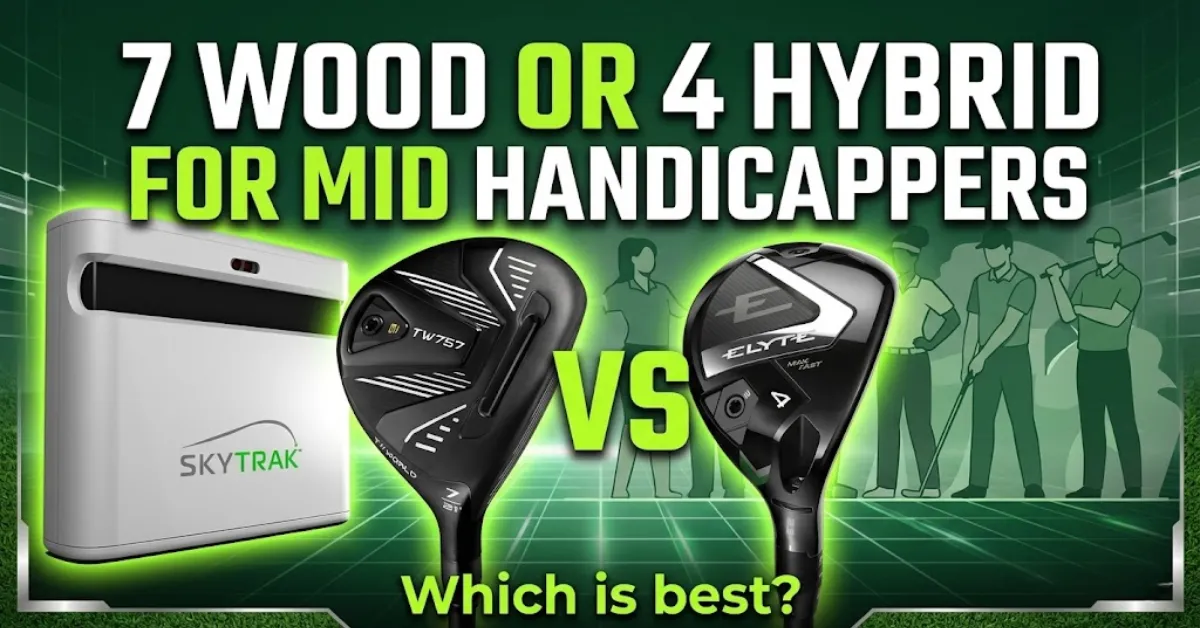
The 7 wood vs 4 hybrid question is one of the most debated bag decisions for mid-handicappers — and the answer is not the same for every golfer.
Both clubs sit in a similar loft range (20–23 degrees) and both replace the 4 iron you probably stopped trusting years ago. But they behave very differently on the course, at different swing speeds, and from different lies.
By the end of this guide, you will know exactly which club fits your swing, your course conditions, and whether it is worth carrying both in the same bag.
7 Wood vs 4 Hybrid: The Key Differences That Actually Matter
At first glance, a 7 wood and a 4 hybrid look like they do the same job. They have similar lofts, they both replace long irons, and they both sit in the 175–210 yard range for most golfers. But the way they get the ball there is completely different.
The 7 wood is a smaller version of a fairway wood. Its larger head, lower center of gravity, and longer shaft (41 inches) produce a high, arcing ball flight that lands softly and stops quickly. The 4 hybrid is a cross between a wood and an iron — a more compact head, a shorter shaft (40 inches), and a flatter swing path that produces a lower, more penetrating flight.
| Feature | 7 Wood | 4 Hybrid |
|---|---|---|
| Shaft Length | 41 inches | 40 inches |
| Typical Loft | 20–23 degrees | 21–23 degrees |
| Ball Flight | High, soft landing | Lower, penetrating |
| Strike Type | Sweeping | Downward |
| Best Lie | Clean fairway / tee | Rough / any lie |
| Draw/Fade Bias | Neutral | Slight draw bias |
| Replaces | 3–4 iron | 4 iron |
Why the 7 Wood Is One of Golf’s Best-Kept Secrets
Pick up a 7 wood and you immediately notice something: confidence. The larger clubhead sits behind the ball and tells your brain “you can hit this.” That feeling is not a trick — it is the result of a lower, deeper center of gravity that genuinely makes this club easier to launch.
The 7 wood has a 41-inch shaft — one inch longer than a 4 hybrid — which produces more swing speed at impact. That extra speed, combined with a higher launch angle, is why most mid-handicappers hit a 7 wood 5–10 yards further than a 4 hybrid of the same loft.
Where the 7 wood wins:
The honest limitation: The sweeping motion a 7 wood needs can be tricky from thick rough or steep downhill lies. If you are hitting from bad positions regularly, the 4 hybrid handles those situations better.
Why the 4 Hybrid Belongs in Almost Every Mid-Handicapper’s Bag
The 4 hybrid was called a rescue club for a reason — it rescues you from positions where a fairway wood simply cannot go. Thick rough, tight lies, downhill stances, and even greenside chip-and-run shots are all within its range.
At 40 inches long (one inch shorter than the 7 wood), the 4 hybrid gives you more control on steep swings. If you naturally take deep divots or have a swing speed above 95 mph with the driver, you will probably find the 4 hybrid easier to control than a 7 wood, which can balloon in the air at higher speeds due to excess backspin.
Where the 4 hybrid wins:
The honest limitation: From a perfect fairway lie with nothing between you and the green, a 7 wood will typically fly higher and stop faster on firm greens. The hybrid’s lower ball flight can be a disadvantage when you need elevation.
7 Wood vs 4 Hybrid: Distance by Swing Speed (The Actual Numbers)
The 180–210 yard range that is often quoted for both clubs only tells part of the story. Your actual distance depends heavily on your driver swing speed. Here is what the real numbers look like:
| Driver Swing Speed | 7 Wood Carry | 4 Hybrid Carry | Difference |
|---|---|---|---|
| Under 85 mph | 155–175 yards | 145–165 yards | 7 wood +10 yards |
| 85–95 mph (avg mid-hdcp) | 175–200 yards | 165–190 yards | 7 wood +10 yards |
| Over 95 mph | 195–215 yards | 190–210 yards | Similar (within 5 yds) |
At moderate swing speeds, the 7 wood carries further because its longer shaft generates more clubhead speed. At faster swing speeds above 95 mph, the gap closes — and the 4 hybrid’s shorter shaft gives better control without sacrificing meaningful distance.
Similarities Between a 7 Wood vs 4 Hybrid
7 Wood vs 4 Hybrid: Distance Comparison
One of the biggest factors in choosing between a 7 wood and a 4 hybrid is distance. How far can you expect to hit each club, and which one will give you the edge on the course?
Which Is Easier to Hit: 7 Wood or 4 Hybrid?
The distances of a 7-wood and a 4-hybrid are often similar, but there are some slight differences.
When it comes to 7-wood and 4-hybrid, it comes down to personal preference and playing conditions. If you need to get the ball higher and stop it on the green early, a 7-wood may be better. But if the ground is steep or the wind is blowing, a 4-hybrid will be more effective.
Keep in mind that the decision to use both should be made based on your needs and the game situation.
7 Wood vs 4 Hybrid from the Rough: Which Club Wins?
This is where the 4 hybrid has a genuine edge — and it is a significant one.
A 7 wood has a wider, larger head. In thick rough, that head can twist at impact as the grass grabs it, leading to inconsistent contact. The sweeping swing path required also makes it harder to extract the ball cleanly from deep lies.
The 4 hybrid has a more compact, narrower head that cuts through rough more cleanly. Its shorter shaft and more downward strike angle also help you make solid contact even when the lie is less than perfect.
The rough verdict:
If you frequently play on courses with thick rough, this single factor might be enough to settle the 7 wood vs 4 hybrid debate for you.
Should You Carry Both a 7 Wood and a 4 Hybrid?
Yes — and many mid-handicappers do.
The question is whether you have room in your bag. Tour rules allow 14 clubs, and most mid-handicappers carry: driver, 3 wood, irons (5 or 6 through pitching wedge), two or three wedges, and a putter. That typically leaves one or two spots for longer clubs like a hybrid or fairway wood.
If you drop your 5 wood or 3 iron, you can often carry both the 7 wood and the 4 hybrid without gapping issues. They are different enough in how they behave that they do not simply duplicate each other:
• Use the 7 wood from the tee and clean fairway lies
• Use the 4 hybrid from the rough, bad lies, and windy conditions
Who should carry both: Mid-handicappers who play varied courses with both open fairways and heavy rough, or golfers who want maximum flexibility for 175–210 yard shots.
Who should pick just one: Golfers with faster swing speeds (over 95 mph) who hit both clubs a similar distance, or those with a tight bag setup who do not want to drop a wedge or iron.
Best 7 Woods and 4 Hybrids for Mid-Handicappers Right Now
Best 7 Woods for Mid-Handicappers Right Now (2026)
1. TaylorMade Qi35 7 Wood — Best overall for mid-handicappers
The Qi35 7 wood delivers high launch, strong carry, and a head shape that inspires confidence at address. Testers at Today’s Golfer rated it as a standout performer at higher swing speeds particularly for height, carry distance, and landing angle. If you want a 7 wood that works from the tee and the fairway, this is the one to try first.
2. Callaway Elyte 7 Wood — Best for slower swing speeds
The Elyte produces a towering trajectory and is one of the easiest 7 woods to find the middle of the face with. Slower swingers benefit most from its high launch and soft landing characteristics. The Ai10x face technology keeps ball speed high even on off-centre strikes.
3. Titleist GT2 7 Wood — Best for consistency
Clean, classic design with a forged L-Cup face for better energy transfer. The GT2 is a high-launch, low-spin option that suits mid-handicappers who want a reliable fairway wood without game-improvement aesthetics. Rated as one of the most complete fairway woods of 2025 by BreakingEighty.
Best 4 Hybrids for Mid-Handicappers Right Now (2026)
1. TaylorMade Qi35 Max Rescue Hybrid — Best for distance + forgiveness
Multiple testers rated the Qi35 Max as the top hybrid of 2025 for accuracy and launch conditions. It produces high ball flight, strong carry, and the draw bias helps keep slices from getting away. Ideal for mid-handicappers who want forgiveness without losing distance.
2. Callaway Elyte X Hybrid — Best for stopping the ball on greens
The Elyte X has the largest profile in the Callaway Elyte hybrid range and took “Best for Height” and “Best for Forgiveness” in Today’s Golfer’s 2025 hybrid test. The Ai10x Face gives you consistent ball speed across the entire face — even the ones you do not quite catch.
3. Ping G440 Hybrid — Best all-round option
The G440 is a larger, confidence-inspiring head that excels in a wide range of situations. Consistently rated as one of the most reliable hybrids on the market for mid-to-high handicappers who want performance from any lie.
How to Choose Between a 7 Wood and 4 Hybrid: 4 Questions to Ask
Still not sure? Our golf club fitting guide explains what to ask for at a launch monitor fitting session — 20 minutes of data will settle this question faster than anything.
Factors to Consider When Deciding
7 Wood vs 4 Hybrid: Common Questions Answered
Similar loft, different clubs. The 7 wood has a larger head, longer shaft, and higher ball flight. The 4 hybrid has a compact head, shorter shaft, and lower penetrating trajectory. Both fill the 4 iron gap — in different ways.
At 85–95 mph driver speed (average mid-handicapper), expect 175–200 yards of carry. Faster swingers above 95 mph will carry it 195–215 yards.
From a clean lie, most golfers find the 7 wood easier due to the larger head and lower CG. From rough or awkward lies, the 4 hybrid is easier. Your most common playing scenario should decide which you prioritise.
Under 90 mph with the driver. The longer shaft generates more speed for moderate swingers. At 95+ mph, both clubs produce similar distances and the hybrid’s control advantage tips the scale.
Yes. They serve different enough purposes (clean lie vs rough) that carrying both adds genuine flexibility. Check your bag setup to ensure you are not sacrificing a wedge you rely on.
In light rough, yes. In moderate to heavy rough, use the 4 hybrid. The wider head of the 7 wood grabs in thick grass – the hybrid’s compact head cuts through cleanly.
Typically a 3 or 4 iron, and sometimes a 4 hybrid, depending on your bag setup and swing speed. It fills the distance gap between your 5 wood and 5 iron.
Our Verdict: 7 Wood vs 4 Hybrid
Here is the honest verdict: if your swing speed with the driver is under 90 mph, start with the 7 wood. It will give you more distance, a higher ball flight, and more forgiveness on off-center strikes. You will hit more greens.
If you swing the driver above 95 mph, take a steeper divot, or regularly find yourself in rough and challenging lies, the 4 hybrid will serve you better. It fits a wider range of situations and gives you more shot variety around the course.
If you have room in your bag? Many mid-handicappers play both — a 7 wood for the clean fairway and tee situations, and a 4 hybrid for the recovery and rough shots. They are different enough in how they behave that carrying both genuinely makes sense if your bag setup allows it.
The best way to know for certain is to hit both clubs on a launch monitor at your local fitting centre and check your actual carry numbers at your swing speed. Twenty minutes of data is worth more than any article — including this one.
Ready to build the rest of your bag? Check out our guide to the best fairway woods for mid-handicappers and our top hybrid picks for mid-handicappers — both tested and ranked on Madknows.