
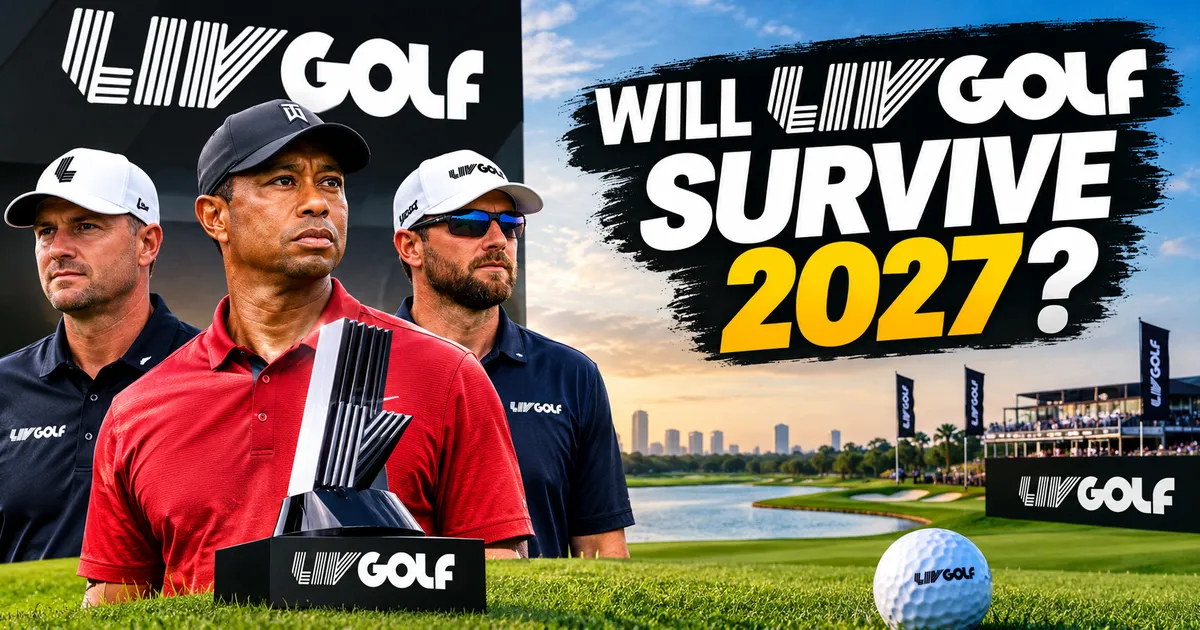
LIV Golf’s future could become clearer within days as the embattled professional golf league approaches an October 25 deadline to secure enough player commitments for its proposed 2027 relaunch.
The Saudi-backed circuit, which filed for Chapter 11 bankruptcy protection in September, is attempting to reinvent itself through a financing agreement with BC Partners Credit and a new player-ownership model.
However, the departures of several prominent golfers, uncertainty surrounding other major names and questions about the league’s relationship with established tours have created significant obstacles.
In a recent Golf Channel report, Gabby Herzig examined the chances of LIV Golf returning in 2027 under its proposed LIV 2.0 structure.
The central question is no longer simply whether investors are prepared to support the league. It is whether LIV can assemble a strong enough player roster to justify that investment.
LIV Golf Faces Critical October 25 Deadline
The immediate challenge for LIV Golf is securing the commitments needed to proceed with its restructuring plan.
Under the agreement with BC Partners, the league must attract a sufficient number of golfers to operate as a credible professional competition.
The player deadline was initially set for October 13 but was subsequently moved to Sunday, October 25.
Importantly, the number of players required has not been publicly specified as a fixed threshold.
Earlier proposals included numerical commitments tied to the number of players and the value of their financial claims. Those requirements were replaced by broader language giving BC Partners the authority to decide whether the proposed roster is sufficient.
This means the identities of the players who agree to participate could be as important as the overall number.
A roster featuring recognizable major champions and commercially valuable competitors would likely be more attractive to sponsors, broadcasters and tournament organizers than one relying heavily on less established names.
The October 25 deadline is not necessarily final.
BC Partners has the ability to extend or waive it, and LIV’s legal representatives have indicated that a broader decision about the organisation’s future could come by the end of October.
Why Did LIV Golf File for Bankruptcy?
LIV Golf entered Chapter 11 bankruptcy protection on September 8, 2026, following a major change in its financial backing.
Saudi Arabia’s Public Investment Fund, which had provided substantial financial support since the league launched in 2022, announced earlier in the year that it would end its funding.
That decision forced LIV to consider a different business model.
Rather than relying on continued financial support from its original backer, the league began pursuing outside investment and a restructuring intended to reduce operating costs.
Chapter 11 bankruptcy protection provides a legal framework for reorganizing a business while addressing contractual obligations and creditor claims.
It does not automatically mean that an organisation has permanently closed.
In LIV’s case, the process has created a route toward a possible relaunch while leaving open the alternative of winding down operations if the proposed transaction cannot proceed.
BC Partners Offers Up to $300 Million for LIV Golf 2.0
The proposed future of LIV Golf centers on financing from BC Partners Credit.
The agreement contemplates up to $300 million in loans and investments to support a restructured competition.
On October 14, a federal bankruptcy judge approved the amended restructuring support agreement, allowing LIV to continue preparations for its potential relaunch.
However, that decision did not constitute final approval of a completed restructuring plan or guarantee that every dollar of the proposed financing would become available.
The investor’s willingness to proceed remains tied to the league’s ability to satisfy important conditions, particularly securing an acceptable playing roster.
The agreement also proposes a substantially different ownership model.
Players would collectively own 52.5% of the reorganized league.
BC Partners and other potential minority investors would hold 45%, while management would retain the remaining 2.5%.
The proposal is intended to give participating golfers a direct financial stake in the organisation’s future.
Whether that opportunity provides enough incentive to retain established stars remains one of the most important unanswered questions.
Jon Rahm’s Departure Creates Major Challenge
The uncertainty surrounding the relaunch has intensified following decisions by several prominent players to pursue alternatives.
One of the most significant developments came in October when an attorney representing Jon Rahm told the bankruptcy court that the two-time major champion had reviewed the proposed LIV 2.0 terms and decided not to participate.
Rahm was one of LIV Golf’s most recognizable stars, making his departure a substantial setback for the league’s ambitions.
Former Open champion Louis Oosthuizen also announced that he intended to leave.
Speaking ahead of the Hong Kong Open, Oosthuizen explained that the proposed schedule did not suit his preference for competing in consecutive events within the same region.
David Puig and other players have also moved away from the proposed structure.
The departures illustrate the competing priorities facing golfers as they assess their next career steps.
Financial arrangements remain important, but players must also consider travel demands, major championship ambitions, world ranking opportunities and access to established professional tours.
What Happens to Bryson DeChambeau and Other LIV Stars?
Another central question concerns the future of players whose decisions remain uncertain.
Bryson DeChambeau has been one of LIV Golf’s most prominent competitors and a major part of the league’s commercial appeal.
However, as of October 23, his definitive participation in LIV 2.0 has not been independently established.
Joaquin Niemann has also discussed uncertainty about whether to continue with LIV or pursue a schedule focused more heavily on European competition and a possible return to the PGA Tour.
Meanwhile, Richard Bland has publicly indicated that he intends to participate in the new league.
Ben Campbell and Brendan Steele have also expressed interest in continuing.
Those positions demonstrate that the decision-making process varies substantially among players.
Another important legal distinction involves existing LIV contracts.
A bankruptcy judge approved the rejection of 19 player contracts as part of the restructuring process, including agreements involving DeChambeau and Dustin Johnson.
But the rejection of an existing agreement should not automatically be interpreted as confirmation that the golfer will leave LIV permanently.
Some players could negotiate new terms and remain part of the reorganized competition.
LIV Golf 2.0 Could Feature Just 10 Tournaments
The proposed LIV 2.0 structure would differ significantly from the league’s previous format.
Plans call for a 10-event season in 2027, with approximately half the tournaments taking place outside the United States.
The reduced schedule is intended to support a more financially disciplined competition.
A smaller calendar could potentially reduce operating costs while providing more opportunities for players to compete elsewhere.
However, it also raises questions about how the league would maintain a consistent audience, attract commercial partnerships and balance international travel.
Oosthuizen’s concerns show that fewer tournaments do not necessarily mean a more convenient schedule for every competitor.
The planned emphasis on team golf would remain an important part of LIV’s identity.
The new ownership structure would also give players a more direct relationship with the success of the league and its teams.
Even so, details of the final calendar, participating teams and confirmed player roster remain subject to the restructuring process.
DP World Tour Rules Complicate LIV’s Plans
Another obstacle involves the relationship between LIV Golf and the DP World Tour.
DP World Tour chief executive Guy Kinnings has warned that golfers may need to choose between participating in LIV 2.0 and competing on the European circuit under the relevant membership rules.
The position could influence players with Ryder Cup ambitions or those looking to maintain regular access to traditional tournaments.
LIV Golf’s legal representatives criticized the timing of those statements during an October bankruptcy hearing, arguing that the restrictions could interfere with efforts to secure player commitments.
The bankruptcy judge acknowledged the concerns but did not issue a ruling establishing that the DP World Tour had acted unlawfully.
The disagreement reflects a broader question facing men’s professional golf: how players can move between competing circuits while satisfying membership obligations.
For LIV 2.0, those choices could have a direct effect on the roster available to support the new competition.
What Are the Chances LIV Golf Survives Into 2027?
There are credible arguments for both outcomes.
LIV has secured court approval of an important restructuring agreement and has attracted a potential investor willing to provide substantial funding.
The proposed player-ownership model also offers a different incentive structure from the guaranteed contracts that characterized the league’s earlier years.
Those developments create a possible route forward.
However, the loss of major stars, uncertainty surrounding other players, reduced financial backing and complications involving competing tours represent substantial risks.
The investor must determine whether the final roster can sustain a commercially viable league.
At this stage, there is no independently supported probability that can accurately express LIV’s chances of survival as a percentage.
The outcome depends on negotiations, commitments and financial decisions that have not yet been completed.
What Happens After October 25?
The immediate priority is determining whether enough players have agreed to the proposed structure.
If BC Partners accepts the roster and the remaining requirements can be satisfied, LIV could continue through the bankruptcy process toward a planned 2027 relaunch.
If the investor concludes that the league is not commercially viable, the alternative could involve winding down operations.
There is also a third possibility: negotiations could continue beyond October 25 if BC Partners extends the deadline.
That means fans should not necessarily expect an official announcement immediately after midnight on Sunday.
Further updates from LIV Golf, BC Partners and the bankruptcy court will be needed to establish the outcome.
Final Thoughts
LIV Golf’s 2027 future rests on a difficult combination of player decisions, financing arrangements and restructuring approvals.
The league has a potential $300 million financial package and a new majority player-owned model, but neither guarantees that the competition will return.
Several well-known golfers have already decided to leave, while the status of other important players remains uncertain.
The October 25 deadline represents a crucial test rather than a predetermined verdict.
For now, the most accurate conclusion is that LIV Golf still has a possible path to survival, but the proposed 2027 relaunch has not been secured.
Reporting based on Golf Channel’s LIV Golf 2.0 coverage, Reuters’ October 14 bankruptcy-court reporting, LIV Golf’s September 8 restructuring announcement, and reporting on player decisions through October 23, 2026.